The unexpected surge in manufacturing output is raising hopes
Author: Klaus Dormann
Russia’s industrial production fell by 0.6% year-over-year in August 2026. An analyst survey had predicted a further decline of 0.1% for September. However, according to the statistics agency Rosstat, industrial production rose by 1.8% in September. Production in the “manufacturing sector” even accelerated by 5.6%. This growth in industrial output likely had an impact on business sentiment. According to a survey of companies conducted by the Russian Central Bank in early October, the previously gloomy “business climate” in the Russian economy improved significantly. The business climate index compiled by the Central Bank, which had been trending sharply downward since mid-2024, returned to positive territory in October.
The “Institute for Economic Forecasting of the Russian Academy of Sciences” now expects industrial production in the fourth quarter to be 2.1% higher than a year ago. Just a month ago, the institute had forecast growth of only 0.9% for the fourth quarter—barely half that figure. For 2026 as a whole, the institute now expects industrial production to grow by 0.7%.
The Russian Ministry of Economic Development, however, takes a much more skeptical view of industrial production trends in 2026. In September, it lowered its forecast for industrial production from +0.6% to −0.2% (Interfax).
According to the government, overall economic growth will decline from 1% to 0.6% in 2026. This forecast falls within the range of 0.5% to 1% that the Russian Central Bank expects for this year’s economic growth.
Central Bank: GDP is expected to grow by 0.5 to 1 percent in 2026
In October, on the occasion of its latest policy rate decision, the Russian Central Bank updated its “Medium-Term Forecast” for the Russian economy’s performance. On November 5, it published a detailed commentary on this, complete with numerous charts. The “Bank of Russia” now estimates that annual real gross domestic product growth reached +1% in the third quarter of 2026 (see the right-hand column in the figure below). Economic growth was thus roughly twice as high as it had forecast in July (+0.5%). According to the central bank, current data “point to sustained economic growth in the fourth quarter of 2026.”
For 2026 as a whole, the Central Bank expects real GDP to grow by 0.5–1% (see blue dots in the figure below). Previously, it had also considered complete stagnation of aggregate economic output possible for this year. The central bank notes that it has raised the lower bound of its forecast range by 0.5 percentage points because growth in domestic demand in the second half of 2026 is expected to be slightly higher than previously anticipated.
GDP growth rate*
Changes from the same quarter of the previous year and from the previous year in %
; gray bars: GDP change from the same quarter of the previous year in %
; black dots: GDP change from the previous year in %
; blue dots: forecasts
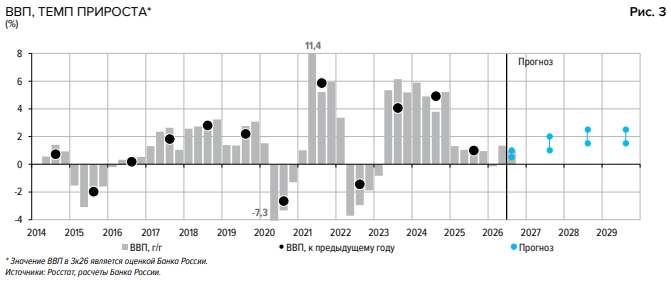
* GDP for the third quarter of 2026 was estimated by the Central Bank.
Sources: Rosstat, calculations by the Central Bank of Russia; Bank of Russia: Commentary on the Central Bank of Russia’s Medium-Term Forecast, Nov. 5, 2026
The Central Bank has lowered its forecast range for growth in 2027 by 0.5 percentage points to 1–2%. It cites as the reason that its monetary policy is more restrictive than previously assumed. Starting in 2028, GDP growth is expected to correspond to the long-term growth of the Russian economy’s production potential of 1.5–2.5%.
Inflation will be noticeably higher at the end of the year than previously expected
Regarding the annual increase in consumer prices in the third quarter, the Central Bank reports that the year-over-year inflation rate stood at 8%. It notes that it had expected only a 7% increase in July. The sharper rise in prices in the third quarter was primarily attributable to “temporary capacity shutdowns in some sectors.” (The Central Bank does not directly cite Ukraine’s attacks on Russian production facilities as the cause of the “temporary capacity shutdowns.”)
Along with its commentary on the forecast, the central bank also published a summary of the discussion surrounding its most recent policy rate decision. In this report as well, it addresses the consequences of the “temporary reduction in production capacity” caused by Ukraine’s attacks. It notes there that the Russian economy is returning to a “positive output gap,” meaning it is once again entering a phase of “overheating” in production capacity, in which demand cannot be met by supply. From this, it concludes that monetary policy must continue to curb demand. Interfax quotes the central bank’s reasoning as follows:
“The economy is returning to a positive output gap. In the third quarter of 2026, domestic demand continued to grow, while a temporary reduction in production capacity limited supply. To gradually reduce the positive output gap under these conditions, it is necessary to maintain the dampening effect of monetary policy on domestic demand.”
Furthermore, regarding current inflation trends, the Central Bank notes that the rise in consumer prices slightly exceeded its expectations due to “the indexation of energy prices effective October 1.”
The central bank has now raised its forecast for the year-end consumer price increase in December 2026 to 7.1–7.6% (see blue dots in the figure below). In its July forecast, it had anticipated a significantly lower inflation rate of 6–7% in December 2026. A year earlier, in December 2025, the inflation rate had even fallen to 5.6%.
However, the central bank remains confident about future inflation trends:
“As the fuel market continues to normalize and under the influence of monetary policy, inflation… will continue to slow.”
The central bank’s new forecast assumes that the annual average inflation rate will decline from 6.2–6.3% in 2026 to 5.2–5.7% in 2027. In December 2027, the rate of price increase is expected to reach the central bank’s target of 4%.
Year-over-year consumer price increase in %
; gray line: Year-over-year consumer price increase in %
; black dots: Consumer price increase compared to December of the previous year
; blue dots: Forecast for the consumer price increase in December
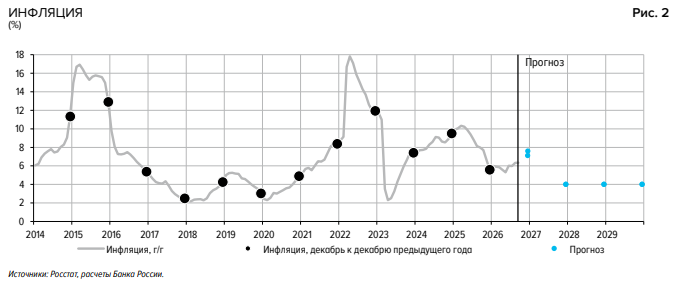
Sources: Rosstat, calculations by the Bank of Russia; Bank of Russia: Commentary on the Central Bank of Russia’s Medium-Term Forecast, Nov. 5, 26
BOFIT: Ukraine’s attacks are also driving inflation. Oil production is falling
BOFIT, the research institute of the Finnish central bank, states in its latest weekly report on the current acceleration in price increases in 2026:
“Inflation has been fueled by sharply rising government deficits and production losses caused by Ukraine’s attacks. The central bank has suspended interest rate cuts and must keep the key interest rate high to counter inflationary pressures.”
BOFIT reports that the oil industry and related sectors have been hardest hit by the attacks on Ukraine. Overall production in the “mining and extraction of raw materials” sector fell by about 4% year-over-year in September. At the same time, crude oil processing at refineries plummeted by about 17% (see the green line in the figure below). Rosstat no longer publishes data on Russian crude oil production. However, the International Energy Agency (IEA) estimates that Russia produced about 9% less crude oil in September than in the previous year (see blue line).
Trends in Russia’s Crude Oil Production and Refining
Volumes; Annual Average for 2023 = 100; Seasonally Adjusted
; Blue Line: Crude Oil Production; Green Line: Oil Refining
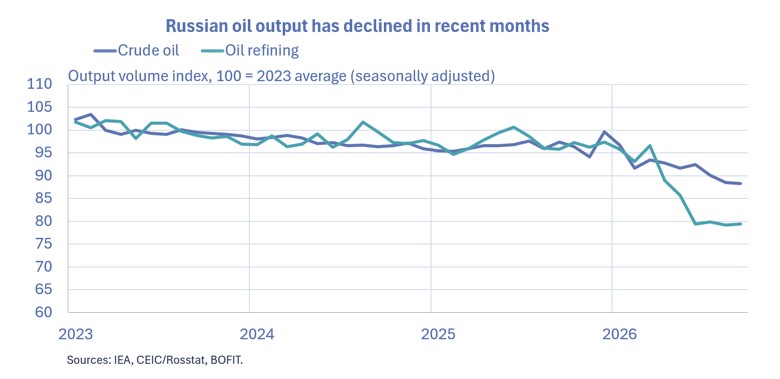
Sources: IEA, CEIC/Rosstat, BOFIT; BOFIT, Bank of Finland: Russian GDP growth remains sluggish despite huge increases in government spending; Weekly Review 45/2026, Nov. 6, 26
Raiffeisenbank: The “positive output gap” is accelerating inflation
According to Stanislav Murashev, chief economist at Russia’s Raiffeisenbank, the most important factor in the Central Bank’s decision on the key interest rate was the determination that the economy was “overheating.” He wrote this in a commentary published on Friday regarding the Central Bank’s discussion on the key interest rate.
Muraschow points out that the Central Bank explicitly stated that the “output gap” in the Russian economy had once again become “positive.” Domestic demand is growing faster than the supply of goods. The clear consequence of this is accelerating inflation. Furthermore, the decline in production capacity has proven to be more persistent than the Central Bank had anticipated. According to Muraschow, this development ultimately calls for a more restrictive monetary policy (see also: video discussion at Finam.ru).
The acceleration in inflation has also already led to an upward revision of the Central Bank’s forecast for the average key interest rate in 2027.
Central Bank: The policy rate will be lowered much more slowly than previously expected
In its commentary on its “Medium-Term Forecast,” the Bank of Russia writes the following regarding the future trajectory of the key interest rate:
“Given the prevailing inflationary risks and the ongoing impact of the idling of production capacity in certain sectors on inflation and inflation expectations, bringing inflation back to the target level of nearly 4% will require a prolonged period of moderately restrictive monetary policy.”
The central bank’s new forecast anticipates the following trajectory for the key interest rate:
- In 2026, the average policy rate will be 14.6% (blue dot in the figure below).
- The forecast for the key interest rate range in 2027 was raised from 10.5–12.5% to 12.5–13.5%, and the forecast for the key interest rate range in 2028 was raised from 8–9% to 9–10%.
- In 2029, when the inflation rate is expected to be firmly anchored at the 4% target, the central bank estimates that the key interest rate will likely return to the range of 7.5–8.5% per year.
Key interest rate (% per year)
gray line: Key interest rate on the respective day
black dots: Annual average
key interest rate blue dots: Forecasts for the annual average key interest rate
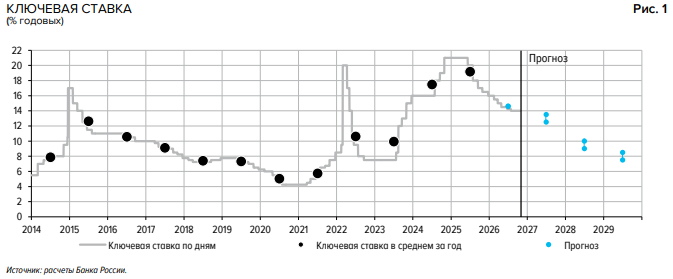
Source: Calculations by the Bank of Russia; Bank of Russia: Commentary on the Central Bank of Russia’s Medium-Term Forecast, Nov. 5, 26
IEF-RAS: The Russian economy is projected to grow by 0.7% in 2026
The “Institute for Economic Forecasting of the Russian Academy of Sciences” (IEF-RAS) once again forecast in its monthly “Short-Term Analysis of Gross Domestic Product Development” last week that Russia’s economy is likely to grow by 0.7% year-over-year in 2026. Nearly all other current forecasts for Russia’s economic growth in 2026 also fall within the Central Bank’s forecast range of 0.5% to 1%.
GDP Forecasts for Russia, 2025–2027
: Year-over-Year Change in Real Gross Domestic Product (in Percent)
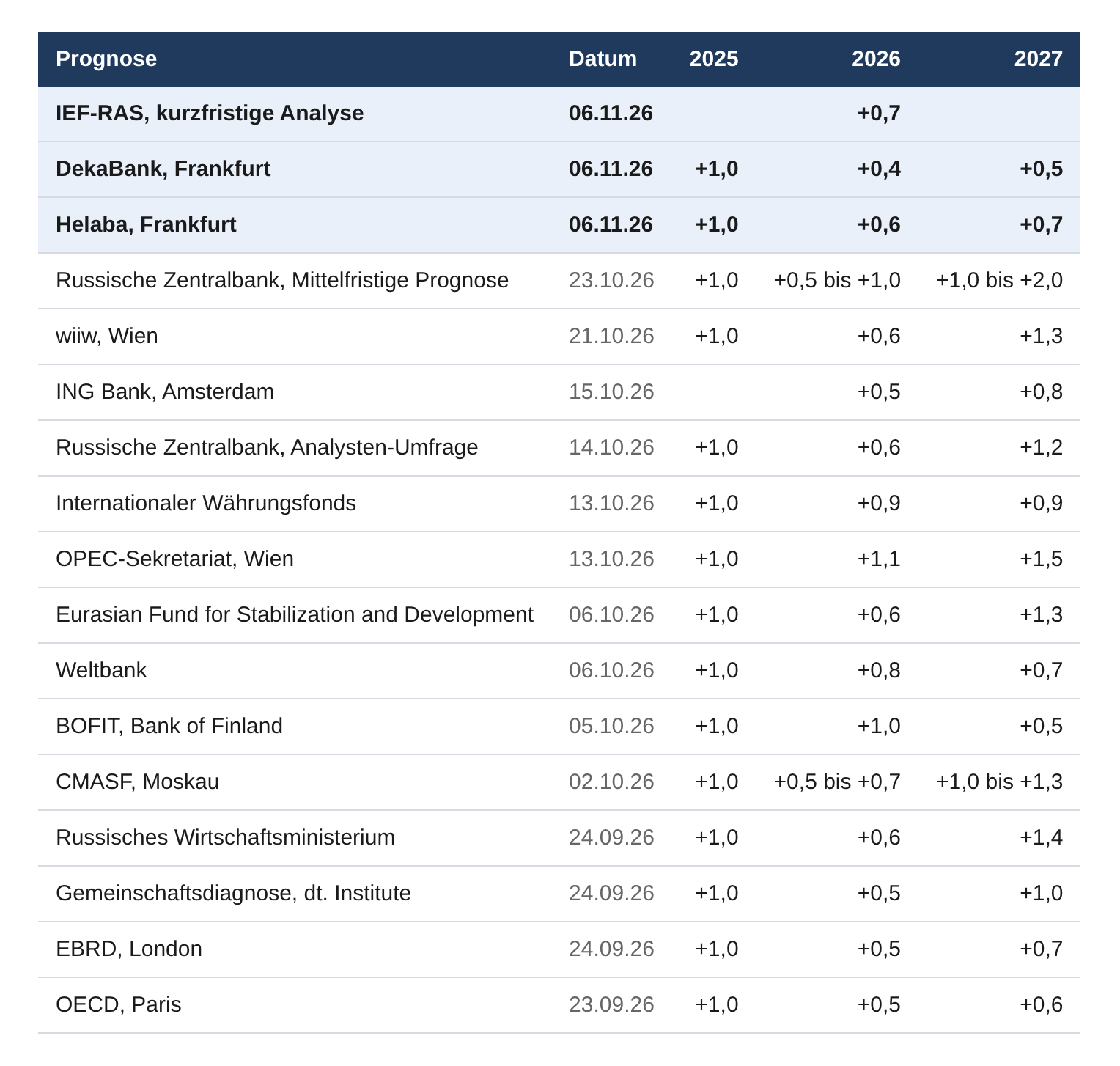
Sources: Data from the respective institutions; compiled by Klaus Dormann
According to IEF estimates, annual real economic growth slowed from 1.3% to 0.8% between the second and third quarters of 2026. The IEF thus estimates GDP growth in the third quarter to be slightly lower than the Central Bank’s projection (+1%).
In September, annual GDP growth accelerated to 1.2% according to the IEF’s estimate (see the blue column on the right in the figure below). Compared to August, the seasonally adjusted real gross domestic product index rose by 0.5% in September.
Estimate of the monthly trend in real gross domestic product
Black line: Real gross domestic product index, Jan. 2019 = 100
Blue bars: Estimate of year-over-year GDP change in %
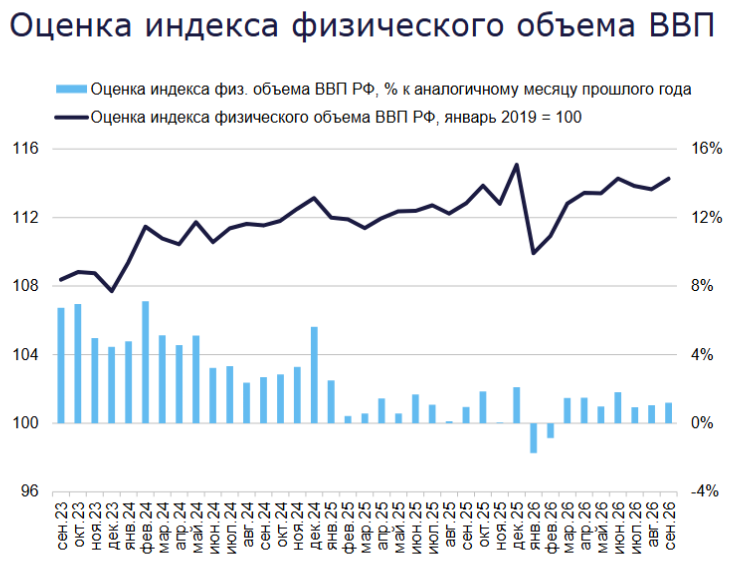
IEF-RAS: “Short-Term Analysis of Gross Domestic Product Trends,” Nov. 6, 26
IEF: Industrial production does not yet signal a recovery in investment
Looking back at the performance of key economic sectors in September, the Institute for Economic Forecasts highlights the following trends:
- The annual growth rate in the manufacturing sector, which accelerated to 5.6% in September 2026, is attributable to strong growth in a limited number of economic sectors. These primarily include industries that are part of the “military-industrial complex.”
- At the same time, 15 out of 24 manufacturing sectors recorded a decline in production in September. As in the previous month, the decline in production was particularly pronounced in coke and petroleum products (−17.3% year-over-year) and in the beverage industry (−22.3%).
- Although the index for investment in fixed assets calculated by the IEF showed a positive value for the first time since August 2025 (+0.6% year-over-year in September 2026), However, according to the IEF, the decline in production recorded in September compared to September 2025 in some sectors of the machinery manufacturing industry does not yet allow for conclusions to be drawn regarding a sustained recovery in investment activity.
Amid overall growth in private consumption, there are varying trends
According to the IEF, a seasonally adjusted analysis of real sales in the three major sectors of consumer demand reveals differing trends:
- Real retail sales fell compared to the previous month for three consecutive months starting in July 2026.
- The volume of paid services for the general public stagnated over the course of 2026.
- Real sales in the hospitality sector continued to grow.
Current data for the first four weeks of October 2026 point to a slowdown in the nominal growth of consumer spending to 7.2–7.5% year-over-year. The rise in real wages (+3.3% year-over-year in July and August 2026), combined with a declining savings rate, is currently sustaining real growth in consumer demand. The rise in real disposable income (+3.4% year-over-year in the third quarter of 2026) and the growth in real wages have converged.
The IEF expects a growth spurt in the industrial sector in the fourth quarter
In August 2026, Russian industrial production had fallen by 0.6% year-over-year. Analysts expected a further slight decline of 0.1% in September (Finmarket.ru). In September, however, the industrial sector began to show significant growth (+1.8% compared to the same month a year earlier; see the black bars in the figure below).
In its “Short-Term Analysis,” the IEF now expects industrial production to rise even more sharply year-over-year from October through December and to be 2.1% higher in the fourth quarter than it was a year ago. A month ago, the institute had forecast growth of just 0.9% for the fourth quarter—barely half that figure.
Industrial
Production: Year-over-Year Change in %
; dark bars: actual values; light blue bars: forecasts as of October 2026
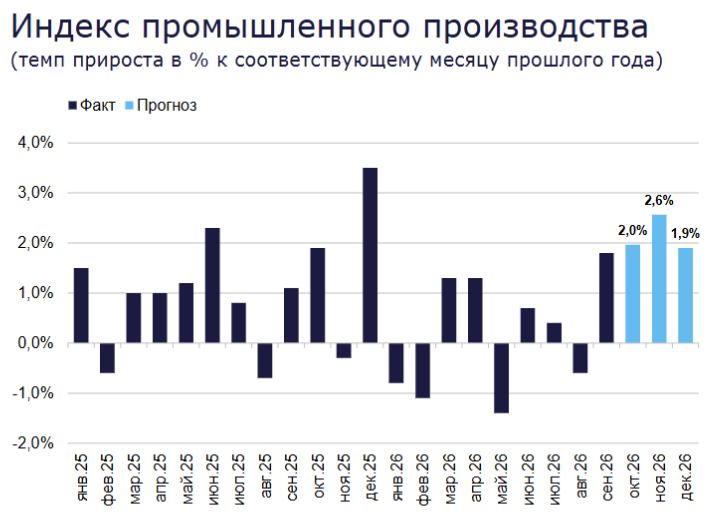
IEF-RAS: “Short-Term Analysis of Gross Domestic Product Trends,” Nov. 6, 26
In contrast, the Moscow-based “Center for Macroeconomic Analysis and Short-term Forecasting” states in its monthly analysis of industrial production trends in September:
“In September, a significant increase in production levels was recorded across the industrial sector as a whole. According to Rosstat’s estimate, seasonally adjusted production rose by 1.0% compared to the previous month—following a 0.3% decline in August.
However, it would be premature to speak of the beginning of a positive trend. Production growth has so far been observed for only one month and follows a long period of stabilization. Furthermore, it must be taken into account that civilian production, excluding the oil industry, is practically stagnating.”
For 2026 as a whole, the “Institute for Economic Forecasting of the Russian Academy of Sciences” now expects industrial production to grow by 0.7%.
The Russian Ministry of Economic Development, on the other hand, lowered its forecast for industrial production in 2026 in September to a decline of 0.2%. Previously, since May, it had expected growth of 0.6% for 2026 (Interfax).
Raiffeisenbank: The surge in production was accompanied by an improvement in the business climate
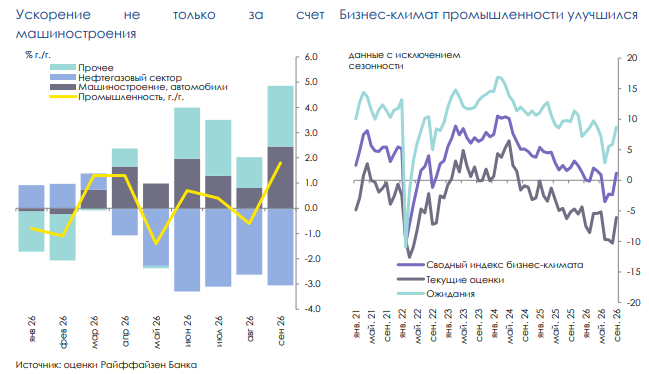
Stanislaw Muraschow compared the trend in industrial production with the trend in the business climate in the Russian economy. He notes that the sharp rise in industrial production in September was accompanied by a dramatic improvement in the business climate, according to the Central Bank’s survey. This is illustrated by the following two figures.
In the left figure, the yellow line shows the 1.8% increase in industrial production in September.
In the figure on the right, the middle blue line shows that the “Composite Business Climate Index” calculated by the Russian Central Bank has recently returned to positive territory (Bank of Russia: Business Monitoring). Previously, it had been trending downward since mid-2024 and had slipped into negative territory. The upper light green line shows how strongly the “Business Expectations” index of the participants in the central bank survey has recovered. The lower gray line indicates that the index assessing the “current business situation” has also risen recently. However, it remains well in negative territory, while “business expectations” are clearly positive.
Trends in Industrial Production and the Business Climate
Source: Raiffeisenbank estimates; Raiffeisenbank, Daily Focus: Strong Acceleration in Industrial Growth in September—Not Just Due to Machinery Manufacturing; 11/02/26
Muraschow emphasizes that the strong acceleration in industrial production growth to +1.8% in September is not solely attributable to the machinery sector. The black portion of the bar in the left-hand figure illustrates the contribution of the machinery sector—including the automotive industry—to the rise in industrial production. According to the chart, the machinery sector and the automotive industry together contributed approximately 2.5 percentage points to industrial production growth in September. Industrial production growth was held back by the decline in output in the oil and gas industry (blue portion of the bar). Muraschow estimates their negative contribution to industrial production growth in September at around 3 percentage points. The other industrial sectors (upper green portion of the bar), on the other hand, made an overall positive contribution to industrial production growth.
Recommended Reading
German-Russian Chamber of Foreign Trade:
- Cabinet reshuffle: four new appointments, one “superminister,” Oct. 30, 26
- Lower Profits, Expensive Loans: Russian Companies Are Investing Less, Oct. 29, 26
- Russia Open to Natural Gas Supplies; October 28, 26
- Key interest rate remains at 14%: Russian Central Bank prepares for a prolonged period of high interest rates, Oct. 28, 26
Overall Economy (Austrian Chamber of Commerce: Country Profile—Russia, as of Oct. 2026;
TradingEconomics: News; Calendar; Riddle, Kommersant, Vedomosti, Politkom, inveb.ru, Finam)
- BOFIT, Bank of Finland: Russian GDP growth remains sluggish despite huge increases in government spending; Weekly Review 45/2026, Nov. 6, 26
- Politkom.ru; Nikita Maslennikov: Moderate macroeconomic dynamics with varying trends; Economic conditions in September and the third quarter; Nov. 5, 2026
- Finam.ru; Victor Grigoriev, Bank of St. Petersburg: The composite PMI fell to 50 points, the lowest level since July, November 5, 26; Finam.ru: The business activity index in the Russian services sector fell to 50.1 points in October, Nov. 5, 2026; Finam.ru; Business Activity in Russia: Price Pressure Eases, but Risks to the Trend Persist. The Russian Manufacturing Purchasing Managers’ Index is close to 50; Nov. 3, 2026
- Kyiv School of Economics: Russia Chartbook, prepared by: Benjamin Hilgenstock, Yuliia Pavytska, Matvii Talalaievskyi, Mariia Pidhorna: Oil Revenues Rebound as Prices Soar; Seasonal Budget Surplus Reduces Fiscal Pressures; Inflation Halts Rate Cuts, November 3, 2026
- CMASF: Industrial Production Trends in September 2026, Nov. 3, 2026
- Raiffeisenbank, Daily Focus: Industrial growth accelerated significantly in September—not only in mechanical engineering; November 2, 26
- russland.capital: Russia’s Economy Is Barely Growing—Defense-Related Sectors Continue to Expand; Oct. 31, 26
- The Bell: The two-speed economy has once again become evident in GDP growth; Oct. 29, 2026
- Finam.ru; Olga Belenkaya: September Results for the Russian Economy. Annual GDP growth slowed, while industry and consumption gained momentum. 10/29/26
- MEC, Igor Savonov: Industrial Production: A One-Time Surge, 10/29/26
- MMI: Industry in September: Record growth since the beginning of the year, 10/29/26
- bne Intellinews, Ben Aris: Russia’s GDP growth slows to 0.5% in September. The economy grew 0.6% in the third quarter, down from 1.3% in the second, as mining, wholesale trade, and agriculture contracted; 10/29/26
- Kommersant; Artem Chugunov: The economy is slowing down. The recovery in industry and consumption in September did not accelerate GDP growth. 10/29/26
- russland.capital: Russian consumers are becoming more cautious—consumption growth is approaching zero, 10/29/26
- Der Standard; “Topic of the Day” podcast: Is Russia running out of money, Torsten Heinrich? How much longer can the Russian economy sustain war expenditures? Military historian and YouTuber Torsten Heinrich answers these questions. Video, Oct. 29, 26; Podcast: Military & History with Torsten Heinrich: Russia’s Economy Is at Its Limit, 21 min., Oct. 18, 26
- bne Intellinews, Ben Aris: Russian consumer spending growth stalls in October, October 28, 2026
- Kommersant; Artem Chugunov: Private demand continues to weaken, Oct. 28, 26
Economic Forecasts:
- IEF-RAS: “Short-Term Analysis of Gross Domestic Product Trends,” Nov. 6, 26
- Bank of Russia: Commentary on the Central Bank of Russia’s Medium-Term Forecast, Nov. 5, 26
- CMASF: Macroeconomic Base Forecast, Oct. 30, 26
- RBC.ru: Sberbank has raised its inflation forecast and adjusted its GDP forecast. It expects GDP growth of 0.5–1% and inflation of 6.5–7.5% by the end of 2026; October 28, 2026
- Bank of Russia: Medium-term forecast; October 23, 26
- Top Leader: Economic trends in Eastern Europe are mixed and highly country-specific. wiiw: New growth model in CEE countries—positive momentum for Austria’s economy, Oct. 27, 2026
- Salzburger Nachrichten; APA: Eastern Europe continues to grow strongly despite high energy prices, Oct. 21, 2026
- Die Presse, Aloysius Widmann: Eastern Europe’s economy is booming—but debt is becoming a problem, October 21, 2026
- Vienna Institute for International Economic Comparisons; wiiw: Fall Forecast 2026;
Andreas Knapp; Press Releases: English; German; Executive Summary; Richard Grieveson: Central, East, and Southeast Europe in 2027: Resilient Growth in a More Dangerous World, Oct. 21, 2026;
wiiw Country Overview: Russia; Additional Press Reports: wiiw in the Press - Bank of Russia: Macroeconomic Survey of the Bank of Russia, October 14, 2026
- International Monetary Fund, IMF: World Economic Outlook: Resilience Under Strain, Urgent Choices, October 2026; Press Briefing Transcript: World Economic Outlook, Annual Meetings 2026, October 13, 2026
- OPEC Secretariat, Vienna: Monthly Oil Market Report, October 13, 2026
- Institute for Economic Forecasting of the Russian Academy of Sciences, IEF-RAS: Short-Term Analysis of GDP Trends; October 12, 2026
- World Bank: Country Report: Russian Federation, in: Macro Poverty Outlook; Europe and Central Asia Update; October 6, 2026; World Bank: Press Release; Europe and Central Asia: Slower Growth with Global Headwinds; October 6, 2026
Monetary Policy, Inflation (Central Bank Calendar; Interfax Reports, Kommersant Reports)
- Finam.ru: If the economy is overheating, should we expect the Central Bank to raise its key interest rate in the near future? The Central Bank expects domestic demand to grow faster than the production of goods and services again. Does this mean the Central Bank could raise the key interest rate? Experts discussed this topic, video, 11/07/26
- Raiffeisenbank.ru; Stanislav Murashov: Summary of the Central Bank’s October Meeting: Signs of Economic Overheating Are Unmistakable; November 6, 2026
- Interfax.com: Russian economy re-entered overheating zone in Q3 2026; monetary policy must restrain domestic demand—Central Bank, November 5, 2026; Interfax.com: Central Bank of Russia’s October discussion summary again demonstrates unanimity on both rate and signal, November 5, 2026
- Bank of Russia: Summary of the Key Rate Discussion released (English); Russian full version: Summary of the discussion on key interest rates during the “Week of Silence” and during the meeting of the Bank of Russia’s Board of Directors on October 23, 2026; Nov. 5, 2026
- Japan Times; Reuters: For many Russians, higher utility bills are the latest inflation shock, Nov. 3, 2026
- Bond Guide: Banks’ record profits are built on shaky ground. Russian banks report record profits while non-performing loans rise significantly. The Bell: The central bank apparently allows risk provisions to be too low. Oct. 31, 26
- Politkom.ru; Nikita Maslennikov: The central bank reiterated its “most important” priority, Oct. 29, 2026
- bne Intellinews, Ben Aris: Russia’s central bank sees 14–16% interest rates in 2027 if inflation risks materialize. The final 2027–2029 monetary policy guidelines add an AI-led global crash as a possible crisis trigger and initiate a review of the 4% inflation target, Oct. 29, 26
- Bank of Russia: Monetary Policy Guidelines for 2027–2029 released, English editions: Monetary Policy Guidelines, Oct. 28, 2026
- Interfax.ru: Inflation in Russia stood at 0.08% from October 20 to 26, and the annual inflation rate fell to 7.11%; October 28, 2026; Interfax.ru: Gasoline prices in Russia fell by 1.63% from October 20 to 26, while diesel prices declined by 0.05%; October 28, 2026
Fiscal Policy; Federal Budget (Interfax Reports)
- IEF-RAS; Ksenia Evgenievna Savchishina: Review of the draft federal law “On the Federal Budget for 2027 and for the Planning Period of 2028 and 2029” (in the first version submitted to the State Duma of the Russian Federation for deliberation on October 1, 2026), Oct. 30, 2026
- ABC News; DAVID MCHUGH, DASHA LITVINOVA (AP): As the war strains the Kremlin’s finances, Putin searches for new revenue streams, Oct. 28, 2026
- United24; Illia Kabachynskyi: Russia Has No More Money to Throw at Its War in Ukraine. Its 2027 Budget Shows Why, Oct. 23, 2026
- russland.capital: Russia’s Budget: Tightening the Belt, But We Can’t Call It That; Oct. 23, 2026; Russia’s Budget: Siluanov Considers the Deficit Small—But Costs Are Rising; Oct. 21, 2026
- FR.de; Marcel Reich: Russia’s Economy Under Pressure: Kremlin Expects Budget Shortfall to Double, October 21, 2026
Energy sector, fuel supply, infrastructure (DW in Russian: Fuel crisis)
- Der Standard; Nicolas Dworak, András Szigetvari: How will the EU get out of the gas crisis? With gas from Russia, say the U.S.; 11/07/26
- Die Presse Podcast; Eduard Steiner discusses with wiiw economist Vasily Astrov and Johannes Benigni, international energy consultant: More Russian Gas for Europe Again: Is Trump’s Idea Toxic or Brilliant? with transcript; 39 min., Nov. 5, 26
- t-online.de; Amy Walker: Gas for Europe. “Trump and Putin Are Planning a Dirty Deal,” Nov. 3, 2026
- Finanzmarktwelt; Josephine Bolliniger-Kanne: New twist in the gas dispute. Gas dispute with the EU escalates: Russia warns, U.S. gets involved. Amid rising gas prices and potential three-way talks on ending the war in Ukraine, the dispute over the European ban on Russian gas imports starting in 2027 is intensifying. Nov. 2, 26
- Merkur.de; Jens Kiffmeier: Putin’s Refineries in Flames: Ukrainian Drones Strike Russia’s Achilles’ Heel, November 2, 2026
- Focus; Lars-Eric Nievelstein: U.S. Diesel Agreement. Kremlin Lowers Oil Export Forecast to 17-Year Low, Nov. 1, 26
- russland.capital: Russia’s Gas Remains a Factor on the World Market—Europe Faces an Expensive Farewell, Oct. 29, 26
- DW; Michael Rostand: FT: The U.S. and Russia are negotiating the return of American oil companies to Russia, October 28, 26
Foreign Trade, Sanctions; Tagesschau: Russia Sanctions
- Meduza: Russia’s economy is suffering under the weight of war and sanctions. So why is the ruble still one of the world’s strongest currencies? November 6, 26
- Riddle; Oleg Logionv: Harvest of War: Russia’s Grain Export Boom Faces a Test, November 4, 2026
- German-Russian Chamber of Foreign Trade: Putin: Good Conditions for Western Companies, October 27, 2026
- Merkur.de; Richard Strobl: German Supermarket Chain Metro Donates Millions to Putin for the War in Ukraine—Clarification Follows Immediately, 10/26/26
- Tichys Einblick, Franka Haase: How Many Sanctions Will It Take for Russia to Back Down?, October 24, 2026
- tagesschau.de; Jean-Marie Magro, ARD Brussels: Oil and Uranium Despite Sanctions. Europe Is Still This Dependent on Russia; Dependencies Remain, Especially for Oil and Uranium; October 24, 26
- russland.capital: Gazprom Offers Gas to Europe: Old Pipeline, New Negotiating Position, October 23, 2026
- russland.capital: Ownership Depending on the Political Climate: Russia Spares U.S. Companies and Puts Pressure on Europeans. European companies are placed under state-imposed external administration in Russia significantly more often than American ones; Oct. 23, 2026
Political Landscape; BR24: Russia
- TAZ Interview by Mathias Brüggmann: Mikhail Khodorkovsky on Russia. “One Should Talk to Putin.” A conversation about sanctions, war, and the Russian opposition, 11/07/26
- t-online; Patrick Diekmann: Setbacks for Putin in Ukraine. The war takes an unexpected turn, Nov. 1, 26
- The Economy, Tyler Hansbrough: “Europe Weary of War Costs, Russia Facing Economic Hardship”: Moves Toward Direct Western-Russian Negotiations Gain Momentum, Opening a New Phase in Talks to End the War; October 29, 26
- Euro News: Brussels Makes It Clear: Nord Stream Pipeline Will Remain Closed After the War, Oct. 28, 2026
Earlier analyses by Klaus Dormann
- Russia: key rate stays at 14%, wiiw sees 0.6% growth · October 26, 2026
- Russia forecasts 2027: IMF, World Bank, OECD compared · October 21, 2026
- Russia: World Bank and BOFIT GDP forecasts for 2026 · October 12, 2026
- Russia: GDP up 0.8% in August as consumption cools · October 5, 2026
The day's most important Russian economic stories. Free, in your inbox three times a week.
Mon, Wed, Fri. Double opt-in, unsubscribe anytime. By subscribing you consent to the processing of your email address as described in our Privacy Policy.