The World Bank and BOFIT do not expect growth to exceed the government's forecast until 2026

Author: Klaus Dormann
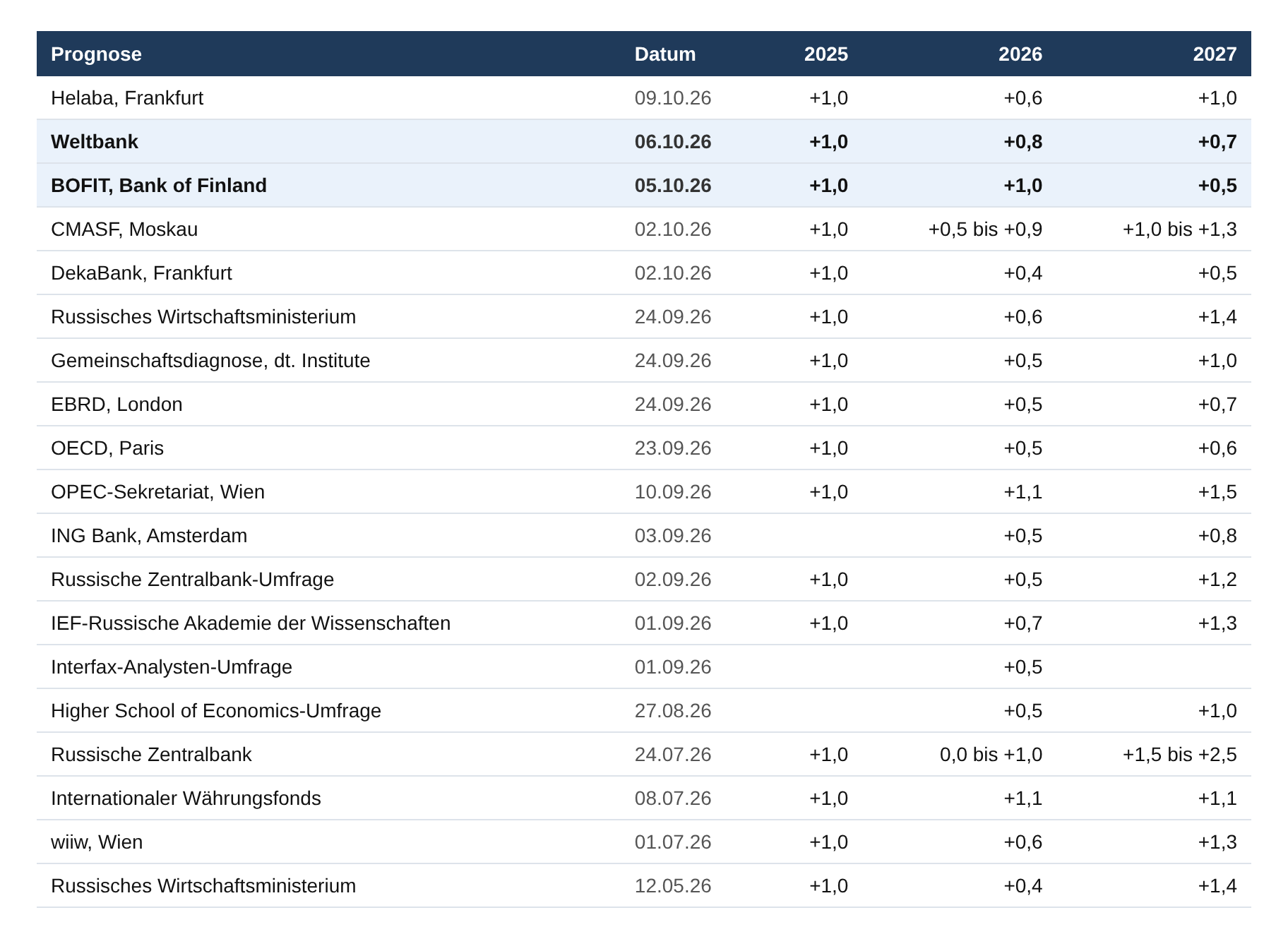
At the end of September, the Russian government raised its forecast for this year’s real gross domestic product growth only slightly, from 0.4 to 0.6 percent. The vast majority of analysts also expect growth in the Russian economy to halve this year, from one percent to about half a percent.
The World Bank and BOFIT, the research institute of the Finnish Central Bank, continue to expect somewhat stronger growth in Russia in 2026. This is evident from their “Fall Forecasts” published last week. As it did at the end of March, the World Bank expects the Russian economy to grow by 0.8 percent this year. BOFIT continues to forecast an increase in aggregate economic output of around one percent.
For 2027, the World Bank and BOFIT are significantly more pessimistic than the government
However, according to BOFIT, the increase in aggregate economic output will halve to around 0.5% next year (note: BOFIT publishes forecasts rounded to the nearest half percentage point). The World Bank expects growth to slow slightly further to 0.7 percent in 2027.
The Russian government, on the other hand, foresees the opposite economic trend in 2027. It expects growth to pick up next year from 0.6 to 1.4 percent.
GDP Forecasts for Russia, 2025–2027
: Year-over-Year Change in Real Gross Domestic Product (in Percent)
Government: Growth will accelerate to 2.4% by 2029, even though fixed investment will decline by 5.4% in 2026 and stagnate in 2027
According to the new government forecast, Russian GDP growth is expected to accelerate further to 1.9% in 2028 and reach 2.4% in 2029 (Vedomosti).
However, the government has significantly lowered its forecasts for the development of fixed investment in 2026. It now expects a 5.4% decline this year (Kommersant.ru). This decline is also reflected in the following chart from Re:Russia showing the trend in fixed investment since 1999.
Fixed-Asset Investment in Russia, 1999–2026 (1999 = 100)
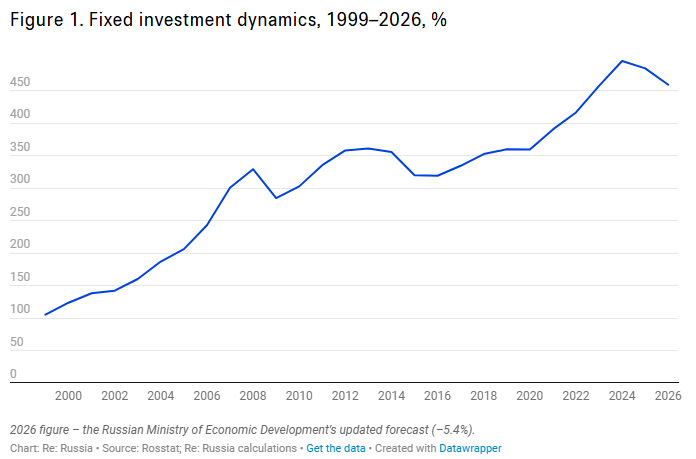
Re:Russia: Military Keynesianism 2.0: The collapse of civilian-sector investment will lead to a fall in incomes and private consumption, Oct. 2, 2026
The figure above clearly shows that fixed investment increased sharply from 2021 to 2024. The Barcelona-based research firm FocusEconomics has published the following table (with an interactive chart) on the high growth rates of fixed investment from 2021 to 2024:
Fixed Investment in Russia, 2021–2025
: Year-over-Year Change in Percent

FocusEconomics: Russia Investment
In 2025, fixed investment began to decline (−0.4%), a trend that the government expects will accelerate to 5.4% in 2026. On September 1, the Institute for Economic Forecasting at the Russian Academy of Sciences had forecast that, following a 0.4% decline in 2025, fixed investment would fall by 3.9% in 2026.
However, according to the government’s forecast, fixed investment will not decline further in 2027 but will instead rise slightly (+0.2%). The government subsequently expects investment growth rates of 2.5% in 2028 and 3% in 2029. Deputy Prime Minister Novak announced this, according to Vedomosti (see also Interfax).
BOFIT: The rapid growth in investment from 2021 to 2024 should be noted
The BOFIT research institute of the Bank of Finland noted in its weekly report dated September 25 that the current decline in investment in Russia is partly attributable to the “rapid growth of previous years”:
“Between 2021 and 2024, investment grew by an average of 8% per year. Investment growth was particularly rapid in sectors related to the war. At the same time, major projects were also carried out in the oil and gas industry, the chemical industry, and the logistics sector—sectors not directly related to the war.
Many of these projects have since been completed or are so far along that their growth-boosting effect on investment has waned. For example, the share of investment in the oil and gas industry and in road transportation has declined this year.”
BOFIT believes that, by historical standards, investment levels remain exceptionally high at present.
Analyst Chernov: “Lower investment means less new capacity”
According to the government’s forecast, investment next year is expected to remain virtually flat (+0.2%) at the level reached in 2026. Even after that, the government does not expect another “investment boom,” with growth rates of 2.5% in 2028 and 3% in 2029.
In light of these investment forecasts, Vladimir Chernov, an analyst at “Freedom Global,” currently considers the government’s projection of an acceleration in Russian economic growth to up to 2.4% in 2029 to be “a rather optimistic scenario.” In a commentary published by the Russian brokerage firm Finam, he notes that this growth forecast would require “more robust investment growth.” He argues:
“After a 5.4% decline in 2026, the recovery over the next three years will only bring investment back to roughly the 2025 level. This limits the potential for rapid GDP growth. Lower investment today means less new capacity tomorrow, so the effects of the investment lull will still be felt even if borrowing costs fall.
Fiscal spending alone will not fully solve this problem. If demand is stimulated without expanding production or increasing labor productivity, part of the money will flow into price increases and imports. The central bank will then be forced to keep interest rates high for longer, which will further dampen investment.”
However, the government’s forecast for GDP growth in 2026 (+0.6%) and the acceleration of growth to 1.4% in 2027 fall within the growth ranges expected by “Freedom Global”: In 2026, the economy is projected to grow by 0.5 to 1%, and in 2027 by 1 to 1.5%.
BOFIT: What are the causes of the current sharp decline in investment?
According to BOFIT, the year-over-year decline in investment for the entire first half of 2026 was approximately 8% (BOFIT Weekly, Oct. 9, 2026). The institute cites the following factors, among others, as causes for this slump:
- Capacity utilization declined slightly in many industries. The demand outlook for companies has deteriorated.
- Financing investments has become more difficult due to weaker profits. From January through June, companies’ average operating income fell by 13% compared with the previous year. One-third of companies reported losses.
- High interest costs are further limiting financing options. In July, the average interest rate on corporate loans with a term of more than one year stood at 13%.
The Research Institute of the Bank of Finland apparently does not expect any further key interest rate cuts in Russia in the near future. It states:
“Financing costs are unlikely to decrease in the foreseeable future, as the Russian Central Bank left the key interest rate unchanged at 14 percent at its September meeting. Until now, the key interest rate had been gradually lowered since June 2025. The central bank explained that a pause in rate cuts was necessary due to the current high level of uncertainty regarding the inflation outlook.”
Deterring Foreign Investors Through “Temporary Takeovers”
BOFIT points out that the share of foreign companies in investments in Russia remains marginal: From January through June, it stood at just 0.1%.
Regarding the consequences of the “temporary takeovers” of foreign companies, BOFIT states in its weekly report of September 25:
“The attractiveness of investing in Russia is unlikely to be enhanced by President Putin’s order last week to ‘temporarily take over’ several foreign companies in Russia. For example, the Russian subsidiaries of Nestlé and Auchan were transferred to a small, previously unknown Russian company. The takeover was justified, among other things, by the companies’ origins in ‘unfriendly’ countries and insufficient investment in the Russian market. What will happen to the companies in the future is uncertain. In similar cases in the past, the companies were often sold to Russian owners at a bargain price.”
World Bank: Russia’s Economic Growth Is Slowing
The World Bank is significantly more skeptical than the government about the Russian economy’s outlook starting as early as 2027. With a projected GDP growth rate of 0.7% next year, it expects production to rise by only half as much as the government forecasts (+1.4%). The World Bank also expects only 0.7% growth in Russia for 2028.
In its “Europe & Central Asia Economic Update” on October 6, the World Bank summarized the economic performance so far in 2026 as follows:
- Growth in the Russian economy during the first half of the year was driven by “robust” private consumption and increased spending on “defense-related sectors.”
- The labor market remains tight, with the unemployment rate at 2.3 percent, near a record low (see the left column in the following World Bank figure, which compares economic indicators for 2026—the dark blue columns—with those for 2025—the light blue diamonds).
- Retail sales were boosted from January through July 2026 by the drawdown of savings and the rise in real wages, growing at a faster rate than in the same period of the previous year. At the same time, however, the “services to the population” sector showed only “limited” growth and grew more slowly than in 2025.
- In the “manufacturing” sector, defense spending partially offset the weakness in production in “civilian industries,” which are struggling with more restrictive credit conditions, falling demand, and supply bottlenecks.
The dark blue column on the right in the figure shows that the federal budget deficit from January through August 2026 was higher than in the previous year (light blue diamond).
World Bank: Growth in Russia is likely to slow
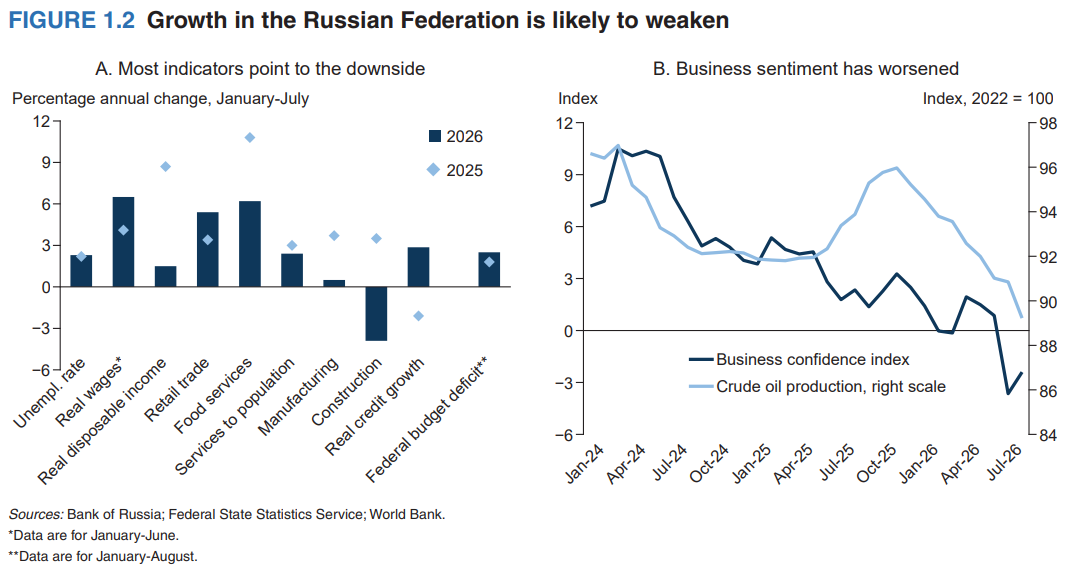
World Bank: Europe & Central Asia Economic Update. Making AI Work: Jobs, Firms, and Productivity; Oct. 6, 26
Among the “challenges” to the Russian economy’s growth, the World Bank cites losses in oil refinery production capacity, declining crude oil production, disruptions in the areas of “logistics” and “infrastructure,” and deteriorating business sentiment.
The right-hand chart of the two World Bank figures above shows that the “Business Confidence Index” has trended significantly downward since mid-2024 (dark blue line). Since July 2026, this corporate “confidence index” has been in negative territory (see: Bank of Russia: Business Confidence Index). The crude oil production index (light blue line, right scale) has been declining since fall 2025.
World Bank: GDP growth slows to 0.8% in 2026
The World Bank published a detailed analysis of the Russian economy’s performance in the Russia chapter of its “Macro Poverty Outlook.” Below is a summary of the World Bank’s assessments:
Although the Russian economy continues to appear resilient from the outside, the “war economy” growth model is losing momentum. For the current year, the World Bank forecasts a 0.8 percent increase in Russia’s real gross domestic product. For 2027 and 2028, the World Bank expects growth of only 0.7 percent.
Real Gross Domestic Product by Expenditure Category

World Bank: Country Report: Russian Federation, in: Macro Poverty Outlook; Europe and Central Asia Update; Oct. 6, 26
According to the World Bank, the decline in gross fixed capital formation will continue through 2028
The World Bank anticipates that the decline in gross fixed capital investment, which began in 2025, will continue. In 2026, it is projected to fall by 1%. Over the next two years, the World Bank expects further declines of 2% (2027) and 1.9% (2028).
Russia’s growth is driven primarily by consumption
In the following World Bank chart, the purple line shows that the real gross domestic product growth rate will stagnate at just under one percent from 2026 to 2028. By far the most important driver of growth in 2026 is private consumption (light blue portion of the bar). Government consumption is also growing (brown). Negative contributions to growth come from net exports (pink) and gross fixed capital formation (dark blue).
Year-over-year real gross domestic product growth in %
Growth contributions by expenditure categories in percentage points
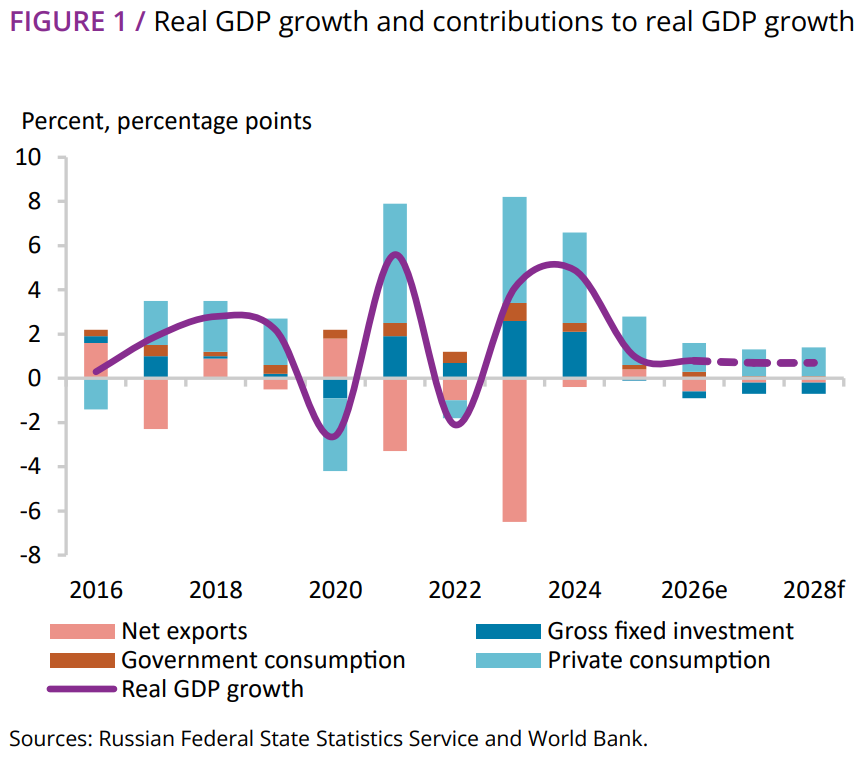
World Bank: Country Report: Russian Federation, in: Macro Poverty Outlook; Europe and Central Asia Update; Oct. 6, 26
GDP growth slowed to 0.6 percent in the first half of 2026, driven by weakening domestic demand, rising inflation, and increasing vulnerabilities in the financial sector.
High real interest rates are weighing on Russian consumers, businesses, and banks. The scope for fiscal policy is shrinking because the budget deficit exceeds targets and the liquid assets of the National Wealth Fund (NWF) are declining.
Although higher export prices for crude oil have temporarily bolstered the external economic position, damage to energy infrastructure is reducing exports of petroleum products. This is leading to domestic fuel shortages and intensifying inflationary pressures. This makes it more difficult for the Russian Central Bank to continue easing monetary policy.
The rise in consumer prices is accelerating
Damage to energy infrastructure has forced fuel rationing in many Russian regions, and domestic gasoline prices have risen. The annual increase in consumer prices climbed to 6.3 percent in August 2026. Inflation is expected to rise to about 6.5 percent in the short term.
While the expected economic slowdown could reduce inflationary pressure in the medium term, the inflation rate is likely to remain above the central bank’s inflation target of 4 percent.
The budget deficit is higher than expected
The fiscal situation deteriorated in the first half of 2026 due to higher spending and tighter domestic financing conditions for the government.
The federal budget deficit reached 2.5 percent of GDP in the period from January through August 2026. It was about half as much higher as planned, as federal spending rose by 14.7 percent in nominal terms compared with the previous year.
Due to low demand from banks for government bonds, the Ministry of Finance turned to the “National Wealth Fund (NWF)” to finance the deficit. The NWF’s liquid assets fell from $52.6 billion in June 2025 to $46.7 billion in August 2026.
The external economic situation improved
As oil prices rose, export revenues from hydrocarbons increased. The current account surplus amounted to $32.4 billion from January through July 2026, compared with $21.5 billion in the same period of the previous year.
Russia’s international currency reserves totaled $720.5 billion in mid-2026. However, an estimated $280 to $330 billion of this amount is “frozen” due to Western sanctions.
Persistently Low Unemployment
Labor market indicators reflect a war-induced labor shortage rather than strong demand for workers. The unemployment rate, which stood at over 4 percent before the war began in 2022, remained near its historic low of 2.3 percent in June 2026. This contributed to real wage growth of 3.4 percent in June. However, the rise in real wages has more than halved compared to its record high of 8.6 percent in January 2026.
The previous decline in the “poverty rate” now appears to be stalling
Persistent inflation and slowing wage growth have increasingly eroded the population’s purchasing power. Households with children, the rural population, and low-income earners are particularly hard hit. Russia’s official poverty rate, however, continued to fall through 2025, dropping from 7.1 percent in 2024 to a record low of 6.7 percent. The decline in poverty is likely to stall in the meantime, however, as economic growth slows. Dwindling fiscal leeway could also lead to cuts in social transfers.
BOFIT expects growth of only half a percent in 2027 and 2028
The “Fall Forecast” on the Russian economy, published last week by the BOFIT research institute of the Bank of Finland, assumes that Russia’s GDP growth will likely be around one percent again in 2026. Next year, however, it is expected to slow further to about half a percent. Growth is also likely to remain this weak in 2028. These growth forecasts from BOFIT are largely in line with the World Bank’s assessments.
In “BOFIT Weekly,” the institute published the following chart on Friday.
Russia’s Real Gross Domestic Product, Year-over-Year Change in %
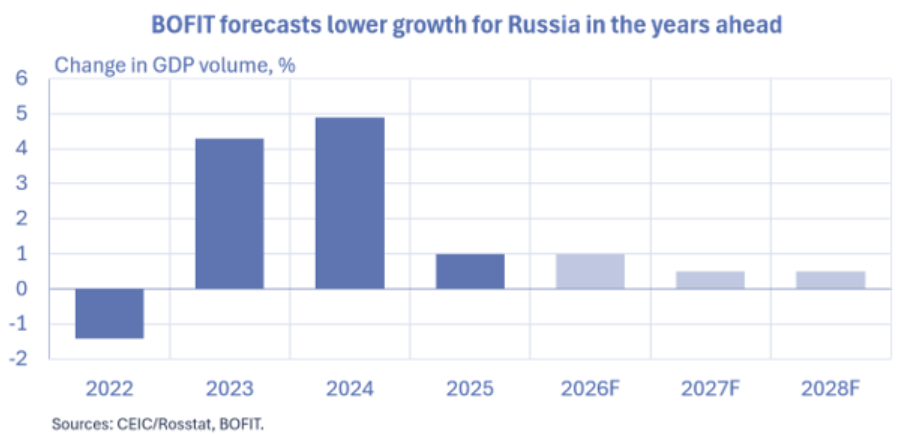
BOFIT, Bank of Finland: BOFIT Weekly: Russia’s growth slows further, government finances remain in the red, Oct. 9, 26
The weekly report highlights, among other things, the following findings from the new BOFIT forecast:
Russia’s growth is driven by rising government spending
Government spending is expected to rise rapidly next year as well, as it has in previous years. The majority of the increase in spending will be attributable to war-related expenditures. The government budget will continue to run a deficit. It will be financed primarily through the issuance of new government debt.
Monetary policy remains restrictive
In September, due to mounting inflationary pressures, the Russian Central Bank did not lower the key interest rate further but left it at 14%. Consumer prices continued to rise by about 6% year-over-year in September. The central bank warned that monetary policy would need to be tightened if fiscal policy were to be loosened more than expected. In its latest forecast, however, the central bank expects the key interest rate to fall to an average of 10.5% to 12.5% next year and to 8% to 9% in 2028.
High interest rates are poison for investment
According to preliminary data, fixed investment fell by 8% year-over-year from January through June. Investment is being held back by tighter financing conditions resulting from deteriorating corporate earnings and high financing costs. In addition, companies’ propensity to invest has declined. Capacity utilization has fallen in many sectors. Demand has weakened.
Growth in private consumption is slowing
The tight labor market has eased somewhat in recent months. There are slight signs of rising unemployment, and wage growth has slowed. High inflation is eroding consumer purchasing power. However, since household savings have risen in recent years, they may be able to offset the decline in income growth.
Russia’s foreign trade is likely to remain weak
Export growth is being constrained by sanctions and Ukraine’s attacks on Russian infrastructure. Imports are being held back by slowing demand growth and the weak ruble. Russia’s current account is expected to show a significant surplus throughout the forecast period.
Recommended Reading
German-Russian Chamber of Foreign Trade:
- Valdai Forum: Key Presidential Statements on the Economy, Foreign Administration, Ukraine, and Germany, Oct. 6, 26
- GDP Forecast 2026: Russian Economy Stagnates, October 2, 2026
- Europe’s Trade with Russia: From the Pipeline Business to the Gas Phase-Out, October 1, 2026
- 2027 Budget: Austerity Measures and New Taxes, September 29, 26
- State vs. Business: Receivership and Nationalization in Russia, September 21, 2026
Podcasts, Videos
- The Sun: Attacks on oil refineries and overspending on military assets are killing the Russian economy. Financier and Putin critic Bill Browder breaks down how 15% interest rates, failed government bond sales, and Ukrainian drone strikes on oil refineries are crippling Moscow’s budget, Video, 9 min., Oct. 9, 2026
- ZDFheute News: Ukraine is attacking oil facilities and a data center. How severely are the Ukrainian attacks impacting Russia’s economy? What role do German companies play in Russia? Most recently, former Chancellor Schröder took on a new position at the Russian subsidiary of the German supermarket chain Globus. Victoria Reichelt discusses this live on ZDFheute with military expert Nico Lange and ZDF correspondent Felix Klauser in Russia, Video, 31 min., Oct. 8, 2026
- russland.RU: Schröder at Globus: A Good Connection as a Safety Net? Video on the former German chancellor’s appointment to the supervisory board of Hyperglobus, Oct. 3, 26
- Deutschlandfunk; Sabine Adler: Nord Stream Trial: Is the Right Perpetrator on Trial? Ukrainian officer Serhii K. is on trial in Hamburg. Was he acting on behalf of the state? And can the pipelines be considered legitimate targets of war? Audio, 20 min., Oct. 6, 26
- Vladimir Milov in a Telekanal video with Michael Nucky: OFZ collapse, developers’ default, and U.S. strike: MILOV explained how the Russian economy collapsed, 45 min., Oct. 5, 26
Economic Forecasts
- Vedomosti; Natalia Zakharova: The Central Bank has identified signs of accelerated economic growth, Oct. 9, 2026
- Freedom Global; Vladimir Chernov: The economy needs investment, not interest rates. The World Bank has maintained its forecast for Russian economic growth in 2026, October 7, 2026
- Interfax.com: World Bank keeps forecast for Russia’s GDP growth at 0.8% in 2026, 0.7% in 2027 and 2028, October 6, 2026
- World Bank: Country Report: Russian Federation, in: Macro Poverty Outlook; Europe and Central Asia Update; October 6, 2026; World Bank: Press Release: Europe and Central Asia: Slower Growth with Global Headwinds, October 6, 2026
- BOFIT, Bank of Finland: BOFIT Forecast for Russia 2026–2028 2/2026, Press Release, Oct. 5, 2026
- newizv.ru: The Central Bank expects Russian GDP growth to slow in 2026, October 5, 2026
- Finam.ru: Real incomes of the Russian population will rise by 1.4% in 2027. And by an average of 2.5% annually over the next two years, October 5, 2026
- CMASF: Base-case macroeconomic forecast for 2026–2029, Oct. 2, 2026
- Tsargrad.Pro: The government expects GDP growth of 1.4% in 2027. However, that is not yet enough to bring the economy up to the global average, September 25, 2026
- Reuters; Darya Korsunskaya: Russia plans a series of tax hikes in 2027–29 to fund military spending, September 24, 2026
- Vedomosti; Ksenia Kotchenko: The Ministry of Economic Development raised its GDP growth forecast for 2026 and kept it unchanged for the next three years. The inflation estimate was also significantly increased due to the fuel factor, September 24, 2026
- Kommersant; Artem Chugunov, Evgenia Kryuchkova: Focus on savings. Private consumption is expected to underpin GDP growth. According to the updated macroeconomic forecast for 2027–2029, the Ministry of Economic Development anticipates that, following the multi-year investment boom, economic growth will be driven primarily by consumer spending, September 24, 2026
- Kommersant: The Ministry of Economic Development has presented a draft macroeconomic forecast for the period 2027–2029, September 24, 26
Overall Economy
- BOFIT, Bank of Finland: BOFIT Weekly Review 41/2026: Russia’s growth slows further, government finances remain in the red, Oct. 9, 2026
- VEB Institute: Global Economic and Market Outlook (October 2–8, 2026), October 9, 2026
- Politcom.ru; Nikita Maslennikov: August Results Contribute to a Slowdown in Macroeconomic Momentum, October 8, 2026
- Bankiros.ru; Margarita Bannikova: The World Bank Forecasts a Decline in Russian GDP Growth to 0.8%: What Is Slowing Down the Economy?, October 7, 2026
- Sergey Blinov: Macro Review No. 40 (2026), October 6, 2026
- CMASF: Trends in the Russian Economy, August 2026, October 6, 2026
- Kommersant; Artem Chugunov: Processing Capacity Remains in the Red. Business Climate Monitoring, October 6, 2026
- KSE Institute: Russia Chartbook by KSE Institute: Russia Ramps Up Domestic Borrowing After a Two-Month Break as Fiscal Pressures Persist Despite Higher Oil Prices, Oct. 5, 2026
- PSB Analytics; Denis Popov: The first leading indicators for September point to continued moderate growth in economic activity; S&P Global Purchasing Managers’ Indices, October 5, 26
- Freedom Global; Vladimir Chernov: The service sector maintains a balance. There is growth, but it is weak; S&P Global Purchasing Managers’ Indices, Oct. 5, 2026
- Münster aktuell; Tim Eichler: Attacks on the oil sector are exacerbating Russia’s economic problems, October 4, 26
- Vladimir Milov on Direct TV: Nabiullina is shocked by inflation! Factories remain unrepaired, and lines are exploding in the regions. Industry and the military-industrial complex have collapsed, and household budgets are bursting at the seams; Video, Oct. 3, 26
Fiscal Policy; National Budget (Interfax Reports)
- Vedomosti; Sergey Pakhomov: Ministry of Finance: Russia’s budget deficit for the first nine months totaled 5.2 trillion rubles, October 9, 2026
- LibMod, Understanding Russia; Alexander Kolyandr: Russia’s War Economy: Solvent, but Not Sustainable. Although the sanctions are having an effect, Russia could still finance its war against Ukraine for years to come. Is Russia willing to mortgage its future for this? October 9, 26
- Raiffeisenbank, Daily Focus: New Budget: Will the Market Believe the Ministry of Finance’s Conservative Plan?, 10/07/26
- russland.capital: Russia’s Oil Revenues: Higher Prices, Less Money in the Budget, October 6, 2026
- Institute for Economic Forecasting of the Russian Academy of Sciences: Speech by Director A. A. Shirov before the Federation Council of the Federal Assembly of the Russian Federation. Source: Parliamentary Hearings on the Draft Federal Budget for 2027 and for the Planning Period of 2028 and 2029; Video, October 5, 2026
- t-online: War budget planned. This is how Putin intends to finance the war in Ukraine in 2027, October 4, 2026
- russland.capital: Russia’s Public Finances: Stability Comes at a Price. Record Payments from the Private Sector, Higher Fines, and Declining Billions in Assets, October 3, 2026
- Bond Guide; The Bell; Julia Starostina: The War Is Eating Away at Russia’s Budget, Oct. 3, 2026
- The Moscow Times: Here’s How Russia Plans to Pay for the War in Ukraine in 2027, Oct. 2, 2026
- Finam.ru; Olga Belenkaya: 2027–29 Budget—Resources Are Being Focused on Priorities, October 2, 2026
- Politcom.ru; Nikita Maslennikov: Budget and Macroeconomic Forecast for the New Three-Year Period, Oct. 2, 26
Monetary Policy, Inflation (Interfax Reports)
- Bankiros.ru: When will the Central Bank cut its key interest rate? According to RBC, analysts at Renaissance Capital expect the Central Bank to cautiously ease monetary policy, Oct. 8, 2026
- Raiffeisenbank, Daily Focus: Tariffs immediately pushed inflation above 7%, October 8, 2026
- Raiffeisenbank, FokusPocus: Core inflation has accelerated, October 1, 2026
- Interfax.ru: At its October meeting to set the interest rate, the Central Bank of Russia will consider more than just the budget factor; Alexei Zabotkin on the sidelines of the Alfa Summit, 10/01/26
- Finmarket.ru: Starting October 1, housing and energy rates in Russia will rise by an average of 9.9%, Oct. 1, 2026
- Bank of Russia: Monetary Policy Guidelines for 2027–2029, September 30, 26
Energy Sector, Fuel Supply
- FR.de: Trump and Putin Plan Nord Stream Comeback – Kushner Already Negotiating with Moscow, Oct. 9, 26
- FR.de: Russia’s Economy Under Constant Fire: Ukraine Shuts Down More Than Half of All Oil Refineries, Oct. 6, 26
- Fortune; AP: “Did they achieve their goal? Partially”: Putin admits weakness as Ukraine claims 51% hit to Russia’s oil refining capacity, October 5, 2026
- energy-policy.ru: Oil exports from the Middle East have exceeded the export volumes prior to the start of the U.S.-Israeli military action against Iran, 10/05/26
- russland.capital: Russia’s Gasoline Supply: Novak Reassures—and Confirms the Shortage, October 3, 2026
- energy-policy.ru: Alexander Novak announced a reduction in damage to refineries and the possibility of diesel exports, October 2, 2026
- Deutsche Welle; Sergei Romaschenko: Putin: Ukraine’s attacks on oil refineries are costing Russia 1% of GDP, October 1, 2026
Foreign Trade, Sanctions
- Bankiros.ru: The dollar will reach the 100 mark in 2026; interview with Anton Nikitin, founder and CEO of Fingold, on the ruble’s devaluation, Oct. 11, 2026
- Focus Online; Lars-Eric Nievelstein: 1.1 Billion Euros in Losses. Ukraine Continues to Attack Russian Ports. That’s Why Russia’s Exports Have Plummeted, Oct. 6, 2026
- KSE Institute: Russian Oil Tracker – September 2026: Russia’s Crude Oil and Oil Product Export Volumes Fell to Their Lowest Level Since 2018, While Higher Prices Lifted Export Revenues by Just $0.3 Billion, October 5, 2026
- Finam.ru: The price of oil exported from Russia by sea has risen to its highest level since early 2022. The average gross value of Russian oil exports has risen to $2.58 billion per week over the past four weeks, October 6, 2026
- German-Russian Chamber of Foreign Trade; Analysis: Europe’s Trade with Russia: From Pipeline Business to the Gas Phase-Out, October 1, 2026
- Telepolis; Franziska Lindner: Russia Takes Control of Metro: Western Companies Under Pressure to Act, 10/01/26
- MarketScreener, Reuters: Putin: Western Companies Could Regain Their Russian Assets If the Situation Develops Favorably, October 1, 2026
- News.de; Sarah Knauth: Putin Does Not Rule Out Nationalization of Western Assets. Kremlin leader Putin has placed the Russian operations of several Western companies under compulsory administration. He explained his intentions to international experts in Moscow, October 1, 2026
Political Landscape; BR24: Russia
- ZDFheute News: The U.S. gets diesel from Russia—what does this mean for Ukraine? Whose side is the U.S. on? And can the diesel deliveries actually lower prices? Sara Bildau discusses this with ZDF reporter Felix Klauser in Moscow and ZDF correspondent Isabelle Schaefers in Brussels. Also joining them is Klemens Fischer, Professor of International Relations and Geopolitics, Video, October 10, 2026
- Tagesschau: Agreement with Putin. Trump announces Russian diesel deliveries, Oct. 10, 2026
- CNN; Matthew Chance: Trump’s diesel deal with Putin drives a wedge through the Western alliance, October 10, 2026
- BBC; Sarah Rainsford: Nord Stream trial: How German police followed the evidence—to Ukraine, 10/09/26
- Deutsche Welle; Jon Shelton, Wesley Rahn: Germany rejects Trump’s demand, ‘fully supports’ Zelensky, October 10, 2026; DW.com; Dmytro Hubenko with dpa, AFP, AP, Reuters: Trump, Putin reach deal to release Russian diesel to the world, October 9, 2026
- Tagesschau; Georg Schwarte: Former Chancellor Schröder Visits Putin. “An Unparalleled Disgrace.” Head-shaking, anger, outrage: Former Chancellor Schröder’s visit to Putin’s birthday celebration in Moscow is met with incomprehension in Berlin, October 9, 2026
- ntv.de: Targeting the Economy. Russia is wearing down Ukraine on yet another front, 10/05/26
- CEPA; Nico Lange: Putin and His War Without End. The Russian leader has laid out his demands: Europe must bow to his will, or the war will go on and on and on, October 5, 2026
- MDR; Jan Kröger; Listeners Shape the Program: When Will Germany Resume Gas Talks with Russia? The AfD and BSW are advocating for the resumption of economic relations with Russia. When will concrete talks on this begin? October 5, 2026