Doubts About Russia's Growth: Consumer Spending Is Now Also Growing at a Slower Pace
Author: Klaus Dormann
According to the Ministry of Economic Development, Russia’s total economic output rose by 0.8% in August compared with the same month a year earlier, slightly more than in July (+0.6%). In the first eight months, real gross domestic product was 0.6% higher than a year ago. The Russian government expects this growth rate to hold for the full year 2026 as well.
On September 24, while presenting the government’s new economic forecasts through 2029, Economy Minister Maxim Reshetnikov emphasized that consumer demand is the “backbone” of Russia’s economic growth. According to the forecast, total retail sales will rise by 4.6% in real terms in 2026. Real wage growth this year is expected to reach 4% (Reuters). Doubts about this are growing. Consumer spending has slowed significantly during the summer months. In August, real total sales in retail, services, and the restaurant industry—calculated by the Ministry of Economic Development as an indicator of “consumer activity”—grew by only 2.9 percent year-over-year, down from 4.6 percent in July and 6 percent in June, Kommersant warns.
Deputy Prime Minister Alexander Novak also pointed out a number of risks to economic development in a speech before the Federation Council last week. Among the “external risks,” he cited a slowdown in global growth, the regionalization of world trade, and further sanctions. Novak cited an unexpectedly long period of restrictive monetary policy and a labor shortage as “internal risks” (Finmarket.ru). However, these risks have been factored into the forecasts.
Zabotkin: Russia Is Returning to Its Long-Term Growth Trend
Alexey Zabotkin, Deputy Chairman of the Russian Central Bank, expressed relative confidence regarding the outlook for the Russian economy on the sidelines of an Alfa-Bank event on October 1. He noted that annual growth rates in most sectors would have bottomed out by late 2025 or early 2026. Overall, growth figures in most basic industries and in aggregate economic output in 2026 would be “moderate, but positive.”
According to Zabotkin’s assessment, economic growth will return to its long-term trend starting in 2027—provided no further major shocks occur. The real GDP growth rate that Russia has achieved over the past 10 to 15 years stands at about 2% per year. For the economy to grow faster, labor productivity and overall productivity must increase, Zabotkin emphasized (Interfax).
President Putin: Growth Was Slowed to Reduce Inflation
On October 1, at the 23rd meeting of the Valdai International Discussion Club, President Vladimir Putin acknowledged that, as in every country, Russia faces economic challenges. Putin explained that Ukrainian attacks on Russian oil refineries had led to a loss of about one percent of gross domestic product (Deutsche Welle; Meduza). He conceded that the Ukrainian attacks had thus partially achieved their goal of damaging the Russian economy. Russia is retaliating with attacks on targets of strategic importance to Ukraine. One consequence, he said, is the virtual standstill of production in the Ukrainian metal industry (English translation of Putin’s speech published by the Presidential Administration, with video: en.kremlin.ru).
At the same time, the president emphasized at the Valdai Club that Russia had succeeded in significantly reducing inflation. The government had deliberately slowed economic growth to combat inflation.
“We had double-digit inflation—10.5% last year—and just over six percent this year. Almost half, you see?”
This is, of course, a positive result, Putin said. However, over the course of 2026, the inflation rate stagnated at around 6 percent (TradingEconomics: March 2025: 10.3%; August 2026: 6.3%; Merkur.de: “Price Spiral Hits Russia Hard After Duma Election,” Sept. 28, 2026).
The president emphasized that the most important thing now is to avoid cooling the economy too much (Interfax.com; Finam.ru). What role does spending on the Russian military play in this? Will the budget deficit—which rose more sharply than expected in 2026—continue to increase next year?
Russia’s increased budget deficit is expected to decline significantly in 2027
Vasily Astrov, a Russia expert at the Vienna Institute for International Economic Comparisons (WIIW), expects that Russia will allocate between 7.5 and 8% of its economic output to military spending in 2027. He told the Handelsblatt that this development is “not a massive increase.” According to the draft budget, the government budget deficit is expected to fall from 3.2 percent of GDP in 2026 to 2.2 percent in 2027. “The central message of the draft budget is consolidation,” Astrov said in Handelsblatt+ (see also Frankfurter Rundschau).
President Putin referred to the planned reduction in the budget deficit at the Valdai Club, stating: “This year’s budget deficit stands at around 3% of GDP; next year it will certainly be 2%.” He added that Russia’s national debt amounts to about 17% of GDP, a low debt-to-GDP ratio by international standards.
Putin’s conclusion at the Valdai Club: The Russian economy and financial system have proven resilient. The overall economic situation is “stable.” According to TASS, Putin stated:
“Everyone thought our society would fall apart, that the economy and the financial system would collapse, but we are facing something we did not expect.”
“We did not anticipate such cohesion and courage in Russian society, nor the stability of the financial system and the Russian economy.”
“Nothing will be nationalized”—Putin assures
During the discussion at the Valdai Forum, President Putin also commented on the Russian government’s decision to place some subsidiaries of Western companies in Russia under so-called “temporary administration” (analysis by the German-Russian Chamber of Foreign Trade). Among those affected is the Düsseldorf-based food wholesaler Metro AG (Telepolis: Russia Takes Control of Metro, Oct. 1, 26; russland.capital: Metro in Russia: The CEO Stays, Control Changes Hands, Sept. 29, 26; DLF interview with Vasily Astrov).
Putin explained that Russia had merely responded to the West’s seizure of Russian assets with these measures. The president assured that the assets of Western companies could be returned to the companies “in a favorable scenario.” Russia “is not taking anything away from anyone, stealing anything, or nationalizing anything,” Putin said. When asked whether the affected assets would be returned in a “favorable scenario,” he replied: “Yes, they will get them back” (Market Screener, news.de; Oct. 2, 26).
Industry has not contributed to weak GDP growth so far
According to calculations by the Russian Ministry of Economic Development, the annual increase in Russia’s total economic output accelerated from 0.6% in July to 0.8% in August 2026. In the first eight months of 2026, real gross domestic product was thus 0.6% higher than last year (see also the table at the end of the article).
Industrial production, however, did not contribute to this weak growth. Overall, it stagnated at the previous year’s level from January through August. In August, total industrial production fell by 0.6% year-over-year, following a 0.4% increase in July (Finmarket.ru).
Within the industrial sector, production in the “manufacturing industry” was 0.5 percent lower in August than a year ago (January through August: +0.4%). Production in the “mining and extraction of raw materials” sector fell by 1.3% year-over-year in August (January through August: -1%).
How did industrial production fare on a seasonally and calendar-adjusted basis?
Compared to the previous month of July, industrial production in August, adjusted for calendar and seasonal factors according to Rosstat data, fell by 0.4% (see the red line in the following figure from the monthly report on industrial production trends by the Moscow-based research institute “Center for Macroeconomic Analysis and Short-term Forecasting, CMASF”). The increase in industrial production seen in July and June was thus lost. However, the CMASF considers it premature to speak of a “negative trend.”
According to the CMASF’s own calculations, seasonally adjusted industrial production in August fell by only half as much as in July—0.2% (see blue line). This marked a continuation of the decline that began in May. However, the CMASF currently estimates the level of industrial production in Russia to be slightly higher than Rosstat does.
The CMASF also calculates an index for production in the “civil” sectors of industry, excluding the petroleum industry (purple line). Here, production stagnated in August at the level reached in the previous month.
Industrial production according to Rosstat data and CMASF estimates
(seasonally adjusted, monthly average for 2021 = 100)
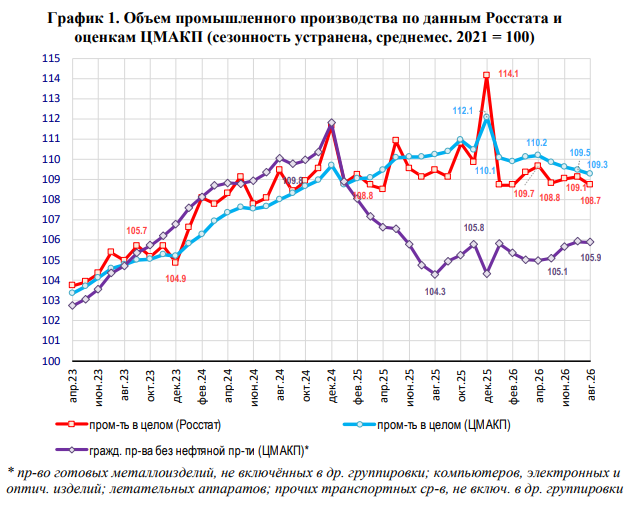
red line: Total industry (Rosstat)
blue line: Total industry (CMASF)
purple line: Civil industrial sectors excluding the oil industry (CMASF)*
* Production of metal products not included in other groups; computers, electronic, and optical products; aircraft; other vehicles not included in other groups
CMASF: Industrial Production in August, September 29, 2026
Growth in household consumption is slowing significantly
The Russian Ministry of Economic Development calculates an indicator for total real household consumption based on Rosstat data on the development of real sales in retail, services, and the food service industry. In June 2026, it was still 6 percent higher than in the previous year. In July, growth slowed to 4.6%. In August, at 2.9%, it was only about half as high as in June.
However, from January through August 2026, year-over-year growth for this “consumer activity” indicator still reached 4.5 percent. Kommersant notes that, according to the Ministry of Economic Development’s new forecast, private consumption will rise by 4.1 percent in 2026 as a whole (significantly more than the 1.2 percent the ministry had projected in its May forecast).
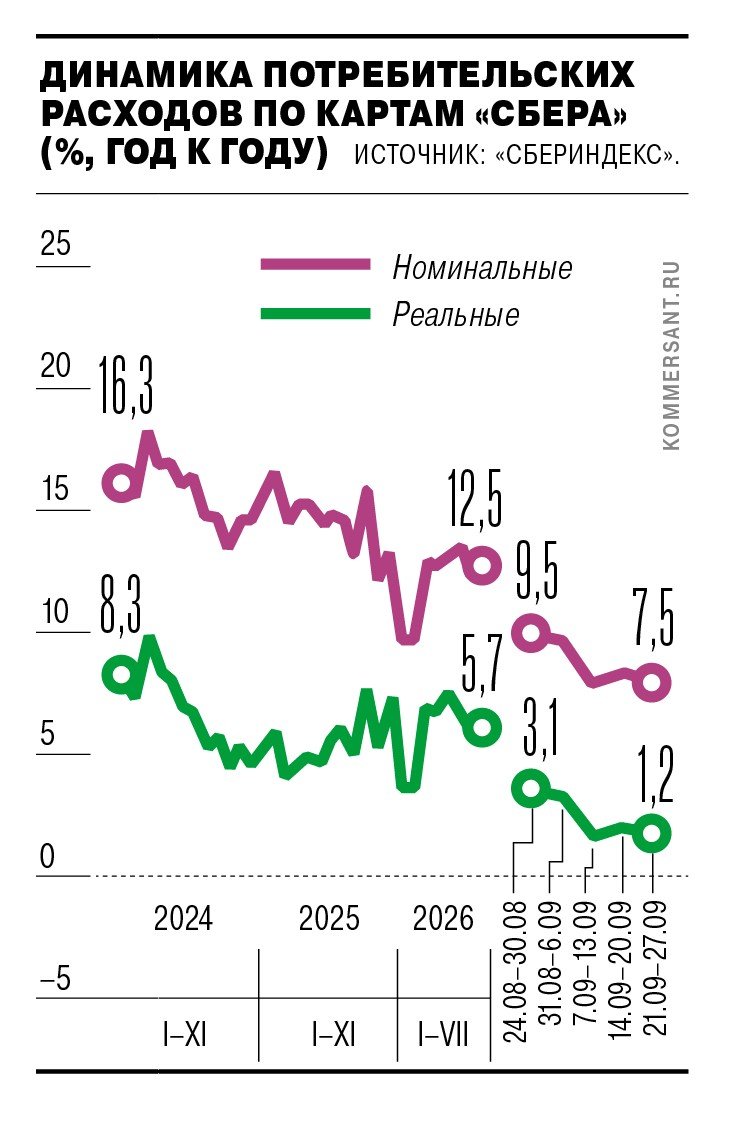
However, private consumption continued to weaken over the course of September. This is shown by data from the SberIndex: From September 21 to 27, real consumer spending was only 1.2% above the previous year’s level, compared with 1.4% the previous week and 5.7% in August 2026 (see the following Kommersant chart).
Trend in Consumer Spending According to the SberIndex
: Year-over-Year Changes in Percent
Purple line: nominal consumer spending
; green line: real, inflation-adjusted consumer spending
Kommersant; Artem Chugunov: Private consumption continues to weaken, Oct. 1, 26
Raiffeisenbank: An Unusually Sharp Decline Following Stable Growth
Stanislaw Muraschow, chief economist at Russia’s Raiffeisenbank, also points out that consumer spending on a wide range of products fell in August for the first time in a long while. He writes:
“For example, seasonally adjusted sales in the food retail sector fell by 0.9% compared to the previous month (previously, growth had been recorded since February 2026).
The non-food sector contracted for the second month in a row, but this time the trend is driven not by automobile sales but by other goods (particularly clothing and shoes, electronics, household goods, pharmaceuticals, etc.).”
Raiffeisenbank has published the following chart to illustrate this. The green line shows how, according to the bank’s estimates, total retail sales have developed on a seasonally adjusted basis compared to the previous month. This overall trend is compared with the trend in retail sales excluding the automotive sector (black line).
Consumer demand has fallen,
though not due to a decline in car sales
Seasonally adjusted sales; month-over-month in %
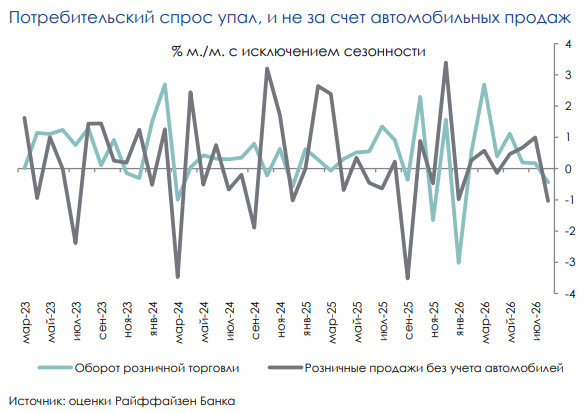
green line: total retail sales; black line: retail sales excluding the automotive sector
Raiffeisenbank; Stanislaw Muraschow:
Consumer Spending: A Temporary Slump or the Beginning of a Soft Landing? Oct. 2, 26
Muraschow considers such a sharp month-over-month decline in consumer spending as seen in August to be unusual following a period of stable growth. He notes that it is reminiscent of the situation in late 2025/early 2026, when consumer spending fluctuated extremely sharply. He therefore considers it premature to speak of a “soft landing” for consumer spending. This would require both a reduction in consumer lending and a slowdown in wage growth. However, the likelihood of a “soft landing” remains high.
Real wages continued to rise strongly amid persistently low unemployment
According to Rosstat, real wages in July 2026 were still up 3.3% year-over-year, slightly weaker than in June (+3.4%). In the first seven months, real wages were 6% higher than in the previous year. In nominal terms, they rose by 12.2%.
The unemployment rate stood at 2.2% in August, remaining at the same level as for the entire period from January through August 2026.
Denis Popov: Moderate GDP growth will continue to be driven by consumption in 2026
In his analysis of the August data, PSB Bank’s chief analyst, Denis Popov, notes that while the slowdown in real wage growth is likely to continue for the remainder of 2026 given the persistently rising inflation rate, However, private consumption will remain the main driver of growth. The Russian economy is expected to post “moderate but positive growth” by the end of the year. The current acceleration in economic growth (an increase in the annual growth rate from 0.6% in July to 0.8% in August) allows the central bank to delay further cuts in the key interest rate.
Popov summarizes the August economic data as follows:
The slight acceleration in overall economic output to 0.8% in August was unexpected given the decline in industrial production (the largest sector of the economy), particularly due to the relatively weak performance in wholesale and retail trade, two sectors that also account for a significant share of GDP.
Wholesale sales declined in August for the first time since the first quarter (-0.5% year-over-year compared with +0.4% in July).
Annual growth in retail sales slowed significantly (+3.3% year-over-year in August compared with +5.3% in July).
The drivers of GDP growth in August were sectors that had recorded relatively weak growth since the beginning of the year: the construction industry (+2.7%), agriculture (+6.6%), and freight transport (+4.2%). It is still too early to draw conclusions about the sustainability of this growth. Given this year’s good harvest, only agriculture is likely to be able to continue its positive trend. However, given the deteriorating export prospects for agricultural products, an improvement in the financial situation in this sector is unlikely.
Russian Ministry of Economic Development: Growth of real gross domestic product and production in key sectors; year-over-year changes in percent
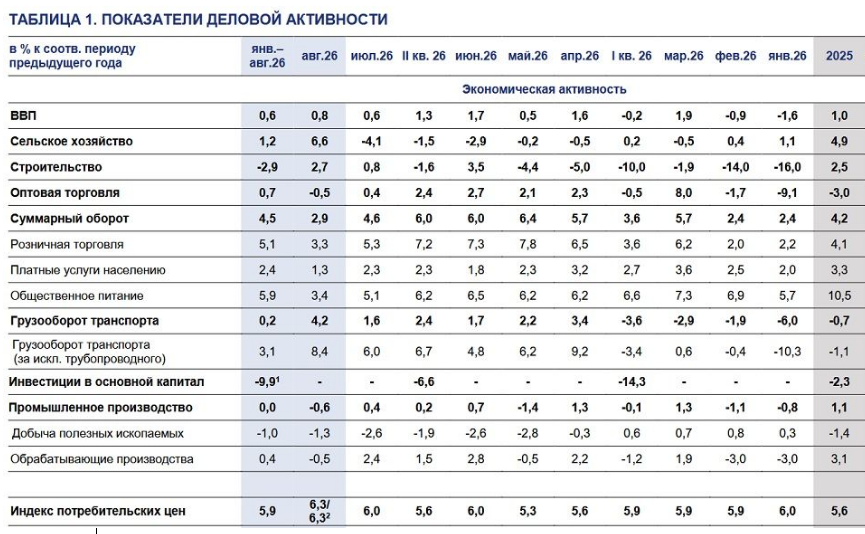
Finam.ru: According to data from the Ministry of Economic Development, Russian GDP grew by 0.8% in August and by 0.6% from January through August; excerpt from the table; September 30, 26
Recommended Reading
German-Russian Chamber of Foreign Trade
- GDP Forecast: Russian Economy to End the Year in Stagnation; Oct. 2, 26
- 2027 Budget: Austerity Measures and New Taxes; September 29, 26
- State vs. Economy: External Administration and Nationalization of Assets; September 21, 26
- Eastern Economic Forum 2026: Quotes and Results, 09/08/26
Podcasts, Videos
- russland.RU: Schröder at Globus: A Good Connection as a Safety Net? Video on the former German chancellor joining the supervisory board of Hyperglobus, Oct. 3, 2026
- Tagesschau.de, Saarland: Gerhard Schröder Joins the Supervisory Board of Globus in Russia, October 2, 2026
- Michael Thumann, Eastern Europe correspondent for “Die Zeit,” in an interview with Zsolt Wilhelm on the “Der Standard” podcast: “Russia’s Plan to Shatter Europe”; YouTube video, Oct. 2, 26
Overall Economy; Economic Data for January through August 2026
- Vladimir Milov in a Direct TV channel video: Nabiullina is shocked by inflation! Factories remain unrepaired, and lines are exploding in the regions. Industry and the military-industrial complex have collapsed, and household budgets are bursting at the seams…; October 3, 2026
- Politkom.ru; Nikita Maslennikov: Budget and macroeconomic forecast for the new three-year period; October 2, 2026
- 1Prime.ru: Rosstat has published its first estimate of GDP for the second quarter of 2026. Rosstat: Russia’s GDP grew by 1.3% in the second quarter of 2026; Oct. 2, 2026
- Finam.ru: Novak Identified the Main Risks to the Russian Economy; Oct. 2, 2026
- russland.news: Putin at the Valdai Forum: New Rules, Old Leverage; with video; Oct. 3, 2026
- TASS; Alexander Temnov: Russia is overcoming all difficulties. Putin on the economic situation; Oct. 1, 2026
- Finam.ru: Putin warned against cooling down the Russian economy too much. According to the Russian president, the authorities have deliberately cooled the economy to bring inflation under control: October 1, 2026
- Deutsche Welle; Sergey Romaschenko: Putin: Ukraine’s attacks on oil refineries cost Russia 1% of GDP; October 1, 2026
- Meduza: By Putin’s own estimate, Ukrainian strikes on Russian refineries have cost Russia 1% of GDP. But he says stopping them isn’t worth halting attacks on Ukrainian vessels, Oct. 1, 2026
- News.de; Sarah Knauth: Putin Does Not Rule Out Nationalization of Western Assets. Kremlin leader Putin has placed the Russian operations of several Western companies under compulsory administration. He explains his intentions to international experts in Moscow; October 1, 2026
- Russia in Global Affairs: Valdai Club: Plenary Session of the 23rd Annual Meeting: LIVE: Responsibility for the Future: Limits of the Possible, or Limitless Possibilities? Video, Oct. 1, 2026
- en.kremlin.ru: Meeting of the Valdai Discussion Club. Vladimir Putin addressed the plenary session of the 23rd annual meeting of the Valdai Discussion Club. This year’s theme is “Responsibility for the Future: Limits of the Possible, or Limitless Possibilities?” October 1, 2026
- PSB Analytics, Denis Popov: According to data from the Ministry of Economic Development, real GDP growth accelerated to 0.8% year-over-year in August; October 1, 2026
- Kommersant; Artem Chugunov: Private consumption continues to weaken; 10/01/26
- Kommersant.ru: SberIndex: Annual consumption growth has slowed. According to data from the Ministry of Economic Development, Russian GDP grew by 0.6 percent in the first eight months; Oct. 1, 2026
- media-talk.ru: Wage growth is slowing: The picture according to Rosstat data; Oct. 1, 26
- media-talk.ru: GDP growth of 0.8% and a decline in industrial production: The economic picture for August, October 1, 2026
- Finmarket.ru: According to the Ministry of Economic Development, Russian GDP grew by 0.8 percent year-over-year in August and by 0.6 percent from January through August; September 30, 26
- Interfax.com: Russia’s GDP grows 0.8% year-on-year in August, 0.6% in the first eight months – Ministry of Economic Development, September 30, 2026
- Finam.ru: According to the Ministry of Economic Development, Russian GDP grew by 0.8% in August and by 0.6% from January through August; +table from the ministry, 09/30/26
- Expert.ru; Anna Bezrukova: The Ministry of Economic Development reported GDP growth of 0.8% for August, September 30, 26
- Finmarket.ru: Agricultural production in Russia rose by 6.6% in August and by 1.2% in the first eight months, September 30, 26
- Finam.ru: Real wages in Russia rose by 3.3% in July compared to the previous year; September 30, 26
- Finam.ru: The unemployment rate in Russia fell to 2.2% in August; 09/30/26; 09/30/26
- Finam.ru: Total corporate profits in Russia fell by 15.7% in the January–July period; 09/30/26
- Finam.ru: Russia’s manufacturing Purchasing Managers’ Index rose to 49.8 points in September; 09/30/26
- CMASF: Industrial production in August, September 29, 2026
- UA NEWS: In 2026, Russian industry will enter a recession for the first time in six years, September 25, 2026
- Raiffeisenbank; Fokus-Pocus: Industrial production plunged below zero again, September 24, 2026
- realnoevremya.ru: Rosstat: Industrial production in Russia fell by 0.6% in August; September 23, 2026
- Finmarket.ru: Industrial production in Russia fell by 0.6% in August; September 23, 2026
- VEB Institute: Global Economy and Markets, September 25, 2026
- BOFIT Weekly Review 39/2026: Russia’s struggles with weak economic trends and rising inflationary pressure, September 25, 2026
Economic Forecasts
- CMASF: Base-case macroeconomic forecast for 2026–2029, October 2, 2026
- Tsargrad.Pro: The government expects GDP growth of 1.4% for 2027. However, this is not yet enough to bring the economy up to the global average; September 25, 2026
- Reuters; Darya Korsunskaya: Russia plans a series of tax hikes in 2027–29 to fund military spending, September 24, 2026
- Vedomosti; Ksenia Kotchenko: The Ministry of Economic Development raised its GDP growth forecast for 2026 and kept it unchanged for the next three years. The inflation estimate was also significantly increased due to the fuel factor; September 24, 2026
- Kommersant: The Ministry of Economic Development has presented a draft macroeconomic forecast for the period 2027–2029; September 24, 2026
- Production and Inflation Forecasts from the Ministry of Economic Development
- Finmarket.ru: The Ministry of Economic Development has raised its inflation and GDP growth forecasts for this year; 09/24/26
- Interfax.ru: The Ministry of Economic Development has raised its inflation forecast for 2026 from 5.2% to 6.8%; September 24, 2026
- Interfax.ru: The Ministry of Economic Development forecasts a 0.2% decline in industrial production for 2026; 09/24/26
- Interfax.ru: The estimate for gas production in Russia was reduced to 683 billion cubic meters for 2026 and to 696 billion cubic meters for 2027; September 24, 2026
- Interfax.ru: The forecast for retail growth in Russia in 2026 has been raised from 0.8% to 4.6%; Sept. 24, 2026
- Interfax.ru: The Ministry of Economic Development has lowered its forecast for the decline in investment in Russia in 2026 to 5.4%; 09/24/26
- Foreign Economic Forecasts: Exchange Rate; Foreign Trade, Energy Exports
- Interfax.ru: The average annual dollar exchange rate will rise from 79.5 rubles in 2026 to 96 rubles in 2029; Sept. 24, 2026
- Interfax.ru: The Ministry of Economic Development has lowered its forecast for Russia’s foreign trade balance in 2026 to $120.8 billion; Sept. 24, 2026
- Interfax.ru: The forecast for Russia’s oil exports in 2026 has been raised by 7.5 million metric tons to 244.7 million metric tons; 09/24/26
- Interfax.ru: The estimate for Russia’s petroleum product exports in 2026 has been reduced by 24 million metric tons to 98.5 million metric tons; September 24, 2026
- Interfax.ru: The estimate for Russia’s pipeline gas exports in 2026 has been raised to 117.5 billion cubic meters; September 24, 2026
- Interfax.ru: The Ministry of Economic Development has lowered its forecast for Russian LNG exports in 2026 to 35 million metric tons; September 24, 2026
- Interfax.ru: Reshetnikov discussed scenarios for forecasting GDP growth; September 24, 2026
- Russian Government: Government meeting on September 24, 2026; Opening remarks by Prime Minister Mikhail Mishustin; Report by Minister of Economic Development Maxim Reshetnikov on the socioeconomic development forecast for 2027 and the planning period of 2028 and 2029; Report by Finance Minister Anton Siluanov on the draft federal law “On the Federal Budget for 2027 and for the planning period of 2028 and 2029,” September 24, 2026
Fiscal policy; national budget (Interfax reports)
- t-online: War budget planned. This is how Putin intends to finance the war in Ukraine in 2027, Oct. 4, 26
- The Moscow Times: Here’s How Russia Plans to Pay for the War in Ukraine in 2027, October 2, 2026
- Bond Guide; The Bell; Julia Starostina: The War Is Eating Away at Russia’s Budget; October 3, 2026
- Finam.ru; Olga Belenkaya: 2027–29 Budget—Resources to Be Focused on Priorities, October 2, 2026
- Politkom.ru; Nikita Maslennikov: Budget and Macroeconomic Forecast for the New Three-Year Period; October 2, 2026
- Frankfurter Rundschau; Patrick Freiwah: Russia’s Economy Stumbles: Putin Takes Precarious Steps to Pay for the War in Ukraine, Oct. 2, 2026
- Frankfurter Rundschau; Felix Busjaeger: Constant drone fire hits Russia’s economy—but Moscow’s reserves will last another two years; Oct. 2, 2026
- bne Intellinews; Ben Aris: Russia’s war financing could run short by early 2028, KSE Institute says. Oct. 1, 2026
- Interfax: Russian government submits three-year draft budget to the State Duma, Oct. 1, 2026
- Handelsblatt+; Carsten Volkery: How Putin Plans to Finance the War in Ukraine Next Year. The costs of the war against Ukraine continue to rise, as the new Russian budget shows. Now President Vladimir Putin wants to raise taxes; 10/01/26
- Focus; Ansgar Graw: Record budget for Putin’s military. Anyone betting on collapse doesn’t understand Putin’s Russia; Oct. 1, 2026
- Finam.ru; Egor Susin, author of the Telegram channel TruEcon: The final figures for the budget deficit in 2026 are slightly higher than expected; Oct. 1, 2026
- Finam.ru: Russian authorities expect oil and gas revenues to decline from 3.3% of GDP in 2026 to 2.7% of GDP in 2029; Oct. 1, 2
- Finam.ru: The government has submitted a draft federal budget to the State Duma with a deficit of 5.5 trillion rubles in 2027; Sept. 30, 26
- German-Russian Chamber of Foreign Trade: 2027 Budget: Austerity Measures and New Taxes; September 29, 2026
- Forbes.ru: Dmitry Prokofiev, economist and head of external communications at NEFT Research: Money-making: Why Russia’s 2027 budget will include tax increases; September 29, 2026
- bne Intellinews, Ben Aris: Russia’s 2027 budget plans a RUB5.5tn deficit as the economy stalls, September 26, 2026
- Fr.de; Stefan Scholl: Moscow’s military spending could push the deficit to 3.3 percent of GDP, September 25, 2026
- RBC.ru: Mishustin: Domestic demand will be the main driver of Russian GDP growth; 09/24/26
- BR24; Peter Jungblut: “Are You Ready?”: Putin Raises Taxes After the Election. No sooner are the Russian parliamentary elections over than massive tax hikes are on the horizon; September 25, 2026
- Dmitry Polevoy: The Russian Ministry of Finance has submitted a budget package to the Russian government for review. So what does the budget look like? September 24, 2026
- The Moscow Times, Russian Service: The government has announced new tax hikes to finance Putin’s military budget; September 24, 2026
- Finam.ru: Russia’s budget deficit will amount to about 2% of GDP annually over the next three years. Priorities include social obligations, defense, support for the military, and technological leadership; September 24, 2026
Monetary Policy, Inflation (Interfax Reports)
- Raiffeisenbank FokusPocus: Core inflation has accelerated, October 1, 26
- Interfax.ru: At its October meeting to set the interest rate, the Central Bank of Russia will consider more than just the budget factor; Alexei Zabotkin on the sidelines of the Alfa Summit, October 1, 2026
- Finmarket.ru: Starting October 1, housing and energy rates in Russia will rise by an average of 9.9%; October 1, 2026
- Bank of Russia: Monetary Policy Guidelines for 2027–2029; September 30, 2026
- Finmarket.ru: Russians are concerned about food prices; Russian Central Bank report “Inflation Expectations and Consumer Sentiment”; September 30, 26
- Bank of Russia: Inflation Expectations Rise in September; September 29, 2026
- Merkur.de; Julian Mayr: Price surge hits Russia hard after the Duma election: Authorities advise stockpiling, September 28, 2026
- t-online; Ellen Ivits: Price surge—Russians urged to stock up; September 28, 26
- Bank of Russia: Summary of the Key Rate Discussion released; PDF; September 23, 2026
Energy Sector, Fuel Supply
- Deutsche Welle; Sergej Romaschenko: Putin: Ukraine’s Attacks on Oil Refineries Cost Russia 1% of GDP, October 1, 26
- Nashaniva.com: Oil and Gas Prices Peak Again: How the Middle East Conflict Benefits Moscow and What This Means for Belarus, September 25, 26
- dpa-AFX: Oil Prices Extend Gains Significantly – Brent Rises Above $107, September 24, 2026
- Global Banking & Finance Review: Russia Cuts Natural Gas Output and Export Forecasts, September 23, 26
Foreign Trade, Sanctions
- FOCUS online; Lars-Eric Nievelstein: Russia’s Economy Breaks Two Negative Records. Ukraine Continues to Attack Russian Ports. That’s Why Russia’s Exports Have Plummeted; October 4, 26
- Telepolis; Franziska Lindner: Russia Takes Control of Metro: Western Companies Under Pressure, October 1, 2026
- Market Screener, Reuters: Putin: Western companies could get their Russian assets back if the situation develops favorably; October 1, 2026
- News.de; Sarah Knauth: Putin Does Not Rule Out Nationalization of Western Assets. Kremlin leader Putin has placed the Russian operations of several Western companies under compulsory administration. He explained his intentions to international experts in Moscow; October 1, 2026
- InoSMI.ru: Following the shutdown of Nord Stream and the EU’s rejection, Russia is scaling back its gas production plans; 09/29/26; Original article: Berliner Zeitung+; Lyudmila Kotlyarova:[]{#anchor} Following the Nord Stream shutdown and the EU’s withdrawal: Russia scales back its gas production plans; 09/24/26
- Russland.capital: Metro in Russia: The CEO stays, control changes hands. The Russian subsidiaries of the German wholesale group Metro are being placed under state-ordered “temporary administration.” A company founded just this September by the former head of Metro’s Russian operations, Johannes Tholey, is set to take over; September 29, 2026
- Deutschlandfunk interview by Jessica Sturmberg with Vasily Astrov: What does Metro’s forced administration mean? September 29, 2026
- BR24: Putin places German retail giant Metro under court-ordered administration, 09/28/26
- RT.de: Receivership of Russian Subsidiaries of European Corporations—Why Now? 09/22/26
Political Context; BR24: Russia
- russland.news: Putin at the Valdai Forum: New Rules, Old Leverage; with video; October 3, 2026
- Russia in Global Affairs: Valdai Club: Plenary Session of the 23rd Annual Meeting: LIVE: Responsibility for the Future: Limits of the Possible, or Limitless Possibilities? Video, October 1, 26
- en.kremlin.ru: Meeting of the Valdai Discussion Club. Vladimir Putin addressed the plenary session of the 23rd annual meeting of the Valdai Discussion Club. This year’s theme is “Responsibility for the Future: Limits of the Possible, or Limitless Possibilities?” October 1, 26