Will Russia's Economic Recovery Come as Early as 2027? Controversial Forecasts
Author: Klaus Dormann
The Russian government, nearly all international economic organizations, and leading research institutes have now published their “fall forecasts” for the Russian economy. There is broad consensus that the Russian economy will grow by only 0.5 to 1 percent in 2026.
However, views on next year’s development vary significantly. The most prominent international economic organizations are in broad agreement that there will be no “economic recovery” in Russia: The growth forecasts from the OECD, EBRD, World Bank, and IMF for 2027 range from just 0.6% to 0.9%. The Russian government, on the other hand, expects its economic growth to more than double, rising from 0.6% to 1.4%.
The IMF’s Position: “Prophet on the right, prophet on the left, the world’s child in the middle”
The International Monetary Fund has positioned itself pretty much right in the middle of the current estimates for this year’s growth in the Russian economy. In its “World Economic Outlook” published last week, it forecasts that Russia’s gross domestic product will rise by 0.9% in 2026, slightly weaker than in 2025 (1%). Next year, too, Russia’s gross domestic product is expected to grow by only 0.9%.
This means that, on the one hand, the IMF is more optimistic about growth in 2026 than the Russian government and a large portion of analysts. The government, after all, expects GDP to rise by only 0.6% this year. Furthermore, the 32 analysts surveyed by the Russian Central Bank from October 9 to 13 also anticipate, on average, only this modest growth.
Regarding next year’s outlook, however, the IMF is relatively pessimistic with its forecast of another 0.9% growth. Participants in the Central Bank’s latest analyst survey, on average, expect the growth rate to double to 1.2% by 2027. The Russian government expects economic output to rise by 1.4% next year. And in its July medium-term forecast—which will be updated on Friday in conjunction with the key interest rate decision—the Russian Central Bank has even projected a growth range of 1.5% to 2.5% for 2027.
The IMF, World Bank, OECD, and EBRD do not believe in Russia’s “2027 recovery”
With its slightly lowered forecasts of 0.9% each, the IMF has moved closer to the World Bank’s position. In early October, the World Bank stood by its forecasts that the Russian economy will grow by 0.8% this year and 0.7% next year. Even slightly lower growth forecasts for the Russian economy were published back in September by the Paris-based OECD (2026: +0.5%, 2027: +0.6%) and the London-based European Bank for Reconstruction and Development (EBRD) (2026: +0.5%, 2027: +0.7%). The best-known international economic organizations based “in the West” are thus in agreement: the “upturn” in growth expected by the Russian government will not materialize in 2027.
However, in their “Joint Economic Assessment,” German economic research institutes were not quite as skeptical in their assessment of the Russian economy’s outlook: The institutes expect Russia’s growth rate to double from 0.5% in 2026 to 1% next year.
And unlike the London-based European Bank for Reconstruction and Development (EBRD), the “Eurasian Fund for Stabilization and Development,” based in Astana, Kazakhstan, expects a growth recovery in 2027 that is only slightly weaker (+1.3%) than that projected by the Russian government (+1.4%).
GDP Forecasts for Russia, 2025–2027
: Year-over-Year Change in Real Gross Domestic Product (in Percent)
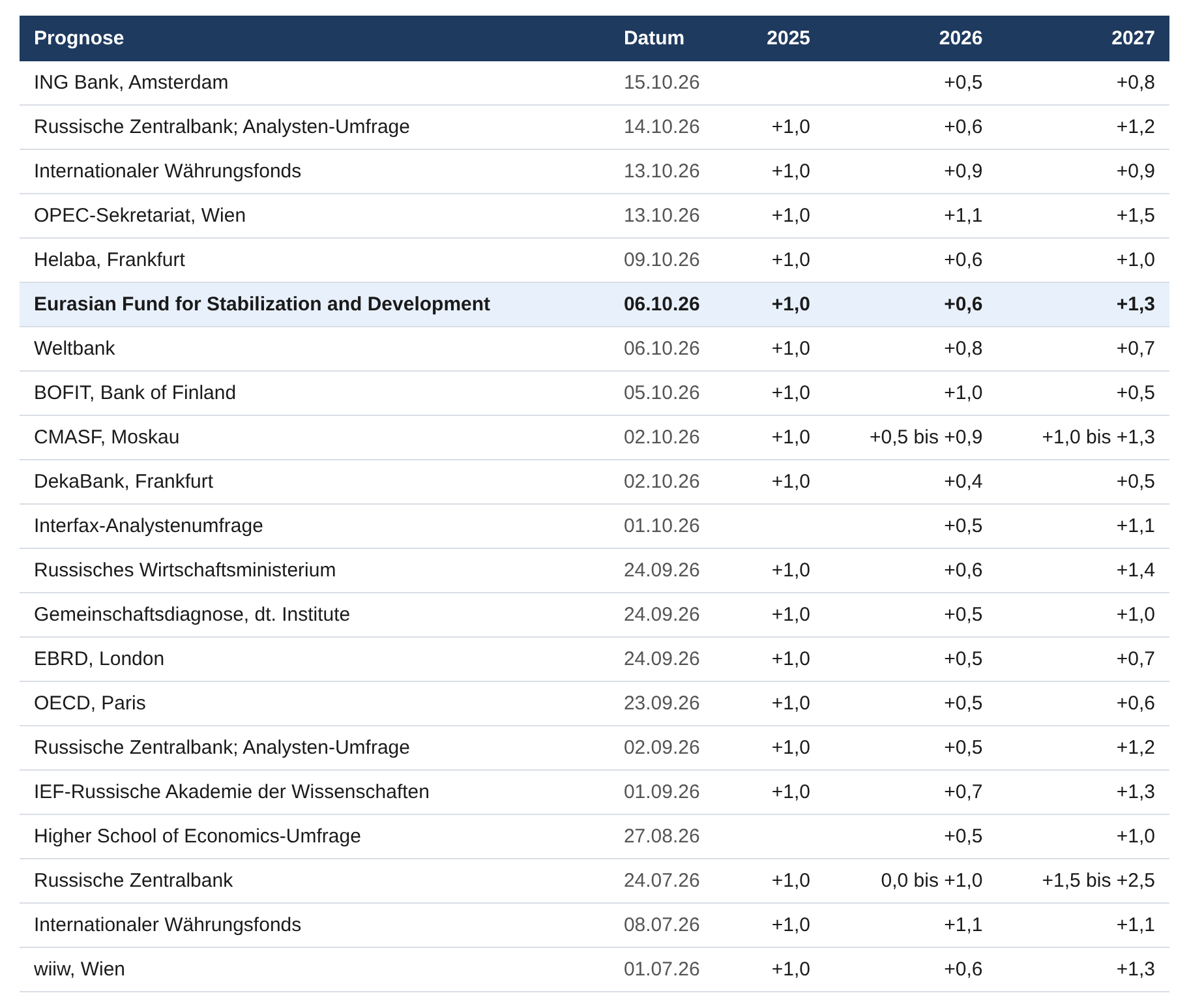
This week, the “Vienna Institute for International Economic Comparisons” will update its forecast. In early July, it still assumed—much like the Russian government—that Russia’s growth would pick up from 0.6% to 1.3% in 2027 (Country Overview).
Russia’s weak growth is becoming more pronounced in a global comparison
According to the IMF’s assessment, global economic growth will also slow somewhat in 2026. At 3.1%, however, it is expected to be about three times as high as in Russia (0.9%). The Russian economy lags even further behind this year’s 3.7% growth rate for the “Emerging Market and Developing Economies” group. According to the IMF forecast, Russia’s growth gap will widen even further next year: Russia’s growth will stagnate at 0.9% in 2027, while global economic growth accelerates.
IMF Growth Forecasts for the Global Economy
: Real GDP, Year-over-Year Change in Percent
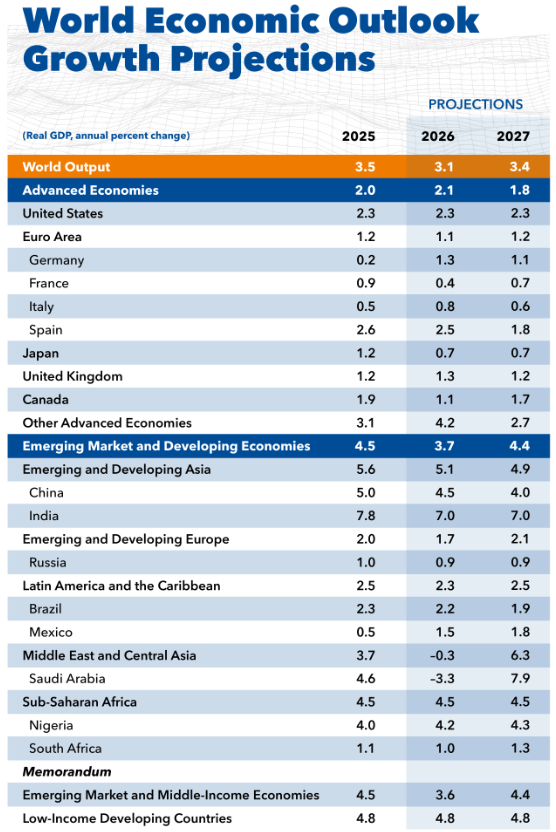
International Monetary Fund (IMF): World Economic Outlook, October 13, 2026
IMF Forecasts on Inflation, Current Account, and the Labor Market in Russia
In the “World Economic Outlook,” the IMF does not elaborate further on its growth forecasts for Russia. It notes that rising commodity prices have supported growth in the Russian economy. At the same time, however, Russia’s exports of diesel fuel and other petroleum products have fallen sharply due to damage caused by attacks on Russian oil infrastructure.
The IMF’s view on inflation trends in Russia is similar to that of the Central Bank. According to the IMF’s assessment, the year-over-year increase in consumer prices will decline from 8.7% in 2025 to 6.1% this year (Central Bank forecast: 5.9 to 6.2%). In 2027, the annual average inflation rate is expected to fall to 4.8% (Central Bank forecast: 4.3 to 5.2%).
According to the IMF, Russia’s current account surplus is expected to more than double this year, reaching 3.8% of gross domestic product (2025: 1.5% of GDP). In 2027, Russia’s current account surplus is projected to reach 3.2% of GDP.
According to the IMF, the unemployment rate is expected to remain at the record low of 2.2% reached in 2025 through 2026. It is not until 2027 that the labor market will become less tight, with the unemployment rate rising to 2.4%.
Other “successor states of the Soviet Union” are growing much more strongly
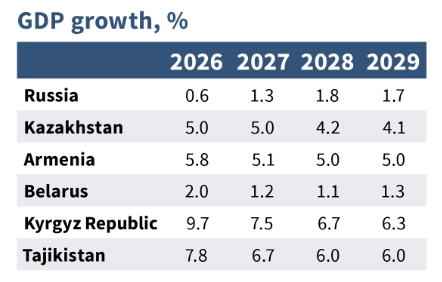
In its semiannual “Regional Economic Outlook” released on October 6, the “Eurasian Fund for Stabilization and Development” (EFSD) compared the trend in aggregate economic output in Russia with that in Kazakhstan, Armenia, Belarus, Kyrgyzstan, and Tajikistan. While growth in Russia slowed to 1% in 2025 and is expected to reach only 0.6% in 2026 (blue line), growth in the other countries of the region accelerated to 5.8% last year. According to the EFSD’s estimates, it will decline to 4.8% this year.
Real Gross Domestic Product
: Year-over-Year Change in Percent
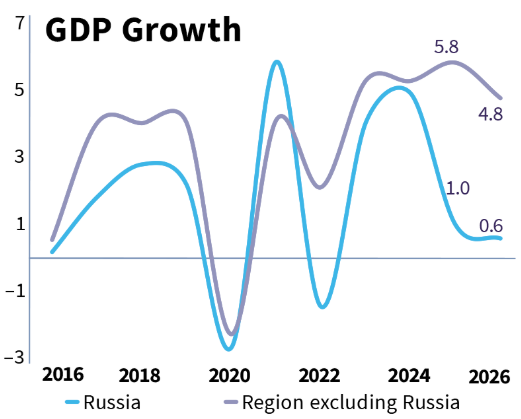
Eurasian Fund for Stabilization and Development: Regional Economic Outlook, Oct. 6, 26
Commentary by Sergei Ulatov, Chief Economist at the EFSD:
“One of the biggest surprises of 2026 was how widely the region’s economies diverged. Russia has seen a significant slowdown in growth, while most other countries, supported by domestic demand, continue to grow strongly.”
For 2027, however, the EFSD—like the Russian government—expects Russia’s growth to roughly double. The economic outlook for Russia is summarized as follows:
“GDP growth will slow to 0.6 percent in 2026. Economic activity recovered in the second quarter, but the economy continues to be weighed down by high financing costs, supply bottlenecks, and a temporary decline in oil refining output. As these factors subside, growth is expected to gradually return to its potential, reaching 1.3 percent in 2027 and approximately 1.7 to 1.8 percent in both 2028 and 2029. Inflation at the end of 2026 is estimated at 6.2 percent, with a return to the 4 percent target expected in 2028.”
Economic Growth in EFSD Countries (in Percent)
Eurasian Fund for Stabilization and Development: Regional Economic Outlook, Oct. 6, 26
IEF-RAS: The GDP forecast for 2026 stabilizes at 0.6 to 0.7%
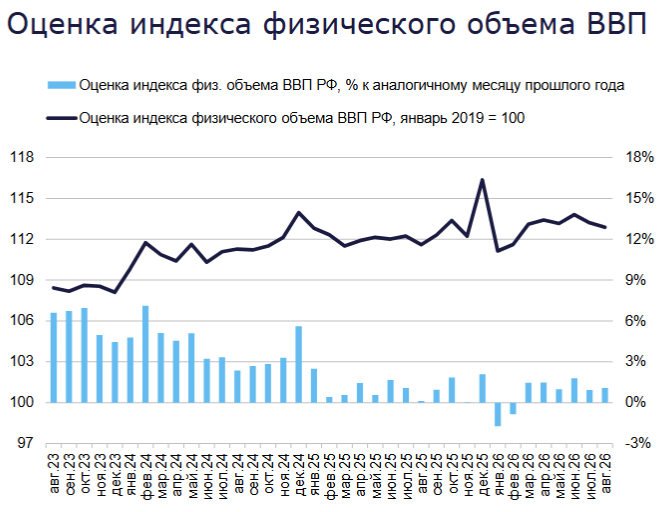
In addition to its quarterly economic forecasts, the Institute for Economic Forecasting of the Russian Academy of Sciences (IEF-RAS) also publishes monthly “short-term analyses” with estimates of GDP trends. Based on data as of early October, the IEF now estimates Russia’s GDP growth for 2026 at +0.7%. According to the institute, the growth forecast for 2026 has stabilized at 0.7 to 0.8% over the past three months.
The institute calculates index values for the seasonally adjusted trend in real gross domestic product (black line in the figure below). According to the IEF, this index has declined month-over-month in the last two months for which data is available. In July, aggregate economic output fell by 0.5% compared to June, and in August, it fell by 0.3% compared to July. However, according to the IEF, real GDP in August 2026 rose by 1.1% compared to August 2025 (right blue bar).
Monthly estimate of the real gross domestic product
index: black line—estimate of the real GDP index, January 2019 = 100
; blue bars—change in the real GDP index compared to the same month of the previous year, in %
Institute for Economic Forecasting of the Russian Academy of Sciences (IEF-RAS): Short-Term Analysis of GDP Trends, Oct. 12, 2026
Central Bank: Growth in the third quarter was “moderate”
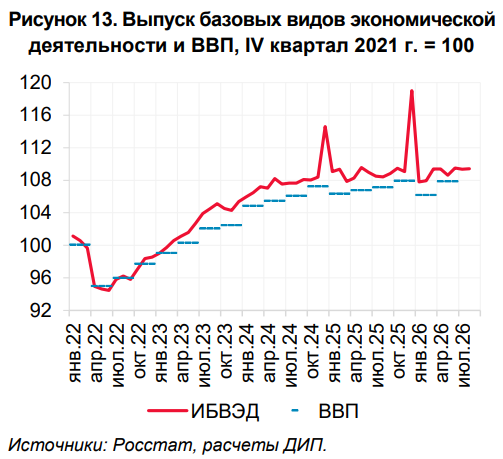
The Russian Central Bank paints a similar picture of macroeconomic output trends in its report “Talking Trends.” The red line in the Central Bank’s chart below shows the monthly trend in output in the so-called “core sectors” of the Russian economy through August. Interfax reported on the August production figures for these sectors (agriculture, industry, construction, freight transportation, retail, and wholesale). The Central Bank uses trends in the “core sectors” as an indicator of overall economic performance.
The Central Bank’s chart compares the trends in the “core sectors” with the quarterly trends in output for the overall economy, namely real gross domestic product (blue lines). In the second quarter of 2026, gross domestic product rose by 1.3 percent compared to the same quarter of the previous year, according to Rosstat, after falling 0.2 percent in the first quarter compared to a year earlier (TradingEconomics).
Output of Key Economic Sectors and GDP
, 4th Quarter 2021 = 100
Bank of Russia: Talking Trends, Oct. 14, 2026
The central bank estimates that, on a seasonally adjusted basis, output in the core sectors of the economy in July and August 2026 was 0.2% higher than in the second quarter of 2026. Economic data for September will not be available until late October. However, the Central Bank notes that business surveys suggest that business activity continued to “rise moderately” toward the end of the third quarter.
Impact of the War on Production Trends
In “Talking Trends,” the central bank also addresses the consequences of Ukrainian attacks on Russian production and infrastructure facilities (Interfax):
“A significant portion of the slowdown in growth in the third quarter was attributable to a temporary decline in the economy’s production potential. The slowdown in domestic demand was less pronounced than the slowdown in overall economic growth. As production capacity recovers, growth rates will rise again,” the Central Bank stated.
The Central Bank also noted:
“The decline in production (a supply shock) primarily affected intermediate goods sectors, particularly oil refineries. The decline in fuel production had an indirect negative impact on the performance of the extraction, transportation, and wholesale sectors. At the same time, the capital goods sectors continued to experience robust growth, partly thanks to public contracts.
In recent months, increased activity in the construction and transportation sectors—driven by the repair and protection of infrastructure facilities as well as the partial rerouting of export shipments via longer logistics chains—provided additional momentum for the economy.”
Central Bank Survey: Slightly Higher Growth with Significantly Higher Inflation
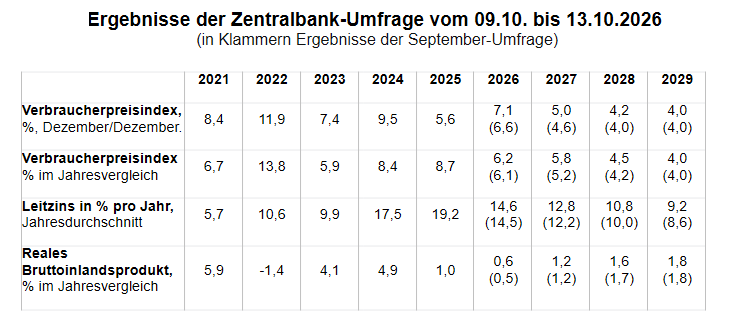
In the Central Bank’s analyst survey conducted from October 9 to 13, participants did not further lower their forecasts for the growth of the Russian economy. On average, their growth forecast for 2026 rose slightly from 0.5% to 0.6%. The analysts’ assessment thus now fully aligns with the government’s growth forecast of 0.6%.
At the same time, however, analysts now expect significantly higher inflation rates than previously. On average, they have raised their forecast for the rise in consumer prices at the end of 2026 by half a percentage point to 7.1% (September survey: 6.6%). By the end of 2027, they now expect the inflation rate to fall only to 5% (September survey: decline to 4.6%). According to the analysts’ assessment, the central bank’s inflation target of 4% will not be reached until the end of 2029—one year later than they had previously expected.
For 2026, analysts now expect an annual average inflation rate of 6.2% (September survey: 6.1%). In 2027, prices are expected to rise by another 5.8% compared to 2026 (September survey: 5.2%).
Bank of Russia: Macroeconomic Survey of the Bank of Russia, Oct. 14, 2026
Analysts now estimate the average annual policy rate for 2026 at 14.6%, slightly higher than in September (14.5%). Given the higher inflation forecast for 2027, they also expect a significantly higher key interest rate next year (12.8%) than in the September survey (12.2%).
The analysts’ average forecast for economic growth in 2027 remains at 1.2%. Unlike the IMF, World Bank, OECD, and EBRD, the participants in the central bank survey therefore expect the Russian economy’s growth to double next year.
Recommended Reading
German-Russian Chamber of Foreign Trade:
- IMF Lowers Russia Forecast, Oct. 16, 26
- Pause in Interest Rate Hikes Expected, Oct. 16, 26
- Higher inflation expected, Oct. 15, 26
- Europe’s Trade with Russia: From the Pipeline Business to the Gas Phase-Out, Analysis, Oct. 1, 26
Economic Forecasts
- Interfax: Analysts raise forecast for Russia’s GDP and inflation in 2026; raise estimate of neutral interest rate for the first time in a long period—CBR survey, October 14, 2026
- TASS: Analysts have raised their forecast for GDP growth in 2026 to 0.6%. According to a Central Bank survey, inflation expectations were raised from 6.6% to 7.1%; October 14, 2026
- Bank of Russia: Macroeconomic Survey of the Bank of Russia, Oct. 14, 2026
- russland.capital: Russia’s Economy: IMF Does Not Expect a Recovery in 2027 Either, Oct. 14, 2026
- Meduza: IMF lowers forecast for Russia’s economic growth, Oct. 13, 2026
- Interfax: IMF lowers Russia’s growth forecast for 2026–2027 by 0.2 percentage points to 0.9% per year, Oct. 13, 2026
- Finmarket.ru: The IMF symbolically raised its forecast for global economic growth. It lowered its July forecast for Russian economic growth in 2026 and 2027 by 0.2 percentage points to 0.9% annually; October 13, 2026
- International Monetary Fund (IMF): World Economic Outlook: Resilience Under Strain, Urgent Choices, October 2026; Press Briefing Transcript: World Economic Outlook, Annual Meetings 2026, October 13, 2026, Oct. 13, 2026
- OPEC Secretariat, Vienna: Monthly Oil Market Report, October 13, 2026
- Institute for Economic Forecasting of the Russian Academy of Sciences, IEF-RAS: Short-Term Analysis of GDP Trends, October 12, 2026
- World Bank: Country Report: Russian Federation, in: Macro Poverty Outlook; Europe and Central Asia Update; Press Release: Europe and Central Asia: Slower Growth Amid Global Headwinds, October 6, 2026
Overall Economy
- The Moscow Times: Russian Business Investment Stalls in Third Quarter as Profits Fall, Uncertainty Persists, October 15, 2026
- Politcom.ru; Nikita Maslennikov: AI Development Amid Heterogeneous Expectations, October 15, 2026
- Interfax: Economic Growth in Russia Continues in Q3 2026, but Slows Slightly Compared to Q2 – CBR Analysts, October 14, 2026
- University of Greifswald: Russia’s War Within: Consequences of the War in Ukraine for Russian Regions. A new study by the University of Greifswald shows how the war in Ukraine is transforming Russian society from within and why these regional consequences are crucial to determining how resilient Russia’s economy and state will remain in the long term; October 14, 2026
- Vedomosti; Ksenia Naumchik: The Central Bank expects GDP growth in 2026 to be slightly lower than in the previous year. Further growth depends largely on an increase in labor productivity; Oct. 13, 2026
- BOFIT, Bank of Finland: BOFIT Weekly Review 41/2026: Russia’s growth slows further, government finances remain in the red, Oct. 9, 2026
Monetary Policy, Inflation (Interfax Reports)
- Vedomosti; Ksenia Kotchenko: Vedomosti Consensus Forecast: Economists are almost unanimously expecting a pause in the central bank’s interest rate decision; Oct. 16, 2026
- Finam.ru; Alena Aleshina: Only one week left. What will the key interest rate be on October 23? Experts expect the Central Bank to continue its pause on interest rate hikes; October 16, 2026
- Finam.ru; Olga Belenkaya: Rising inflationary pressure is preventing the Central Bank from lowering its key interest rate. Preview of the Central Bank’s key interest rate decision; 10/16/26
- Bank of Russia: Inflation in Russia; 10/14/26
- Interfax: Slowing inflation in Russia to 4% by 2027 requires well-calibrated decisions on the future trajectory of the rate—CBR analysts; October 14, 2026
- Bank of Russia, News: Talking Trends: Moderate Growth Continues; Research and Forecasting Department Bulletin: “What Do the Trends Say?”; Full Report: “О чем говорят тренды”; Oct. 14, 26
- Interfax: CBR to factor higher-than-expected third-quarter inflation into October forecast – Zabotkin; Oct. 14, 2026
- Raiffeisenbank; Fokus-Pocus: September Inflation: Acceleration of sustained inflation already evident in the data; Oct. 10, 2026
Fiscal Policy; National Budget (Interfax Reports)
- FR.de; Patrick Freiwah: Despite Sanctions: Why Russia’s Oil and Gas Revenues Are Surging in October; October 17, 2026
- Focus online; Lars-Eric Nievelstein: Due to Global Market Shortages, Putin Is Again Earning More Money from Oil Sales; Oct. 16, 2026
- The Moscow Times: Russia’s Growing State Sector Nears Limit for Sustained Growth, Economist Warns; Report on an RBC interview with Alexander Isakov, head of Sberbank’s Center for Macroeconomic Research and chief economist at the state-owned development bank VEB.RF; October 16, 2026
- Finam.ru; Olga Belenkaya: The budget shows a second monthly surplus ahead of the costly fourth quarter. By the end of the year, the deficit could rise to 7.3 trillion rubles, which is nearly double the originally planned amount; Oct. 12, 26
Energy Sector, Fuel Supply, Infrastructure
- Vedomosti; Philip Ivanov: Novak stated that there are no problems with the sale of Russian oil. Many countries want to buy it given the imbalance on the global market; 10/18/26
- Vedomosti; Maxim Tsulanov: Novak’s key statements on refineries and U.S. diesel supplies. Russia is ready to increase shipments to Europe; 10/16/26
- Council on Foreign Relations; Mary Kate Godfrey: Trump’s Russian Diesel Deal, Explained. Trump announced a new diesel deal with Putin on October 9, to the surprise of many U.S. allies; 10/16/26
- taz; Mathias Brüggmann: Drones Targeting Data Centers. The drone attacks on the internet company Yandex have serious consequences for the Russian economy. Many aspects of daily life are restricted; 10/14/26
- Oilprice.com; Michael Kern: Novak Calls U.S. Diesel Deal a ‘Positive Signal’ for Russia’s Economy, October 14, 2026
- Business Recorder: Diesel deal opens the way for more Russia-U.S. cooperation, says Kremlin envoy, October 14, 2026
- The Bell: Trump Convinces Putin to Restart Diesel Exports, 10/14/26
- russland.capital: Russian Diesel for the Global Market: Moscow Gains Leeway, Energy Agreement Remains Open, 10/13/26
- Expert.ru; Stanislav Mitrachovich, leading expert at the National Energy Security Fund and senior researcher at the Financial University under the Government of the Russian Federation: Why Trump Eased Sanctions on Russian Diesel; October 12, 2026
- Tagesschau: Agreement with Putin. Trump Announces Russian Diesel Shipments; Oct. 10, 26
- 20 Minuten; Justin Arber, Benedikt Hollenstein; Deutsche Presse-Agentur: Diesel from Russia: Trump circumvents his own sanctions; October 9, 2026
- Inosmi.ru; Reuters: Trump said Russia would supply the U.S. and the global market with diesel fuel; October 9, 2026
- FR.de: Trump and Putin Plan Nord Stream Comeback – Kushner Is Already Negotiating with Moscow, Oct. 9, 2026
Foreign Trade, Sanctions; Tagesschau: Russia Sanctions
- The Moscow Times (Russian): Trump suggested that Europe should resume buying Russian gas as part of a “peace agreement” for Ukraine; 10/18/26
- Watson.ch; dpa: U.S.: Rubio Defends Suspension of New Sanctions Against Russia; Oct. 18, 2026
- The Business Times: Trump to take up to 60 days to assess economic impact of Russia sanctions: Rubio, Oct. 18, 2026
- Vedomosti; Elena Vostrikova: Trump ordered that some of the “Graham sanctions” against Russia not be enforced; Oct. 18, 2026
- Tagesschau: “National Interest.” Trump Suspends Planned Sanctions Against Russia; 10/17/26
- The Moscow Times; Reuters: Trump Signs Order Exempting Russia From New Sanctions Legislation, October 17, 2026
- Watson.ch: “Historic”: Moscow Welcomes Trump’s Tariff Suspension; Zelenskyy Criticizes Move, Oct. 17, 2026
- Raiffeisenbank; Financial Market Overview, Daily Focus: The balance of payments in August was not affected by the fuel export ban, October 16, 2026
- Der Pragmaticus; Bob Savic, sanctions and trade advisor at the London-based commercial law firm Fieldfisher LLP and head of geopolitical consulting at the Global Policy Institute, London: Why Sanctions Won’t Bring Russia to Its Knees; October 16, 2026
- CBC.ca; AP: Trump pauses sanctions package targeting the Russian economy. Citing U.S. national interest, the White House does not immediately explain the rationale; 10/16/26
- Tagesschau: Business in Russia. Kremlin takes control of more Western-owned companies; 10/16/26
- Wirtschaftswoche: Sanctions. Russia places assets of European companies under state control. Which companies are affected; 10/16/26
- Cash-online.de: The Kremlin has placed the Russian subsidiary of German packaging manufacturer Menshen under compulsory administration—the third decree of this kind since September, following those involving Nestlé and Metro; 10/16/26
- Vermögenszentrum.ch; VZ Analysis by Florian Estermann: The Russia Dilemma: Should Companies Stay or Leave? An Overview of the Different Strategies; 10/15/26
- russland.capital: Russia’s exports are growing: Raw materials dominate, Asia accounts for four-fifths. Russia’s exports of goods rose significantly in the first eight months of 2026; 10/14/26
- Merkur.de; Commentary by Oliver Stock: EU Sanctions Against Russia: Toughness Is Not Yet a Strategy, October 14, 2026
- ZDFheute; Felix Klauser, Moscow: State-imposed receivership in Russia. How Putin is increasingly cracking down on European companies; October 13, 2026
- Tagesschau; Tina Hassel, Brussels: EU Approves Largest Round of Sanctions Against Russia, Oct. 12, 2026
- Council of the EU, Press Release: EU Agrees to Largest-Ever Package of Sanctions Targeting Nearly 1,600 Individuals and Entities in Russia’s Military-Industrial Complex; October 12, 2026
Political Landscape; BR24: Russia
- Deutsche Welle; Christoph Hasselbach: Russia’s Threat to Germany: How Serious Is It? Experts Say Germany Has So Far Been Ill-Prepared for Russian Provocations; Oct. 17, 2026
- Tagesschau; Joachim Weber, expert on security policy at the University of Bonn, in an interview with Jessy Wellmer on Tagesthemen: The Nord Stream bombing: The trial and its political explosive potential. Was the attack on the Nord Stream pipeline ordered by the highest levels of the Ukrainian government? Could this trial have political repercussions? And how should Germany respond? Video, Oct. 14, 26
- Tagesschau24 Top Story: Trial Begins on Nord Stream Blast, Video, 12 min., Oct. 14, 2026
- Deutsche Welle News; Berlin Briefing: Former German Economy Minister Habeck: Russia Is Still the Biggest Threat. In a special edition of Berlin Briefing from the Warsaw Security Forum, Nina Haase and Alexandra von Nahmen speak with Robert Habeck about the threat from Russia, the strategic importance of the Arctic, and the resilience of European democracies; Video, Oct. 13, 26
- CNN; Matthew Chance: Trump’s diesel deal with Putin drives a wedge through the Western alliance, October 10, 2026
- ZDFheute News: The U.S. is getting diesel from Russia—what does this mean for Ukraine? Whose side is the U.S. on? And can the diesel deliveries actually lower prices? Sara Bildau discusses this with ZDF reporter Felix Klauser in Moscow and ZDF correspondent Isabelle Schaefers in Brussels. Also joining them is Klemens Fischer, professor of international relations and geopolitics; Video, Oct. 10, 26
The day's most important Russian economic stories. Free, in your inbox three times a week.
Mon, Wed, Fri. Double opt-in, no tracking, unsubscribe anytime. By subscribing you consent to the processing of your email address as described in our Privacy Policy.