Despite high interest rates, weak growth is picking up—according to the wiiw as well
Author: Klaus Dormann
As expected by nearly all analysts, the Russian Central Bank once again refrained from further lowering its key interest rate on Friday. It had already kept the key interest rate at 14% in September. In a press release accompanying its “Fall Forecast” published on Wednesday, the “Vienna Institute for International Economic Comparisons” (wiiw) states that the acceleration of inflation in Russia due to the “fuel crisis” prompted the central bank not to lower the key interest rate further. Commenting on the consequences, Vasily Astrov, a Russia expert at the wiiw, critically notes that the pause in monetary easing is, of course, detrimental to the recovery of the Russian economy. High interest rates would hamper economic activity.
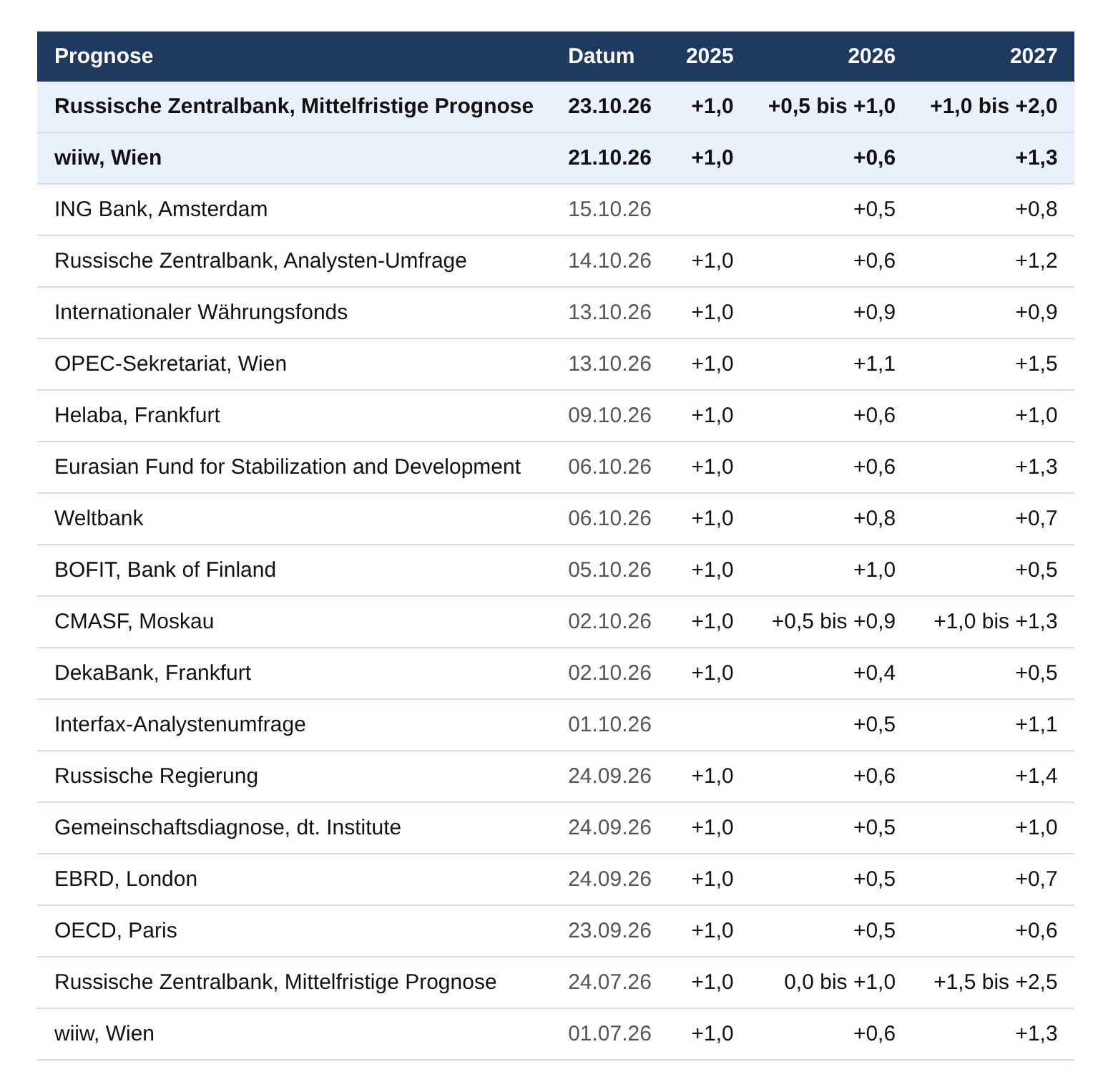
Despite the high key interest rates, however, the wiiw stands by its July forecast that while Russian economic growth will slow to 0.6% in 2026, it will accelerate to 1.3% next year. These wiiw forecasts are almost entirely in line with the Russian government’s growth projections (2026: 0.6%; 2027: 1.4%).
The government’s and the wiiw’s growth forecasts for 2026 and 2027 now also fall almost exactly in the middle of the growth ranges published by the Russian Central Bank on Friday in its updated “Medium-Term Forecast.” For 2026, the Central Bank now expects economic growth of between 0.5% and 1%. In 2027, it is expected to range between 1% and 2%.
In contrast, the most prominent international economic organizations agree that there will be no significant upturn in the Russian economy in 2027: The growth forecasts from the IMF, World Bank, OECD, and EBRD for next year range from just 0.6% (OECD) to 0.9% (IMF). The international economic organizations expect Russia’s growth in 2027 to stagnate at the very weak level reached in 2026.
GDP Forecasts for Russia, 2025–2027
: Year-over-Year Change in Real Gross Domestic Product (in Percent)
How the key interest rate has evolved over the long term
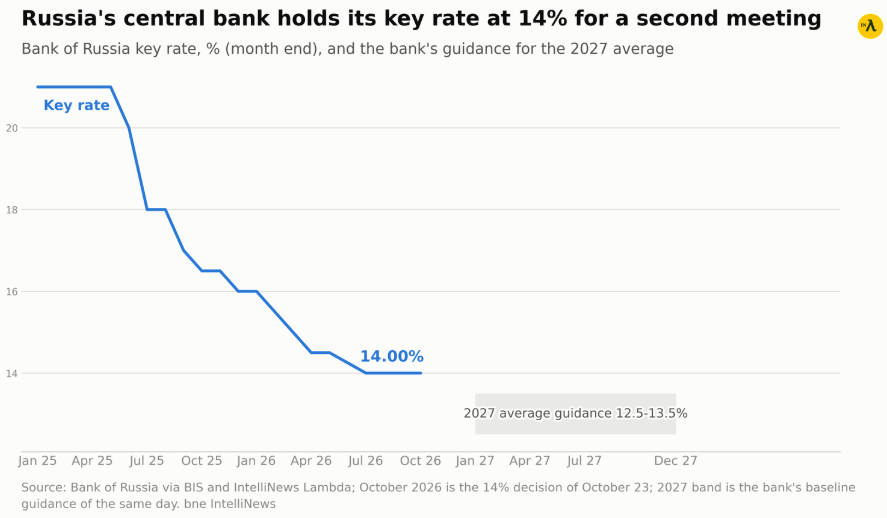
Since June 2025, the Central Bank has cut its key interest rate in ten consecutive steps from 21% to 14% in July. In its September policy decision, it refrained from further cuts for the first time. The following TASS chart shows that, at 14 percent per year, key interest rates remain above average when compared to long-term trends since 2018.
Russian Central Bank’s Key Interest Rate in Percent per Year
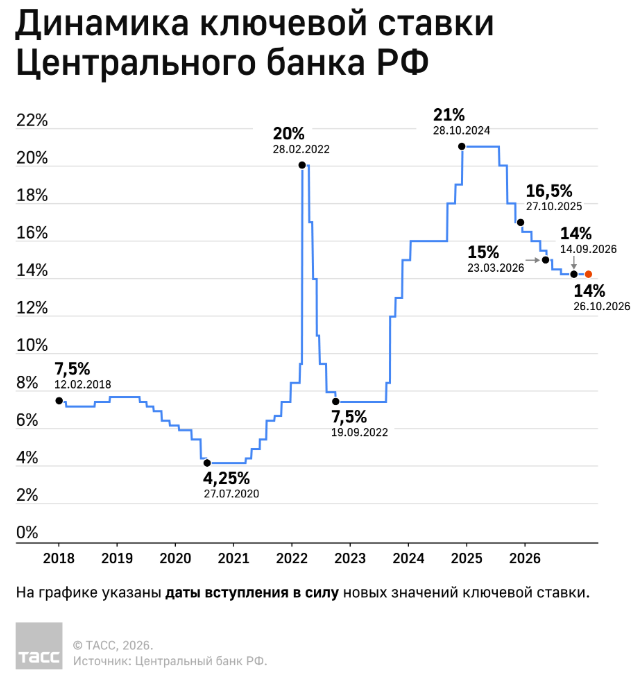
TASS: The Central Bank has narrowed its forecast for GDP growth in 2026 to 0.5–1%, Oct. 23, 2026
The Central Bank now expects lower growth and higher inflation in 2027
In the Central Bank’s new “Medium-Term Forecast,” two changes in particular stand out compared to the last edition from July. First, the Central Bank now anticipates higher inflation rates than previously projected and, as a result, a slower decline in interest rates.
At the same time, it assumes that economic growth in 2027 will accelerate less than previously expected. In any case, it has now lowered its projected growth range for 2027 by half a percentage point, from 1.5 to 2.5% to 1 to 2%.
Compared to its July forecast, the central bank narrowed its forecast for GDP growth in 2026 to a range of 0.5 to 1% (see the fourth row of the table below). Previously, with a range of 0 to 1%, it had not ruled out complete stagnation of the Russian economy in 2026, with “zero growth.”
Medium-term forecast by the Bank of Russia dated October 23, 2026 (excerpt)
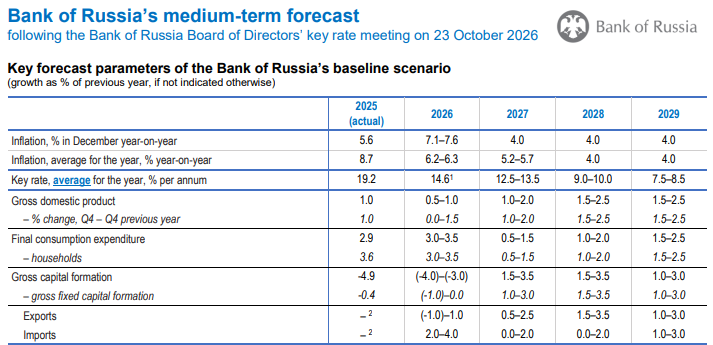
Bank of Russia: Medium-term forecast; October 23, 2026
The Central Bank raised its forecasts for inflation and the key interest rate
The Central Bank no longer expects an annual inflation rate of 6 to 7% in December 2026, but rather 7.1 to 7.6% (first row of the table above). According to the Central Bank, the seasonally adjusted year-over-year increase in consumer prices accelerated from 4.8% to 8% between the second and third quarters of 2026.
The central bank raised its forecast for the year-over-year increase in prices for 2026 compared to 2025 from 5.9 to 6.2% to 6.2 to 6.3%. However, it still expects to reach its inflation target of 4% in December 2027. The majority of analysts do not believe this will happen. The central bank’s survey conducted prior to the interest rate decision showed that, on average, participants still expect an inflation rate of 5% by the end of 2027.
According to the central bank’s new forecast, the key interest rate will average 14.6% in 2026 (third row of the table above). For next year, the central bank now expects the key interest rate to decline to an annual average of 12.5 to 13.5%. Previously, it had anticipated a steeper decline to 10.5 to 12.5%.
Private consumption will flourish in 2026, but business investment could decline
The Central Bank now estimates that household consumption will rise by 3 to 3.5% in 2026. Previously, it had anticipated a sharper slowdown from the robust 3.6% growth achieved in 2025 to a range of 1.5% to 2.5%.
Fixed investment (“gross fixed capital formation”), which declined slightly in 2025 (-0.4%), will at best stagnate in 2026, according to the central bank. However, the central bank also considers a 1% decline possible.
According to the forecast, investment will grow faster than private consumption in 2027
For 2027, the central bank expects growth in fixed capital formation to range between 1% and 3%. Gross capital formation, which has been declining sharply so far, is then expected to recover by as much as 1.5% to 3.5%. In contrast, according to the central bank, growth in private consumption will slow to 0.5 to 1.5% next year. The central bank therefore appears to believe that investment, rather than private consumption, could be the “driver” of economic growth next year.
The Central Bank raised its oil price forecasts for 2026 and 2027
The average forecast for the Urals crude oil price was significantly raised in the central bank’s new forecast for 2026 (from $60 to $72 per barrel). For 2027, it rose slightly from $50 to $55. The higher oil price forecasts led to higher projections for export and current account surpluses. At the same time, import estimates were also raised.
How President Nabiullina Justifies Maintaining the High Policy Rate
The following chart from bne Intellinews shows the decline in the key interest rate from 21% in June 2025 to 14% in July 2026. Since then, the Central Bank has kept the key interest rate at this level. For next year, the Central Bank now expects the key interest rate to decline to an annual average of 12.5 to 13.5%. In the chart, this decline is indicated by the gray area in the lower right corner (“2027 average guidance: 12.5–13.5%”).
The Russian Central Bank maintains its key interest rate at 14% for
the second time Key interest rate in % (end of month); Central Bank forecast for the average key interest rate in 2027
bne Intellinews, Ben Aris: Russia’s central bank holds key rate at 14%, raises inflation forecast; Oct. 24, 2026
In her statement on Friday explaining the decision to maintain the key rate at 14 percent, Russian Central Bank President Elvira Nabiullina noted that the decision to lower the key rate had, on the one hand, depended on the government’s budgetary decisions. Given the budget parameters that have since been adopted, it would actually have been possible to lower the key rate further.
However, a second factor influencing the decision against a rate cut was “the impact of temporary capacity reductions” on inflation and inflation expectations. By this, she likely meant the effects of damage to Russian production facilities caused by attacks from Ukraine. According to the president, the central bank expects these effects to be felt “in the longer term.” Therefore, monetary policy must remain “moderately restrictive over an extended period.”
At the end of her statement, Nabiullina explained the outlook for future key interest rate developments as follows:
“Core inflation remains high, and inflation expectations in the economy continue to hover near their peak levels of recent years. Unfortunately, this situation could persist longer than was forecast in July. To bring inflation back down to 4%, we must therefore maintain a moderately restrictive monetary policy over an extended period. Against this backdrop, we have raised our average key interest rate forecast for the coming year to 12.5–13.5%.”
Previously, the central bank had expected a significantly larger reduction in the key interest rate to 10.5–12.5% in 2027.
Business Association Again Criticizes the Central Bank’s Monetary Policy
Alexander Schochin, chairman of the Russian Union of Industrialists and Entrepreneurs, once again criticized the central bank’s monetary policy. According to TASS, speaking on the sidelines of the “Russian Industrialists 2026” forum regarding the decision to keep the key interest rate unchanged, he said the Central Bank could easily have implemented a “symbolic cut” of 50 or 25 basis points. This would have affected neither the overall economic situation nor lending. He believes a 50-basis-point cut could be attempted. Alternatively, the Central Bank could follow the example of the U.S. Federal Reserve or the European Central Bank and lower the key interest rate by 25 basis points (see also the association’s press release: Alexander Murychev: Keeping the key interest rate at 14% is an expected decision, Oct. 23, 26).
What Nabiullina Says About Current Inflation Trends
Regarding the Central Bank’s new forecast that the annual inflation rate is likely to reach 7.1 to 7.6% in December 2026—rather than the 6 to 7% previously expected by the Central Bank—the president stated:
“Inflation this year will be 7.1 to 7.6 percent, which is higher than our July forecast. The reasons for this elevated level are temporary in nature. Companies are making significant efforts to restore their production capacities. As the situation normalizes, inflation will slow under the influence of a moderately restrictive monetary policy. According to our forecast, current price growth rates will fall back to 4% in the first half of 2027.”
However, according to the Central Bank’s forecast, the year-over-year increase in consumer prices for 2027/2026 will still reach 5.2 to 5.7% (following a year-over-year increase of 6.2 to 6.3% for 2026/2025).
How Nabiullina Justifies the New GDP Forecast for 2026
Regarding the “upward revision” of the Central Bank’s forecast for economic growth in 2026 from 0 to 1% to 0.5 to 1%, the Central Bank president points to stronger domestic demand. She noted that consumption growth has slowed only slightly.
Investment activity continues to recover. This is reflected in the rise in production and imports of capital goods, as well as in positive trends in the construction sector. According to a survey by the Central Bank of Russia, companies expected “moderate growth” in investment in the fourth quarter of 2026.
In the second half of 2026, economic activity will also grow “moderately,” according to the president. Production has increased in a wide range of sectors in recent months.
Nabiullina’s View on the “Financial Stability” of Companies in Russia
In light of reports about an increasing number of bankruptcies (see: bne Intellinews), President Nabiullina also commented on the financial performance of Russian companies during the press conference. Overall, Nabiullina does not see any risks to the “financial stability” of companies in Russia. She describes the debt problems of some companies as “temporary.” According to a report by Olga Belenkaya, chief economist at the brokerage firm FINAM, she said at the press conference:
“There are no risks to financial stability in the Russian Federation, even though some large companies are struggling with debt problems; these are temporary and do not affect the overall situation. We will publish new data in early December as part of a financial stability report. According to data from July 1, the proportion of companies whose operating profits do not cover interest payments—that is, the cost of debt service—has risen slightly. However, we also see that the situation for some companies is improving given the current macroeconomic conditions, current trends, and the effects of the previous key interest rate cut. In addition, external conditions have improved for a number of industries.”
“For the vast majority of companies—the so-called ‘heavyweights’—we also assess the difficulties they are temporarily facing, which require debt restructuring, as temporary. Banks, too, view these difficulties in restructuring loans as temporary. There are currently no risks to financial stability as a whole. Therefore, this could not have been a factor in the key interest rate decision.”
The wiiw’s growth forecasts are almost in line with the government’s forecast
In its “Fall Forecast” published on October 21, the “Vienna Institute for International Economic Comparisons” stands by its “Summer Forecast” from July 1, stating that the growth in real gross domestic product will slow to “minimal growth” of just 0.6% in 2026. The Russian government also anticipates a slowdown in economic growth to 0.6% (Kommersant.ru). For 2027, the wiiw continues to expect growth to accelerate to 1.3% (government forecast: +1.4%).
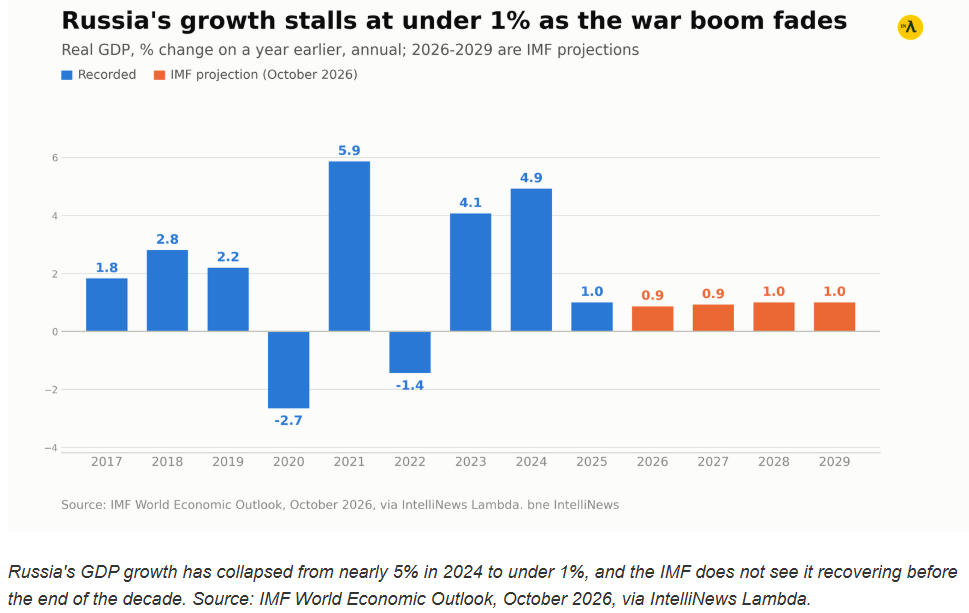
In contrast, the World Bank expects growth to decline further in 2027, from 0.8% to 0.7%. The IMF expects the growth rate to stagnate at 0.9% next year.
IMF Forecasts: Russia’s Growth Stalls Below One Percent. The War Boom Is Over
Real Gross Domestic Product; annual change in %
bne Intellinews, Ben Aris: “Russia’s state-owned giants buckle under war costs and high rates,” Oct. 23, 2026
In the longer term, however, the wiiw remains slightly below the government’s forecast. The wiiw is lowering its growth forecast for 2028 from 1.7% to 1.5% (government forecast: +1.9%). According to the IMF forecast, growth will then reach only 1%.
The unemployment rate remains low
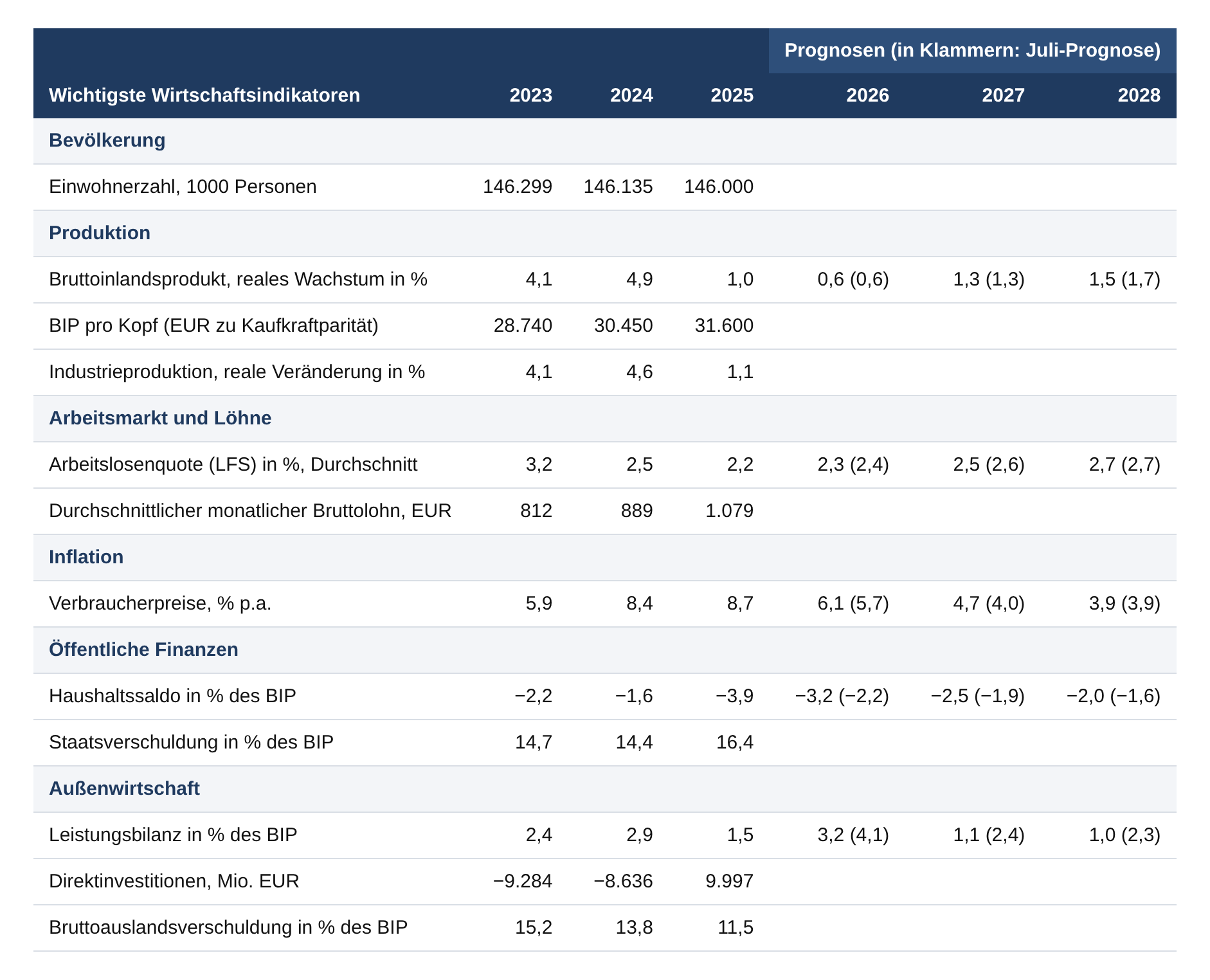
Russia’s very low official unemployment rate, which fell to 2.2% in 2025, will rise slightly less than the wiiw had previously expected over the next two years, despite the somewhat lower growth projections, according to the wiiw’s fall forecast. In 2026, the unemployment rate is projected to reach 2.3% and rise to 2.5% in 2027.
The inflation rate is falling much more slowly than previously expected
The wiiw is now raising its inflation forecasts noticeably compared to the “Summer Forecast.” The institute now expects that the annual average increase in consumer prices in 2026 will not slow from 8.7% to 5.7%, but only to 6.1%. In 2027, the inflation rate is expected to fall to 4.7%. Previously, the wiiw had expected it to drop to the central bank’s target of 4% as early as next year.
In its press release on current inflation trends, the wiiw notes that Ukrainian drone attacks on Russian refineries have led to a “veritable fuel crisis” across the country. The rise in prices caused by the fuel crisis prompted the central bank in September to suspend, for the time being, further cuts to the key interest rate, which stands at 14%.
Slower Decline in Key Interest Rates, Slump in Investment in the First Half of the Year
Vasily Astrov, a Russia expert at the wiiw, comments critically on the interest rate trend:
“Pausing monetary easing is, of course, detrimental to Russia’s recovery because high interest rates hamper economic activity. Thus, the Ukrainian drone attacks are having a very concrete negative effect on Russian growth.”
Astrov views the low level of investment in new production capacity as “one of the biggest structural problems facing the Russian economy.” According to the wiiw, Western sanctions have made high-quality capital goods, such as machinery, scarce in Russia. Fixed investment plummeted by about 10% in the first half of 2026. This undermines long-term growth potential.
The wiiw’s “Fall Forecast” compared with the “Summer Forecast”
wiiw Country Overview: Russia
wiiw: The government budget deficit will decline more slowly than expected
The government budget deficit, which more than doubled in 2025 to 3.9% of GDP according to the wiiw, will decline noticeably more slowly than the institute previously expected during the forecast period from 2026 to 2028. In 2026, it will decline to only 3.2% of GDP, whereas a decline to 2.2% had previously been expected (the deficit ratio specified by wiiw as the “budget balance” is not the most commonly cited deficit ratio in the Russian federal budget, but rather the deficit ratio in the “consolidated government budget,” which is the sum of the deficits of the federal budget, regional budgets, and state extrabudgetary funds; The Moscow Times).
The wiiw press release states the following regarding budget developments:
“The high costs of the war against Ukraine are also straining the national budget and will lead to a budget deficit of over 3% of GDP in 2026. For 2027, the government plans tax increases and spending cuts, though the defense budget and social benefits are to be exempt from these measures.”
Vasily Astrov emphasizes:
“Next year, too, President Putin will have no trouble whatsoever financing the war against Ukraine, because Russia’s national debt is very low by international standards and the government can continue to borrow money from domestic banks.”
The current account surplus will rise only temporarily in 2026
In its fall forecast, the wiiw estimates this year’s Russian current account surplus to be significantly lower than previously projected. As recently as early July, it had forecast that the current account surplus would nearly triple by 2026, rising from 1.5% of GDP to 4.1% of GDP. Now, the wiiw expects it to double this year to 3.2% of GDP (the Russian Central Bank anticipates a similarly sharp increase in the current account surplus in 2026, from 39 to 71 billion U.S. dollars). However, according to the wiiw, the current account surplus will fall back to only about 1% of GDP in both 2027 and 2028 (Central Bank forecasts: 2027: $31 billion; 2028: $14 billion).
The wiiw press release states the following regarding external economic developments:
“Due to fuel shortages, the Russian government was also forced to impose export bans on gasoline, diesel, and kerosene, which meant that Moscow was unable to benefit as much from the high world market prices for fossil fuels resulting from the war in Iran.”
Regarding the “diesel deal” between U.S. President Trump and President Putin, expert Astrov emphasizes that “it remains to be seen” how much diesel Russia can actually bring to the world market through this deal.
Conclusion: Despite “rising inflation,” the wiiw expects 1.3% growth in 2027
Compared to its “Summer Forecast” published in early July, the wiiw maintains its previous growth projections for 2026 (+0.6%) and 2027 (+1.3%) in its “Fall Forecast.” Only for 2028 does it lower its forecast slightly, from 1.7% to 1.5%. The very low unemployment rate is expected to rise even slightly less in 2026 and 2027 than previously anticipated.
However, the institute expects the annual inflation rate to decline significantly more slowly than previously anticipated. The target inflation rate of 4 percent will not be reached in 2027, but only in 2028. The institute also estimates that the government budget deficit will decline noticeably more slowly by 2028 than it had previously anticipated.
The wiiw summarizes its forecast in the “Country Overview Russia” as follows:
“Russia is heading toward its second consecutive year of near-stagnation, weighed down by high interest rates and Western sanctions. Fuel shortages resulting from Ukrainian drone attacks on refineries have fueled inflation and prompted the central bank to suspend the easing cycle it had been pursuing since mid-2025. In our baseline scenario, which assumes a continuation of the status quo regarding the war and sanctions, we forecast only a slight acceleration in growth over the forecast period, which will remain below 2% per year.”
Recommended Reading
German-Russian Chamber of Foreign Trade:
- The number of German companies has declined, Oct. 23, 26
- Siluanov to be granted additional powers, Oct. 21, 2026
- Novak Estimated the Gasoline Shortage at 5%, Oct. 20, 26
- New taxes will bring 3.2 trillion into the state treasury; 10/20/26
Economic Forecasts
- Bank of Russia: Medium-term forecast; October 23, 2026
- Salzburger Nachrichten; APA: Eastern Europe continues to grow strongly despite high energy prices, 10/21/26
- Die Presse, Aloysius Widmann: Eastern Europe’s economy is booming—but debt is becoming a problem; October 21, 26
- Wirtschaftswoche; dpa: Economic Forecast: Ukraine “with its back against the wall.” Russia is suffering from sanctions and a fuel crisis—but experts say Putin can continue to finance the war. Why Ukraine is simultaneously coming under increasing pressure; Oct. 21, 2026
- IT Boltwise: Ukraine’s Economy Under Pressure: wiiw Lowers Growth Forecast to 0.6 Percent; Oct. 21, 2026
- Vienna Institute for International Economic Comparisons; wiiw: Fall Forecast 2026; Andreas Knapp; Press Releases: English, German; Executive Summary; Richard Grieveson: Central, East, and Southeast Europe in 2027: Resilient Growth in a More Dangerous World, Oct. 21, 2026; wiiw Country Overview: Russia; Additional Press Coverage: wiiw in the Press
- Kommersant, Artem Chugunov: The inflation target has been pushed back further. Analysts agree on a slight acceleration in GDP growth accompanied by higher prices and interest rates, October 14, 2026
- Interfax: Analysts raise forecast for Russia’s GDP and inflation in 2026; raise estimate of neutral rate level for the first time in a long period—CBR survey, Oct. 14, 2026
- TASS: Analysts have raised their forecast for GDP growth in 2026 to 0.6%. According to a Central Bank survey, inflation expectations were raised from 6.6% to 7.1%; Oct. 14, 2026
- Bank of Russia: Macroeconomic Survey of the Bank of Russia, October 14, 2026
- International Monetary Fund (IMF): World Economic Outlook: Resilience Under Strain, Urgent Choices, October 2026; Press Briefing Transcript: World Economic Outlook, Annual Meetings 2026, October 13, 2026
- OPEC Secretariat, Vienna: Monthly Oil Market Report, October 13, 2026
- Institute for Economic Forecasting of the Russian Academy of Sciences, IEF-RAS: Short-Term Analysis of GDP Trends; October 12, 26
- World Bank: Country Report: Russian Federation, in: Macro Poverty Outlook; Europe and Central Asia Update; October 6, 2026; World Bank: Press Release; Europe and Central Asia: Slower Growth with Global Headwinds; October 6, 2026
Monetary Policy, Inflation (Central Bank Calendar; Interfax Reports, Kommersant Reports)
- Trend.at; APA: Russian Central Bank Keeps Key Rate High; October 24, 2026
- bne Intellinews, Ben Aris: Russia’s Central Bank Holds Key Rate at 14%, Raises Inflation Forecast; October 24, 2026
- Finam.ru; Olga Belenkaya: The Russian Central Bank left the key interest rate unchanged and forecasts less room for rate cuts in 2027; October 23, 2026
- Kommersant; Vadim Visloguzov: The Central Bank Is in No Hurry. The Pause in Key Rate Cuts Could Be Extended; Oct. 23, 2026
- Kommersant: Meeting of the Board of Directors of the Central Bank of Russia. Key points, Oct. 23, 2026
- Russian Union of Industrialists and Entrepreneurs; Press Release: Alexander Murychev: Keeping the key interest rate at 14% is an expected decision, Oct. 23, 2026
- TASS: Shokhin called the decision to keep the key interest rate unchanged as expected. According to the chairman of the Russian Union of Industrialists and Entrepreneurs, the Central Bank could agree to a symbolic cut of 50 or 25 basis points, 10/23/26.
- Radio “Kommersant FM”: “The trajectory of the key interest rate has changed significantly.” Alexander Isakov, chief economist at Sberbank and VEB.RF, on the Central Bank’s statements; Oct. 23, 2026
- Vedomosti; Mikhail Belyaev: How Nabiullina Explained the Decision to Keep the Key Rate Unchanged. The regulator expects inflation to reach 7.6% in 2026 and has raised its forecast for the average inflation rate; Oct. 23, 2026
- Interfax.ru: As expected, the Bank of Russia kept its key interest rate at 14%; Oct. 23, 2026; The Central Bank narrowed its forecast for Russian GDP growth in 2026 to 0.5–1.0% and lowered it to 1.0–2.0% for 2027; Oct. 23, 2026; The Russian Central Bank has raised its forecast for the average interest rate for 2027 and 2028; Oct. 23, 2026.
- The Moscow Times, Russian edition; Reuters: The Russian Central Bank keeps its key interest rate unchanged and hopes to bring inflation back down to 4% by 2027; Oct. 23, 2026
- Reuters – Translated by MarketScreener: Russian Central Bank keeps key rate at 14% and raises inflation forecast for 2026; Oct. 23, 2026; Reuters; Elena Fabrichnaya and Gleb Bryanski: Russian Central Bank Keeps Key Rate on Hold at 14%, Raises 2026 Inflation Forecast, Oct. 23, 2026
- Parliamentary Gazette; Julia Katenyova: The Central Bank once again kept the interest rate at 14% per year; Oct. 23, 2026
- Bank of Russia: Statement by Bank of Russia Governor Elvira Nabiullina following the Board of Directors meeting on October 23, 2026; October 23, 2026
- Bank of Russia; Press Release: Bank of Russia Keeps Key Rate at 14.00% p.a., October 23, 2026
- Bank of Russia: Medium-term forecast; October 23, 2026
- Finam.ru; Olga Belenkaya: Rising inflationary pressures are preventing the central bank from lowering its key rate; Preliminary report on the central bank’s key rate decision: October 16, 2026
- Bank of Russia: Inflation in Russia; October 14, 2026
Overall Economy (Kommersant, Vedomosti, Politkom)
- t-online; Ellen Ivits: Russians feel ashamed at the checkout. Gasoline, water, electricity—there’s hardly anything in Russia that isn’t getting more expensive. Some prices are doubling in a very short time; October 24, 2026.
- bne Intellinews, Ben Aris: Russia’s state-owned giants buckle under war costs and high interest rates, October 23, 2026
- Podcast: Military & History with Torsten Heinrich: Russia’s Economy Is at Its Limit, 21 min., Oct. 18, 26
- russland.capital: Putin Wants an Investment Boom—But Companies Lack the Necessary Conditions, Oct. 17, 2626
- Moscow Times: Russian Business Investment Stalls in Third Quarter as Profits Fall, Uncertainty Persists, Oct. 15, 2026
- Politkom.ru; Nikita Maslennikov: AI Development Amid Mixed Expectations, Oct. 15, 2026
- Interfax.com: Economic growth in Russia continues in Q3 2026, but slows somewhat compared to Q2 – CBR analysts, Oct. 14, 26
- Vedomosti; Ksenia Naumchik: The Central Bank expects GDP growth in 2026 to be slightly lower than in the previous year. Further growth depends largely on an increase in labor productivity; October 13, 2026
- National Public Radio; Wailin Wong, Paddy Hirsch: “Why hasn’t the Russian economy collapsed?” Six reasons cited by Elina Ribakova, Timothy Ash, and Vladislav Inozemtsev, audio + transcript, March 24, 2026
Fiscal Policy; National Budget (Interfax Reports)
- United24; Illia Kabachynskyi: “Russia Has No More Money to Throw at Its War in Ukraine. Its 2027 Budget Shows Why,” Oct. 23, 2026
- russland.capital: Russia’s Budget: Tightening the Belt, But We Can’t Call It That; October 23, 26; Russia’s Budget: Siluanov Considers the Deficit Small—But Costs Are Rising; October 21, 26
- FR.de; Marcel Reich: Russia’s Economy Under Pressure: Kremlin Expects Budget Shortfall to Double, October 21, 2026
- FR.de; Patrick Freiwah: Despite Sanctions: Why Russia’s Oil and Gas Revenues Are Surging in October, 10/17/26
- Focus online; Lars-Eric Nievelstein: Due to global market shortages, Putin is once again earning more money from oil sales; 10/16/26
Energy Industry, Fuel Supply, Infrastructure
- Frankfurter Rundschau: First Russian diesel shipment to the U.S. begins following Trump-Putin agreement, Oct. 23, 26
- Focus Online, Lars-Eric Nievelstein: Russia is tapping into the Arctic for increased oil exports, Oct. 23, 26
- CNN; Matt Egan: From the “dark fleet” to Russian diesel, there are no “silver bullets” for bringing down fuel prices, October 21, 2026
- Vedomosti; Philip Ivanov: Novak stated that there are no problems with the sale of Russian oil. Many countries want to buy it given the imbalance on the global market; October 18, 2026.
- Vedomosti; Maxim Tsulanov: Novak’s key statements on refineries and the U.S. diesel supply. Russia is ready to increase shipments to Europe; Oct. 16, 2026
- Council on Foreign Relations: Mary Kate Godfrey: Trump’s Russian Diesel Deal, Explained. Trump announced a new diesel deal with Putin on October 9, to the surprise of many U.S. allies; October 16, 2026
- TAZ; Mathias Brüggmann: Drones Targeting Data Centers. The drone attacks on the internet company Yandex have serious consequences for the Russian economy. Many aspects of daily life are restricted; October 14, 2026
- russland.capital: Russian Diesel for the Global Market: Moscow Gains Leeway, Energy Agreement Remains Open, 10/13/26
- The Bell: Trump convinces Putin to restart diesel exports, Oct. 14, 2026
- Hellmeyer of the Week: ftd.de: U.S. Buys Russian Diesel! A Sign of Thawing Tensions? 10/12/26
Foreign Trade, Sanctions; Tagesschau: Russia Sanctions
- tagesschau.de; Jean-Marie Magro, ARD Brussels: Oil and Uranium Despite Sanctions. Europe Is Still This Dependent on Russia; Dependencies Remain, Especially for Oil and Uranium; October 24, 26
- russland.capital: Gazprom Offers Gas to Europe: Old Pipeline, New Negotiating Position. 10/23/26
- russland capital: Ownership Depends on the Political Climate: Russia Spares U.S. Companies and Puts Pressure on Europeans. European companies are placed under state-ordered external administration in Russia significantly more often than American ones; Oct. 23, 26
- Focus online; Lars-Eric Nievelstein: Ships Circumvent EU Sanctions. Putin Ends the Hide-and-Seek Game of His Shadow Fleets. Now the Country Is Increasingly Reflagging the Ships, 10/23/26
- International Relations Review; Nicky Reich: Not So Isolated: How Russia Employs the FSU to Circumvent EU Sanctions, Oct. 22, 2026
- Tagesschau; Matthias Fuchs, WDR: Despite the split. Globus’s business with Russia continues to raise questions; Oct. 21, 26; This topic on the program: Das Erste | Plusminus | WDR; Matthias Fuchs: Why are German companies betting on the Russian market—despite the war? Oct. 21, 26
- Financial News; dts News Agency: German Companies’ Business with Russia Continues to Decline. German-Russian trade has declined significantly in many respects since February 2022; Report by the Federal Statistical Office (Destatis), October 21, 2026
- Handelsblatt, dpa: Economic relations with Russia have declined sharply; Oct. 21, 2026
- russland.capital: Russia’s foreign trade is growing—but the Central Bank needs to double-check the figures, Oct. 20, 26
- cash; Sören Premer and Dr. Tatiana Vukolova: Russia and Metro: When ownership remains, but control is lost. The forced administration of Metro’s Russian operations raises questions: How far will government intervention go? Is Russia harming its own economy? And how can European companies protect their investments? October 20, 26
- t-online, jaf: EU sanctions against Russia. France is still funneling millions of euros into Putin’s war chest. EU countries continue to import large quantities of fossil fuels; Oct. 19, 2026; Source: energyandcleanair.org: September 2026 – Monthly analysis of Russian fossil fuel exports and sanctions
- Kommersant; Artem Chugunov: The balance of payments does not match forecasts; 10/19/26
- National Public Radio, NPR; Audio + Transcript: Congress reacts to executive order exempting Russia from economic sanctions; Eric McDaniel reports on how Congress reacted to President Trump’s order to exempt Russia from economic sanctions; October 18, 2026
- Moscow Times.ru: Trump suggested that Europe resume buying Russian gas as part of a “peace agreement” for Ukraine; October 18, 2026
- Watson.ch, dpa: U.S.: Rubio Defends Suspension of New Sanctions Against Russia; Oct. 18, 2026
- Business Times: Trump to take up to 60 days to assess economic impact of Russia sanctions: Rubio, Oct. 18, 2026
- Vedomosti; Elena Vostrikova: Trump ordered that some of the “Graham sanctions” against Russia not be enforced; October 18, 2026
- Tagesschau: “National Interest.” Trump Suspends Planned Sanctions Against Russia; 10/17/26
- Moscow Times, Reuters: Trump Signs Order Exempting Russia From New Sanctions Legislation, October 17, 2026
- Watson.ch: “Historic”: Moscow Welcomes Trump’s Tariff Suspension; Zelenskyy Criticizes Move, Oct. 17, 2626
Political Context; BR24: Russia
- German Foreign Policy: In the Spiral of Escalation. The spiral of escalation, triggered by Ukraine’s attacks on Russian warehouses and refineries—which were applauded in Germany—is taking its toll primarily on the Ukrainian economy; wiiw’s fall forecast, Oct. 23, 2026
- Merkur; Lukas Richter: Nord Stream, EU accession, renouncing NATO—this is what Washington is proposing for peace in Ukraine, October 23, 26
- Nau.ch; Stephan Felder: Has Russia Already Won the War in Ukraine? Trump Meets Putin Halfway, Ukraine Struggles with Starlink Restrictions. Has Russia Won the War? Two Experts Disagree; October 23, 26.
- ZDF “heute” interview with Rüdiger von Fritsch, former German ambassador to Russia: A dangerous closeness to Russia? Why the U.S.’s negotiating position is weakened; 18 min., Oct. 22, 26
- “Die Presse” podcast: “What’s Important Today”: Is Trump turning toward Russia? “Putin’s strategy is certainly to crush Ukraine this winter”; Clemens Patek, foreign policy news editor, in conversation with Jutta Sommerbauer, Ukraine correspondent for “Die Presse,” Oct. 22, 26
- Meduza: Russia plans to appoint four new deputy prime ministers as Finance Minister Anton Siluanov gains influence and Prime Minister Mikhail Mishustin loses a close aide, Oct. 20, 2026
The day's most important Russian economic stories. Free, in your inbox three times a week.
Mon, Wed, Fri. Double opt-in, no tracking, unsubscribe anytime. By subscribing you consent to the processing of your email address as described in our Privacy Policy.