Russian-African Economic Relations
Anyone searching the “Tagesschau” website for information on Russian-African economic relations will come across the headline “Weapons for Raw Materials.” According to Tagesschau.de, this is how “many agreements” could be summarized.
The statistics, however, tell a different story: It is not weapons, but wheat that is Russia’s primary export to African markets. Russia now supplies about 32% of the wheat imported by African countries. Two decades ago, that figure was only 13%. Africa accounts for 38%—more than one-third—of Russia’s total wheat exports. Grain makes up 87% of the value of all Russian food exports to African countries.
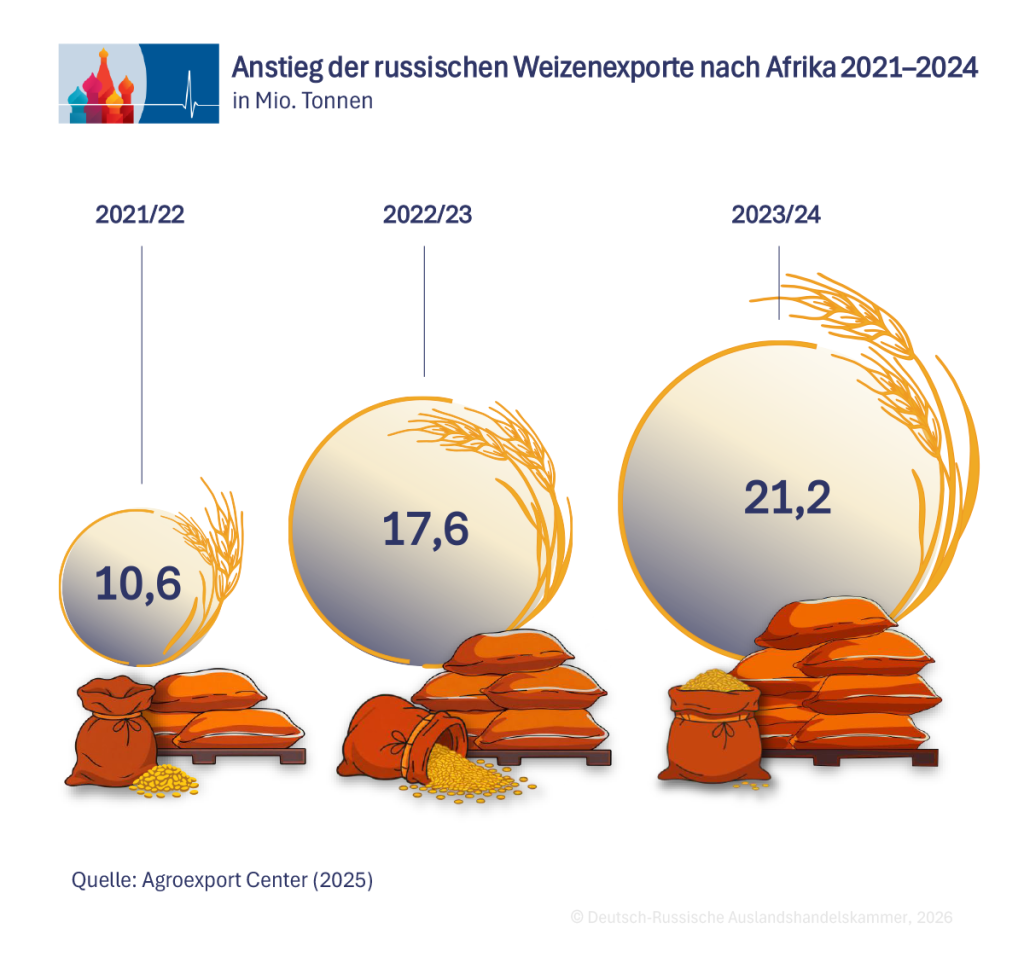
Egypt has traditionally been the largest buyer of Russian wheat. In 2019, the North African country imported 3.8 million metric tons of Russian wheat; by 2025, that figure had risen to 13 million metric tons. This reflects both the needs of Egypt’s growing population and Russia’s increased export capacity.
Russia Is the Largest Arms Supplier, Ahead of China and the U.S.
As for Russian arms exports to Africa, the state-owned arms trading company Rosoboronexport does not publish annual financial statements or trade figures. According to the company, however, shipments to Africa account for 30% of its total orders. According to the Swedish research institute SIPRI, Russia was Africa’s largest arms supplier from 2020 to 2024, with a market share of 21%, followed by China with 18% and the U.S. with 15%. At the same time, SIPRI notes that Russian arms exports from 2021 to 2025 declined by 64% compared to the period from 2016 to 2020.
After wheat, mineral fuels, oils, and petroleum products are the second-largest commodity group in Russian exports to Africa. These are followed by iron, steel, and other metal products, as well as fertilizers and sunflower oil. Russian agricultural machinery also plays a significant role in exports. Combine harvesters and tractors from Russia hold a market share of about 12.5% in Africa. The company “Rostselmash” from Rostov-on-Don alone accounts for 25% of the African combine harvester market.
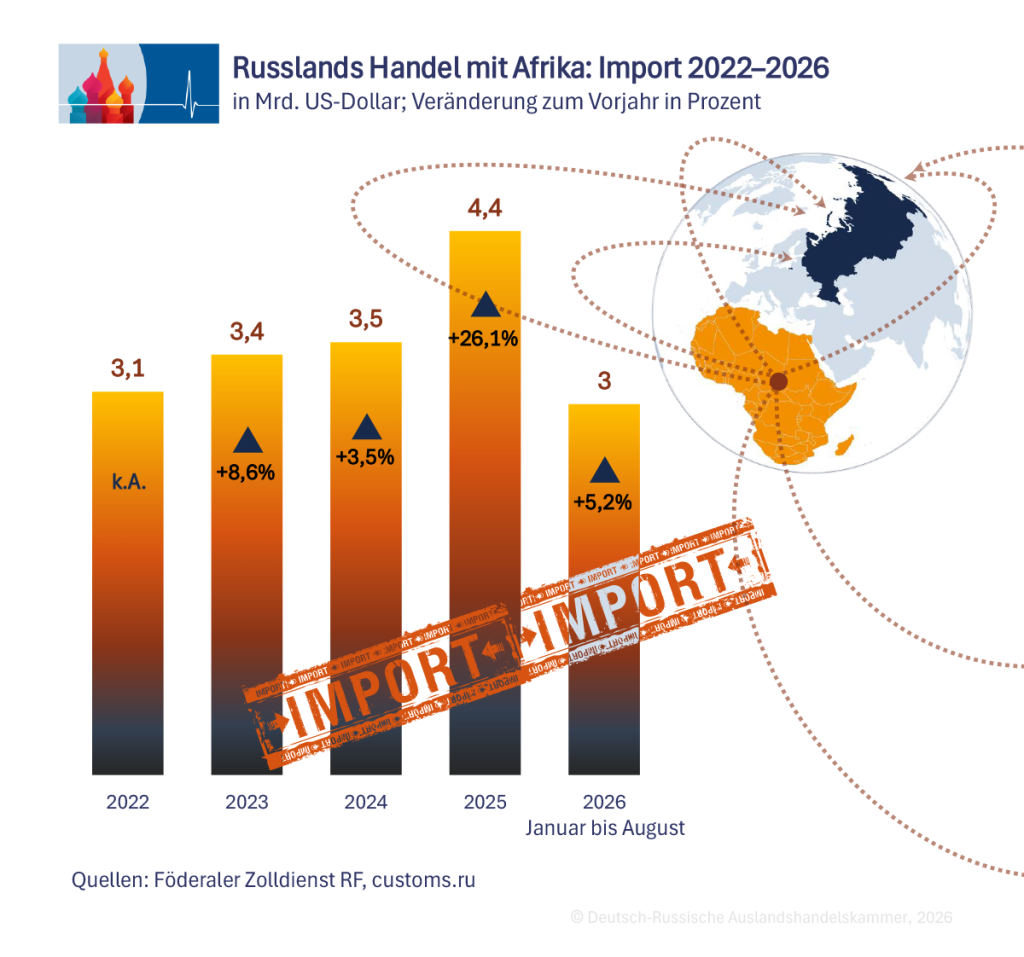
Russian imports from Africa consist primarily of agricultural products. Foodstuffs account for about 60% of imports. The largest share is made up of fruits, nuts, citrus fruits, and dried fruits, followed by vegetables, roots, tea, and coffee. In addition, there are cocoa beans and cocoa products, primarily from Ghana and Nigeria, as well as canned fruit and juices.
Total trade in goods between the Russian Federation and Africa amounted to 27 billion U.S. dollars last year. Both Russian exports and imports from Africa have been growing since 2022. While Russia imported goods worth $3.1 billion in 2022, that figure had already risen to $4.4 billion by 2025—an increase of 42%. During the same period, Russia managed to increase its exports from 14.8 billion to 22.7 billion U.S. dollars. This represents an impressive 54% increase, albeit from a comparatively low baseline.
For example, Africa’s trade with the European Union (EU) is more than ten times higher than its trade with Russia. In 2025, Africa’s trade with EU countries totaled $395 billion. Compared to the $27 billion in trade volume between Russia and Africa—with its 1.6 billion people—trade with the European Union and its 740 million inhabitants, despite harsh sanctions, was still more than twice as high at 57.2 billion euros. Africa’s trade volume with China in 2025 was also about ten times higher than that with Russia, totaling 348 billion U.S. dollars.
None of the African states has joined the sanctions against Russia, which are essentially backed by the United States and the European Union. African countries reject sanctions without the approval of the United Nations Security Council. Added to this is their vital economic interest in maintaining unrestricted trade with all countries in order to promote their development.
Third Russia-Africa Summit
Speaking recently about the future significance of the African market, Russian Minister of Economic Development Maxim Reshetnikov noted that while trade with Africa currently accounts for only 4% of total foreign trade, this figure “does not reflect the potential of the African continent.” Reshetnikov is confident that Russia will nearly double its trade with Africa to $50 billion by 2050.
The Russia-Africa Summit, which took place October 28–29 in Moscow at the “Gostiny Dvor” on Red Square, provided the impetus for such optimistic outlooks. Forty-eight of 54 African nations participated, 22 of them represented by presidents or prime ministers. It was already the third summit of its kind since 2019. The Russian president used the conference to hold bilateral talks with 21 African heads of state. At the summit, 150 agreements were signed and a comprehensive joint declaration was adopted. In it, Russia and the African nations commit to a “shared responsibility” for a “balanced and equitable multipolar world” and to “non-interference in internal affairs.”
Russian President Vladimir Putin explained at the summit how Russia is changing its strategy for economic cooperation with Africa. Africa, according to Russian President Putin, has “become a pole of the global economy,” in part due to its dynamic demographic growth. By 2050, the continent will already have 2.5 billion inhabitants. Russia wants to help Africans “achieve the continent’s economic independence.” This requires “long-term investments in the energy sector,” in transportation and logistics, as well as steps toward “digital sovereignty.” Russia, according to Putin, rejects “neocolonial exploitation of natural resources and human resources.” Russian investors create jobs and secure tax revenue for African nations.
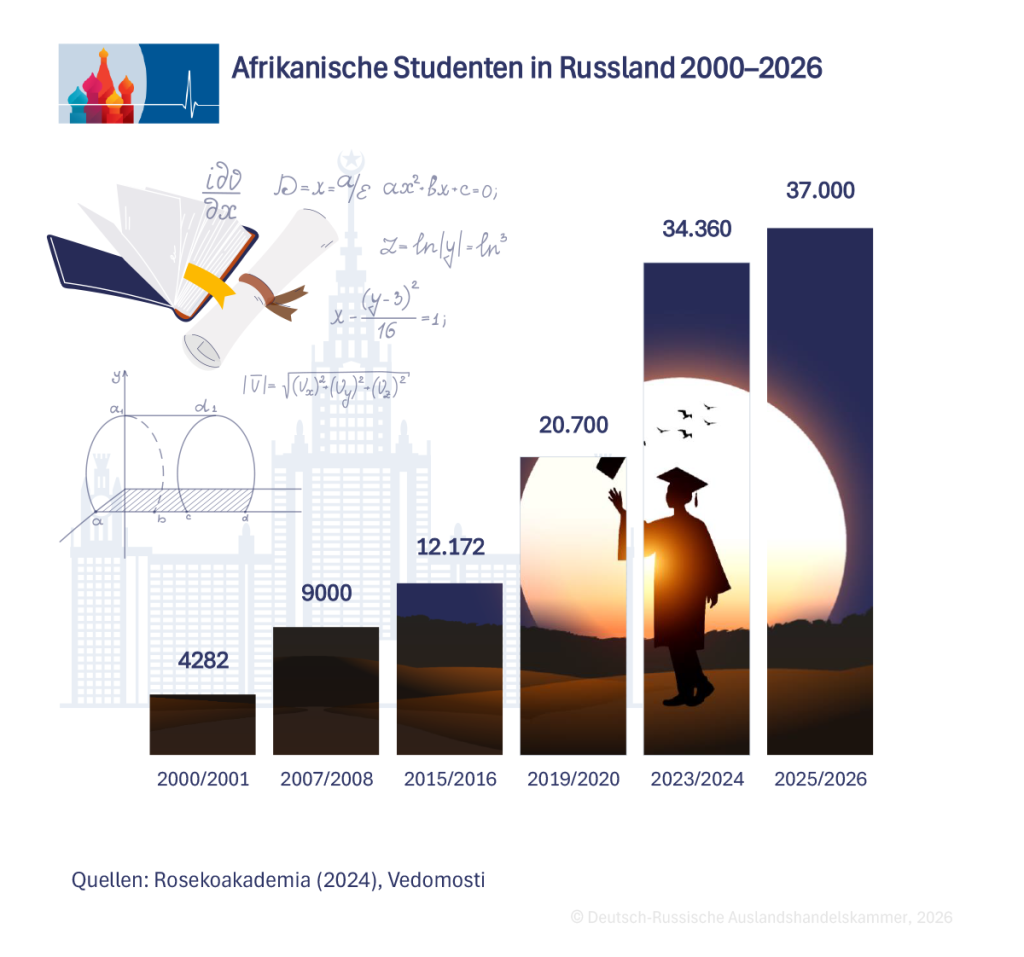
President Putin noted that Russia’s plans for Africa’s development also include the modernization of power plants. His country, the Russian head of state said, is “genuinely interested in the comprehensive development and deepening of trade relations and humanitarian cooperation.” In this context, Putin also mentioned the growing number of African students at Russian universities, particularly at the Patrice Lumumba University of Friendship of Peoples in Moscow. Their total number, according to Putin, is close to 40,000.
Putin described the transition to using national currencies as essential for growing trade. He noted that Russia already conducts 85% of its business with African partners in this manner. Putin did not use the term “moving away from the dollar,” a phrase that Africans also publicly avoid. But that is precisely the intention.
Energy Resources as a Prospect
Oil and petroleum products account for a significant portion of Russian exports to Africa. In 2025, oil and products such as heating oil and lubricants made up about 30% of the Russian Federation’s total exports to Africa. In 2025, African countries imported a total of 12.39 million metric tons of fuels from Russia, primarily diesel and heating oil. This represents an 11% increase over the previous year. The main buyers were Egypt, Libya, and Morocco.
However, the increase is also due to rising fuel consumption for passenger cars and the popular Chinese motorcycles—which are used primarily by a large portion of the younger generation in African cities—as a result of population growth. In recent years, a growing number of contracts and memoranda of understanding have been signed between Russian energy companies and African oil companies. The cooperation ranges from production contracts and joint ventures to memoranda of understanding.
For example, the Russian oil company Lukoil, together with the Egyptian company Ganope / South Valley Egyptian Petroleum Holding Co., has secured concessions for oil production in the South Wadi El Sahl region in the country’s eastern desert. Oil giant Rosneft initialed a memorandum of understanding with Oranto Petroleum in Nigeria regarding joint investments across Africa.
Gazprom Neft signed a cooperation agreement with GEPetrol in Equatorial Guinea for the geological exploration of two blocks in an offshore oil field in the Atlantic Ocean. In the Congo, a joint venture between Zakneftegazstroy-Prometey and the local company SNPC is working on the construction of a 1,300-kilometer pipeline into the interior of the country. Russia holds a 90% stake in the joint venture.
Given the large number of agreements, it is striking that many of them are not legally binding but rather take the form of long-term letters of intent. This is due to financing problems in both Russia and African countries. For the Russian side, the military conflict with Ukraine has a doubly negative impact: it blocks access to European and American lenders and ties up significant government funds.
African countries have immense financial needs to increase production. However, undercapitalized banks and the government cannot raise the necessary funds for innovation and investment. Furthermore, African companies often shy away from cooperating with Russian partners because they fear discrimination or sanctions from Western partners.
From Russia’s perspective, the export of nuclear technology for energy production to Africa offers promising prospects. The Russian state-owned corporation Rosatom, which initially cooperated primarily with South Africa through 2014, has been expanding across the entire African continent since 2015. More than 20 African countries have now signed partnerships with the Russian nuclear monopoly, including Tanzania, Zambia, Ghana, Nigeria, Namibia, Sudan, Mali, and Algeria.
Rosatom CEO Alexei Likhachev announced in October that his company had binding agreements in 29 of 54 African republics. However, even here, letters of intent and framework agreements predominate. The only Russian-African nuclear project that has been financed and is already under construction is the El Dabaa nuclear power plant near Alexandria in Egypt.
The importance of nuclear power for the continent’s future energy production becomes clear when one considers this figure: About 600 million of the more than 1.5 billion people in Africa have no access to electricity. And even in cities with millions of residents, such as Togo’s capital, Lomé, power outages lasting for hours across entire neighborhoods are a frequent part of daily life.
Logistics and Transportation as Key Priorities
Africa’s expanding economy—with growth of 4.2% expected this year by the African Development Bank—needs improved logistics, faster transportation corridors, more and better railways, ports with greater capacity, expanded airports, and new pipelines. Such projects were also on the agenda at the Russia-Africa Summit and are the subject of negotiations between government agencies and private companies on both sides. Russia faces the challenge of establishing trade routes independent of the West, as well as new storage capacities and supply structures. Vladimir Putin’s invitation to African airlines to organize more flights to Russia also fits into this context.
However, much like in the energy sector, the logistics sector tends to see more well-worded memorandums than well-funded projects with construction cranes in operation. Russian market experts also fear that little is likely to change as long as Russia remains embroiled in the military conflict in Ukraine and is subject to Western sanctions.
Sources: Kremlin, Monocle 1, 2, Vedomosti, Tass, CNN (EN), Fokus Afrika
- Russian Bakery Industry: Local Bread Is Getting More Expensive
- Russian-Armenian economic relations under pressure
- Competition with China: German Economy Under Increasing Pressure
Source: German-Russian Chamber of Foreign Trade, Russian-African Economic Relations, November 5, 2026.
This article was prepared for the German-Russian Chamber of Foreign Trade.
Earlier coverage: Russia
- Russia: Business trips cost 63,000 rubles per person · November 15, 2026
- Russia: Tunnel through the Bering Strait for $205.4 billion · November 14, 2026
- Xenia Sobchak: Ban on Starting a Business in Russia Until 2029 · November 13, 2026
- Russia: The 18 Richest Russians Lose $25 Billion · November 13, 2026
The day's most important Russian economic stories. Free, in your inbox three times a week.
Mon, Wed, Fri. Double opt-in, unsubscribe anytime. By subscribing you consent to the processing of your email address as described in our Privacy Policy.