Russian-Armenian Economic Relations Under Pressure
The question of whether Russia remains Armenia’s most important economic partner despite political differences can be answered using the pattern of the fictional and popular Radio Yerevan jokes: In principle, yes, but…
Declines in Trade
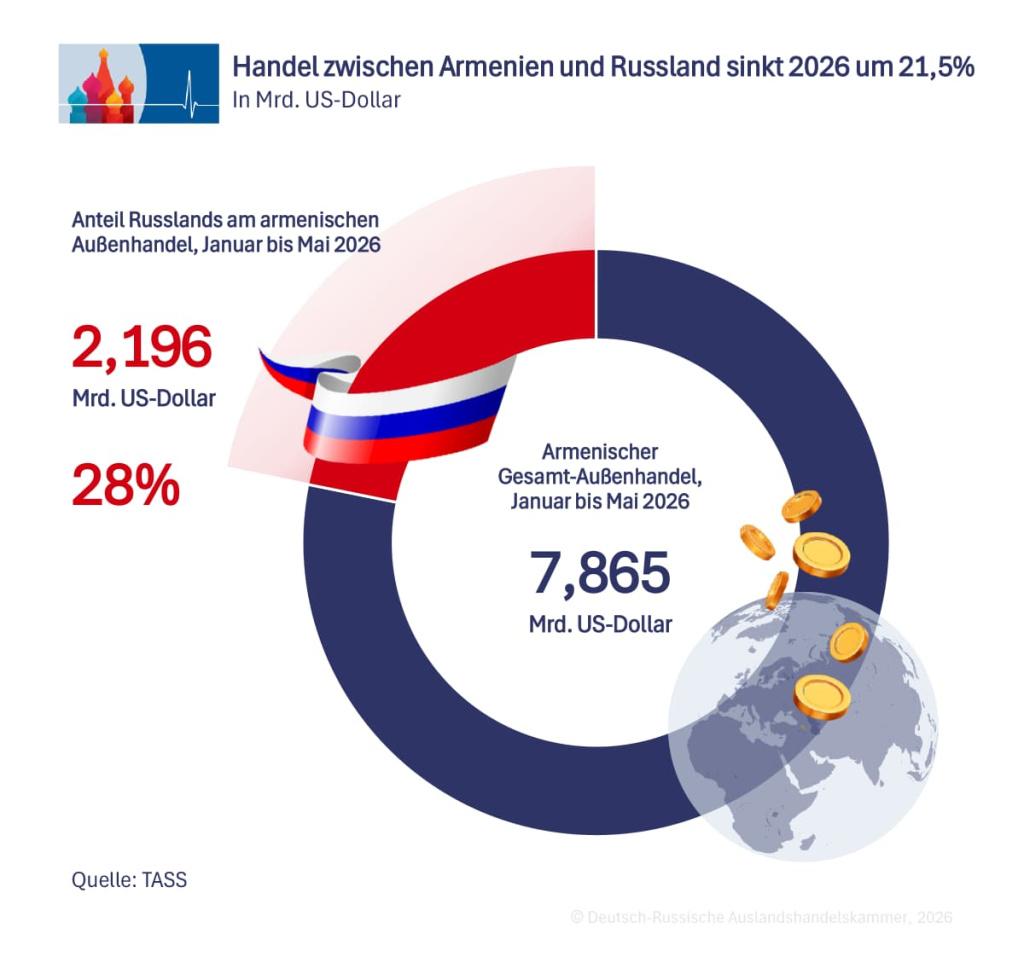
In the first half of 2026, trade between Armenia and Russia shrank significantly. Trade between the two countries fell by 21.5% from January through May 2026 compared to the previous year. According to the Armenian Statistical Service, Armenian-Russian trade totaled $2.196 billion in the first five months of this year. From January through May 2025, the figure had been 2.763 billion. The increase in imports from Armenia following the start of hostilities in Ukraine suggests a high proportion of goods shipments circumventing Western sanctions. For example, imports of machinery and technical equipment not produced in Armenia doubled from 2021 to 2023, while imports of automobiles rose fifteenfold, reaching $516.5 million.
In addition to agricultural products, Armenia primarily exports electronic devices, optical equipment, measurement and medical technology, machinery, mechanical devices, as well as gemstones and precious metals to the Russian Federation. Russian exports to Armenia consist primarily of precious stones and precious metals, mineral fuels, grains, electrical engineering products, and machinery and mechanical equipment.
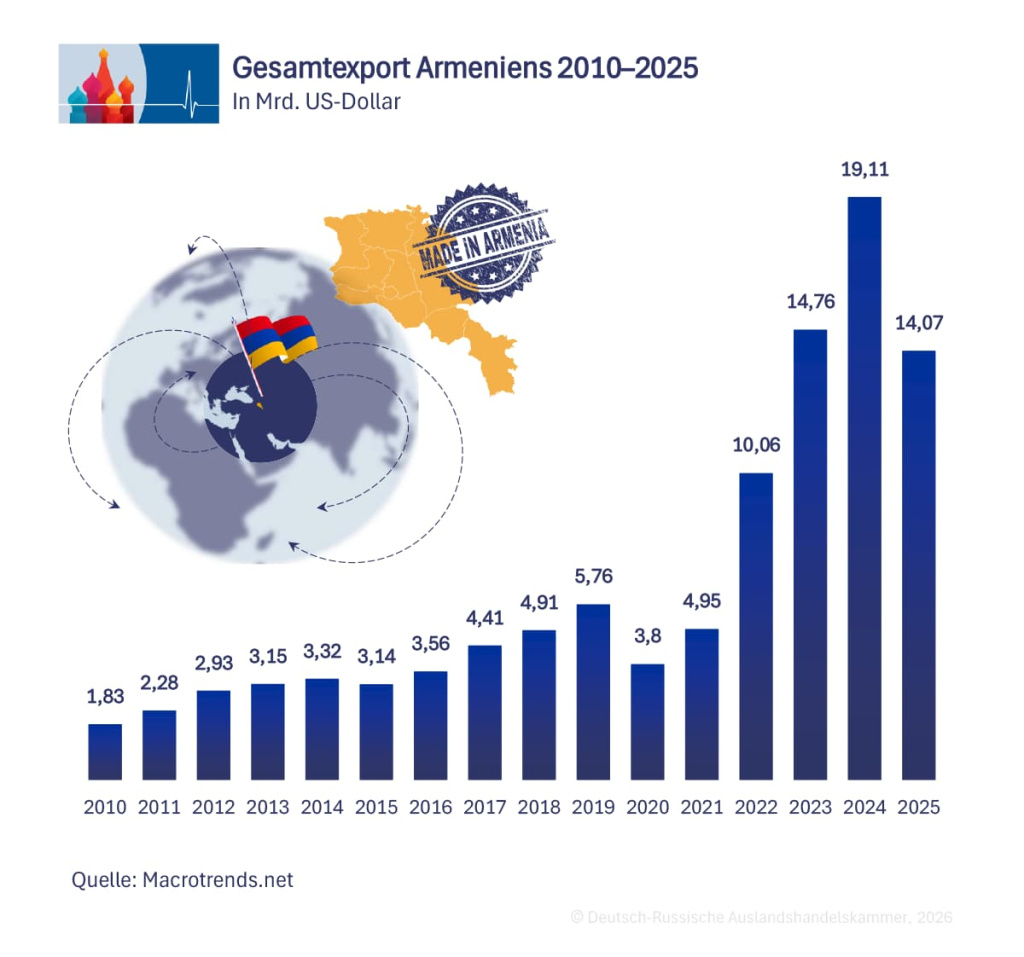
Russia’s share of Armenia’s total foreign trade turnover was still 35.1% from January through May 2025; this year, it stands at 28%. At the same time, Armenia’s trade with other partner countries in the Eurasian Economic Union grew. Trade with Belarus rose by 8.3%, with Kazakhstan by 10%, and with Kyrgyzstan by 194.8%. This extraordinary increase reflects Armenia’s efforts to redistribute and diversify its trade flows. The fact that this has been successful is evident in the stability of Armenia’s overall trade balance. Armenia’s foreign trade from January through May 2026 totaled $7.865 billion, which is only 0.1% below the figure for the same period last year.
The slump in trade between Moscow and Yerevan in the first half of the year resulted from measures taken by Russian authorities responsible for inspecting imported food and plant products. On May 22, Russia initially halted imports of Armenian flowers, then suspended shipments of brandy, tomatoes, cucumbers, and strawberries. In early June, the Rosselkhoznadzor regulatory agency also banned the import of cherries, peaches, nectarines, and grapes. Starting June 2, Russia no longer recognized the certificates issued for fish and fish products from Armenia. The Foreign Ministry in Moscow stated that the reason was a violation of phytosanitary standards by Armenian producers and suppliers.
Russian media placed the increased sensitivity of Russian regulatory authorities toward Armenian products in a geopolitical context and interpreted it as a reaction to the government’s tendency to move closer to Europe. In this context, Russian media also noted a statement by State Duma Chairman Vyacheslav Volodin, who compared the observable shift in Armenia’s course to the situation in Ukraine in 2013–2014. Armenian Prime Minister Nikol Pashinyan described the measures taken by the Russian authorities as “politicized” and unjust.
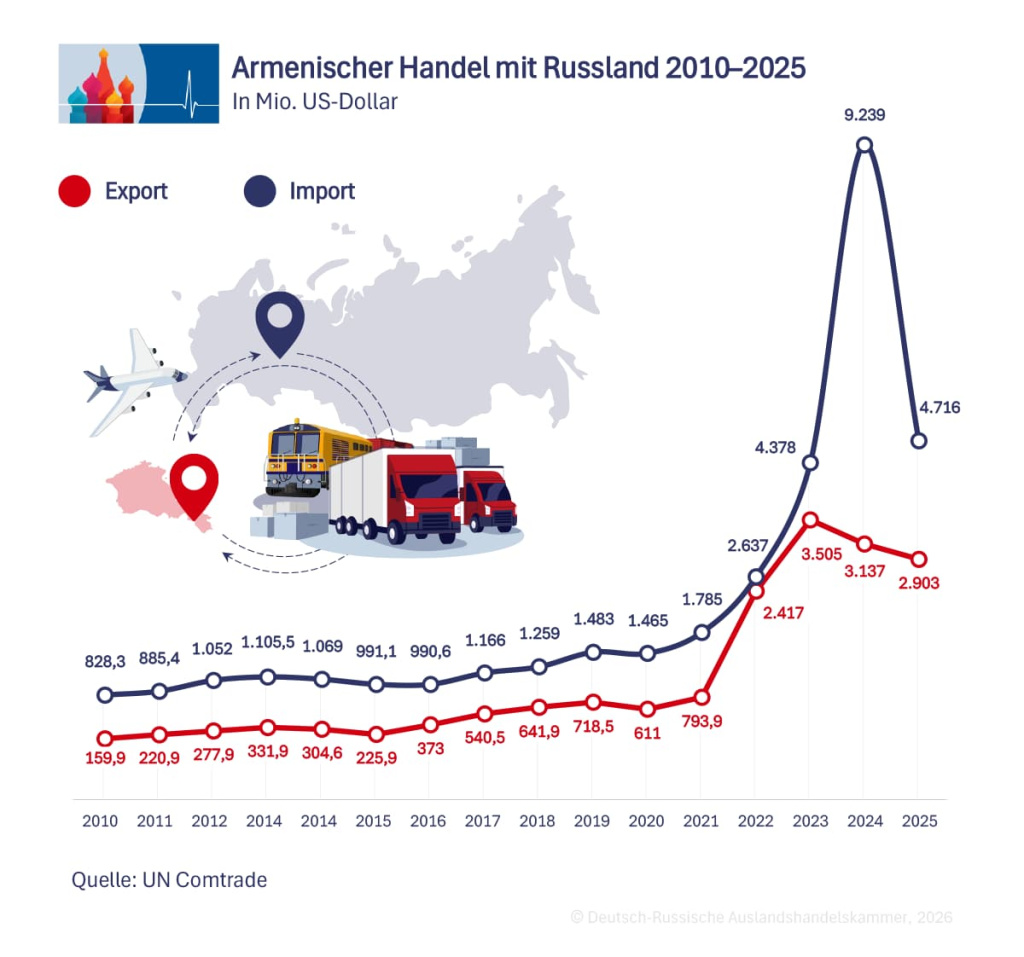
Prior to the complaints from the Moscow authorities this early summer, Armenian trade with Russia had experienced a major upswing over the past three decades. While imports from Armenia to Russia were valued at 49.5 million U.S. dollars in 1997, they quadrupled by 2007 to 198.8 million U.S. dollars. By 2017, Armenian trade with Russia had risen to 540.5 million euros. Following the start of Russia’s “special military operation,” Armenian imports grew to 2.42 billion dollars in 2022. The following year, imports from Armenia reached a record high of $3.50 billion. In 2024, imports from Armenia fell slightly to $3.13 billion and stood at $2.90 billion in 2025.
Risk Factor: EU Integration
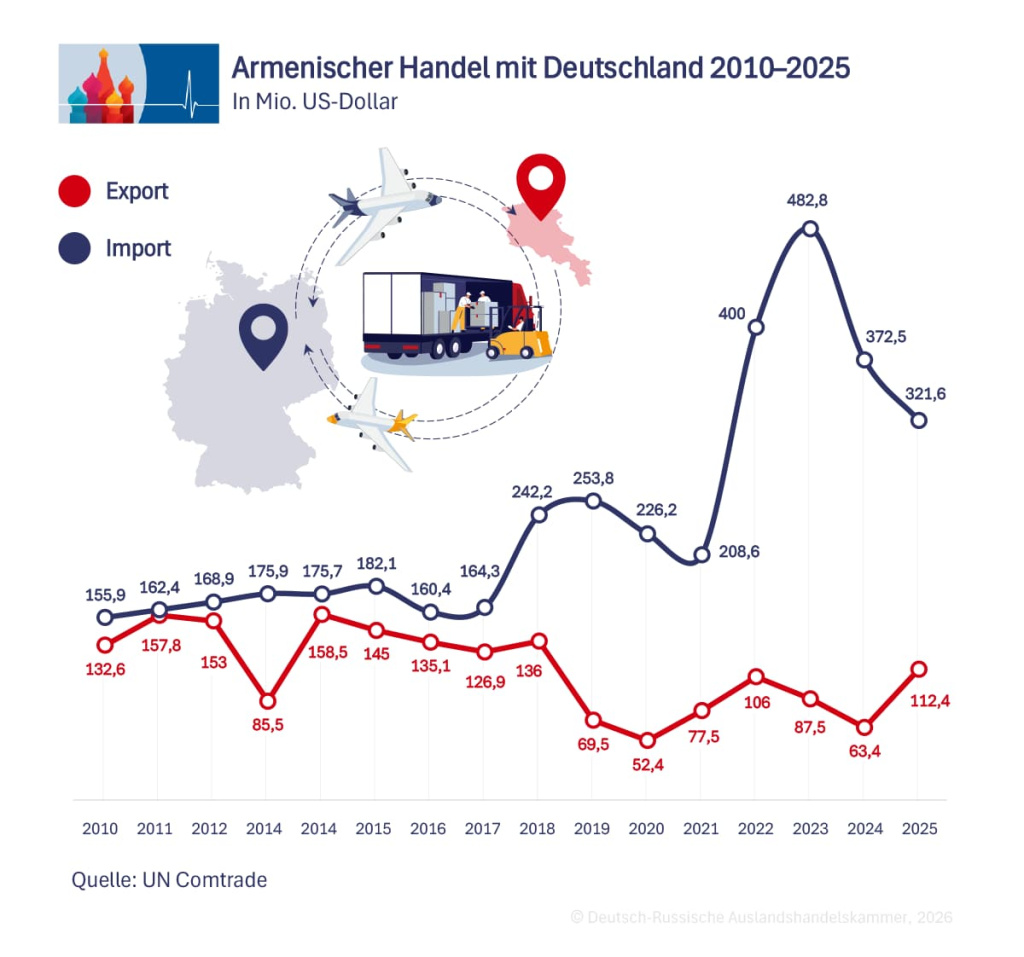
In November 2017, Armenia concluded a comprehensive Association Agreement with the European Union (EU), which has been in full force since March 2021 after being ratified by all 27 EU member states. The agreement includes a free trade agreement providing for gradual access to the EU single market for Armenian goods and services. It also provides for sectoral cooperation in the areas of transportation, digitalization, climate protection, education, and energy. In addition, it offers visa facilitation for students and researchers.
Armenia’s cooperation with the European Union is limited by its membership in the Eurasian Economic Union (EAEU). As a result, Armenia does not receive tariff reductions from the EU for exported industrial goods. Furthermore, the European Commission must grant approval to every Armenian company seeking to supply the EU market following an on-site inspection. This process takes at least several months. The EU also does not pay Armenia any subsidies for losses incurred in trade with Russia. European Commission President Ursula von der Leyen merely announced that the EU would pay Armenia a lump sum of 50 million euros as compensation for agricultural exports blocked by Russia. According to estimates, Armenia will be able to supply the EU this year with at most 5% to 10% of the milk and fish volumes blocked from the Russian market.
Nevertheless, the issue of rapprochement with the EU played a significant role in the Armenian parliamentary election campaign, from which Prime Minister Nikol Pashinyan’s party emerged victorious on June 7 with 49.5% of the vote. The EU Association Agreement has raised expectations in significant segments of Armenian society for a substantial rapprochement with the EU, with the prospect of membership. In response, fears were voiced among the Russian public that Armenia intended to leave the Eurasian Economic Union. Russian politicians, including the president, warned that Armenia could not belong to both the EAEU and the EU at the same time.
Russia viewed it negatively that the Armenian prime minister did not attend a Eurasian Economic Union conference on May 29 in the Kazakh capital of Astana and was represented by a deputy prime minister instead. Following his election victory, Pashinyan traveled to Moscow and emphasized that his country intended to continue working “actively and closely” within the Eurasian Economic Union.
Nevertheless, relations between the two countries remain strained by what Moscow views as unresolved suspicions that Armenia intends to at least loosen its ties to the Eurasian Economic Union—or even sever them entirely in the long term.
Russia Remains Armenia’s Most Important Partner
Despite the current problems, Russia remains Armenia’s largest single trading partner, ahead of the United Arab Emirates (UAE) and the People’s Republic of China. It should be noted, however, that Armenian exports to the UAE are primarily due to the re-export of gold imported from Russia. China is primarily a key import partner, mainly for the supply of machinery.
According to the United Nations, exports to Russia account for a total of 24% of Armenia’s exports. According to estimates by experts in Moscow, Armenian brandy holds a 50% market share in Russia. Approximately 600,000 to 750,000 metric tons of grapes are used annually in Armenia for its production.
About 90% of the fruit supplied by Armenia goes to Russia—proportions that create practical constraints for reaching an understanding.
From Armenia’s perspective, Russia is not only by far the largest buyer of brandy and agricultural products. Its role as an energy supplier is stable and currently irreplaceable. “Gazprom Armenia,” a wholly owned subsidiary of the Russian parent company, supplies 2.5 billion cubic meters of gas annually to the South Caucasus country. Gazprom has no competition in the Armenian energy market. In addition, Russia is Armenia’s primary supplier of wheat, which is now transported via Azerbaijan.
A key factor in the economic relations between the two countries is that the majority of foreign investment in Armenia comes from Russia. Both countries are currently working on a new economic cooperation program for the period 2026 to 2026. Russian investors are involved in 20 major projects in Armenia, primarily in the fields of metallurgy, automotive manufacturing, and oil and nuclear energy.
There are no signs that investors from the EU would be willing or able to surpass Russia in these areas in the foreseeable future.
Trade Relations with Deep Historical Roots
Economic relations between Armenia and Russia are rooted in centuries of trade. As early as the 17th century, Armenian merchants served as intermediaries for Russia in trade with the Orient. They brought silk and precious stones to Moscow and Arkhangelsk. Economic ties intensified when the Armenian-populated khanates of Yerevan and Nakhchivan became part of Russia in 1828 following a peace treaty between Russia and Persia. Armenian brandy, sold in Moscow delicatessens, soon became very popular among the Russian upper class.
Economic ties became even closer after 1921, when Armenia was incorporated into the Soviet Union. Beginning in the 1950s, the Soviet Republic of Armenia became an important center for industry and technology. Armenia emerged as the leading producer of electrical engineering and machine tools in the Soviet Union. Soviet investment policy in Armenia focused on the development of modern industry. Armenia was to transform from a supplier of raw materials into a center of science. The Computer Research Center in Yerevan, founded in 1956, played a key role in this process.
The high level of education among the Armenian population, with a growing number of qualified engineers, played a decisive role in this development. The “Nairi” computer factory was established, which produced calculators, among other things. After the collapse of the Soviet Union, the former manufacturing facility transformed into a service provider in the fields of software and IT. Experts of Armenian descent in Silicon Valley in the U.S. fostered growing ties with the West.
Despite Armenia’s efforts to draw closer to the EU, this aspiration can only be realized to a limited extent in the foreseeable future. The EU has classified Armenia only as an “associated neighbor” but has not offered it candidate status. This rules out EU membership for at least the next two decades, especially since even the prospect of accession for EU candidates Moldova and Ukraine remains uncertain.
Under these circumstances, another factor plays a role in economic relations between Armenia and Russia: according to estimates, approximately 1.1 to 1.3 million Armenians live in the Russian Federation, including 350,000 to 450,000 in Moscow alone.
Remittances from Russia to Armenia, totaling $3.8 billion, account for about one-eighth of the former Soviet republic’s gross national product.
Approximately 300,000 to 500,000 Armenians also hold Russian citizenship, since Armenia began allowing dual citizenship in 2011. Many of them are entrepreneurs and have strong ties to Russian businesspeople. This, too, points toward a pragmatic arrangement between both sides in the medium term and a revival of Armenian-Russian trade, including in the food sector.
Sources: Monocle, RBC, Kommersant 1, 2, TASS (all RU), Destatis
Source: German-Russian Chamber of Foreign Trade, Russian-Armenian Economic Relations Under Pressure, August 5, 2026.
This article was prepared for the German-Russian Chamber of Foreign Trade.