Turbulent Travel Costs: Business Travel Is Getting More and More Expensive
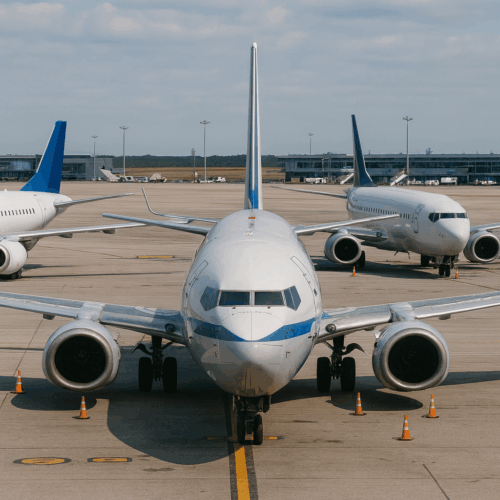
By the end of the year, the number of business trips in Russia is expected to rise slightly to 21.7 million, compared to 21 million last year, according to a forecast by the Moscow-based consulting firm J’son & Partners Consulting. However, the tourism industry is under immense pressure. Due to intensified Ukrainian drone attacks, flights are regularly delayed or canceled. Russian airports temporarily suspended operations 2,860 times for security reasons in the first eight months of this year alone, the aviation authority Rosaviatsiya reported in October.
“Business travelers are extremely sensitive to delays and rescheduled appointments, as negotiations and important business processes depend on adhering to the schedule,” explains Stepan Mastryukov, head of business travel at the tour operator OneTwoTrip. On the other hand, rising prices for airline tickets and accommodations are becoming an increasingly significant factor, resulting in reduced travel budgets, Mastryukov added.
Average travel costs currently amount to 63,000 rubles per person, equivalent to 696 euros. In 2025, companies paid an average of 56,200 rubles (597 euros) per trip, compared to 45,700 rubles (456 euros) in 2024, according to figures from J’son & Partners Consulting. Next year, analysts expect another sharp increase in average travel costs to 69,600 rubles (769 euros).
According to data from Aeroclub, one of Russia’s leading business travel organizers, a plane ticket for an international business trip cost an average of 40,000 rubles (442 euros) in the first nine months of 2026. In the third quarter of this year, analysts even recorded a price increase to 44,000 rubles, equivalent to 486 euros. Those who chose business class paid 190,300 rubles (2,103 euros) during the same period.
According to forecasts, the business travel market is expected to grow by 16% this year to 1.36 trillion rubles (15.03 billion euros). Last year, the business travel market had a volume of 1.180 trillion rubles (12.55 billion euros). Market experts attribute this growth to rising travel costs. For next year, J’son & Partners Consulting expects a volume of 1.49 trillion rubles (16.4 billion euros)—more than triple the 2020 figure, when the segment generated 468 billion rubles (5.68 billion euros) in revenue.
Companies Are Tightening Their Belts
One of the most common cost-cutting measures companies are taking is switching from business class to business-economy, reveals Aeroclub press spokesperson Julia Schadrina. Companies are also reducing the size of their travel delegations and organizing online participation in events taking place elsewhere instead of sending employees on trips, says Schadrina. This applies to conferences, negotiations, and exhibitions. Schadrina sums up that cost-cutting on business travel sometimes leads companies to try to juggle as many tasks as possible during a single business trip.
However, no one wants to do away with business travel entirely. Even though companies are managing business trips more frugally today, issues related to deliveries, partnerships, and market entry abroad still need to be resolved in person, says Aeroclub Director Julia Lipatowa. While the number of economy-class bookings fell by 8% in the first nine months compared to the same period last year, the number of business-class flights rose by 12%. Lipatova attributes this to the fact that, at present, it is primarily company executives and highly qualified professionals who are traveling abroad on business.
When it comes to domestic travel, some industries are traveling significantly less than before. For example, Russian companies in the oil and gas industry booked 40% fewer flights in the second quarter of this year. Sectors such as IT and pharmaceuticals showed a much greater willingness to travel abroad on business trips. Last year, the IT and telecommunications sector accounted for the largest share of international business travel at 19%. The pharmaceutical industry followed in second place (12%), and the Russian energy sector came in third, with a decline from 12% in 2024 to 8% in 2025.
Most Popular Destinations
According to Aeroclub, the duration of business trips has increased from five to six days. Another trend: Flights within Russia are increasingly being replaced by train travel. According to Aeroclub, these account for 48% of all business trips. The Moscow–St. Petersburg train route alone accounts for 70% of bookings. Overall, 40% of all business trips are to Moscow and St. Petersburg. Yekaterinburg, Novosibirsk, and Kazan follow. OneTwoTrip does not provide data on the market share of these destinations.
According to Aeroclub, most international business trips currently go to China, which holds a 22% market share. Kazakhstan ranks second (11%), followed by Belarus (10%), Turkey (8%), and Uzbekistan (also 8%). Places six through ten go to Armenia (4%), Serbia (4%), the United Arab Emirates (3%), India (2%), and Georgia (2%). Travelers pay the least for a flight to Belarus (13,000 rubles – 143 euros) and the most for a ticket to Serbia (55,900 rubles – 618 euros).
Sources: Kommersant, Forbes 1, 2, Tourprom, Delovoy Peterburg
Source: German-Russian Chamber of Foreign Trade, “Turbulent Travel Costs: Business Travel Becoming Increasingly Expensive,” November 6, 2026.
This article was prepared for the German-Russian Chamber of Foreign Trade.
Earlier coverage: Russia
- Russia: Tunnel through the Bering Strait for $205.4 billion · November 14, 2026
- Xenia Sobchak: Ban on Starting a Business in Russia Until 2029 · November 13, 2026
- Russia: The 18 Richest Russians Lose $25 Billion · November 13, 2026
- Russia: 5th in the World in GDP According to the Big Mac Index · November 12, 2026
The day's most important Russian economic stories. Free, in your inbox three times a week.
Mon, Wed, Fri. Double opt-in, unsubscribe anytime. By subscribing you consent to the processing of your email address as described in our Privacy Policy.