Russian Bakery Industry: Local Bread Rolls Are Getting More Expensive
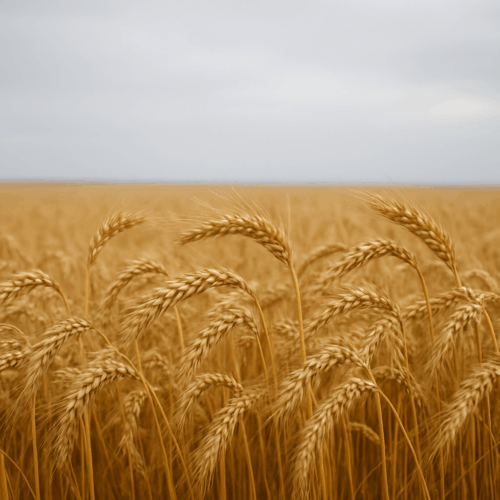
On display at the Bread Museum in St. Petersburg is a small gray loaf weighing 125 grams, baked according to a recipe from the time of the Siege of Leningrad. Belarusian President Alexander Lukashenko presented a similar loaf to his Russian counterpart on May 9 of this year, the 81st anniversary of Victory Day. “It was interesting to try the blockade bread,” President Vladimir Putin remarked. The famine of the 1920s, the meager bread rations during World War II, the blockade rations mixed with sawdust, the cornbread of the Khrushchev era, the empty shelves during Gorbachev’s perestroika — bread was not a given during certain periods of Soviet rule.
Bread with a History: From Artisanal to Factory-Made
In Tsarist Russia, bread was mainly baked by artisans in bakeries and on farms. In the USSR, the first bread factory with mechanized production lines opened in Moscow in 1925. There, 80 workers baked about 40 metric tons of loaf bread daily. In the 1930s, more efficient, automated factories sprang up throughout the Soviet Union.
After the Great Patriotic War (1941–1945), the baking industry was rebuilt in record time despite enormous destruction. Assembly-line production, automated lines, and optimized recipes were introduced.
For decades, the price of basic bread in the USSR was socially regulated and remained unchanged. The state subsidized the difference between production costs and the retail price. Bakers did not have to compromise on quality, seek out cheaper alternatives, or speed up the production process. On the other hand, the selection of baked goods in the USSR was severely limited.
In the second half of the 1980s, decentralization and the introduction of enterprise-level accounting led to supply bottlenecks and flour shortages. The proportion of low-quality flour in total production rose from 20% in 1980 to 47% in 1986. In the other Soviet republics, it even reached 90%. A quarter of the bakeries had to be written off due to dilapidation. The quality of bread baked in small bakeries was significantly worse than that of large-scale operations, which led to consumer dissatisfaction.
The State Trade Inspection Agency attempted to identify substandard products as early as the production stage using state standards (GOST). Nevertheless, substandard products inevitably found their way onto store shelves. The industry fell into crisis. However, ration cards did not have to be reintroduced.
At the time of the collapse of the USSR, the Ministry of the Food Industry controlled approximately 2,500 large bread factories and 500 mechanized bakeries. The Zentrosoyuz cooperative system, which supplied rural areas, operated over 10,700 bakeries, while the Ministry of Railways and other agencies maintained 4,120 bakeries.
Was bread better in the past?
The Russian Bakers’ Association, which includes 220 member bakeries, looks back nostalgically on the strict quality standards of the Soviet era. At that time, GOST standards regulated not only the composition of bread but also the production technology. Only certain types of flour were permitted, and the quantities of ingredients were strictly controlled. Baking improvers, baking powder, and preservatives were banned. The flour was made from durum wheat with optimal protein content and a high gluten content. Modern varieties, on the other hand, are often designed for maximum yield rather than optimal baking quality.
In the USSR, the pre-dough method was used, in which the dough was allowed to rise for four to six hours. The pre-dough—a mixture of flour, water, and yeast—was fermented for several hours. Only then were the remaining ingredients added, and the dough underwent another fermentation phase. This extended fermentation allowed for the breakdown of complex carbohydrates and proteins, making the bread more flavorful and easier to digest.
Modern bakeries have largely switched to an accelerated process in which all ingredients are mixed at the same time and the fermentation process is shortened to 1.5 to 2 hours. This allows more bread to be baked in less time, though at the expense of product quality. Flavor enhancers and flavorings are added, but these do not replace natural fermentation.
Bread Sales by Category
According to the analysis agency Infoline, there were 29,890 bakeries in Russia in 2025. According to the analysis agency BusinessStat, the bakery market reached a volume of 7.5 million metric tons in 2025, an increase of 1.5% over the previous year. In terms of value, this market amounted to nearly 1.67 bio rubles, equivalent to 16.9 billion euros, according to calculations by the “Dom Chleba” bakery chain.
The industry produced 44,000 metric tons of chilled semi-finished baked goods, with sales rising by 8% thanks to reduced logistics costs and the ability to bake locally. There was stable demand for bread snacks, particularly those with various additives (70,000 metric tons), rolls and pretzels (139,000 metric tons), Middle Eastern sweets (54,000 metric tons), and pretzel sticks and breadsticks (11,000 metric tons).
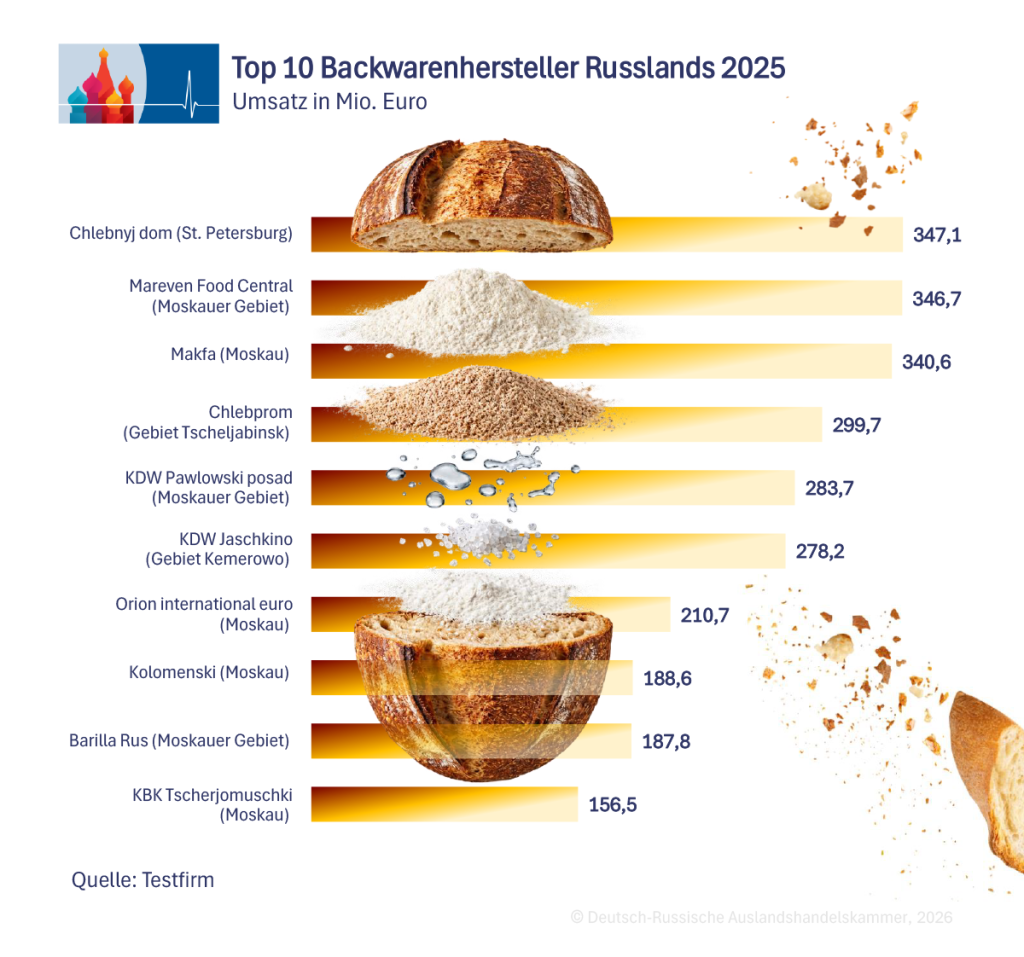
Graphic: German-Russian Chamber of Foreign Trade
The category of cakes, tarts, and donuts for on-the-go consumption grew by 19%. Bakeries are increasingly promoting cakes and donuts as accompaniments to coffee. Supermarkets, in turn, are expanding their selection of fresh baked goods, and online delivery services are adding baked goods to their “quick order” category. Artisanal breads—baked in small batches with natural ingredients and a long fermentation process—as well as functional products enriched with vitamins, minerals, and dietary fiber also saw strong growth.
Sales of traditional breads and baked goods made from wheat, rye, and a mixture of rye and wheat flour declined by 3% to 5%, while the price of bread rose by 12.8% year-over-year.
According to the analytics firm NTech, 1.4 million metric tons of bread were sold in 2025, an increase of just 0.9% compared to 2024. This weak growth continued into the first quarter of 2026. Sales of loaves of bread rose by only 2% in the first three months compared to the previous year, while sales of traditional loaf-shaped bread increased by 4% and sales of baguettes declined by 1%.
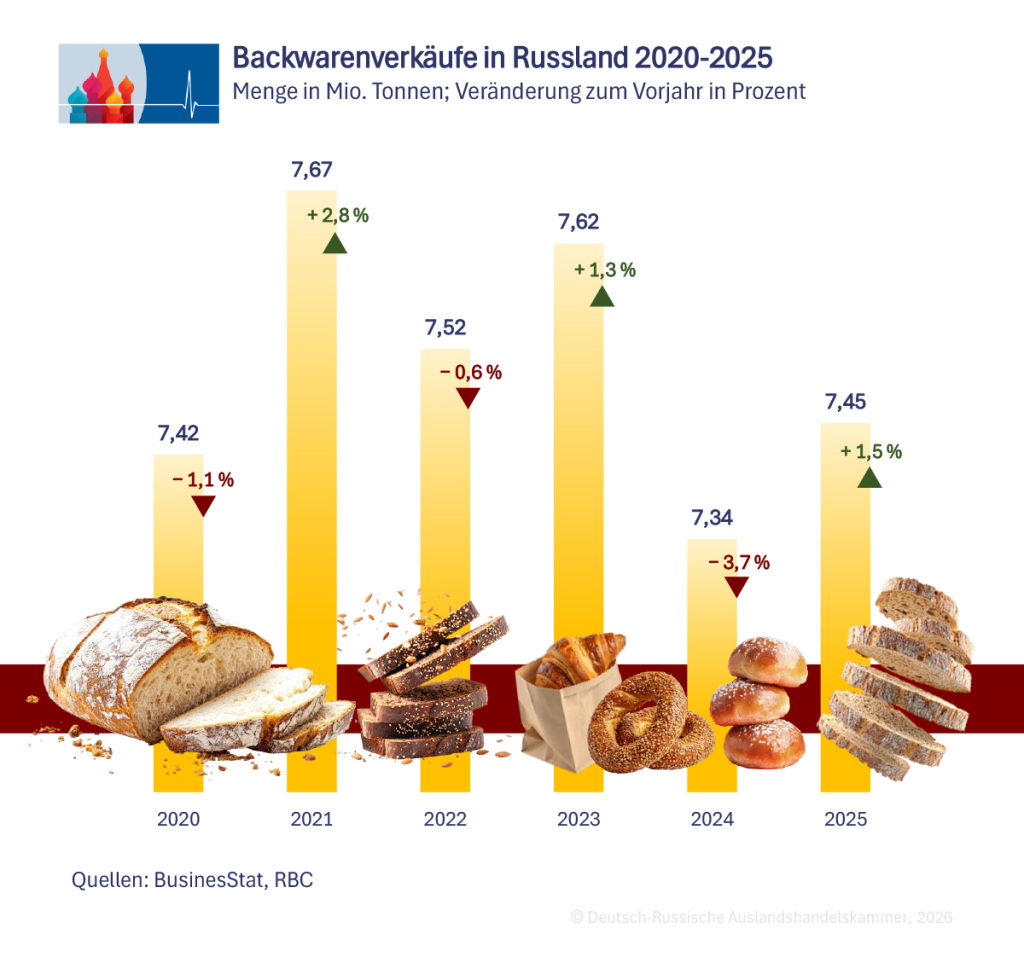
Graphic: German-Russian Chamber of Foreign Trade
Loaves of bread and box loaves, which remain a staple for the older generation, families with children, and residents of small towns, are gradually losing popularity and being displaced by competition from bakeries, particularly by the growing selection of “national” bread varieties such as lavash, tortillas, and ciabatta. For example, at the O’Key supermarket chain, ciabatta sales rose by nearly 290% in the first five months of 2026 compared to the previous year, sales of bread with additives increased by 16%, while baguette sales rose by 5.3%.
Small Businesses in Crisis
Small bakeries produce over 90% of Russia’s bread. In March 2026, there were still around 7,600 such businesses in cities with more than one million residents. However, their number has fallen by 7% compared to 2024.
The mass closure of small bakeries was driven by various factors, including rising rents and insufficient electricity capacity. Above all, however, many bakeries were struggling with the increase in the value-added tax rate from 20% to 22%, which was accompanied by a drastic reduction in the income threshold for applying the simplified tax system—from 60 million to 20 million rubles (from 60,000 to 200,000 euros), which exempts businesses from paying value-added tax. Added to this were sharp increases in raw material prices for flour, butter, sugar, and other ingredients, a growing shortage of skilled workers, and the declining purchasing power of the Russian population.
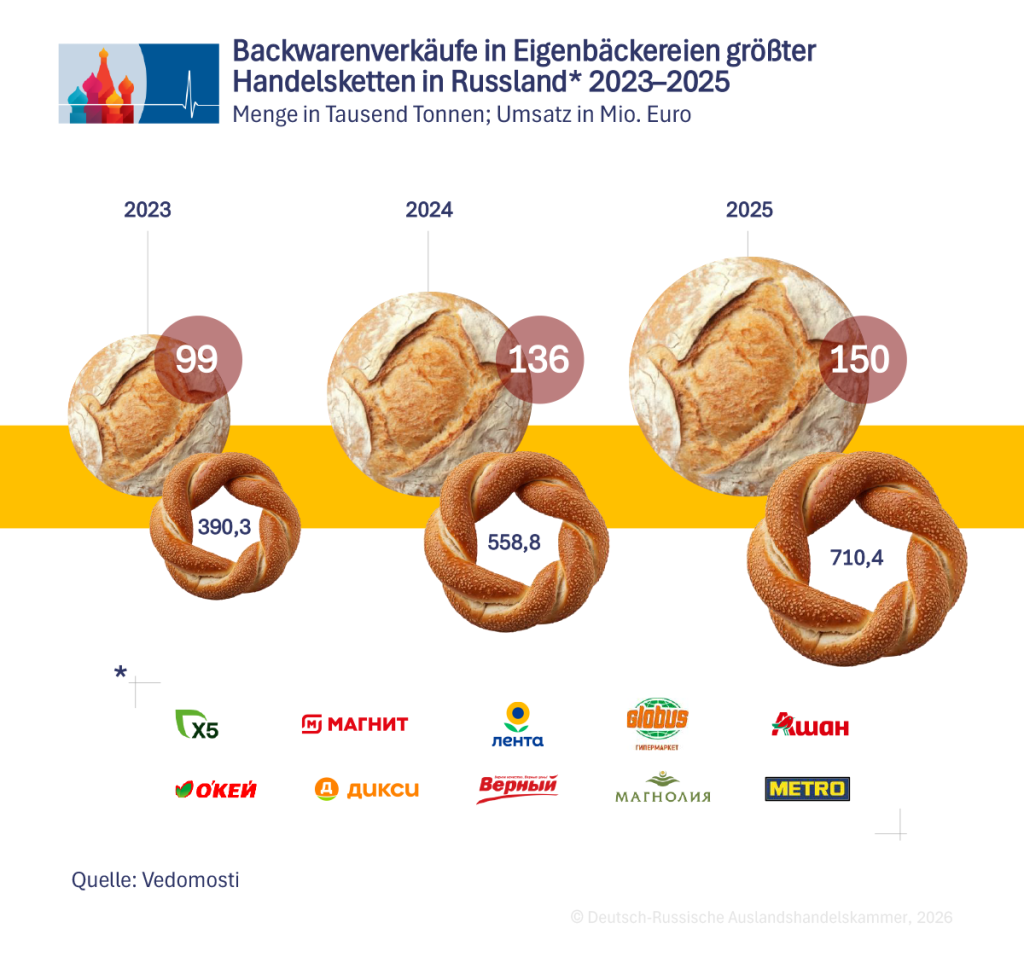
Graphic: German-Russian Chamber of Foreign Trade
Supermarket chains are increasingly setting up their own bakeries and are gradually displacing small bread producers. Total retail sales of baked goods reached 67 billion rubles in 2025, equivalent to 680 million euros. The industry continues to expand actively. For example, the Magnit supermarket chain opened 2,100 new stores last year, bringing the total number of its in-house bakeries to 6,500. Magnit’s retail sales volume rose by nearly 70%, while the supermarket chain Pyaterochka’s sales increased by 20%. A total of 80% of Pyaterochka stores have a bakery—and new stores are no longer opened without one. They have now become an integral part of the business model.
Today’s consumers are no longer satisfied with the selection of mini-cafés: they want not only high-quality coffee and desserts, but a full-service restaurant serving breakfast, lunch, and dinner. Bakeries therefore occupy a niche between traditional restaurants and fast-food chains, offering quick service at a reasonable average price.
Freshly baked goods have become the new standard in food retail and offer an affordable option for a meal. It remains to be seen which competitor will prevail: retailers who source ingredients at low wholesale prices, or independent bakeries that prioritize quality. While the average consumer today is cutting back on everything—even a croissant for breakfast—there are still those who can easily afford it.
Goodbye to Full-Scale Production: The Shift to Frozen Goods
According to data from the international conference “Modern Bakery 2025,” sales of frozen baked goods in Russia rose by 14% last year to 731,000 metric tons. The frozen baked goods segment is growing steadily, driven by fluctuating demand, labor shortages, and the expansion of retail chains and the foodservice industry, which require standardized, high-quality products.
Retailers are moving away from complex, in-house production processes (mixing ingredients, baking) and are instead turning to centralized production: Pre-made products are flash-frozen in commercial kitchens and then thawed and baked at the point of sale within 10 to 15 minutes. A production run lasting just a few hours is sufficient to produce a two-week supply of frozen products. Analysts at the Neo agency describe frozen baked goods as the most profitable segment of the baking industry. Their production profitability exceeds 30%.
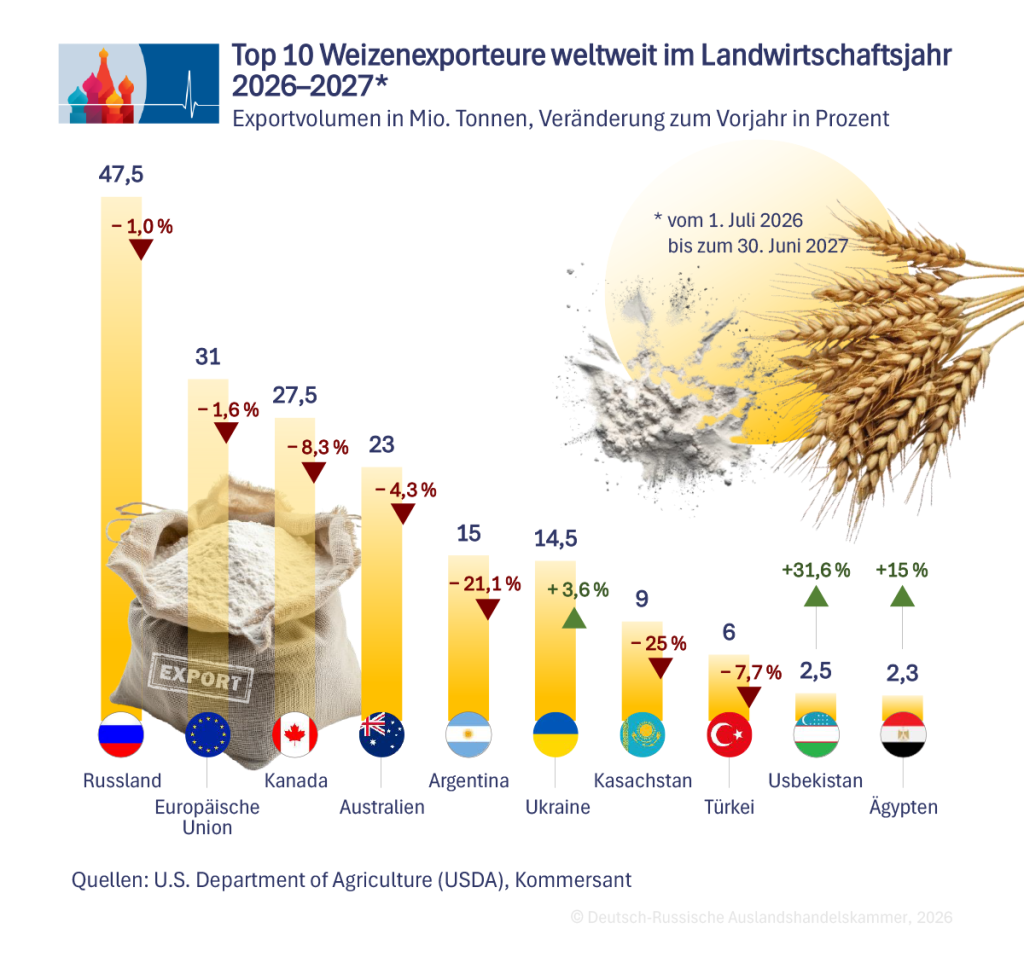
Graphic: German-Russian Chamber of Foreign Trade
Trend Toward “Affordable Premium Products”
The “Modern Bakery 2026” trade fair in Moscow presented new trends in the bread industry this spring. These include modernization—through the use of robotics and domestic software, among other things—the use of predictive analytics and AI, and the expansion of high-performance production lines. By 2030, the share of domestic equipment in grain storage and processing is expected to reach 87%, and 57% in the edible oil and fat industry as well as in the bread industry. According to forecasts, bakery chains will expand in the retail sector and in rural areas.
Recipe optimization—that is, adapting recipes for healthier eating—is also gaining popularity in Russia. This includes a preference for sourdough and whole-grain bread, the selection of “clean label” products, the reduction of sugar content and the optimization of calorie content, the increase in protein and fiber content, the integration of prebioticsand probiotics, the switch to natural colors and flavorings, and the automation of production at all stages—from sourdough to packaging.
Bread sales at discount stores are declining due to rising prices. At the same time, more affluent customers who value a healthier lifestyle are increasingly buying from smaller bakeries or even baking their own bread. Irina Osokina of the agricultural conglomerate RusAgro spoke at the “Bread and Pastries” conference about a “new underclass.” This refers to people who, until recently, lived in relative prosperity but are now forced to rethink their consumption habits. This target group, in particular, is among the main consumers of the “affordable premium” segment: products with higher nutritional value, enriched with fiber, protein, vitamins, and minerals, that are slightly more expensive than mass-market products.
“Today,” says Marina Kostyuchenko, director of the Research Institute of the Bakery Industry, “the popularity of whole-grain flour products containing sunflower, flaxseed, sesame, pumpkin, and sprout seeds, as well as alternative flours such as buckwheat, oats, and amaranth, is on the rise”. The St. Petersburg-based company Sdorovy Khleb, which translates to “Healthy Bread,” completely avoids wheat flour and produces high-protein, low-carbohydrate, and low-gluten baked goods, snacks, and desserts made from spelt, flaxseed, lupine, and Jerusalem artichoke.
Recipe for Success: Croissants from Mondelez
The Chipita confectionery factory in St. Petersburg, which is owned by the U.S. conglomerate Mondelez International, has increased its croissant production by 20% over the past two years. Last year, the plant in Krasnoye Selo, located in the city on the Neva River, produced 36,000 metric tons of croissants, reaching its full capacity. Mondelez is the global market leader in the baked goods sector, with a market share of 11.5%.
Among others, the factory supplies the Russian retail chains Pyaterochka, Perekrestok, Chishik, Magnit, and Krasnoye i Beloye with packaged croissants and even exports to CIS countries. In 2025, the company increased its international export volume by 30% compared to the previous year. The products are made entirely from Russian ingredients. In addition to the plant in St. Petersburg, Mondelez International, headquartered in Moscow, operates three other plants: two in the Vladimir region and one in Veliky Novgorod. The two plants produce chocolate, cookies, biscuits, chewing gum, and candies.
According to the analysis agency BusinessStat, sales of baked goods in the snack segment rose by 19% in 2025. Mikhail Burmistrov, managing director of the market research firm Infoline Analitika, attributes this, among other things, to rising chocolate prices, which in turn were driven by higher cocoa bean prices resulting from a poor harvest in West Africa. As a result, given the growing popularity of coffee, some consumers are increasingly opting for croissants instead of chocolate. Sales of croissants will continue to grow moderately, according to the expert.
Source: German-Russian Chamber of Foreign Trade, Russian Bakery Industry: Local Bread Rolls Are Getting More Expensive, October 22, 2026.
This article was prepared for the German-Russian Chamber of Foreign Trade.
The day's most important Russian economic stories. Free, in your inbox three times a week.
Mon, Wed, Fri. Double opt-in, no tracking, unsubscribe anytime. By subscribing you consent to the processing of your email address as described in our Privacy Policy.