Forecasts for Russia's growth are slowly approaching one percent
Author: Klaus Dormann
In 2025, growth in the Russian economy declined sharply. The “war boom” of 2023 and 2024 cooled off to a 1 percent increase in real gross domestic product. Many forecasts throughout 2026 predicted that the increase in aggregate economic output would decline significantly further that year. At one point, the Russian Ministry of Economic Development projected growth of just 0.4%. In September, however, it raised its forecast for 2026 to 0.6 percent. This weak growth rate was also anticipated in the latest analyst surveys conducted by the Russian Central Bank and the Interfax news agency in October and early November. However, the trend in output during the third quarter now appears to be raising hopes in Russia that this year’s overall economic growth could be closer to one percent.
Forecasts are converging “from the bottom” and “from the top”
On Friday, the statistics agency Rosstat released a “preliminary estimate” indicating that overall economic output in the third quarter was 1% higher than in the previous year. In response, the Ministry of Economic Development stated that real gross domestic product growth in 2026 could “slightly” exceed its previous forecast of 0.6% (Finmarket.ru).
Central Bank Governor Nabiullina stated in a speech to the Duma on November 12 that the Central Bank expects GDP growth of around one percent “by the end of 2026.” Interfax and numerous other media outlets subsequently reported that Nabiullina had said the Central Bank expected economic growth of around one percent “this year” (see quotes at the end of the article). In its “Medium-Term Forecast” updated on October 23, the Central Bank had projected a rise in real gross domestic product for 2026 in the range of 0.5 to 1 percent.
In the monthly economic survey conducted by the Interfax news agency, analysts’ growth forecasts for 2026 had already risen on average from 0.5% to 0.6% by early November.
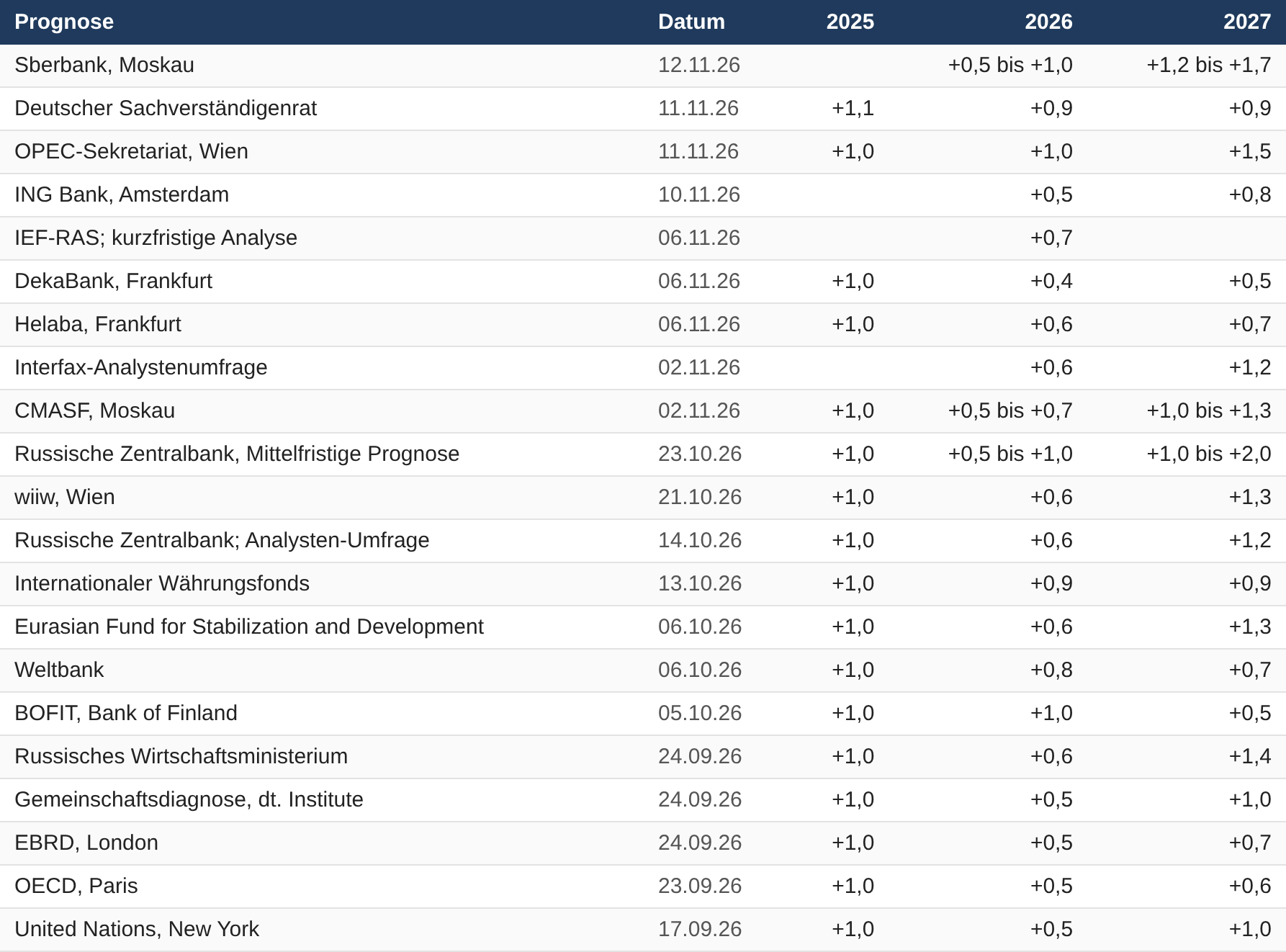
While growth forecasts in Russia are thus gradually approaching a GDP increase of around one percent “from below,” Germany’s “German Council of Economic Experts” and the Vienna-based OPEC Secretariat have lowered their growth forecasts for Russia. In its “Annual Report,” the German Council of Economic Experts revised down its semi-annually updated forecast for Russia’s economic growth this year from 1.2% to 0.9%. The Vienna-based OPEC Secretariat lowered its forecast for Russia—updated monthly in the “Oil Market Report”—from 1.1% to 1%.
GDP Forecasts for Russia, 2025–2027
: Year-over-year change in real gross domestic product, in percent
Sources: Data from the institutions cited; compiled by Klaus Dormann
Will growth accelerate in 2027 as expected by the government?
Although growth forecasts for 2026 are pointing in different directions, they now almost all fall within a narrow range of 0.5 to 1 percent. Following the Central Bank’s lead, Russia’s Sberbank also cited this growth range as its forecast in late October (Vedomosti).
There are noticeably greater differences in the assessments of how the economy will develop next year. While the Russian government and many Russian analysts expect growth to accelerate to over 1 percent in 2027, nearly all international observers anticipate that Russia’s growth rate will largely stagnate next year or reach at most 1 percent. Exceptions include the OPEC Secretariat, which expects growth to accelerate to 1.5% in 2027, and the “Vienna Institute for International Economic Comparisons,” which forecasts that growth will double from 0.6% to 1.3%. Sberbank even considers it possible that growth could accelerate to between 1.2% and 1.7% in 2027 (Interfax).
Like the IMF, the German Council of Economic Experts also expects growth of only 0.9% in 2027
On November 11, the German “German Council of Economic Experts” published its “Annual Report.” The brief notes on the development of the Russian economy that were customary until a few years ago are no longer included. Only a table on economic growth and consumer price trends in selected countries also contains forecasts for Russia.
The German Council of Economic Experts now expects Russia’s annual economic growth to reach only 0.9% in both 2026 and 2027, which is likely to be slightly lower than in 2025. These forecasts align exactly with the GDP projections published by the International Monetary Fund in mid-October in its “World Economic Outlook.” By contrast, in their “Joint Economic Assessment” released in late September, the five leading German economic research institutes expected Russia’s economic growth to halve to 0.5 percent in 2026 and not return to 1 percent until 2027.
Compared to its “Spring Report” published in late May 2026, the German Council of Economic Experts lowered its forecasts for Russia’s economic growth even further. It revised its forecast for 2026 downward by 0.3 percentage points, from 1.2% to 0.9%. It also lowered its forecast for growth in 2027 from 1% by 0.1 percentage points to 0.9%. The Council thus expects the Russian economy’s growth rate to stagnate at just under 1% in 2026 and 2027.
In contrast to the Expert Council and the IMF, however, the Russian government expects the Russian economy’s growth to accelerate next year from 0.6% to 1.4%. This assessment largely corresponds to the average growth forecasts in the latest Interfax analyst survey, which projects growth will double from 0.6% to 1.2% (Finmarket.ru).
Rosstat: In the third quarter of 2026, GDP was 1% higher than a year ago
According to a “preliminary estimate” released on Friday by the Federal State Statistics Service (Rosstat), Russia’s real gross domestic product rose by 1 percent in the third quarter of 2026 compared to the third quarter of 2025. This estimate from Rosstat is significantly higher than an earlier estimate of 0.6% from the Ministry of Economic Development (Finmarket.ru). Rosstat plans to release more detailed data on GDP composition on December 11 and on GDP expenditure on December 30 (russland.capital; Finam.ru).
How GDP Evolved Quarter by Quarter Through the Second Quarter of 2026
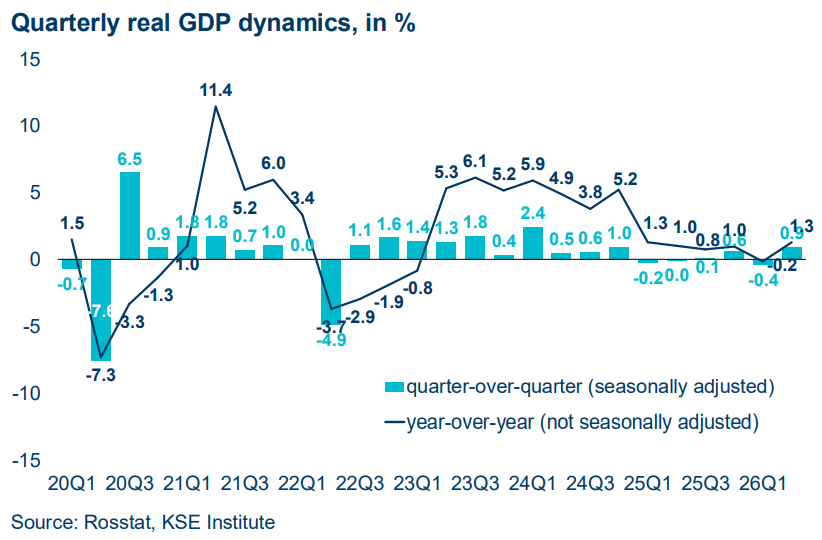
In the following figure from the “Russia Chartbook” published by the Kyiv School of Economics in early November, the dark blue line shows the annual rates of change in real gross domestic product for the quarters from the first quarter of 2020 through the second quarter of 2026. The turquoise bars show the seasonally adjusted quarter-over-quarter rates of change. According to the Kyiv School of Economics, GDP rose by 0.9% on a seasonally adjusted basis in the second quarter of 2026 compared to the previous quarter.
Quarterly Change in Real Gross Domestic Product (%)
Source: Kyiv School of Economics: Russia Chartbook, Nov. 3, 26
In the second quarter of 2026, GDP rose by 1.3 percent year-over-year, while in the first quarter it fell by 0.2 percent. It is important to note the differences in the number of working days: The first quarter of 2026 had three fewer working days than the first quarter of 2025, while the second quarter had three more working days than the previous year. In contrast, the third quarter of this year had the same number of working days as last year.
“Hard Numbers”: GDP in Line with the Trend in the Third Quarter
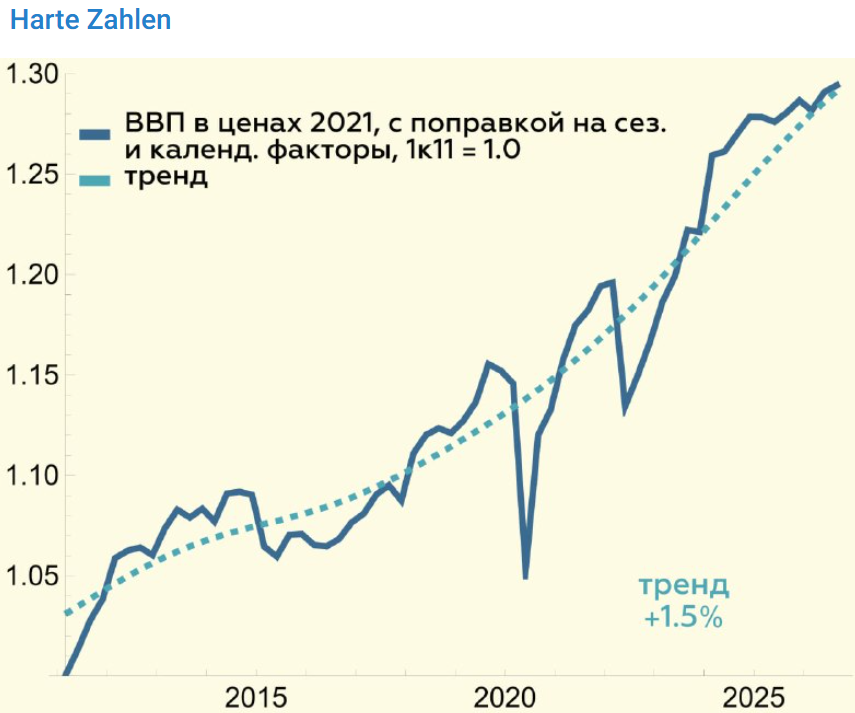
In the third quarter of 2026, according to preliminary calculations by the Russian Telegram channel “Hard Numbers,” GDP continued to rise on a seasonally and calendar-adjusted basis compared to the previous quarter. According to “Hard Numbers,” the Russian economy is growing at an annual rate of 1.5% (dotted turquoise line in the figure below). Since 2024, the real gross domestic product trend line has far exceeded the trend line due to high economic growth during the “war boom” of 2023 and 2024. Due to the slowdown in annual growth to around 1 percent since 2025, the real gross domestic product trend line has once again approached the trend.
Quarterly trend in real gross domestic product since 2011
; Q1 2011 = 1; seasonally and calendar-adjusted
Source: Hard Numbers: What Was the GDP Like in the 3rd Quarter of 2026? The Trend Is Confirmed; Nov. 13, 2026
Ministry of Economy: Our forecast for 2026 may be slightly exceeded
At the end of September, the Russian Ministry of Economic Development raised its growth forecast for 2026 from 0.4% to 0.6% (Finmarket.ru). Following the announcement of Rosstat’s new estimate of 1% growth for the third quarter, the ministry stated in a comment that this exceeded its own previous estimate of 0.6% GDP growth for the third quarter. The ministry explained that its forecast for growth in 2026 as a whole—0.6%—could also be slightly exceeded.
Finmarket quotes the ministry’s statement as follows:
“The Russian economy continues to grow despite external challenges and constraints. According to current data, GDP growth in the third quarter was driven by domestic demand and certain sectors of the real economy. The manufacturing sector recorded growth, with mechanical engineering and metallurgy making the largest contributions. The construction sector is back on a growth trajectory, and freight traffic has continued to increase.”
“Rosstat’s preliminary estimate suggests that GDP growth rates through the end of 2026 could be slightly higher than the current forecast. Further growth will depend on the pace of structural reforms in the economy and the effective implementation of national projects.”
German Council of Economic Experts: Russia’s Inflation to Decline Only Slightly in 2027
After Russian consumer prices rose by 8.7% year-over-year in 2025 compared to 2024, the German Council of Economic Experts expects the annual inflation rate in Russia to decline significantly to 6.2% in 2026. This forecast aligns with that of the Russian Central Bank, which expects an inflation rate of 6.2 to 6.3% this year (Central Bank’s medium-term forecast).
In 2027, according to the Council of Experts, the annual average inflation rate will be only slightly lower at 5.8%. The Russian Central Bank, however, considers a further decline in the inflation rate to as low as 5.2% possible. However, its forecast range extends from 5.2% to a price increase of 5.7%. By the end of 2027 and then also as an annual average for 2028, the Central Bank aims to reach its inflation target of 4%.
The OPEC Secretariat continues to expect accelerated growth in 2027
Unlike the German Council of Economic Experts—which, in line with many international economic organizations, does not expect the Russian economy’s growth to accelerate to over one percent next year—the Vienna-based OPEC Secretariat, in the November issue of its monthly “Oil Market Report,” continues to anticipate that the Russian economy will pick up slightly in 2027, with real gross domestic product growth reaching 1.5%. Growth will be driven by further monetary easing and stable domestic demand.
This would mean that economic growth next year would be slightly higher than the Russian government’s forecast, which anticipates an acceleration in economic growth from 0.6% in 2026 to 1.4% in 2027.
The OPEC Secretariat’s View on Russian Fiscal and Monetary Policy
The OPEC Secretariat summarizes its assessment of the economic implications of the government’s fiscal policy and the central bank’s monetary policy as follows:
Fiscal policy is likely to continue supporting the economy, even though the budget for the period 2027–2029 calls for gradual consolidation: The federal deficit is projected to decline from 3.2% of GDP in 2026 to 2.2% in 2027 and to 1.9% in 2028 and 2029. High spending on defense, security, and social programs will continue to limit fiscal flexibility.
Monetary policy is also likely to remain restrictive for longer than originally anticipated. The Russian Central Bank left its key interest rate unchanged at 14% in both September and October, as short-term price pressures remained high.
The central bank has raised its inflation forecast for the end of 2026 to 7.1–7.6% and now expects an average key interest rate of 12.5–13.5% for 2027. Monetary easing is therefore likely to proceed much more slowly than previously expected. Inflation is now not projected to return to the 4% target until sometime in 2027.
OPEC Secretariat: Russian Economy to Grow by 1 Percent in 2026
The OPEC Secretariat has lowered its forecast for Russian economic growth in 2026 to 1%. It explains this forecast as follows:
“Following the decline in the first quarter of 2026, economic activity recovered only modestly in the subsequent quarters. GDP growth slowed to about 1% year-over-year in the third quarter of 2026. While household demand, government spending, and commodity prices continue to provide support, recent indicators point to weaker momentum: private-sector activity is virtually stagnant, and growth is increasingly concentrated in government-supported sectors. Against this backdrop, the growth forecast for 2026 was revised downward from 1.1% (last month’s estimate) to 1%.
Regarding the current “moderate” growth, the OPEC Secretariat notes in summary:
Household demand is proving to be relatively robust. Unemployment is near a historic low. However, high financing costs, labor shortages, and capacity constraints are increasingly weighing on production growth. Outside of government-subsidized sectors, economic growth is slowing. Damage to energy infrastructure poses a further risk to growth because it affects fuel supplies, prices, and exports.
The Purchasing Managers’ Index has fallen to the “growth threshold”
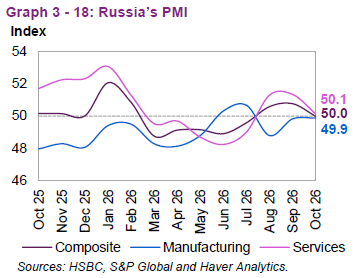
Regarding the current “moderate” performance of the Russian economy, the OPEC Secretariat also points to the trends in the Purchasing Managers’ Indices published by the research firm S&P Global. The following figure shows that the “composite” Purchasing Managers’ Index, the “Composite PMI Output Index,” fell to an index value of 50 in October (black line in the figure). The OPEC Secretariat reports that the trends in the Purchasing Managers’ Indices for the manufacturing sector (blue line) and the services sector (purple line) thus pointed to largely stagnant activity in the private sector overall in October. An index value of 50 is considered the “growth threshold.”
Purchasing Managers’ Indices for Russia
Source: OPEC Secretariat, Vienna: Monthly Oil Market Report, November 11, 26
The OPEC Secretariat reports:
“The Purchasing Managers’ Index for the manufacturing sector rose slightly from 49.8 in September to 49.9, remaining just below the 50-point threshold. Production and new orders continued to decline—albeit only slightly—while export orders fell at the sharpest rate since May 2022. Employment also declined, though at a slower pace than at the beginning of the year; furthermore, business sentiment improved somewhat.
The Purchasing Managers’ Index for the services sector fell in October from 51.3 in September to 50.1, indicating near-stagnation after two months of growth. New business declined for the first time in three months, foreign demand weakened significantly, and business confidence continued to wane.”
Nabiullina: “By the end of 2026,” the economy will grow by one percent
Elvira Nabiullina, President of the Russian Central Bank, commented on the current state of the Russian economy last week during two speeches on November 9 and November 12 in the Russian Parliament regarding the monetary policy guidelines adopted by the Central Bank.
In its “Medium-Term Forecast,” updated on October 23, the Central Bank expects real gross domestic product to grow by 0.5 to 1 percent in 2026. For economic growth in the fourth quarter of 2026 compared to the fourth quarter of 2025, the “Medium-Term Forecast” projects a growth rate of 0 to 1.5%.
At the Duma plenary session on November 12, Nabiullina stated—according to the text of her speech published by the Central Bank in Russian—that the Central Bank expects GDP growth of around one percent “by the end of 2026” (“We expect GDP to grow within the range of 1% by the end of the year”). It remains unclear, however, whether she meant the year-over-year GDP growth rate for 2026 compared to 2025 or perhaps just the annual growth rate for the fourth quarter.
At the same time, the president emphasized that much, of course, depends on how quickly the production facilities damaged by Ukrainian attacks can be restored:
“As you can see, the situation varies by industry, but overall, the economy has recovered in the second half of the year. We expect GDP growth of around 1% by the end of the year. This is despite production losses in some sectors resulting from the attacks. Without this factor, economic growth this year would certainly have been higher.
What is driving this growth? The machinery sector, particularly the military-industrial complex. Rising incomes and consumer spending are leading to growth in retail and in many sectors geared toward domestic demand.
The latest data point to a gradual increase in economic growth. Much depends, of course, on how quickly the production capacity damaged by the attacks can be restored. The government and businesses are doing everything they can to restore and protect the facilities as quickly as possible.”
Interfax.com quoted Nabiullina’s assessments of economic growth trends in its English edition as follows:
“As you can see, the situation varies across different sectors, though the economy overall has moved onto an upward trajectory in the second half of the year. We expect GDP to grow approximately 1% this year despite the loss of production capacity in certain sectors owing to attacks. Were it not for this factor, economic growth would of course have been higher this year.”
Recommended Reading
German-Russian Chamber of Foreign Trade:
- Big in Purchasing Power, Small in Dollars: Russia’s Economy in a Country-by-Country and Citizen-by-Citizen Comparison, Nov. 12, 26
- Russian-African Economic Relations, Nov. 5, 26
- Serbs Oppose Sanctions, Nov. 3, 26
- Cabinet reshuffle: Superminister to rein in budget spending, Oct. 30, 26
Overall Economy (Austrian Chamber of Commerce: Country Profile—Russia, as of Oct. 2026;
TradingEconomics: News; Calendar; Riddle, Kommersant, Vedomosti, Politkom, inveb.ru, Finam)
- russland.capital: Russia’s Economy Grows by One Percent—Slightly More Than Expected; Nov. 14, 26
- t-online; Tobias Schibilla: Russia’s War Industry. A Horrific End Is on the Horizon; Nov. 14, 26; Sources: CEPA: “Managing Russia’s Military-Industrial Degradation,” Nov. 10, 26; Carnegie Russia Eurasia Center; Alexandra Prokopenko: “Who Is Funding Russia’s War in the 2027 Budget?”, Oct. 2, 26
- Finmarket.ru: Russia’s GDP grew by 1% in the third quarter. Preliminary Rosstat estimate, Nov. 13, 26
- Kommersant.ru: Russia’s GDP grew by 1% in the third quarter; November 13, 2026
- Anadolu Agency; Gokhan Ergocun: Russia’s GDP growth slows to 1% year-on-year in Q3. GDP slows from 1.3% expansion in Q2, though beats the Economic Development Ministry’s 0.6% estimate, November 13, 2026
- Finam.ru: Investment in fixed assets in Russia fell by 6.2% in the third quarter. This marks the third consecutive quarter of decline, November 13, 2026
- Invest-Foresight (if24.ru): Gref spoke about the rise in delinquent payments, 11/13/26
- Aktien News, Daniela Eckert: Russia’s economy is slowing due to Ukrainian attacks on industry, Nov. 13, 2026; The Print, Bloomberg: Russian economy hit as Ukrainian attacks deal a blow to industry, Nov. 13, 2026
- The Hill, Comments by Dov Zakheim, opinion contributor: Russia’s economy is reeling — Trump should be raising the pressure if he wants peace, November 13, 2026
- Kommersant.ru: Nabiullina linked the economic downturn to drone attacks. Nabiullina: Russia’s GDP growth will not exceed 1% by the end of the year, Nov. 12, 26; Nabiullina on the drawbacks of preferential mortgages, the high key interest rate, and the reasons for the economic slowdown, November 12, 2026
- Politkom.ru; Nikita Maslennikov: Between a Mild Recession and Low Growth; 11/12/26
- Kommersant; Artem Chugunov: The economy is in line with forecasts. Current GDP growth is in line with annual expectations; 11/11/26
- S&P Global: Russia Business Outlook, November 11, 2026; Russia Services PMI, Russia Composite PMI, November 5, 2026; Russia Manufacturing PMI, November 2, 2026
- Carnegie Russia Eurasia Center; Alexander Kolyandr and Alexandra Prokopenko: How Are Russian Banks Posting Record Profits Amid Economic Stagnation? Nov. 10, 2026
- russlandTV: Gaidar Institute: Russia’s Economy Lacks the Foundation for Stronger Growth, November 9, 26
- Kommersant; Artem Chugunov: Oil Prices and Weakening Demand Slowed Growth. Gaidar Institute Analysis of the Slowdown in Russian Economic Growth; November 8, 26
- Bank of Finland Institute for Emerging Economies (BOFIT); Parviainen, Sinikka; Pyle, William: Material Well-Being in Wartime Russia: Evidence Through the End of 2025; BOFIT Policy Brief, November 9, 2026
- BOFIT, Bank of Finland: Russian GDP growth remains sluggish despite huge increases in government spending; Weekly Review 45/2026, November 6, 2026
Economic Forecasts:
- TASS: Ministry of Economic Development: Year-end GDP growth could exceed forecasts. According to preliminary estimates by Rosstat, annual GDP growth in the third quarter of 2026 will be 1%; November 13, 2026
- Interfax.ru: The Central Bank expects Russian GDP to grow by about 1% in 2026. The data suggest that growth rates will rise in the future, Nabiullina said, November 12, 2026
- Sberbank Forecasts: Interfax.ru: Sberbank expects Russia’s GDP growth to range from 1.2% to 1.7% in 2027, with inflation between 4.5% and 5%; Nov. 12, 2026; Interfax.com: Sberbank forecasts Russia’s GDP growth at 1.2%–1.7% and inflation at 4.5%–5% in 2027, Nov. 12, 2026; Vedomosti: Sberbank has raised its forecast for Russian GDP growth in 2026 to 1%, Oct. 28, 2026
- Kommersant; Artem Chugunov: The economy is performing in line with forecasts. Current GDP growth is in line with annual expectations; Nov. 11, 2026
- German Council of Economic Experts: Annual Report and Spring Report; November 11, 2026
- OPEC Secretariat, Vienna: Monthly Oil Market Report, Nov. 11, 26
- IEF-RAS: “Short-Term Analysis of Gross Domestic Product Trends,” November 6, 26
- Bank of Russia: Commentary on the Bank of Russia’s Medium-Term Forecast, Nov. 5, 26
- CMASF: Macroeconomic Base Forecast, 10/30/26
- RBC.ru: Sberbank has raised its inflation forecast and revised its GDP forecast. It expects GDP growth of 0.5–1% and inflation of 6.5–7.5% by the end of 2026; October 28, 2026
- Bank of Russia: Medium-Term Forecast; October 23, 2026
- Vienna Institute for International Economic Comparisons (wiiw): Fall Forecast 2026;
Andreas Knapp; Press Releases: English; German; Executive Summary; Richard Grieveson: Central, East, and Southeast Europe in 2027: Resilient Growth in a More Dangerous World, Oct. 21, 2026;
wiiw Country Overview: Russia; Additional Press Reports: wiiw in the Press - Bank of Russia: Macroeconomic Survey of the Bank of Russia, October 14, 2026
- International Monetary Fund, IMF: World Economic Outlook: Resilience Under Strain, Urgent Choices, October 2026; Press Briefing Transcript: World Economic Outlook, Annual Meetings 2026, October 13, 2026
- World Bank: Country Report: Russian Federation, in: Macro Poverty Outlook; Europe and Central Asia Update; October 6, 2026; World Bank: Press Release; Europe and Central Asia: Slower Growth with Global Headwinds; October 6, 2026
Monetary Policy, Inflation (Central Bank Calendar; Interfax Reports, TASS, Kommersant)
- Kommersant.ru: Nabiullina linked the economic downturn to drone attacks. Nabiullina: Russia’s GDP growth will not exceed 1% by the end of the year, November 12, 2026; Nabiullina on the drawbacks of preferential mortgages, the high key interest rate, and the reasons for the economic slowdown, November 12, 26
- TASS: GDP growth forecasts and affordable mortgages. Statements by Nabiullina. Speech by Elvira Nabiullina, Chair of the Bank of Russia, at a plenary session of the State Duma, November 12, 2026
- Bank of Russia: Speech by Elvira Nabiullina at the State Duma plenary session on the main directions of the unified state monetary policy for 2027–2029, in Russian; Nov. 12, 2026
- bne Intellinews; Ben Aris: Russia’s inflation jumps to about 7% in October, ruling out early rate cuts. The central bank’s weekly estimate puts annual inflation at the bottom of its raised forecast range, November 11, 26
- Business FM: Rosstat reported a rise in weekly inflation to 0.12%; “Everything is within seasonal norms,” says Sofya Donez, chief economist at T-Investments; Nov. 11, 2026
- Russia.capital: Nabiullina: Attacks on infrastructure are slowing further interest rate cuts, 11/10/26
- TASS: Plans to cut the key interest rate and raise prices. Statements by Nabiullina. The phase of restrictive monetary policy is a necessary step toward lower interest rates, and this path must be followed through to the end, explained the head of the Central Bank of Russia. 11/09/26
- Bank of Russia: Speech by Elvira Nabiullina at a joint meeting of the State Duma committees on the main directions of the unified state monetary policy for 2027–2029, in Russian, November 9, 2026; Speech in English: Elvira Nabiullina’s speech at a joint meeting of State Duma committees on Monetary Policy Guidelines for 2027–2029, November 9, 2026
Fiscal Policy; National Budget (Interfax reports)
- Finam.ru; Olga Belenkaya: Budget – The cumulative deficit remained virtually unchanged in October. Budget expenditures are rising faster than expected, but the pace is slowing; November 11, 2026
- bne Intellinews, Ben Aris: Russia’s ten-month budget deficit climbs to RUB5.2 trillion, 2.3% of GDP. Higher oil and gas taxes in October all but balanced the month, but the ministry’s own year-end estimate implies another $25 billion in the red by December, November 10, 2026
- FR; Bleranda Shabani: A billion-dollar hole in the budget: Russia’s war economy comes under pressure, Nov. 9, 2026
Energy sector, fuel supply, infrastructure (DW in Russian: Fuel crisis)
- Kreiszeitung; Felix Busjaeger: Ukraine Strikes Lukoil Refinery—Oil Processing Plummets, 11/13/26; Jens Kiffmeier: 30 Percent of Capacity Paralyzed: Ukrainian Sustained Fire Plunges Russia’s Oil Economy into Crisis; November 11, 2026
- Finanzmarktwelt; Josephine Bollinger-Kanne: No More Cheap Gas from Russia—Hungary Changes Course, Nov. 12, 26
- bne Intellinews; Ben Aris: EU’s bill for Russian Yamal LNG hits €8.7bn with 50 days left before the ban. Europe has paid more for Yamal gas in ten months than in all of 2025, as higher prices outpace a 6% increase in volumes ahead of January; 11/11/26
- Merkur.de; Marcel Reich: Trump Wants to Sell Putin’s Gas to Europe: Controversial Plan for Peace in Ukraine Puts the EU in a Dilemma; November 8, 2026
- Der Standard; Nicolas Dworak, András Szigetvari: How Can the EU Get Out of the Gas Crisis? With Gas from Russia, Say the U.S.; Nov. 7, 2026
- Die Presse Podcast; Eduard Steiner discusses with wiiw economist Vasily Astrov and Johannes Benigni, international energy consultant: More Russian Gas for Europe Again: Is Trump’s Idea Toxic or Brilliant? with transcript; 39 min., Nov. 5, 2026
Foreign Trade, Sanctions; Tagesschau: Russia Sanctions
- Meduza: Russia’s economy is suffering under the weight of war and sanctions. So why is the ruble still one of the world’s strongest currencies? Nov. 6, 2026
- ZDFheute News: Ukraine: Military expert Lange on the collapsed diesel deal and talks in Abu Dhabi. The diesel deal between the U.S. and Russia may have fallen through. According to the Financial Times, Russian diesel is not arriving in the U.S. as agreed; November 6, 2026
Political Landscape; BR24: Russia
- Ronzheimer; Interview with CNN Correspondent Fred Pleitgen: Inside Moscow: The Calm Before the Storm? Pleitgen reports on the mood in Russia, the consequences of Ukrainian drone attacks, and the question of how much longer Putin can continue his war. He explains why the Kremlin is pinning great hopes on Donald Trump and what demands Russia intends to push through; November 9, 26
- Union Foundation; Interview by Michael Scholl with Dr. Ignaz Lozo, ZDF journalist and historian of Eastern Europe: FORMER MOSCOW CORRESPONDENT: Why Putin’s Plan in Ukraine Is Failing Is NATO’s eastward expansion to blame for the war in Ukraine? Lozo explains why he sees Putin’s power waning. He identifies flaws in Germany’s policy toward Russia. His thesis: There will be no further Russian attack on a European country, but the pinpricks will continue, November 8, 2026
- TAZ Interview by Mathias Brüggmann: Mikhail Khodorkovsky on Russia. “We Should Talk to Putin.” A conversation about sanctions, war, and the Russian opposition, November 7, 2026
VEB Institute: Report on the meeting of the “Economy” working group of the Petersburg Dialogue; November 10, 2026: On October 29, 2026, a meeting of the Petersburg Dialogue’s Economy working group took place in Kaliningrad. The topic was “The Development Strategy of the Kaliningrad Region in Interaction with the Baltic States under the New Geopolitical Conditions.” The event was organized by the VEB Institute in cooperation with the Institute for Europe of the Russian Academy of Sciences and the Russian branch of the Petersburg Dialogue. Participants included representatives from academia and business, public organizations, lawyers, and journalists from Russia, Germany, Austria, and France.
See also:
- Tagesschau.de: German Shadow Diplomacy. A Back Door to Moscow? July 16, 2026
- Wikipedia: Petersburg Dialogue; with references to the unofficial continuation of the activities of the association, which was dissolved in April 2023.
Earlier analyses by Klaus Dormann
- Russia: industrial output rises 1.8% in September · November 9, 2026
- Russia: GDP grows just 0.5% in September · November 2, 2026
- Russia: key rate stays at 14%, wiiw sees 0.6% growth · October 26, 2026
- Russia forecasts 2027: IMF, World Bank, OECD compared · October 21, 2026
The day's most important Russian economic stories. Free, in your inbox three times a week.
Mon, Wed, Fri. Double opt-in, unsubscribe anytime. By subscribing you consent to the processing of your email address as described in our Privacy Policy.