How Much of the Money from Car Sales Stays in the Country: A Comparison of Lada, VW, Tesla, Haval, and BYD
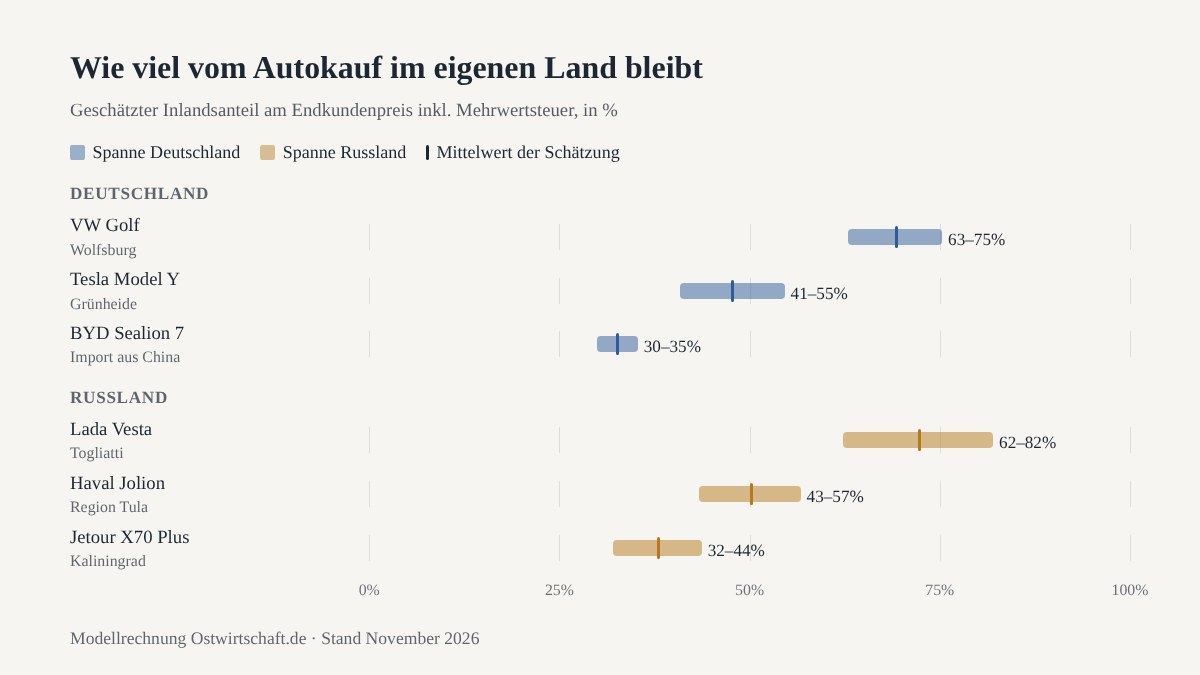
A Tesla from Brandenburg contributes about 15 percentage points more of the purchase price to the German economy than a BYD from China. In Russia, a Haval from Tula generates nearly as much domestic value added per vehicle as a Lada. It’s the location that matters, not the brand.
Analysis by Thomas Baier
According to our model calculations, about 69% of the purchase price of a new VW Golf remains in Germany, compared to only about 33% for a BYD Sealion 7. The difference lies in the production location, not the brand’s origin. A Tesla Model Y from Grünheide, at around 48%, is significantly closer to the Golf than to the Chinese import. The same pattern emerges in Russia: A Lada Vesta from Togliatti accounts for about 72%, a Haval Jolion from the Tula region for about 50%, and a Jetour X70 Plus from Kaliningrad for about 38%. If you factor out the value-added tax (VAT) incurred on every domestic purchase, the figures drop to 53%, 32%, and 17% in Germany, and 54%, 32%, and 20% in Russia. These figures are estimates with margins of 10 to 20 percentage points. They allow for a division into three groups, but not an exact ranking.
The starting point is clear for both markets. A buyer in Germany chooses between a Model Y for 39,990 euros from Brandenburg and a Sealion 7 for 49,990 euros from China. A Russian car buyer chooses between a Vesta starting at 1.58 million rubles (17,400 euros) and a Jolion starting at 2.05 million rubles (22,500 euros). In both cases, the question is what portion of this money goes toward wages, profits, and taxes in their own country.
1. How to Measure the Domestic Share of a Car Purchase
The purchase price of a new car is broken down into four parts. The first is value-added tax (VAT): In Germany, it is 19%, which amounts to 16% of the gross price. In Russia, it rose from 20% to 22% as of January 1, 2026, which corresponds to 18% of the gross price. The second component consists of domestic trade, logistics, and distribution. The third component is the manufacturer’s ex-factory price. It includes wages, depreciation, and profits at the factory, as well as all purchased parts. The fourth component consists of import duties, if the car is imported.
Domestic value added is generated at the factory itself and by all domestic suppliers along the supply chain. A sheet of steel from Salzgitter counts, while a semiconductor from Taiwan does not. Wages and profits are part of this value added. Adding them separately results in double counting. Our model avoids this by breaking down the factory price only once: into a domestic and a foreign component.
There are no model data available for this breakdown. Manufacturers do not publish the cost structures of individual vehicles. We therefore work with industry averages and plausibility ranges. According to an analysis by the Munich-based ifo Institute, the German auto industry operated with an intermediate input ratio of around 75% of the production value. Thus, only a quarter of the factory-gate price is generated at the auto plant itself. The rest depends on where the suppliers are located.
Two terms must be distinguished. The Russian debate refers to “localization” and usually means the number of components sourced from Russian suppliers. This count says little about value. One hundred locally manufactured plastic clips weigh less than a single imported control unit. Our model therefore focuses on the value share.
Here’s an overview of the results, each expressed as a percentage of the retail price:
| Model | Country | Price | Domestic share, including sales tax | Excluding VAT | Domestic Amount (Average) |
|---|---|---|---|---|---|
| VW Golf 1.5 TSI | DE | 32,080 euros | 63–75% | 47–59% | 22,200 euros |
| Tesla Model Y RWD | DE | 39,990 euros | 41–55% | 25–39% | 19,100 euros |
| BYD Sealion 7 | DE | 49,990 euros | 30–35% | 14–19% | 16,300 euros |
| Lada Vesta | RU | 1.58 million rubles | 62–82% | 44–64% | 1.14 million rubles (12,600 euros) |
| Haval Jolion | RU | 2.45 million rubles | 43–57% | 25–39% | 1.23 million rubles (13,500 euros) |
| Jetour X70 Plus | RU | 3.10 million rubles | 32–44% | 14–26% | 1.18 million rubles (12,900 euros) |
Source: Eastern Economy’s own model calculation, prices as of November 2026, Russian Central Bank exchange rate of 91.03 rubles per euro (November 14, 2026)
How much of the car purchase price remains in the home country
Estimated domestic share of the retail price, including VAT, in %
- Range in Germany
- Range in Russia
- Average of the estimate
Show table
| Model | Country | Lower limit | Mean | Upper limit |
|---|---|---|---|---|
| VW Golf | DE | 63% | 69% | 75% |
| Tesla Model Y | DE | 41% | 48% | 55% |
| BYD Sealion 7 | DE | 30% | 33% | 35% |
| Lada Vesta | RU | 62% | 72% | 82% |
| Haval Jolion | RU | 43% | 50% | 57% |
| Jetour X70 Plus | RU | 32% | 38% | 44% |
Sources: Purchase prices: manufacturers and retailers (as of November 2026); VAT: German VAT Act (UStG) §12, Federal Law No. 425-FZ; Customs duties: EU Implementing Regulation 2024/2754, Decision 2020/2053; Exchange rate: Russian Central Bank, 91.03 rubles per euro (November 14, 2026); Value-added shares: Eastern Economy’s own model calculation.
Methodology: Domestic share = value-added tax + domestic trade and distribution + domestic value added at the plant and among domestic suppliers + domestic customs duties. Ranges based on plausibility assumptions; no manufacturer data. Recycling fee in Russia assumed to be refunded for locally manufactured products.
2. Lada Vesta: High vertical integration, controversial quota
AvtoVAZ has been manufacturing the Vesta again in Togliatti since March 2023, after production in Izhevsk was halted due to a shortage of parts. According to the automotive portal Kolesa.ru, the 2026 model year costs 1.581 million rubles (17,400 euros). Sales are sluggish: In October 2026, the Vesta sold 4,956 vehicles, according to the analysis agency Autostat—33.5% fewer than a year earlier.
Localization is the central point of contention. AvtoVAZ states that, since 2022, it has localized 1,825 components and materials with Russian suppliers. For the Vesta, Granta, Largus, and Niva, the group cites a localization rate of 96%, measured by the number of parts. The state-run automotive institute NAMI arrives at different figures. Its analyst, Alexander Gortschakow, put the confirmed localization rate for the Granta—the most localized Russian model—at 45.7%. For all passenger cars built in Russia, NAMI calculated a weighted average of 32.8% for the year 2024, reports the daily newspaper Izvestia. “The figures we cite are confirmed by documents from the Chamber of Commerce and Industry,” says Gortschakow.
The truth probably lies somewhere in between. The NAMI method only accounts for documented components and technologies. Some of the value added in Togliatti is missing from this calculation: the stamping plant, body shop, paint shop, and engine and transmission production. Conversely, electronics, semiconductors, and individual engine parts continue to come from China and other countries. We therefore estimate the domestic share of the factory price at 50 to 75 percent. This accounts for 62 to 82 percent of the purchase price, including sales tax. The wide range is honest: publicly available data does not allow for a more precise estimate.
One feature sets the Vesta apart from all other models. Profits and the corporate headquarters are Russian. AvtoVAZ reported a net profit for the first half of 2026 and plans investments of more than 40 billion rubles (440 million euros) for the full year, as reported by the industry portal Autonews.ru. Development, procurement, and administration are based in Togliatti. This portion of the value added is factored into the price of every Vesta and remains in the country.
3. VW Golf: Main Plant with an Expiration Date
The Golf is its German counterpart. The base model, the 1.5 TSI Life with 116 PS, has a list price of 32,080 euros. It is built in Wolfsburg, the flagship plant, which, according to Volkswagen, employs around 70,000 people (as of 2024). The manufacturing process is considered particularly labor-intensive. “This makes the production of our bestseller immensely complex,” said Rainer Fessel, the plant manager at the time, referring to the many variants, as quoted by the magazine *auto motor und sport*. According to this, it takes about 20 hours to build a Golf.
There are many factors in favor of a high domestic content. The engine, transmission, and many major components come from German Group plants and German suppliers. Development, purchasing, and Group administration are based in Wolfsburg. However, the industry’s international interdependence works against this: wiring harnesses from North Africa, electronics from Asia, and castings from Eastern Europe. According to the state-owned development bank KfW, the industry contributed about 21% to the value added of the manufacturing sector in 2022. At the same time, the share of German supplier parts has declined with the rise of electric cars, KfW writes, without providing a specific figure. We estimate the domestic share of the factory-gate price at 50 to 65%. Including sales tax and retail, the Golf’s domestic share comes to 63 to 75%.
This figure has an expiration date. Starting in 2027, Volkswagen will shift production of the gasoline-powered Golf to its plant in Puebla, Mexico. Additionally, as of late October 2026, the company has temporarily paused development work on the electric successor, the ID. Golf, according to the industry portal Electrive. The main plant is missing its cost-saving targets for 2026 by around 300 million euros, reports the portal Ecomento. A Golf from Puebla will be sold in Germany as an import. The trade agreement between the EU and Mexico makes it duty-free, but the value added from assembly is generated in Mexico. According to our estimates, its domestic market share is likely to be closer to that of a Tesla than to that of today’s Golf. Group-level development and some of the components remain German, but the assembly does not.
4. Tesla Model Y: American company, value added in Brandenburg
Tesla builds the Model Y for Europe in Grünheide near Berlin. The base model costs 39,990 euros. According to its annual financial statements, Tesla Manufacturing Brandenburg SE employed 11,083 people—including temporary workers—at the end of 2025, up from 11,003 the previous year. It produced approximately 202,000 vehicles, 9,000 fewer than in 2024. Revenue fell from 7.7 to 7.1 billion euros, while net income rose from 56.8 to 77.1 million euros, reports Electrive.
These figures illustrate how Tesla distributes value creation. On a per-vehicle basis, the plant generated approximately 35,000 euros in revenue. Profit amounted to about 380 euros per car, or roughly 1% of revenue. Grünheide effectively functions as a manufacturing site. The group’s profit margin is generated primarily by the parent company. For Germany, this means that wages, depreciation on the plant, energy, and local services remain in the country. The majority of the company’s profits flow to the U.S.
The largest import item is the battery. So far, battery packs have been manufactured in Brandenburg, while the cells come from the U.S. and Asia. Starting in 2027, Tesla plans to manufacture its own 4680-format cells in Grünheide and invest just under 250 million U.S. dollars to do so. Capacity is expected to reach 18 gigawatt-hours per year, plant manager André Thierig announced. The goal is to have “enough cells, enough batteries” for the growing vehicle production, he told the broadcaster rbb24. At the same time, Tesla plans to increase production to up to 7,500 vehicles per week and create 3,500 jobs, 1,500 of which will be in cell production.
We currently estimate the domestic share of the factory price to be 25 to 40%. This figure is lower than for the Golf because cells, electronics, and some of the powertrain components are imported, and R&D as well as consolidated profits are based in the U.S. On the other hand, the distribution share is smaller because Tesla sells directly. Overall, 41 to 55% of the purchase price remains in Germany. With in-house cell production, this figure would rise. By how much depends on where the cathode and anode materials come from.
5. Haval Jolion: Chinese brand, Russian full cycle
Great Wall Motor has been operating its largest plant outside of China in the Tula region since 2019. The plant in the Usslovaya Industrial Park includes a stamping shop, body shop, paint shop, and assembly line. Since March 2024, a dedicated factory there has been manufacturing engines, and mechanical machining of engine parts will be added starting in 2025. In August 2026, a second stamping line went into operation, with a capacity of 150,000 vehicles per year, according to the Interfax news agency. This was followed in September by a plant for automatic transmissions—the first of its kind for Great Wall in Russia. According to the Kolesa.ru portal, approximately 4,000 employees work at the site.
The Jolion is the volume model. Since 2021, more than 259,000 units have rolled off the assembly line in Tula. In 2025, Haval sold over 65,700 Jolions in Russia. The updated 2026 model year costs 2.049 million to 2.649 million rubles (22,500 to 29,100 euros). For our calculation, we’ll use the mid-range Optimum trim level priced at 2.449 million rubles (26,900 euros). “Localization is the most important prerequisite that allows us to maintain a stable presence on the Russian market,” says Zhang Junxue, head of Great Wall in Russia, in an interview with the Gazeta.ru portal. The rolled sheet metal for the body parts is also to be sourced from Russian production.
The official assessment, however, remains cautious. According to the Ministry of Industry’s scoring system, the Jolion 2025 scored 1,630 points, while the Granta scored 5,284 points, reports the website www1.ru, citing NAMI. Electronics, infotainment systems, and—until fall 2026—transmissions will come predominantly from China. We estimate the domestic share of the factory price at 25 to 40 percent. Including taxes and retail, 43 to 57 percent of the purchase price remains in Russia.
A portion of this consists of profits made by the Chinese owner. The former distribution company, Haval Motor Rus, increased its net profit 25.8-fold in 2023 to more than 7.5 billion rubles (81 million euros), with revenue of 323 billion rubles (3.5 billion euros), Interfax reported. These profits are generated in Russia and are subject to income tax there. The dividends are sent to China. For the country’s value added, the full profit counts; for the income of Russian residents, only the portion subject to tax counts.
6. Jetour X70 Plus: Assembled in Kaliningrad, Value Added in China
The Jetour X70 Plus rolls off the assembly line at contract manufacturer Avtotor in Kaliningrad. Since 2025, Avtotor has been welding and painting the car bodies itself, reports Autonews.ru. A modernized welding line has since enabled the production of the Dashing and the X70 Plus with complete body construction. In our estimation, the engine, transmission, electronics, and large parts of the interior are likely to continue coming from China as component kits. The list price is 3.099 million rubles (34,000 euros); according to the trade journal *Sa Rulem*, a price of 2.499 million rubles is achievable with discounts.
This places the X70 Plus between two production models. In pure screw assembly—known in technical jargon as SKD—the painted body arrives fully assembled. In CKD assembly, individual parts are delivered, and the plant handles the welding and painting itself. In a full-cycle operation, such as the one in Tula, a stamping plant is added, followed later by engine and transmission production. The X70 Plus has reached the second stage. We estimate the domestic content of the factory price at 10 to 22 percent. Including taxes and retail markups, this amounts to 32 to 44 percent.
The brand itself is undergoing a transformation. At the end of October 2026, the AGR holding company unveiled the new Votour brand, whose first model, the V5, is a rebranded Jetour Dashing, according to Autonews.ru. It remains to be seen whether the X70 Plus will be built under a new name and at a different location in the future. For our calculation, the name makes no difference. What matters is which manufacturing steps take place in Russia.
7. BYD Sealion 7: Taxes and Trade Instead of Manufacturing
The Sealion 7 comes from Chinese plants. According to BYD manager Stella Li, the new plant in Szeged, Hungary, is scheduled to begin series production in the fourth quarter of 2026. According to Reuters, the compact car Dolphin Surf will be the first model to roll off the assembly line. For now, the Sealion 7 will remain an imported vehicle. It starts at 49,990 euros in Germany; in its fall 2026 leasing offer, BYD lists a purchase price of 41,990 euros.
A 10% standard tariff and a 17% countervailing duty apply at the border. The European Commission has set this rate for BYD via an implementing regulation. Starting in January 2026, Chinese manufacturers can replace the additional duty with minimum price commitments. However, BYD, Geely, and SAIC will continue to pay it until such a commitment is approved. For Germany, the duty is only partially a source of revenue. According to the EU’s Own Resources Decision, member states retain 25% to cover collection costs. The remaining 75% goes into the EU budget. The Commission proposes lowering this retention rate to 10% for the next financial framework.
This allows the Sealion 7 to be broken down more precisely than any other model. Of a 100-euro purchase price, 16 euros go to the tax authorities as value-added tax. About 13 euros go to retailers, the importer, ports, and logistics providers. Approximately 15 euros are customs duties, of which just under 4 euros go to Germany and a good 11 euros to Brussels. About 56 euros cover the ex-factory value of the goods and ocean freight. These costs are incurred almost entirely in China. This results in a domestic share of 30 to 35 percent. Excluding VAT, the figure is 14 to 19 percent.
Another factor shifts the balance. For registrations starting in January 2026, the federal government is subsidizing private buyers of electric cars with up to 6,000 euros, depending on income and the number of children. The program has a budget of 3 billion euros. The subsidy does not distinguish based on the place of production. In an extreme case, a subsidized buyer of a Sealion 7 could receive more in subsidies than the German government collects in customs duties. We do not include the subsidy in the quota calculation because it depends on the individual buyer.
Where do 100 euros or 100 rubles of the purchase price go?
Breakdown of the retail price, average estimate
- Value-Added Tax
- Domestic value added
- Foreign value added
- Customs duties (share for Germany and the EU)
View table
| Model | Value-Added Tax | Domestic Value Added | Foreign value added | Customs duties (share of Germany and the EU) |
|---|---|---|---|---|
| Tesla Model Y | 16 | 32 | 52 | 0 |
| BYD Sealion 7 | 16 | 13 | 56 | 15 |
| Lada Vesta | 18 | 54 | 28 | 0 |
| Haval Jolion | 18 | 32 | 50 | 0 |
Sources: Purchase prices: Manufacturers and dealers (as of November 2026); VAT: German VAT Act (UStG) §12, Federal Law No. 425-FZ; Customs duties: EU Implementing Regulation 2024/2754, Decision 2020/2053; Exchange rate: Central Bank of Russia, 91.03 rubles per euro (Nov. 14, 2026); Value-added shares: Eastern Economy’s own model calculation.
Methodology: Average values from the estimate, rounded; segments do not overlap and total 100. Domestic value added includes trade, distribution, manufacturing, and domestic suppliers. In the case of BYD, 25% of the tariff goes to Germany, and 75% to the EU budget. Uncertainty per segment: ±5 to 10 points; see Figure 1 for ranges.
8. Germany and Russia: Two Paths to Localization
Both countries want to keep value added within their borders. They use different instruments to achieve this. Russia relies on levies, points, and subsidies. The key tool is the recycling surcharge, the Utilisazionny Sbor. For a new passenger car with a displacement of 1 to 2 liters and 160 to 190 PS, it will amount to 900,000 rubles (9,900 euros) in 2026, and 800,800 rubles (8,800 euros) for a 1.5-liter engine with 150 PS. The rates will continue to rise annually through 2030. Domestic manufacturers also pay the levy but receive a refund through industry subsidies if their models accumulate enough localization points. For 2026, a simplified threshold of 2,000 points applies.
The levy therefore functions like a refundable tariff for domestic manufacturers. For the government, it is an important source of revenue: According to the magazine Profil, it is expected to contribute up to 1.7 trillion rubles (18.7 billion euros) to the budget in 2026. The Ministry of Industry is granting major manufacturers a payment deferral until December 2026. The ministry explained that this is due to “the current conditions of expensive credit financing.” In our calculations, we treat the tax on locally manufactured vehicles as neutral. Whether the Jolion, with 1,630 points, will receive the full refund has not been publicly confirmed. If it does not, part of the purchase price will shift from the industry to the government.
The consequences are measurable. Russian plants accounted for 63% of passenger cars sold in June 2026, up from 56% for the full year of 2025, according to the parliamentary newspaper. However, part of this consists solely of assembly. The strategy for the auto industry called for a localization rate of 65% by 2026. NAMI considers the risk of missing this target to be high. “You can’t achieve a high level of localization overnight, simply by snapping your fingers and issuing directives from government offices,” says Maxim Kadakov, editor-in-chief of Sa Rulem.
Germany takes the opposite approach. There are no localization requirements, no point systems, and no national tariffs. External protection is handled by the EU, and it applies only to imports from third countries. Businesses are attracted through location policy and subsidies. Tesla chose Grünheide because of the sales market, not because of tariffs. BYD chose Hungary because a plant in the EU avoids countervailing duties. However, a BYD plant in Szeged would hardly generate any more value added for Germany than one in China. Assembly would take place in Hungary, and the German customs duty of just under 4% would be eliminated.
9. What the Numbers Show—and What They Don’t
Percentages and absolute amounts tell different stories. Vesta has the highest domestic content in Russia, but not the highest domestic value. At 72% of 1.58 million rubles, approximately 1.14 million rubles (12,600 euros) remain in the country. For Jolion, it’s 50% of 2.45 million rubles, or about 1.23 million rubles (13,500 euros). Even the Jetour, at 38% of 3.1 million rubles, comes to around 1.18 million rubles (12,900 euros). Per vehicle, all three models are thus quite close in terms of revenue. Excluding VAT, the Vesta is again in the lead, with about 860,000 rubles compared to 790,000 rubles for the Jolion and 620,000 rubles for the Jetour.
In Germany, the gap is wider. The Golf contributes about 22,200 euros to the economy, the Tesla about 19,100 euros, and the BYD about 16,300 euros. For the BYD, however, nearly 8,000 euros of that is VAT. This VAT would also apply to any other domestic purchase. When comparing purchasing decisions, therefore, the key factor is the value added excluding tax: about 17,100 euros for the Golf, 12,700 euros for the Tesla, and 8,300 euros for the BYD.
One car purchase, two effects: rate and amount
Estimated domestic amount per vehicle, broken down into value added and value-added tax (average)
- Domestic value added (DE)
- Domestic value added (RU)
- Value-Added Tax
View table
| Model | Share (incl. VAT) | Domestic Amount | of which excluding VAT |
|---|---|---|---|
| VW Golf | 69% | €22,200 | €17,100 |
| Tesla Model Y | 48% | €19,100 | €12,700 |
| BYD Sealion 7 | 33% | €16,300 | €8,300 |
| Lada Vesta | 72% | 1.14 million ₽ | 0.86 million ₽ |
| Haval Jolion | 50% | 1.23 million ₽ | 0.79 million ₽ |
| Jetour X70 Plus | 38% | 1.18 million ₽ | 0.62 million ₽ |
Sources: Purchase prices: manufacturers and dealers (as of November 2026); VAT: German VAT Act §12, Federal Law No. 425-FZ; Customs duties: EU Implementing Regulation 2024/2754, Decision 2020/2053; Exchange rate: Bank of Russia, 91.03 rubles per euro (November 14, 2026); Value-added shares: Eastern Economy’s own model calculation.
Methodology: Domestic amount = average of the domestic share × list price. The scales of the two countries are separate; euro and ruble amounts are not directly comparable. Ruble values were converted using the Russian Central Bank’s exchange rate as of November 14, 2026.
There are three caveats associated with each of these figures. First, the breakdown of a purchase price is not a multiplier. One euro in wages in Wolfsburg generates additional demand, as does one euro in customs duties in Brussels—just elsewhere. Second, discounts alter the picture. A BYD with an 8,000-euro discount shifts shares from the dealer to the manufacturer—or vice versa—depending on who bears the cost of the discount. Third, the figures depend on the exchange rate. A weaker ruble makes imported parts more expensive and reduces the domestic share, without anything changing in Togliatti.
The initial thesis largely stands up to this scrutiny. The production location accounts for most of the differences. An American Tesla from Brandenburg generates significantly more revenue in Germany than a Chinese import, and a Chinese Haval from Tula, Russia, significantly more than a Jetour from Kaliningrad. However, the brand does not disappear from the equation. It determines where development, corporate administration, and profits are generated. For the Golf and the Vesta, these functions are based domestically; for Tesla, Haval, and Jetour, they are based abroad. This explains the roughly 10 to 15 percentage point gap between the Golf and Tesla, even though both are assembled in Germany.
This leads to three conclusions for the German economy. Moving Golf production to Mexico costs more in domestic value added than the market share of Chinese imports: a Golf from Puebla falls, per vehicle, roughly to today’s Tesla level. Battery cell production in Grünheide is the single most effective lever for increasing the proportion of electric cars built in Germany. Suppliers in Brandenburg and Saxony should therefore monitor this closely. For companies with business in Russia, the Haval case shows that the Russian system of levies and rebates pushes foreign manufacturers toward actual manufacturing, not just assembly. The next stage of this realignment begins with the components. In the future, those who manufacture transmissions, electronics, and batteries will determine the domestic content—regardless of which logo is on the grille.
Frequently Asked Questions
How much of the purchase price of a new car stays in Germany?
According to our model calculation, between about 30% for an electric car imported from China and about 75% for a Golf built in Germany. About 16 percentage points of that is value-added tax, which is levied on every domestic purchase.
Does a Tesla from Grünheide benefit the German economy?
Yes. Wages, depreciation, energy, and local services remain in Brandenburg. We estimate the domestic share at 41 to 55% of the purchase price. The corporate profit and the battery cells, on the other hand, currently come from abroad.
Is a Haval built in Russia a Russian car?
Economically, to some extent. The plant in the Tula region presses, welds, paints, assembles, and manufactures engines. About 43 to 57% of the purchase price remains in Russia, including taxes. Development, electronics, and profit distribution go to China.
What does the EU tariff on Chinese electric cars mean for Germany?
Less than is often assumed. Germany retains 25% of the tariff revenue to cover collection costs; 75% goes to the EU budget. For the BYD Sealion 7, that amounts to just under 4% of the purchase price for Germany.
Why doesn’t a high percentage necessarily mean a lot of value added?
Because the actual amount matters. A more expensive car with a lower tariff rate can keep more money in the country. In Russia, a Haval Jolion generates roughly the same amount of domestic revenue per vehicle as a cheaper Lada Vesta.
Recommended Reading
- Russia’s Auto Market: Recovery from a Low Base
- Car Sales in Russia: Sharp Decline, More Local Production
- Russia: List of Approved Taxi Models
Earlier coverage: Russia
- Russia: Business trips cost 63,000 rubles per person · November 15, 2026
- Russia: Tunnel through the Bering Strait for $205.4 billion · November 14, 2026
- Xenia Sobchak: Ban on Starting a Business in Russia Until 2029 · November 13, 2026
- Russia: The 18 Richest Russians Lose $25 Billion · November 13, 2026
The day's most important Russian economic stories. Free, in your inbox three times a week.
Mon, Wed, Fri. Double opt-in, unsubscribe anytime. By subscribing you consent to the processing of your email address as described in our Privacy Policy.