EU Forecast: Declining Investment Keeps Russia in a Growth Slump
Author: Klaus Dormann
On Tuesday, the European Commission published its “Fall Forecast” for economic developments in EU member states and other major economies, including a section on Russia. In its spring forecast in May, the Commission had still expected the Russian economy to grow by 1.3% in 2026—slightly more than in 2025 (+1%). Now it has cut this forecast by more than half and expects real gross domestic product to rise by only 0.6% this year. In doing so, the European Commission is “adopting” the Russian government’s forecast, which also anticipates this low growth rate for 2026.
Unlike the government, however, the European Commission does not expect growth to pick up next year. While the government forecasts an acceleration in economic growth to 1.4% for 2027, the Commission expects aggregate economic output to rise by only 0.6% again next year. In 2028, too, the Russian economy is projected to grow by only 0.9%. In making these forecasts, the Commission is primarily assuming very weak investment growth. It expects investment to fall sharply in 2026 (-5.3%) and to remain virtually stagnant over the next two years. According to the EU’s forecasts, Russia’s gross domestic product would thus remain in a “growth trough” during the four-year period from 2025 to the end of the forecast period in 2028 with annual growth in real gross domestic product ranging from 0.6 to a maximum of one percent.
With these “fall” GDP forecasts for Russia, the European Commission aligns with the assessments of other major international economic organizations. In October, the growth forecasts from the International Monetary Fund (+0.9% in both years) and the World Bank (2026: +0.8%; 2027: +0.7%). In September, the London-based European Bank for Reconstruction and Development (EBRD), the OECD, and the United Nations had forecast even slightly lower growth rates for Russia.
Russian analysts expect growth to double by 2027
Participants in the analyst surveys conducted by the Russian Central Bank (mid-October) and the Interfax news agency (early November), however, share a similar view of Russia’s economic outlook as the Russian government. In both surveys, participants expected, on average, that growth in the Russian economy would double from 0.6% in 2026 to 1.2% next year.
Sberbank also expects the Russian economy to recover from this year’s decline in investment starting in 2027. While the European Commission expects a further 0.5% decline in investment next year, Sberbank forecasts an increase of 1.5% to 2.5%. If the key interest rate is lowered from the current 14% to 12% by the end of next year, the decline in investment seen so far will reverse, said Alexander Vedyachin, First Deputy Chairman of the Board of Sberbank, in an interview with Reuters. Although economic growth is expected to slow to 0.6% in 2026, it will pick up again to 1.4% next year as the “pause” in investment comes to an end.
GDP Forecasts for Russia, 2025–2027
: Year-over-Year Change in Real Gross Domestic Product (Percent)
| Institution | Date | 2025 | 2026 | 2027 |
|---|---|---|---|---|
| European Commission, Brussels | November 17, 2026 | +1.0 | +0.6 | +0.6 |
| Sberbank, Moscow | 11/26/16 | +0.6 | +1.4 | |
| German Council of Economic Experts | 11/11/26 | +1.1 | +0.9 | +0.9 |
| OPEC Secretariat, Vienna | 11/11/26 | +1.0 | +1.0 | +1.5 |
| ING Bank, Amsterdam | 11/10/26 | +0.5 | +0.8 | |
| IEF-RAS; Short-Term Analysis | 11/06/26 | +0.7 | ||
| DekaBank, Frankfurt | 11/06/26 | +1.0 | +0.4 | +0.5 |
| Helaba, Frankfurt | 11/06/26 | +1.0 | +0.6 | +0.7 |
| Interfax Analyst Survey | November 2, 26 | +0.6 | +1.2 | |
| CMASF, Moscow | 11/02/26 | +1.0 | +0.5 to +0.7 | +1.0 to +1.3 |
| Central Bank of Russia, Medium-Term Forecast | October 23, 26 | +1.0 | +0.5 to +1.0 | +1.0 to +2.0 |
| wiiw, Vienna | October 21, 2026 | +1.0 | +0.6 | +1.3 |
| Russian Central Bank; Analyst Survey | 10/14/26 | +1.0 | +0.6 | +1.2 |
| International Monetary Fund | 10/26/13 | +1.0 | +0.9 | +0.9 |
| Eurasian Fund for Stabilization and Development | October 6, 26 | +1.0 | +0.6 | +1.3 |
| World Bank | 10/26/06 | +1.0 | +0.8 | +0.7 |
| BOFIT, Bank of Finland | 10/05/26 | +1.0 | +1.0 | +0.5 |
| Russian Ministry of Economic Development | September 24, 2026 | +1.0 | +0.6 | +1.4 |
| Joint Economic Forecast, German Institutes | September 24, 2026 | +1.0 | +0.5 | +1.0 |
| EBRD, London | September 24, 2026 | +1.0 | +0.5 | +0.7 |
| OECD, Paris | September 23, 2026 | +1.0 | +0.5 | +0.6 |
| United Nations, New York | September 17, 26 | +1.0 | +0.5 | +1.0 |
Sources: Data from the institutions cited; compiled by Klaus Dormann
Sberbank’s GDP forecasts for 2026 and 2027, as cited by Vedzhakhin, correspond exactly to the forecasts updated by the Ministry of Economic Development at the end of September. Although the Federal State Statistics Service (Rosstat) estimated economic growth for the period from January to September 2026 at 0.8% in a preliminary assessment, the Ministry noted in a comment that this year’s GDP growth could be higher than its previous forecast (Finmarket):
“Rosstat’s preliminary estimate suggests that GDP growth rates through the end of 2026 could be slightly higher than the current forecast. Further growth will depend on the pace of structural reforms in the economy and the effective implementation of national projects.”
Sberbank Expects Rising Investment and 1.4% GDP Growth in 2027
According to a Finam report, Sberbank released additional information on its current assessment of economic developments in Russia during a Reuters interview. Alexander Vedyachin highlights the following trends regarding the development of investment, consumption, and government demand:
In 2027, a cut in the key interest rate will cause gross fixed capital formation to grow by 1.5% to 2.5% following this year’s decline.
Labor demand will weaken in 2027. Consequently, a slight increase in the record-low unemployment rate from 2.3% to 2.5% is possible. Real wage growth will slow from 4.6% to between 2.3% and 2.7%. Consumption growth will halve from 3.9% to 1.8%.
The demand stimulus from government spending will diminish in 2027. The federal budget deficit will fall from around 3% of GDP in 2026 to 2.4% of GDP. As a result, government demand will become “growth-neutral.”
According to Sberbank’s assessment, the key interest rate—currently at 14 percent—will not be lowered to 10 to 12 percent until late 2027 or early 2028. Only once it reaches this level will a “sustainable recovery in investment” be possible. This is expected to occur between 2028 and 2029. GDP growth of between 1.5 and 2.0% is then anticipated. The key interest rate will be lowered to 9% in 2029.
What Denis Popov of PSB Bank Has to Say About the Weak Investment Trend
Vedomosti has compiled assessments from well-known Russian analysts on investment trends. Denis Popov, a senior expert at the state-owned PSB Bank, summarizes his view as follows:
Investment is currently being held back, among other things, by the rising tax burden and restrictive monetary policy, with the key interest rate currently at 14%. Companies’ equity capital is declining. Since Russian companies finance about half of their investments with their own funds, these factors are hampering investment.
High interest rates are making it difficult to raise debt capital. With falling profits, companies’ creditworthiness has deteriorated (see also: German-Russian Chamber of Foreign Trade: Returns Halved and Analysis: “Lower Profits, Expensive Loans: Russian Companies Are Investing Less,” Oct. 29, 26)
Popov suggests: In the short term, easing monetary policy could be the most effective tool for stimulating investment. However, this is not enough to set a new investment cycle in motion. Improvements in tax policy are also necessary. Additional measures must be taken to develop the Russian capital market. A systematic policy to attract foreign investment is also necessary.
Plans by the Ministry of Economic Development to Stimulate Investment
In mid-November, the Russian Ministry of Economic Development presented a plan to promote investment at a meeting of the State Council. It covers eight areas, including the development of a “platform economy,” the promotion of investment in the regions, and the stimulation of technology investment (Kommersant, Forbes.ru, Vedomosti+).
Among other things, the goal is to further reduce barriers to investment caused by government regulations. For example, the government has already reduced the administrative burden on companies by easing reporting requirements. A law was also passed containing measures to restructure companies before insolvency proceedings are initiated. There are also plans to strengthen the role of the state development corporation VEB.RF as an investor (see also bne Intellinews).
Key Findings of the European Commission on the Russian Economy
The European Commission expects the Russian economy to perform significantly worse than Sberbank forecasts. It summarizes its analysis of Russia regarding economic growth, inflation, and public finances as follows:
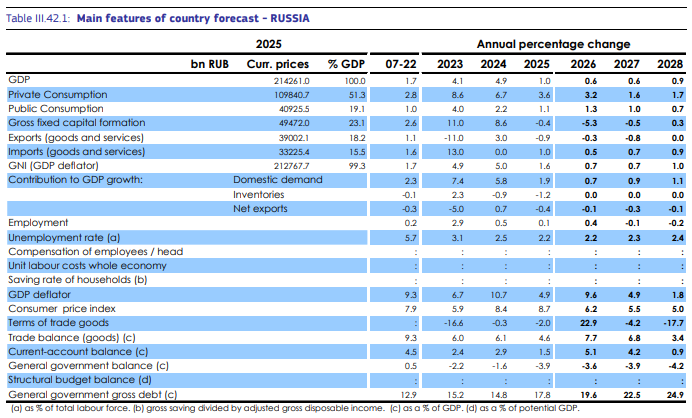
“After slowing to 1% in 2025, real GDP growth in Russia is expected to decline further to 0.6% in 2026 and stagnate at that level in 2027—despite high oil and gas prices. A slight increase in the growth rate to 0.9% is forecast for 2028.
Inflation began to rise again at the end of 2026. Although a downward trend is expected for the remainder of the forecast period, the inflation rate is likely to remain above the Central Bank’s target of 4%.
As long as Russia continues its war of aggression against Ukraine, war-related expenditures will continue to drive up government spending at the federal and regional levels. This will lead to persistent deficits in the overall public budget and a rise in public debt.”
How Investment and Consumption Are Evolving
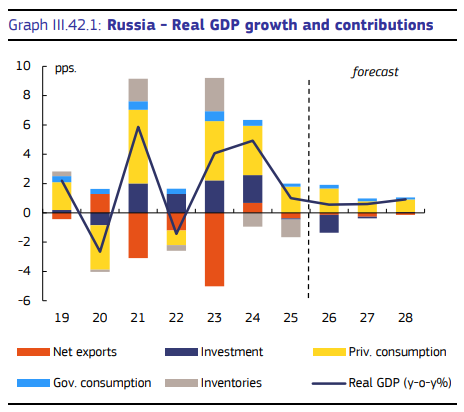
The following chart from the European Commission on the breakdown of real gross domestic product highlights the important role of investment (black bar segments) in the development of aggregate economic output (black line). In 2024, when economic growth accelerated to 4.9%, the rise in gross fixed capital formation (+8.6%) still made a strong contribution to growth. By 2025, gross fixed capital formation had already declined slightly (-0.4%). In addition, economic growth last year was slowed by a drawdown in inventories (gray bar segment) and the trend in net exports (brown bar segment).
Real Gross Domestic Product, year-over-year change in %;
growth contributions from the expenditure categories net exports, investment, private consumption, government consumption, and inventory changes in percentage points
European Commission: Economic Forecast for the Russian Federation; November 17, 26
Sharp decline in investment in 2026 amid continued strong growth in consumption
According to data from the European Commission (see table below), following a slight decline in 2025 (-0.4%), investment plummeted by 8.1% in the first half of 2026 compared with the same period a year earlier. The Commission notes that high interest rates and international sanctions continue to weigh heavily on the investment capacity of the “civilian sectors” of the Russian economy. “Military-related sectors,” on the other hand, are said to benefit from government demand and preferential loans. For 2026 as a whole, the European Commission estimates that the decline in gross fixed capital formation will accelerate to 5.3% (government forecast: -5.4%; Interfax).
Private consumption (yellow section of the bar chart) remains the most important driver of growth. According to the EU forecast, it will rise by 3.2% in 2026, only slightly weaker than in 2025 (+3.6%). This is based on the continued strong growth in real wages. However, the Commission notes that retail sales growth slowed significantly after a strong second quarter. Consumer confidence fell in the third quarter to its lowest level since early 2023.
Further Outlook for Gross Domestic Product Growth Through 2028
In summary, the Commission expects the following trends over the forecast period:
Persistently high military spending, capacity constraints, and high interest rates are likely to weigh on the Russian economy throughout the entire forecast period. The labor market remains tight due to the war and demographic trends.
Investment will decline significantly in 2026 (-5.3%) and then largely stagnate (2027: -0.5%; 2028: +0.3%). The “windfall profits” generated in the energy sector in 2026 are not expected to be used by companies for investment, but rather, for the most part, to reduce debt.
Private consumption will remain the most important “growth driver” in 2026 as well. However, with a slower rise in real wages, the growth rates of private consumption in 2027 and 2028—at 1.6% and 1.7%, respectively—are expected to be only about half as high as in 2026 (+3.2%).
Russia’s exports are expected to decline slightly in 2026, partly as a result of Ukrainian counterattacks on Russian infrastructure. A further decline in exports is forecast for 2027. The increased demand for Russian oil supplies stemming from the conflict in the Middle East is expected to subside.
Overall, Russia’s GDP growth is expected to slow to 0.6% in both 2026 and 2027, before rising slightly to 0.9% in 2028.
European Commission Forecasts for Russia
European Commission: Economic Forecast for the Russian Federation; Nov. 17, 2026
In a footnote to its analysis of Russia, the European Commission comments on the reliability of official Russian statistics:
“Some analysts argue that Russia’s economic situation is worse than the official data suggest. While not all economic arguments supporting this view are convincing, data manipulation cannot be entirely ruled out in the context of Russia’s war of aggression. It is striking, however, that even the official data now clearly point to an economic downturn.”
The EU expects the inflation rate to remain above the 4% target
The European Commission summarizes the trend in consumer prices as follows:
While inflation is likely to be higher than the EU had anticipated in the spring, it will nevertheless decline over the forecast period through 2028: After the annual increase in consumer prices accelerates to 8.7% in 2025, it is projected to be 6.2% in 2026, 5.5% in 2027, and 5.0% in 2028 (see table above: Consumer Price Index). In contrast, the Russian Central Bank expects to reach its inflation target of 4% on an annual average basis in 2028 (“Medium-term Forecast”).
Regarding current consumer price trends, the European Commission states:
After the annual inflation rate hit a low of 5.3% in May 2026, it rose again, reaching 6.3% in September. Ukrainian counterattacks on Russian energy infrastructure have intensified price pressures.
The government’s expansionary fiscal policy is also driving up prices. Further increases in public spending will largely feed into inflation because the economy is already operating at the limits of its production capacity.
Added to this is strong wage growth. However, the rise in wages is expected to slow somewhat over the forecast period. The unemployment rate is likely to remain at its historic low of 2.2% in 2026 and rise slightly to 2.4% by 2028.
Against this backdrop, the central bank has so far only cautiously lowered its key interest rate—in October, it was kept at 14%. As a result, real interest rates remain high and are weighing on economic activity.
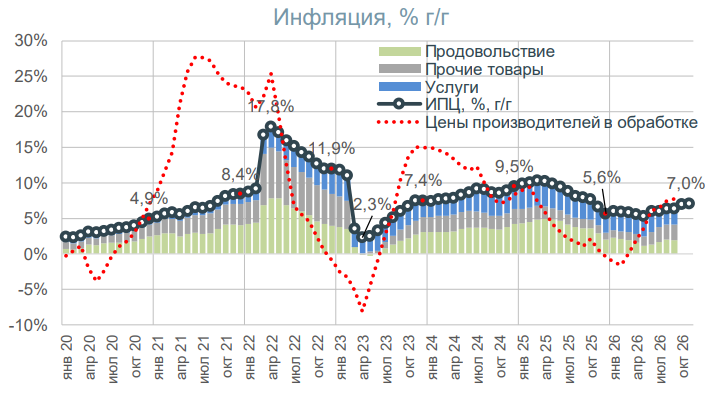
The following chart from the weekly report of the state-owned development corporation VEB.RF shows that, according to the institute’s estimates, the annual increase in consumer prices accelerated to 7.0% in the week ending November 16 (previous week: 6.7%).
Inflation Trends in Russia
: Black line: Change in the consumer price index compared to the
same month of the previous year; Red line: Change in the industrial producer price index compared to the same month of the previous year
VEB Institute: Global Economy and Markets, Nov. 19, 26
The budget deficit will decline only temporarily in 2026, while public debt will rise
According to the table above from the European Commission’s 2025 report, Russia’s general government deficit-to-GDP ratio rose to 3.9 percent of gross domestic product.
In 2026, the European Commission expects a temporary decline in the deficit-to-GDP ratio to 3.6% of GDP. It anticipates an increase in government revenue of around 10%.
However, according to the Commission, the general government deficit will rise again to 3.9 percent of GDP in 2027 due to rising military spending and reach 4.2 percent of GDP in 2028. In this regard, the Commission notes that it continues to consider the military spending planned in the Russian budget for 2027 and 2028 to be “unrealistically low.”
According to the Commission, gross government debt will rise from 17.8% of GDP in 2025 to 19.6% of GDP in 2026. By 2028, the public debt-to-GDP ratio is projected to rise to nearly 25% of GDP.
What “downside risks” does the European Commission see for its forecasts?
In the Commission’s assessment, there are “significant downside risks” that the economic situation in Russia could develop even less favorably than it expects. For example, further sanctions against Russia could further undermine Russian exports and fuel inflation in Russia (through higher import prices). This would require a monetary policy response from the Russian Central Bank, which is likely to further restrict investment.
Another downside risk is that a “bottleneck” could arise in the financing of the national budget. This could be caused by a sharp decline in demand for Russian government bonds or unexpectedly high military spending.
The most significant “upside risk” is another rise in oil prices
The European Commission cites a prolonged conflict in the Middle East as the most significant “upside risk” to Russia’s economic growth. If this were to drive oil prices sharply higher, Russia could benefit.
However, the following chart from the VEB Institute’s latest weekly report shows that prices for Brent crude and Russian Urals crude have fallen sharply since the end of October. Most recently, Urals was trading at $74 per barrel, and Brent crude at $92 per barrel (Global Oil Shock). Earlier this year, oil prices had already fallen sharply once between May and early July 2026, but subsequently rose again to well over $100 per barrel.
Prices of Brent and Urals crude oil in $/barrel (right scale)
Difference between the Urals price and the Brent price in % (left scale)
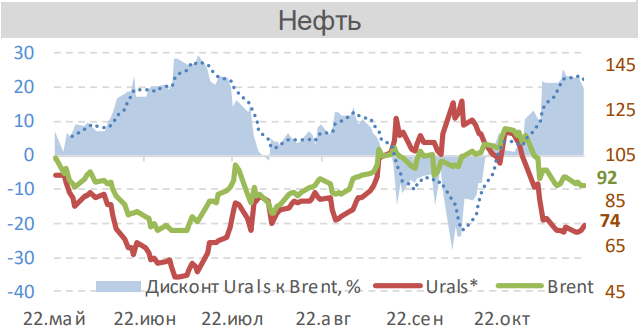
VEB Institute: Global Economy and Markets, Nov. 19, 26
The blue area in the figure shows that the Urals price was most recently about 20 percent lower than the Brent price.
PSB Forecast: The lower Brent price will remain flat through the end of 2026
Ekaterina Krylova, an analyst at PSB Bank, summarized her views on the current decline in oil prices and price trends through the end of 2026 on the bank’s Telegram channel:
Prices have fallen by nearly 20% since early November. The market has adjusted its expectations to reflect a supply surplus. This is confirmed by the IEA’s November report. For the first time since the start of the conflict in Iran, the IEA has identified an oversupply. Since August, global production has risen by 5.3 million barrels per day, mainly due to the resumption of supplies from the Persian Gulf. The IEA forecasts a surplus of about 1.7 million barrels per day (bpd) for the fourth quarter and 3.8 million bpd for 2027.
However, the increase in global inventories in October (+52 million barrels) is attributable exclusively to oil in tankers, while onshore inventories are at their lowest level since 2016. Therefore, we do not expect any further sharp price declines in the near future. By the end of the year, we expect the Brent price to range between $85 and $95, although short-term fluctuations may be driven by news from the Persian Gulf.
Recommended Reading
German-Russian Chamber of Foreign Trade:
- Returns Halved, Nov. 18, 26
- Nord Stream Could Save 9.5 Billion Euros Annually, but No Restart in Sight; November 17, 26
- Big in Purchasing Power, Small in Dollars: Russia’s Economy in a Country-by-Country and Citizen-by-Citizen Comparison, November 12, 26
Economic Forecasts:
- bne Intellinews, Ben Aris: EU forecast keeps Russia sanctions in place through 2028 as Ukraine seeks €115bn. Brussels expects Russia’s economy to grow only marginally under sanctions for three years, while Kyiv still needs to secure €25 billion of the €115 billion it says it needs for 2027, Nov. 20, 2026
- European Commission: Autumn 2026 Economic Forecast shows continued growth amid higher inflation; including: Economic Forecast for the Russian Federation; Nov. 17, 2026
- Sberbank Forecasts: Finam.ru: Sberbank expects the Russian economy to recover from its investment slump starting in 2027; Alexander Vedjakhin, First Deputy Chairman of the Board of Sberbank, in an interview with Reuters; Nov. 16, 2026; Global Banking & Finance Review; Reuters, Elena Fabrichnaya and Gleb Bryanski: “Russia’s Sberbank predicts loan quality deterioration as economy faces systemic challenges,” Nov. 16, 2026
- TASS: Ministry of Economic Development: Year-end GDP growth could exceed forecasts. According to preliminary estimates by Rosstat, annual GDP growth in the third quarter of 2026 will be 1%; Nov. 13, 2026
- Interfax.ru: The Central Bank expects Russian GDP to grow by about 1% in 2026. The data suggests that growth rates will rise in the future, said Nabiullina, November 12, 2026
- Sberbank Forecasts: Interfax.ru: Sberbank expects Russia’s GDP growth to range from 1.2% to 1.7% in 2027, with inflation between 4.5% and 5%; Nov. 12, 2026; Interfax.com: Sberbank forecasts Russia’s GDP growth at 1.2%–1.7% and inflation at 4.5%–5% in 2027, Nov. 12, 2026; Vedomosti: Sberbank has raised its forecast for Russian GDP growth in 2026 to 1%, Oct. 28, 2026
- Kommersant; Artem Chugunov: The economy is performing in line with forecasts. Current GDP growth is in line with annual expectations; Nov. 11, 2026.
- German Council of Economic Experts: Annual Report and Spring Report; Nov. 11, 2026
- OPEC Secretariat, Vienna: Monthly Oil Market Report, Nov. 11, 26
- IEF-RAS: “Short-Term Analysis of Gross Domestic Product Trends,” November 6, 26
- Bank of Russia: Commentary on the Central Bank of Russia’s Medium-Term Forecast, Nov. 5, 26
- CMASF: Macroeconomic Base Forecast, 10/30/26
- RBC.ru: Sberbank has raised its inflation forecast and revised its GDP forecast. It expects GDP growth of 0.5–1% and inflation of 6.5–7.5% by the end of 2026; October 28, 2026
- Bank of Russia: Medium-Term Forecast; October 23, 2026;
- Vienna Institute for International Economic Comparisons; wiiw: Fall Forecast 2026;
Andreas Knapp; Press Releases: English; German; Executive Summary; Richard Grieveson: Central, East, and Southeast Europe in 2027: Resilient Growth in a More Dangerous World, Oct. 21, 2026;
wiiw Country Overview: Russia; Additional Press Coverage: wiiw in the Press - Bank of Russia: Macroeconomic Survey of the Bank of Russia, October 14, 2026
- International Monetary Fund, IMF: World Economic Outlook: Resilience Under Strain, Urgent Choices, October 2026; Press Briefing Transcript: World Economic Outlook, Annual Meetings 2026, October 13, 2026
- World Bank: Country Report: Russian Federation, in: Macro Poverty Outlook; Europe and Central Asia Update; October 6, 2026; World Bank: Press Release; Europe and Central Asia: Slower Growth with Global Headwinds; October 6, 2026
Overall Economy (Austrian Chamber of Commerce: Country Profile—Russia, as of Oct. 2026;
TradingEconomics: News; Calendar; Kommersant, Vedomosti, Intellinews, inveb.ru, Finam, Hard Numbers, Riddle,
- bne Intellinews, Ben Aris: Levada poll shows worsening living conditions in Russia; Nov. 22, 26.
- bne Intellinews, Ben Aris: Russia drafts plan to revive investment after a 9.9% first-half slump, Nov. 19, 26
- Forbes.ru; Andrey Zlobin: The Ministry of Economic Development has drawn up a plan to revive the investment cycle; Nov. 19, 26
- Kommersant: The Russian Ministry of Economic Development has drawn up a plan to revive the investment cycle; November 19, 2026
- Parliamentary Gazette: An expert explained Russia’s rise to the top of Europe in terms of GDP, based on purchasing power parity. The reasons are the dynamic growth of the Russian economy, the slowdown in German growth, and the country’s large population, according to Alexey Zubets, director of the Center for Socio-Economic Research; Nov. 19, 2026
- FR.de; Yannick Hanke: Putin mocks the West—but how strong is Russia’s economy really? 11/18/26
- Kronen Zeitung; Matthias Fuchs: “Overcoming” Sanctions. Putin Boasts: “Russia Is Number One in Europe.” Russian leader Vladimir Putin outlined his worldview at the APEC economic summit in China. He boasted of a strong Russian economy, declared Western sanctions a failure, and lamented “state egoism,” Nov. 18, 26
- Kommersant; Artem Chugunov: Companies thrive on hope. Companies have raised their expectations despite weaker demand. Central Bank survey; November 18, 2026
- Finam.ru: The Bank of Russia’s business climate indicator remained virtually unchanged in November. Expectations for the next three months have improved; Nov. 17, 26
- Vedomosti.ru: Experts expect Russia’s GDP growth to accelerate in 2028–2029; November 17, 2026
- Prime.ru: According to an expert, Russian GDP could grow by 0.7 to 1 percent by the end of the year. Forecast by Vladimir Yeremkin, senior researcher at the Structural Research Laboratory of the Presidential Academy; November 17, 2026
- Finam.ru: Sberbank expects the Russian economy to recover from its investment slump starting in 2027; Alexander Vedjakhin, First Deputy Chairman of the Board of Sberbank, in an interview with Reuters; Nov. 16, 2026
- Global Banking & Finance Review; Reuters, Elena Fabrichnaya and Gleb Bryanski: “Russia’s Sberbank predicts loan quality deterioration as economy faces systemic challenges,” November 16, 2026
- Reuters; Elena Fabrichnaya and Gleb Bryanski: “Russia’s Sberbank predicts loan quality deterioration as economy faces systemic challenges,” November 16, 2026
- Morgenpost; Christian Kerl: Oil Facilities Destroyed, Economy Under Pressure: How Long Can Putin Sustain the War? Ukraine Has Neutralized Half of Russia’s Oil Refineries; November 16, 2026
- Raiffeisenbank Daily Focus; Stanislaw Muraschow: Third-Quarter GDP Growth Exceeded Initial Estimates. Rosstat Releases Preliminary GDP Estimate; November 17, 2026
- MEC Interdisciplinary Competence Center Moscow; Igor Savonov: GDP: Better Than Expected; 11/16/26
- Kommersant, Artem Chugunov: The economy exceeded the Ministry of Economic Development’s expectations. GDP grew by 1% in the third quarter; November 15, 2026
- bne Intellinews, Ben Aris in Berlin: Russia’s GDP growth slows to 1% in the third quarter; November 14, 2026
- russland.capital: Russia’s economy grows by one percent—slightly more than expected; 11/14/26
- russland.capital: Job cuts loom after shorter workweeks. Russian companies could face a transition from shortened workweeks to layoffs in 2027. Alexander Schochin, president of the Russian Union of Industrialists and Entrepreneurs (RSPP), warns of this, November 16, 2026; Russian companies plan job cuts—despite historically low unemployment, June 13, 2026
- t-online.; Tobias Schibilla: Russia’s War Industry. A Horrific End Is on the Horizon; November 14, 2026; Sources: CEPA: “Managing Russia’s Military-Industrial Degradation,” November 10, 2026; Carnegie Russia Eurasia Center; Alexandra Prokopenko: “Who Is Funding Russia’s War in the 2027 Budget?”, October 2, 26
- kp.ru: The Ministry of Economic Development has raised its forecast for Russian GDP growth: The economy grew by 0.8% in the first nine months. Nov. 14, 26
- Finmarket.ru: Russian GDP grew by 1% in the third quarter. Preliminary Rosstat estimate, November 13, 26
- Kommersant.ru: Russia’s GDP grew by 1% in the third quarter; November 13, 26
- Anadolu Agency; Gokhan Ergocun: Russia’s GDP growth slows to 1% year-on-year in Q3. GDP slows from 1.3% expansion in Q2, though beats the Economic Development Ministry’s 0.6% estimate, November 13, 2026
- Interfax.ru: Rosstat reported an 8.5% decline in fixed asset investment in Russia from January through September, November 13, 2026.
- Finam.ru: Investment in fixed assets in Russia fell by 6.2% in the third quarter. This marks the third consecutive quarter of decline, November 13, 2026
- Investing for the Future: Gref Discussed the Rise in Overdue Payments, 11/13/26
- Stock News, Daniela Eckert: Russia’s economy is slowing due to Ukrainian attacks on industry, Nov. 13, 2026; The Print, Bloomberg: Russian economy hit as Ukrainian attacks deal a blow to industry, Nov. 13, 2026
- The Hill, Comments by Dov Zakheim, opinion contributor: “Russia’s economy is reeling — Trump should be raising the pressure if he wants peace,” Nov. 13, 2026
Monetary Policy, Inflation (Central Bank Calendar; Interfax Reports, TASS, Kommersant)
- Raiffeisenbank, Daily Focus; Stanislaw Murashow: Inflation is gaining momentum again, November 19, 2026
- Kommersant: The Central Bank stated that the fuel crisis prevented inflation from falling to 4% in 2026, November 18, 2026
- Yahoo Finance; Reuters; Elena Fabrichnaya and Gleb Bryanski: Russia’s Sberbank predicts a deterioration in loan quality as the economy faces systemic challenges; Nov. 16, 26
- Wirtschaft TV.com; Stefanie S. Klief: Putin’s Banks: A Facade of Strength. Billions in Profits Mask Growing Credit Risks—Why Russia’s Banking System Is Becoming Increasingly Dependent on the State; November 15, 26; Carnegie Russia Eurasia Center; Alexander Kolyandr and Alexandra Prokopenko: How Are Russian Banks Posting Record Profits Amid Economic Stagnation? Russia’s banking sector is sinking ever deeper into a crisis that the authorities are simply managing rather than trying to fix; November 10, 2026
- Kommersant.ru: Nabiullina linked the economic downturn to drone attacks. Nabiullina: Russia’s GDP growth will not exceed 1% by the end of the year, Nov. 12, 2026; Nabiullina on the drawbacks of preferential mortgages, the high key interest rate, and the reasons for the economic slowdown, November 12, 2026
- TASS: GDP growth forecasts and affordable mortgages. Statements by Nabiullina. Speech by Elvira Nabiullina, Chair of the Bank of Russia, at a plenary session of the State Duma, November 12, 2026
- Bank of Russia: Speech by Elvira Nabiullina at the State Duma plenary session on the main directions of the unified state monetary policy for 2027–2029, in Russian; Nov. 12, 2026
- bne Intellinews; Ben Aris: Russia’s inflation jumps to about 7% in October, ruling out early rate cuts. The central bank’s weekly estimate puts annual inflation at the bottom of its raised forecast range, November 11, 26
Fiscal Policy; National Budget (Interfax reports)
- bne Intellinews, Ben Aris: Russia’s Duma passes the 2027 budget in its second reading with a $66 billion deficit, November 19, 2026
- The Bell; Denis Kasyanchuk: Russia’s small businesses are feeling the strain of wartime tax hikes, November 18, 2026
- Vladimir Milov; Video on the budget deliberations: Lawmakers foresee a catastrophe: population decline, a budget shortfall, and growing national debt; November 13, 2026
- Finam.ru; Olga Belenkaya: Budget—The cumulative deficit remained virtually unchanged in October. Budget expenditures are rising faster than expected, but the pace is slowing; Nov. 11, 26
- bne Intellinews, Ben Aris: Russia’s ten-month budget deficit climbs to RUB5.2 trillion, 2.3% of GDP. Higher oil and gas taxes in October all but balanced the month, but the ministry’s own year-end estimate implies another $25 billion in the red by December, Nov. 10, 2026
Energy sector, fuel supply, infrastructure (DW in Russian: Fuel crisis)
- FR, Steffen Maas: Crimea Bridge Cut Off, Fuel in Short Supply: New Pressure on Putin’s Overheated War Economy, 11/20/26
- Finanzmarktwelt; Josephine Bollinger-Kanne: End of EU Imports: Russia Diverts Yamal LNG to China; 11/19/26
- Business Insider; Matthew Loh: Russia’s Gasoline Crisis Escalates—Now the Kremlin Is Taking Unusual Measures, Nov. 19, 2026
- ntv: Consequences of Ukrainian attacks. Insider: Russia’s oil refining plummets, November 18, 2026
- Lars-Eric Nievelstein: Putin’s Gasoline Sales Plunge 31 Percent, November 18, 2026
- Moscow Times.ru: Russia has lost nearly half of its fuel production capacity following three weeks of Ukrainian attacks on refineries, Nov. 18, 2026
- German-Russian Chamber of Foreign Trade: Nord Stream Could Save 9.5 Billion Euros Annually, but No Restart in Sight; November 17, 2026
- Salzburger Nachrichten: wiiw: EU Heads into Winter with “Historically Low” Gas Reserves, Nov. 16, 2026
- Forbes; Ken Silverstein, Senior Contributor: Europe Is Quitting Putin’s Gas, But Trump Buys In At Ukraine’s Expense. Ken Silverstein analyzes the energy transition, AI, and geopolitics, November 15, 2026
- Carnegie Russia Eurasia Center; Sergey Vakulenko: How Realistic Is a U.S.-Brokered Gas Deal Between Russia and the EU? November 12, 2026
- Kreiszeitung; Felix Busjaeger: Ukraine Strikes Lukoil Refinery—Oil Processing Plummets, November 13, 2026; Jens Kiffmeier: 30 Percent of Capacity Paralyzed: Ukrainian Sustained Fire Plunges Russia’s Oil Economy into Crisis; November 11, 2026
- Finanzmarktwelt; Josephine Bollinger-Kanne: The End of Cheap Gas from Russia—Hungary Changes Course, Nov. 12, 2026
- bne Intellinews; Ben Aris: EU’s bill for Russian Yamal LNG hits €8.7bn with 50 days left before the ban. Europe has paid more for Yamal gas in ten months than in all of 2025, as higher prices outpace a 6% increase in volumes ahead of January; November 11, 2026
- The Telegraph; Hans van Leeuwen: Europe’s gas shortage could open the door for Putin. U.S. talks in Abu Dhabi trigger fears that Brussels will be tempted back into a Kremlin energy trap, November 10, 2026
Foreign Trade, Sanctions; DIHK: Sanctions Against Russia; Tagesschau: Russia Sanctions
- Hard Numbers: What’s Behind the Strong Growth in Russian Foreign Trade This Year? Nov. 20, 2026
- bne Intellinews, Ben Aris in Berlin: Asia accounts for 76% of Russia’s trade as nine-month turnover rises 14%; November 19, 2026; Russia-China trade is on track for a record year as the yuan handles most payments, November 17, 2026
- Finam.ru; Yuri Kravchenko, Veles Capital: The balance of payments for September sent a slightly positive signal for the ruble. The surplus rose, while the trade balance remained virtually unchanged. 11/17/26
- Finam.ru; Victor Grigoriev, Bank of St. Petersburg: Russia’s balance of payments deteriorated in the third quarter. Rising imports and services are putting pressure on the ruble, 11/17/26
- Raiffeisenbank Daily Focus; Stanislav Murashov: September’s trade balance ignored rising oil prices; 11/16/26
- bne Intellinews, Ben Aris in Berlin: Russia’s current account surplus climbs 43% year-over-year to $40.8 billion in nine months, November 16, 2026
- Tagesschau: EU imposes sanctions on propagandists, hackers, and banks, Nov. 16, 2026
- Russia’s Pivot to Asia: Russia’s Foreign Trade Surplus Rises to US$116.8 Billion in January–September 2026 – Asia Now Accounts for 72% of All Russian Trade: Economic Analysis; Nov. 15, 2026
- The Bell; Denis Kasyanchuk: Wave of Confiscations Sweeps Up Two More Major Foreign Companies, November 11, 2026
Political Landscape; BR24: Russia
- Tagesschau: German-Ukrainian Economic Forum. “Investments Will Be Recouped Many Times Over,”: November 20, 2026
- Stern, dpa: An Overview of the Situation. More Than Just Weapons: Berlin Wants to Strengthen Ukraine Economically, November 20, 26
- bne Intellinews, Ben Aris: Russia’s VTsIOM shows trust in Putin slipping to 74.6% from early-November high; November 20, 2026
- German Economic Institute; Melinda Fremerey / Simon Gerards Iglesias / Moritz Mehlem: Russia: Three out of four Germans support sanctions, but support is waning, November 19, 2026
- DIHK Podcast “WirtschaftsWissen,” Episode 85: Ukraine — Opportunities and Risks for German Companies. How can economic cooperation succeed while Russia is deliberately targeting Ukraine’s energy supply, logistics, and industry? DIHK expert Stefan Kägebein discusses the background of the 9th German-Ukrainian Economic Forum, November 19, 2026
- Merkur; Marcel Reich: Deutsche Bank Under Pressure: Secret Documents Reveal Deals with Putin’s Oligarchs, Nov. 17, 2026
- Carnegie Russia Eurasia Center; Dimitar Bechev: Russia Has Not Lost the Balkans, Despite Vučić’s Defeat in Serbia, November 17, 2026
- bne Intellinews; Ben Aris in Berlin: Russia’s war economy produces few winners as companies turn to quiet layoffs. Russia’s war against Ukraine has cost more than RUB70 trillion ($849bn) but produced almost no real winners, according to economist Vladislav Inozemtsev, November 18, 2026
- Riddle; Vladislav Inozemtsev, CASE: A War Without Beneficiaries: Vladislav Inozemtsev on why the war against Ukraine has not yet wrecked the Russian economy, who is profiting from it, and why it has no genuine beneficiaries, November 16, 2026
- DTS News Agency, Augsburger Allgemeine: Poll: Majority of Germans View Russia as a Threat: Yet there is also a minority that vehemently holds the opposite view, according to a poll conducted by Ipsos for *Der Spiegel*, Nov. 16, 26
- BBC; Vitaly Shevchenko, Chief Analyst, BBC Monitoring: Russia’s mega-rich are already imagining a future after Putin, November 16, 2026; t-online: Russia’s super-rich are preparing for the post-Putin era, November 18, 2026;
- NZZ Podcast; Guest: Ulrich Schmid, Professor of Eastern European Studies, University of St. Gallen; Host: Marlen Oehler: Power Vacuum in the Kremlin: What Might a Post-Putin Russia Look Like? NZZ Geopolitics; Analysis of scenarios for a post-Putin Russia: from a palace coup by the elites to vassal status under China to the country’s disintegration into regional fiefdoms; November 11, 26
Earlier analyses by Klaus Dormann
- Russia: industrial output rises 1.8% in September · November 9, 2026
- Russia: GDP grows just 0.5% in September · November 2, 2026
- Russia: key rate stays at 14%, wiiw sees 0.6% growth · October 26, 2026
- Russia forecasts 2027: IMF, World Bank, OECD compared · October 21, 2026
The day's most important Russian economic stories. Free, in your inbox three times a week.
Mon, Wed, Fri. Double opt-in, unsubscribe anytime. By subscribing you consent to the processing of your email address as described in our Privacy Policy.