Eastern Economic Forum 2026: Quotes and Results
At this year’s Eastern Economic Forum in Vladivostok, held September 1–4, top Russian politicians and business leaders commented on current economic developments, including the gasoline crisis and Decree No. 604 on the security of critical infrastructure. We have summarized the key points for you.
ECONOMY AND FINANCE
Maxim Reshetnikov, Minister of Economic Development
“Our economy is no longer resource-based; it has long been a highly complex mechanism, because no resource-based economy could have withstood these tens of thousands of sanctions. We have a complex economy. First, the existing resource component is highly diversified. Second, it is extremely efficient; otherwise, given the sanctions and other factors, we would have long since become a laggard in the market, with the highest production costs, long since driven out of the market and unable to export. We are withstanding all this pressure.” / Tass (RU)
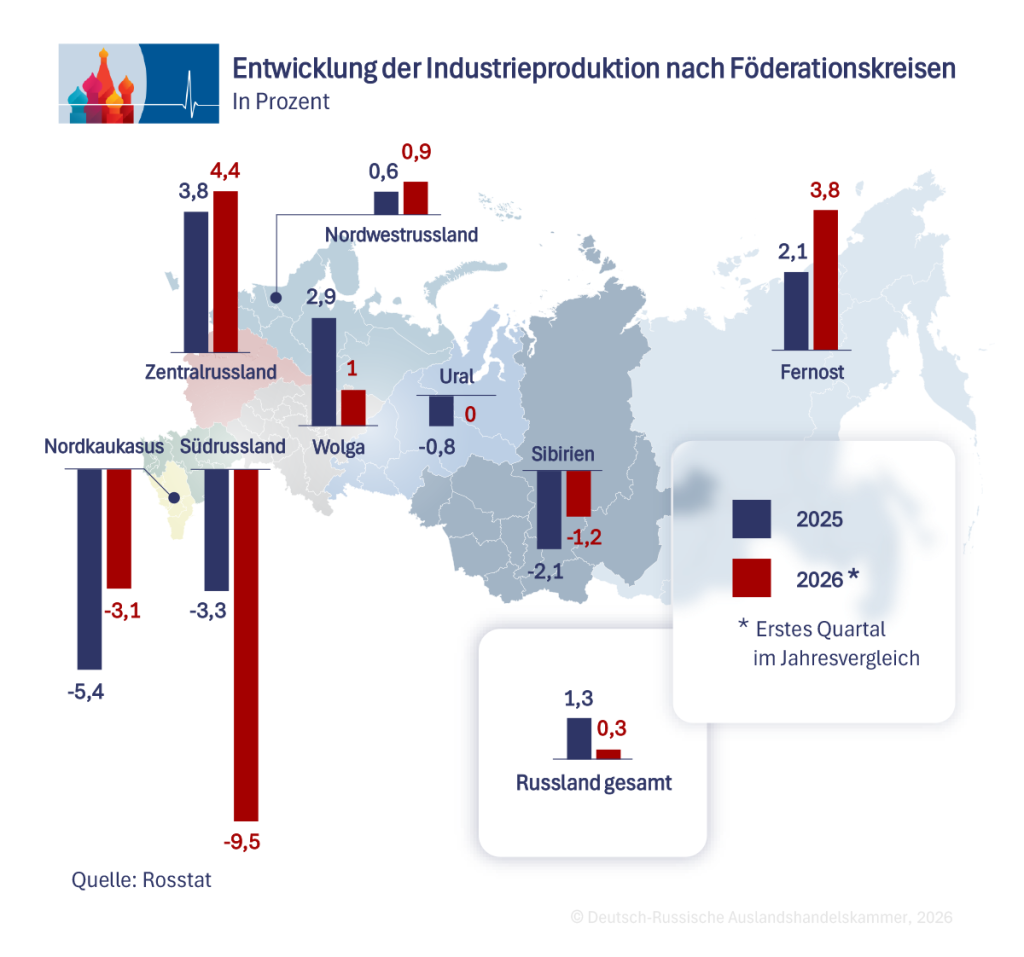
“The current economic slowdown is, in general, a natural phase of the business cycle, as the economy is subject to cyclical fluctuations. The previous phase was characterized by rapid growth, which led to rising inflation as a side effect. The focus on fighting inflation has evidently led to a natural credit crunch, rising interest rates, and slower growth, which attests to the normal nature of our economy.” / TASS (RU)
“The next investment cycle will also differ in terms of investment structure.” Reshetnikov noted that investments previously flowed primarily into the oil and gas industry, but are now directed toward aircraft manufacturing, shipbuilding, and telecommunications equipment. “Our investments […] must continue to grow.” / TASS (RU)
Foundations of Russia’s future economic model: “First, maintaining macroeconomic stability and normalizing the budget deficit are essential for lowering interest rates. Without this, it will be difficult to launch a new investment cycle. Second, we must improve the business climate and the institutional environment, promote entrepreneurship, and strengthen competition. Third, we must maximize the promotion of new technologies and innovations—including the platform economy and AI—as well as flexible forms of employment. And overall, we need regulations that help make optimal use of all available resources, whether labor, fixed assets, energy capacities, etc.” / RBC (RU)
German Gref, CEO of Sberbank
“The Central Bank speaks of a gradual slowdown [in the economy], but we are talking about a cooling-off, even an overcooling. The numbers speak for themselves. […] We see that business climate indicators have fallen to a record low this year: minus 3.6 points. We haven’t seen figures like this since the spring of 2022.” / Tass (RU)
“We won’t see a turning point until market interest rates have normalized and are in the range of 10–12%. In my view, returning to such a normalized level is the key task for renewing and stabilizing economic growth. I am convinced that everyone must keep an eye on macroeconomic conditions today; the economy needs support.” / RBC (RU)
DECREE ON THE SECURITY OF CRITICAL INFRASTRUCTURE
Vladimir Putin, President of Russia
“This is not about any plans for nationalization. The state had no intention whatsoever of nationalizing anything. We have asked our colleagues—in this case, those in the oil and gas sector—to ensure the protection of their companies. […] They are investing their own money in purchasing the necessary equipment and training specialists to protect their companies. This, and only this, is the purpose of the decree.” / TASS (RU)
Alexander Novak, Deputy Prime Minister for the Energy Sector and Economic Development
“The decree […] is intended as a preventive measure to once again create incentives for companies to participate more actively in the ongoing protection of their facilities.” / TASS (RU)
Denis Manturov, First Deputy Prime Minister
“So far, there has not been a single case of expropriation. […] I very much hope that everyone understands what needs to be done. I truly hope that it will not have to be enforced. The decree is not intended to be used to take anything away from anyone tomorrow. No one has that goal. […] Should any damage occur, we will assess each individual industry and each individual company separately.” / TASS (RU)
FUEL CRISIS
Alexander Nowak, Deputy Prime Minister for the Energy Sector and Economic Development
“Our domestic market is currently fully supplied with diesel and kerosene. As for motor gasoline—AI-92, 95, 98, various grades—there is indeed a slight shortage at the moment, and certain disruptions are occurring. […] We are working with companies to procure additional gasoline from friendly countries, neighboring countries, and other countries. The first shipments have already begun and are helping to supply the market. Therefore, all necessary measures will continue to ensure market stability.” / TASS (RU)
“We are currently observing a partial decline in production volumes compared to forecasts, which is attributable, among other things, to underutilization of oil refineries due to unplanned maintenance work. […] Currently, about 10% of our facilities are undergoing maintenance […]. This incurs significant costs for refineries and energy facilities. However, it is worth the expense, as shutdowns at the refineries—should they be shut down—would result in substantial losses for the companies.” / TASS (RU)
Andrei Nikitin, Minister of Transport
“There are certain difficulties, and these may continue in the future. However, thanks to coordinated cooperation between the Ministry of Transport and the Ministry of Energy, these problems are being resolved promptly. Airlines are being supplied with fuel.” / RBC (RU)
Vladimir Putin, Russian President
“There are two ways to combat the fuel shortage. One is to develop air defense. That is indisputable. The second way is a retaliatory strike to prevent them from harming us. That’s all.” / RIA Novosti (RU)
INDUSTRY
Anton Alikhanov, Minister of Industry and Trade
“As of today, we have found new partners for all 13 idled sites [automobile plants abandoned by foreign investors]. Control over the Russian beneficiaries will be maintained, while the technologies developed there and the rights to the design documentation will remain in Russia. […] Investors have already invested approximately 120 billion rubles (1.19 billion euros) in capacity expansion, and this amount will triple by the time the special investment agreements are finalized. In addition, since 2022, we have supported the development of components worth over 125 billion rubles (1.24 billion euros). As a result, nearly half of the 700 critical components are already in production.” / RBC (RU)
INVESTMENT CLIMATE
Vladimir Putin, President of Russia
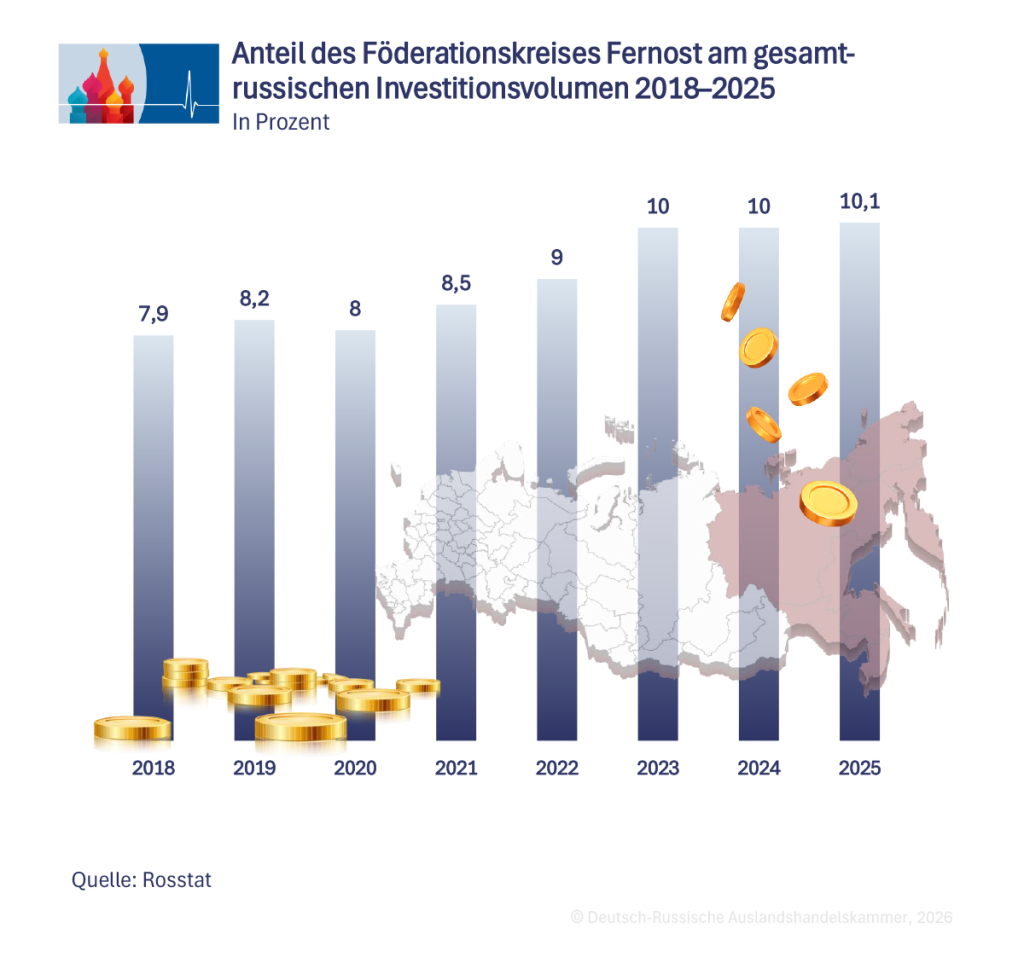
“We also greatly value the participation of foreign partners and investors who invest capital and technology in development projects, not only in the Far East and the Arctic, but throughout Russia.” / Kremlin.ru (RU)
“It is important to continue creating favorable and predictable conditions for investors that are geared toward the needs of entrepreneurs and the regions and are in line with Russia’s national interests. In this context, I would like to propose a kind of initiative to the new legislative session of the State Duma of the Russian Federation, which will be newly elected in September. I am counting on the deputies to take an active stance and carry out successful parliamentary work to further improve the business climate.” / Tass (RU)
PARALLEL IMPORTS
Anton Alikhanov, Minister of Industry and Trade
“The volume of parallel imports could reach a total of 20.5 billion U.S. dollars in 2026. [For comparison: At the end of 2025, the volume stood at over 23.1 billion U.S. dollars.] As we have emphasized on several occasions, the decline in parallel imports is a natural trend and is linked, among other things, to the development of domestic production and the substitution of products from unfriendly countries with similar products from friendly countries.” / Tass (RU)
SMALL AND MEDIUM-SIZED ENTERPRISES
Vladimir Putin, President of Russia
“Small and medium-sized enterprises need, first and foremost, stability and security for sustainable development. […] The government does not always act in this way. Perhaps we are experiencing certain changes too frequently—not only in the tax base but also in the overall tax burden. Small businesses repeatedly bring this to our attention. […] The government must also take this into account and work on it. […] We will continue to seek new and effective tools to provide support.” / TASS (RU)
FUTURE PROJECTS
Vladimir Putin, President of Russia
“Starting January 1 of next year, a unified preferential regime will take effect in the Far East and the Arctic. The support measures are no longer tied to specific special economic zones or priority development areas, but are specifically and effectively tailored to activities throughout the entire Far East region. Investment projects in the Far East and the Arctic will thus benefit from a comprehensive range of support measures, including reduced social security contributions, tax and customs incentives, support for infrastructure development, the construction of industrial facilities, and much more.” / Kremlin.ru (RU)
Alexey Chekunkov, Minister for the Development of the Far East and the Arctic
“The development of the Trans-Arctic Transport Corridor (TTK) is currently the most important area for the entire Russian transportation sector. All future major infrastructure projects will be linked in some way to the TTK, as it is not merely a route from Kaliningrad and Murmansk to Vladivostok and Shanghai, but a full-fledged transportation artery stretching from the Atlantic to the Pacific. Total investment in raw materials projects in the Russian Arctic will exceed 30 trillion rubles (298.3 billion euros).” / TASS (RU)
DIGITAL RUBLE
Andrei Kostin, CEO of VTB Bank
“The digital ruble, like all modern technologies—including the internet and cell phones—will gradually enter circulation. We’ll have to get used to it. […] There are certain advantages, including transparency. […] People shouldn’t worry that someone is trying to spy on them. It’s primarily about transparency for the individual themselves, for the customer.” / TASS (RU)
ARTIFICIAL INTELLIGENCE
German Gref, CEO of Sberbank
“The impact of [artificial intelligence] will gradually increase, reaching an estimated 1% of GDP by 2030, and then about 0.5% annually thereafter. No technology has ever had such a dramatic impact on economic development. […] Over the next three to four years, we will see explosive growth and profound changes in everything we have grown accustomed to. We must prepare people for this.” / Tass (RU)
EASTERN ECONOMIC FORUM (EEF)
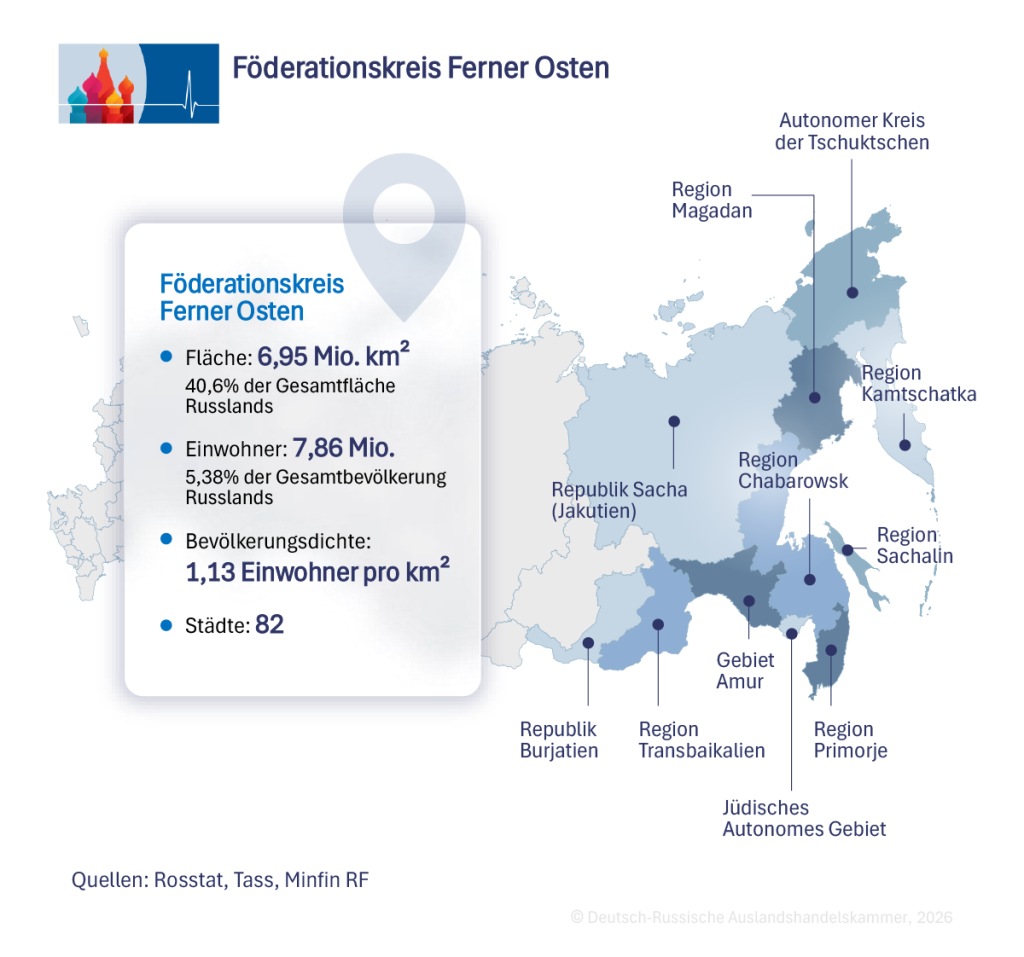
The annual Eastern Economic Forum (EEF) has been held since 2015 in Vladivostok at Far Eastern Federal University on Russky Island. The forum was canceled only once, in 2020, due to the COVID-19 pandemic. The forum’s goal is to promote accelerated economic development in Russia’s Far East and assess its potential through expert analysis, to expand international cooperation in the Asia-Pacific region, and to increase and showcase the region’s investment appeal.
The forum is organized by a committee headed by Yuri Trutnev, Deputy Prime Minister of the Russian Federation and Plenipotentiary Representative of the Russian President in the Far Eastern Federal District.
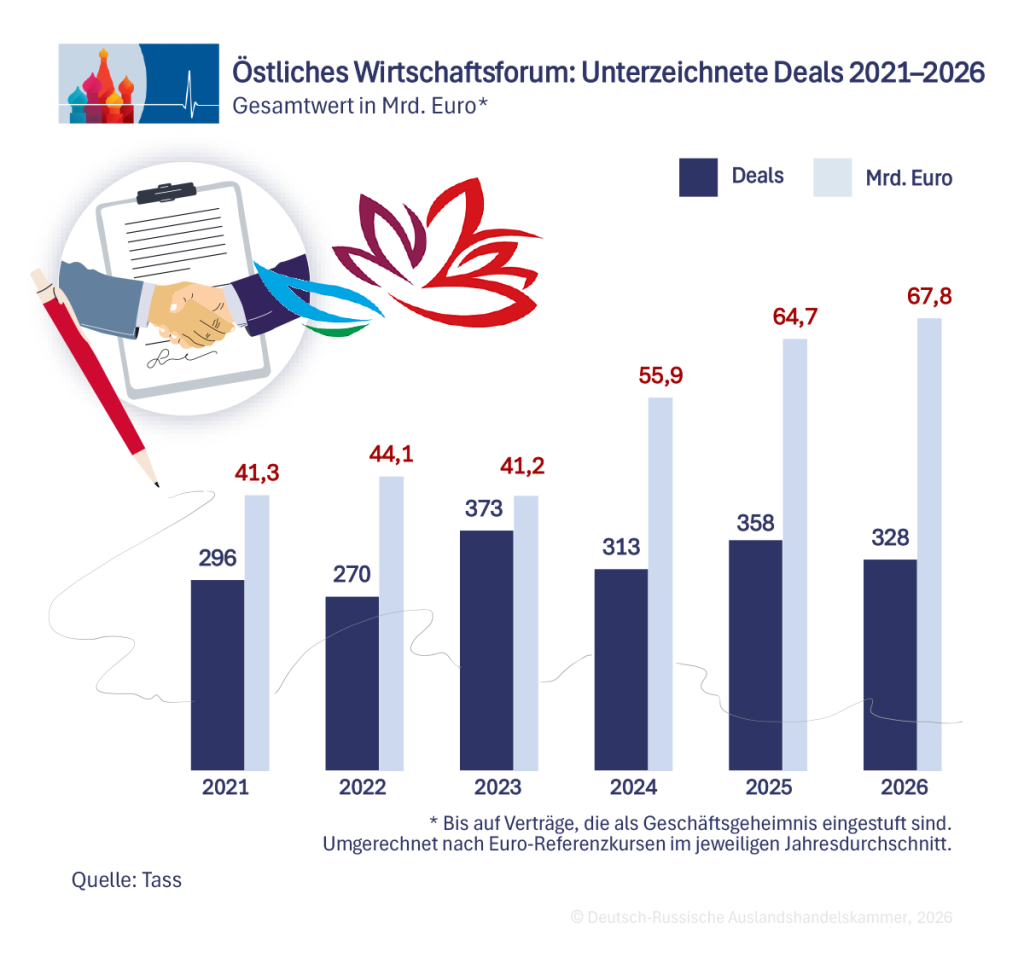
The 2026 Eastern Economic Forum was attended by 9,300 people from 78 countries, including 2,400 representatives of Russian and foreign companies representing more than 1,050 firms. A total of 328 agreements, contracts, and roadmaps were signed. The total value of the signed documents amounts to 6.814 bio rubles (68.8 billion euros).
Most Significant Business Deals in 2026:
- Russia’s largest semiconductor complex will be built in Primorye. The Ministry of Industry and Trade, the Ministry for the Development of the Russian Far East, the regional government, and IKS Holding signed a cooperation agreement for the investment project.
- Rosatom and the Far East and Arctic Development Corporation have signed a cooperation agreement to implement projects for the development of the Russian Arctic region and the Trans-Arctic Transport Corridor. The parties’ focus is on developing an icebreaker transport model and advancing the Northeast Passage.
- AO “Arhangelsk Deep-Water Port” and the Far East and Arctic Development Corporation are planning to build a deep-water area at the seaport of Arkhangelsk. The project involves the creation of modern port infrastructure designed to strengthen the region’s role in handling cargo flows to northern destinations.
- Rosatom and TOO “Kazakh Nuclear Power Plants” have signed a contract for the turnkey construction of the Balhash Nuclear Power Plant in the Almaty region of Kazakhstan.
- The Republic of Sakha (Yakutia), the Far East and Arctic Development Corporation, and the Development Corporation for the Republic of Sakha have signed a cooperation agreement to implement the Mohe–Naiba international transport corridor project. The goal of the project is to create a transportation and logistics infrastructure in Yakutia that will connect the People’s Republic of China to the Republic via the Amur Region.
- The Far East and Arctic Development Corporation, AO WIS, and AO Growth Crystal have signed an agreement to establish an investment mechanism for the implementation of the Arctic and Trans-Arctic Transport Corridor. The purpose of the agreement is to pool the parties’ efforts to attract investment in projects for the development of transportation, port, logistics, and other infrastructure in the Russian Arctic.
Sources: ÖWF, Kommersant 1, 2 (all RU)
Source: German-Russian Chamber of Foreign Trade, Eastern Economic Forum 2026: Quotes and Results, September 8, 2026.
This article was prepared for the German-Russian Chamber of Foreign Trade.