A Controversial Debate: Is Russia's Economy on the Verge of "Collapse"?
On June 11, the Kiel Institute for the World Economy published “Kiel Report 9” on the Russian economy, titled “Endgame: The State of the Russian Economy.” It also includes contributions from other renowned research institutes.
Some may have wondered what exactly is meant by “Endgame.” Has Russia’s economy perhaps qualified for a “final” in competition with other countries? The title certainly piques curiosity! However, the headlines on some of the institute’s other information pages about the report make it clear what the Kiel IfW apparently wants to convey to readers first and foremost.
Provocative Headlines from the Kiel Institute
The IfW’s “media release” on the report is titled “Endgame: Russia’s War Economy Is Reaching Its Limits.” Elsewhere, the IfW Kiel also refers to the new Kiel Report under the headline “Endgame: Russia’s Economy Under Pressure.”
The IfW has also published a German translation of the “Executive Summary,” the first article in the Kiel Report. This summary of the findings is titled “Russia’s Economy in Its Final Stage.” Its authors are Torbjörn Becker, Director of the “Stockholm Institute of Transition Economics (SITE) at the Stockholm School of Economics” since 2006, and Moritz Schularick.
Professor Dr. Moritz Schularick, President of the IfW Kiel, also explained the findings of the Kiel Report in detail in Politico’s “Berlin Playbook Podcast” in a conversation with Rixa Fürsen (36 min.). The podcast is titled “Russia on the Brink of Collapse.”
What is likely to have stuck with many readers from these “headlines” is this: The Russian economy is under pressure. It is reaching its limits and is on the verge of collapse. The “final stage” has been reached.
Janis Kluge: Russia is experiencing an “economic slowdown”
A surprising number of media outlets have conveyed these messages to the public over the past two weeks. Hardly any newspaper failed to mention the Kiel Report. Numerous experts addressed it in their commentaries.
Ostwirtschaft.de compared the Kiel Report’s theses two weeks ago with assessments by Dr. Janis Kluge, a Russia expert at the German Institute for International and Security Affairs (SWP), particularly with a lecture Kluge gave at Marburg City Hall in May. In a recent interview with t-online, Janis Kluge commented, among other things, on the new Kiel Report. Kluge characterizes the Russian economy as experiencing an “economic slowdown.” He currently sees no signs of a “collapse”:
Question from t-online: “In
light of the problems facing the Russian economy, many observers have already predicted a collapse. Recently, the IfW Kiel concluded that the Russian economy is in its ‘final stage.’ Do you share this assessment?”
Answer from Janis Kluge:
“No, I currently see no signs of a collapse. However, Russia is experiencing an economic slowdown. Due to increased military spending and a labor shortage, the economy had recently been overheating. This led to rising inflation, prompting the central bank to take action. Interest rates were raised drastically, which in turn slowed down the economy.”
Kluge: We also have “crash prophets” here in Germany
In a roughly 70-minute conversation with Janis Kluge about the development of the Russian economy—published on June 27 by the “im Loop” podcast from the financial firm “Finanzfluss”—host Mary Abdelaziz-Ditzow asked right at the start (minute 2):
“Well, it’s often the case that economists—Western economists, that is—predict that the Russian economy is heading into a steep decline. But so far, that hasn’t happened. …”
Janis Kluge replied, among other things (minute 4):
“… what we’re seeing right now—or what we see time and again—is that we have, I’d say, ‘crash prophets.’ We’re familiar with this in Germany, and it’s happening with the Russian economy as well.
There are various reasons why they exist. It’s a bit of an information war, of course. So, it’s also about making Russia look weak, which is perhaps a legitimate concern if one wants to politically support Ukraine and the continuation of sanctions, so to speak. For some, this is a legitimate way of saying, “Yes, Russia is on the verge of collapse; we just need to keep going a little longer.”
Professor Libman expects prolonged stagnation
Prof. Dr. Alexander Libman commented on the topic in an article for the FU Berlin online magazine (“Is Russia Facing Economic Collapse?”). He believes that current developments in the Russian economy point more toward prolonged stagnation than a sudden collapse. Libman’s conclusion:
“As long as the markets in Russia are functioning in principle, they will adapt and keep the economy running—though, of course, there can be no talk of economic growth. This also means that, despite the economic problems, Putin will have money for his war in Ukraine in the foreseeable future.”
Vasily Astrov: Russia Is Still Far From a Real Collapse
Eduard Steiner discussed the Kiel Theses with Vasily Astrov, a Russia expert at the “Vienna Institute for International Economic Comparisons,” on the podcast of the Austrian newspaper “Die Presse.” In the episode titled “Is Russia’s Economy Really in Its Final Stages?”, wiiw expert Astrov summarized his views as follows (starting at minute 12):
Ever since the sanctions were imposed, there have been repeated predictions that the Russian economy is on the verge of collapse. That has not happened.
We do indeed see problems. And these problems have intensified in recent months, especially with regard to economic growth.
But I believe Russia is still a long way from a real collapse. I think there’s a bit of wishful thinking involved when people talk about a terminal stage.
“The Economist”: Russia’s Economy Is Not on the Verge of Collapse
Even the British business magazine “The Economist” took up the topic of “the collapse of the Russian economy”—citing the Kiel Report. The Luxembourg-based website “L’essentiel” has now published a German translation of the Economist article (large portions were published in Russian on Inosmi.ru).
“The Economist” headlines its article:
“Russia’s war economy has problems—but is not about to crash”
The magazine therefore does not expect the Russian war economy to collapse in light of its problems. Regarding the “resilience” of the Russian economy, “The Economist” summarizes, among other things:
Since the invasion of Ukraine in early 2022, Vladimir Putin’s Russia has defied those who have repeatedly predicted an economic collapse. It has circumvented Western sanctions by redirecting its foreign trade toward countries such as China and India. Between 2022 and 2025, Russia’s inflation-adjusted per capita GDP rose by 12 percent. Given the bleak forecasts, that is not a bad result. Despite new pressures, Russia’s war economy is not on the verge of collapse.
The Goldman Sachs indicator points to weak growth
According to *The Economist*, official Russian statistics suggest that real GDP contracted by 0.2 percent in the first quarter compared to the same period last year (Finmarket.ru; dpa/AFX). However, it should be noted that measuring the development of aggregate economic output in the first quarter is complicated by numerous special factors (purchases brought forward to the fourth quarter of 2025 due to the VAT increase in early 2026; fewer working days; exceptionally bad weather).
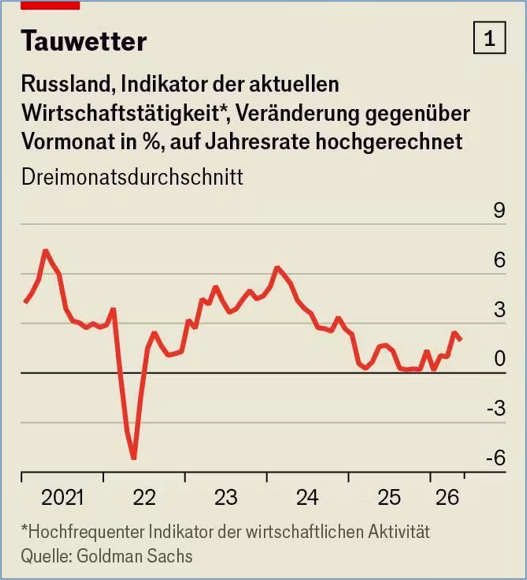
According to The Economist, a potentially more reliable indicator of economic trends is the “Current Activity Indicator” for Russia, calculated by Goldman Sachs and shown in the figure below. The “Current Activity Indicator (CAI)” points to weak economic growth, not a collapse (see Figure 1 below).
“L’essentiel”: Russia’s war economy is weakening—but not collapsing. June 25, 2026
The Economist also notes that data from the state-owned VEB Bank even point to an acceleration in GDP growth in March and April, partly thanks to rising oil prices.
“The Economist’s” conclusion: “It is highly unlikely that Russia’s economy is in a recession.”
Further insights from “The Economist” on the Russian economy
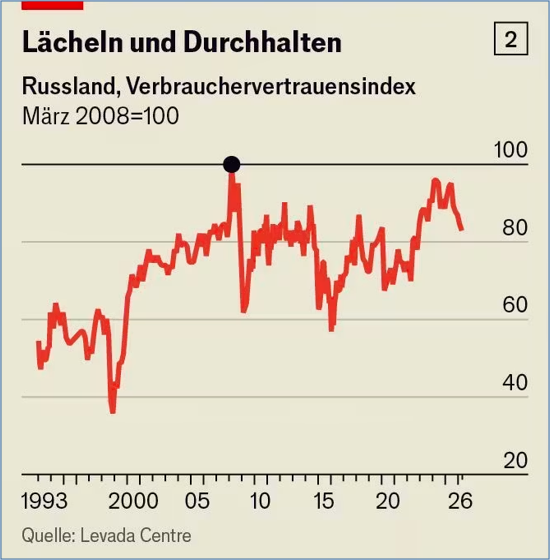
According to the independent Levada Center, consumer confidence has fallen. However, this decline came from a level that was close to an all-time high in 2025 (see Figure 2 below; Levada Center: Consumer Sentiment Index).
“L’essentiel”: Russia’s war economy is weakening—but not collapsing. June 25, 2026
Jobs may be slightly harder to find than they were a year or two ago. However, the unemployment rate remains close to its record low of around two percent.
Russia is facing increasing difficulties in exporting fossil fuels, the lifeblood of its economy. This is due to intensified Ukrainian attacks on energy infrastructure as well as a decline in oil prices from the highs reached during the Iran war. Nevertheless, total exports of goods in April—the most recent month for which data is available—were slightly above the previous year’s level.
Inflation is now only about half of its recent peak of over ten percent. Real wages, which are already 25 percent above 2019 levels, continue to rise.
“The civilian economy is treading water rather than shrinking”
Regarding the significance of increased defense spending for the resilience of the Russian economy, *The Economist* summarizes:
Last year, the government spent the equivalent of seven to eight percent of GDP on the armed forces. However, compared to prewar levels, this represents an increase of only three to four percent of GDP. This increase is not insignificant, but it is also not large enough to trigger massive knock-on effects. The civilian economy is treading water rather than shrinking.
The Economist: How Putin’s government can finance the war
The magazine describes Russia’s fiscal problems as “not yet acute.” It explains this as follows:
To finance the war, the government can raise taxes, as it recently did with the value-added tax. It can cover the remaining deficit—currently around three percent of GDP—using reserves from the sovereign wealth fund. It can borrow on the largely controlled domestic capital market.
In an emergency, financial officials could even tap into the ruble deposits of companies and households. That would be a last resort with significant consequences. But who would stop them, asks “The Economist”?
“The Economist” expects growth of about one percent in Russia in 2026
In conclusion, “The Economist” states:
All in all, Russia can expect GDP growth of around one percent this year (roughly on par with France or Canada). Tighter sanctions, such as those announced by the United Kingdom on June 16, could slow this growth somewhat. The same applies to further falling oil prices and an escalation of Ukrainian attacks on Russian oil infrastructure. But to actually bring Putin’s war economy to a standstill, “something significantly more radical” would be required.
VEB Institute: This Is How Much GDP Has Recovered Through April
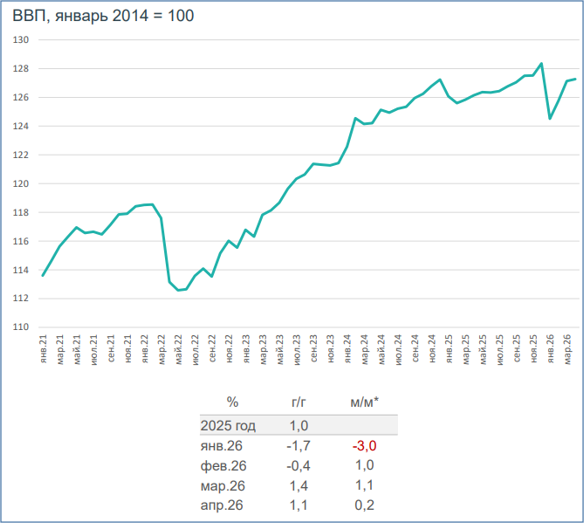
The following chart from the research institute of the state-owned development corporation VEB, showing the monthly trend in real gross domestic product, indicates that Russia’s overall economic output plummeted in January. According to VEB’s estimate, real GDP fell by 3.0 percent compared to December, after seasonal and calendar adjustment (see the right-hand column of the table below the figure). Although aggregate economic output recovered strongly in February and March, GDP grew by only 0.2% month-over-month in April.
Real Gross Domestic Product Index; January 2014=100
*M/M: Month-over-month change in percent;
estimate by the VEB Institute, adjusted for seasonal and calendar factors
VEB Institute: Russia’s Economy in April–May 2026, June 16, 26
GDP and industrial production will grow even more slowly in 2026 than in 2025
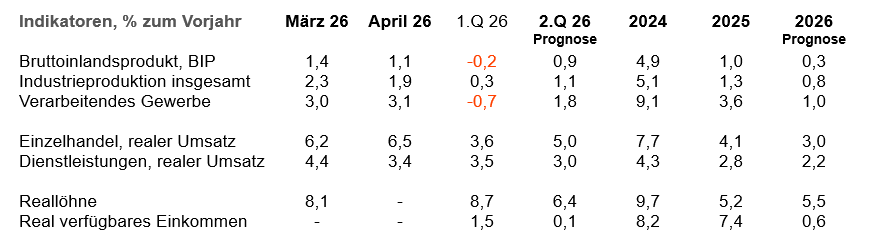
The VEB Institute’s report on economic developments in April and May also includes some new forecasts in a table at the end.
The institute lowered its forecast for this year’s real gross domestic product growth to 0.3 percent. In February, it had still expected an increase of 0.8 percent. Thus, the VEB Institute expects slightly less growth in 2026 than the Russian government, which lowered its GDP forecast in May from 1.3 to 0.4 percent.
According to the VEB Institute, annual industrial production growth will decline from 1.3 percent in 2025 to 0.8 percent in 2026.
Preliminary economic data and forecasts from the VEB Institute
VEB Institute: Russia’s Economy in April–May 2026, June 16, 2026
Incomes are rising at a much slower pace, and consumer demand is waning
According to the VEB forecast, growth in real disposable income will slow sharply in 2026 due to the increase in the value-added tax and lower corporate earnings. It will no longer reach 7.4% as in 2025, but will be only 0.6%. However, real wage growth will accelerate slightly from 5.2% to 5.5% in 2026.
Real retail sales growth will slow to 3.0 percent in 2026 (2025: +4.1%). Real sales in the services sector will grow by only 2.2 percent in 2026 (2025: +2.8%)
Decline in industrial production in May; PSB Bank lowers 2026 GDP forecast
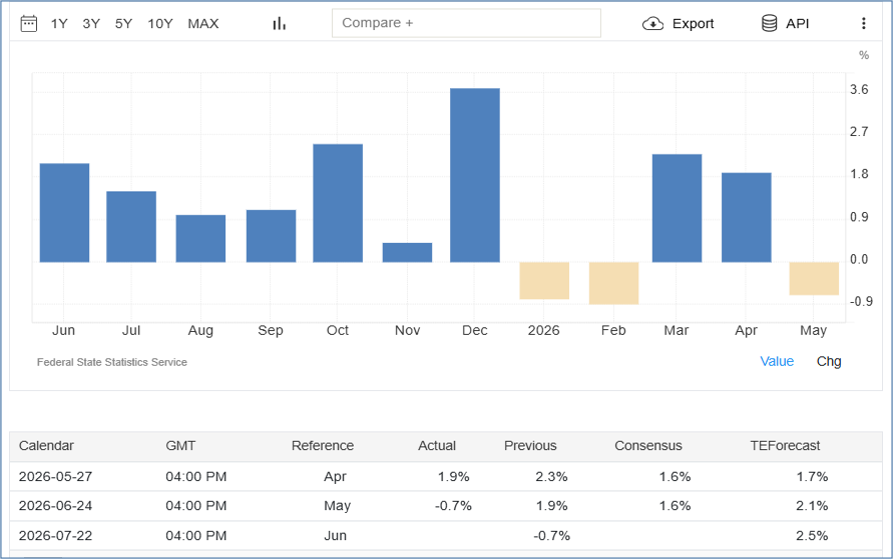
The Federal State Statistics Service (Rosstat) reported on June 24 that industrial production in May fell by 0.7% compared to the previous year. From January through May 2026, it grew by only 0.4% year-over-year.
Industrial production;
year-over-year change in percent
Trading Economics: Russia Industrial Production; June 24, 26
The decline in industrial production in May was attributable to a drop in production in the “Mining and Extraction of Raw Materials” (-2.7% compared to May 2025 and -0.2% compared to January–May 2025), with the main factor being the decline in the oil and gas sector.
Growth in “manufacturing” slowed to just +0.5% year-over-year in May (down from +3.1% in April). From January through May, manufacturing grew by only 0.3% compared to the previous year.
This was reported by the state-owned PSB Bank, which lowered its forecast for this year’s economic growth from +1.0% to +0.6%.
Recommended reading:
German-Russian Chamber of Foreign Trade:
Analyses, in German; also in Russian; (selection):
- Small Interest Rate Hike Dampens Business Hopes, June 23, 26
- Russian Labor Market: Full Employment and Labor Shortages, June 19, 26
- EU vs. Russia: A Comparison of Economic Forecasts, June 11, 26
Discussion contributions on the question: “Is Russia’s economy on the verge of collapse?”
- CEPR & VideoVox Economics: Endgame: The State of the Russian Economy; video of a webinar from June 15, 26, on the new Kiel Report on the Russian economy. In a discussion with the authors, the following topics are addressed: how much longer the Kremlin can sustain its military campaign, the costs associated with dependence on China, and why export revenues remain the decisive factor in Russia’s ability to continue the war; June 25, 26;
Authors and panelists include:
Torbjörn Becker (Stockholm Institute for Transition Economics)
, Konstantin Egorov (University of Antwerp)
, Alicia García-Herrero (Bruegel, Hong Kong University of Science and Technology)
, Matthew C. Klein (The Overshoot)
, Iikka Korhonen (Institute for Emerging Economies at the Bank of Finland)
, Elina Ribakova (Kyiv School of Economics, Peterson Institute for International Economics, Bruegel)
, Lucas Risinger (KSE Institute)
, Moritz Schularick (Kiel Institute for the World Economy, CEPR) - Janis Kluge, German Institute for International and Security Affairs (SWP), in conversation with Mary Abdelaziz-Ditzow on the “Im Loop” podcast: Have the sanctions against Russia fizzled out? Kluge outlines the current situation and analyzes the key mechanisms behind Russia’s resilience, video, 71 min., June 27, 2026
- Overton Magazine; Florian Rötzer: Is the Russian Economy Running Out of Steam in the War? June 24, 26
- Mark Galeotti with Pyotr Kurzin, host of “The Global Gambit”: Inside Russia’s Cracking Economy; 31 min., June 23, 2026
- Finanz und Wirtschaft; André Kühnlenz: War Economy. The predicted collapse of Russia’s economy has not materialized. Tougher sanctions and drone attacks by Ukraine are causing government revenues to shrink significantly. Nevertheless, military spending rose by a third in the first quarter, June 23, 2026
- Stories Framing the Globe; Ivan Kondratenko: Explainer: Russia’s War Economy Is Stalling but Not on the Brink of Collapse, According to The Economist. Magazine Disputes Recession Forecasts: GDP May Grow About 1% This Year, and No Rapid Crash Is Yet in Sight, June 23, 2026
- MK.ru: The resilience of the Russian economy has come as an unpleasant surprise to a leading Western magazine. The Economist: Western sanctions have failed to curb Russia’s economic growth, June 23, 2026
- Inosmi.ru; The Economist UK: The Russian economy has problems, but it is not in danger of collapsing; June 23, 2026; Original article: The Economist: Russia’s war economy has problems—but is not about to crash. Vladimir Putin is still able to fund his aggression; June 22, 2026;
- The Economist+: Russia’s war economy has problems—but is not about to crash. Vladimir Putin is still able to fund his aggression; June 22, 2026; German translation, published by “L’essentiel”: Russia’s war economy is faltering—but is not about to crash. Russia’s war economy is showing increasing cracks. However, according to new data, a rapid economic collapse is not in sight, June 25, 2026
- The Economist Videos: Why Vladimir Putin won’t end the war; March 25, 2026; Has Putin pushed Russia’s economy too far? February 20, 2026
- Telepolis; Bernd Müller: Gazprom facilities on fire: “Russia’s economy is in its final stages,” June 22, 2026
- Janis Kluge, German Institute for International and Security Affairs (SWP), in an interview with t-online; Simon Cleven, Jakob Hartung: Russia’s Economy: “The Russian leadership is worried”; Kluge sees no signs of an imminent collapse, but an economy coming under increasing pressure; June 21, 2026
- Royal United Services Institute: Global Security Briefing Podcasts, Episode 122: Inside Russia’s Wartime Economy; Natia Seskuria, Senior Research Fellow, Russian and Eurasian Security, is joined by RUSI Associate Fellow Charles Hecker; June 17, 2026
- “Die Presse” podcast “Russia – Gas, Sanctions, Oligarchs”; Eduard Steiner in conversation with Vasily Astrov, wiiw: Is Russia’s economy really in its final stages? German and Swedish economists claim that Russia’s economy is in its final stages. Are they right? Can it only be saved by an end to the war in Ukraine? And whom has the elite chosen as the scapegoat for the disaster? 38 min., June 17, 2026
- Prof. Dr. Alexander Libman; in: Freie Universität Berlin; Campus.Leben; The Online Magazine of FU Berlin: Is Russia on the Brink of Economic Collapse? Since the outbreak of full-scale war, predictions of a rapid collapse of the Russian economy have been mounting. But how realistic are they? June 17, 2026; Berliner Zeitung; Liudmila Kotlyarova: “No Collapse”: Economist Clarifies What Is Happening to Russia’s Economy Now. Eastern Europe expert Alexander Libman explains what the country can expect in the long term, May 4, 2026
- Austrian Academy of Sciences; Prof. Wolfgang Müller: Is Russia’s economy on the verge of collapse? High inflation, skyrocketing military spending, shrinking growth: Under the pressure of war and sanctions, Russia’s economy is showing clear cracks. ÖAW historian and Eastern Europe expert Wolfgang Müller analyzes where the Kremlin is actually vulnerable—and what has kept it afloat so far; June 16, 2026
- Prof. Dr. Moritz Schularick, President of the Kiel Institute for the World Economy, in an interview with Rixa Fürsen; Politico Europe; Berlin Playbook Podcast: “Russia on the Brink of Collapse,” 36 min., June 13, 2026
- Sky News: Vladimir Putin has plunged Russia’s economy into the “death zone.” Here’s why. Is Russia’s economy faltering? Businesses are closing, bills and taxes are rising—the growing costs of the conflict are being felt not only on the battlefield but also in everyday life and in households. Sky correspondent Ivor Bennett reports from St. Petersburg; Niall Paterson speaks with military expert Professor Michael Clarke, June 4, 26
- Merkur.de; Natalia Abbakumova, Catherine Belton; Washington Post: Grim warning for Russia: Expert expects a collapse similar to that of 1917 as early as this fall; April 30, 26
- loyal, We Are the Reserve; Julia Egleder: Is the Russian Economy on the Verge of Collapse? March 16, 26
- Inosmi.ru; Berliner Zeitung: Russia’s economy is at its peak. It is not on the verge of collapse. Economist Astrov: Russia can sustain its current defense spending for years to come; March 1, 2026; Original article: Berliner Zeitung+; Alexander Dubowy: Interview with an economist: Russia’s economy is at its limit, but not on the verge of collapse. Vienna-based economist Vasily Astrov explains why Moscow’s war economy is stagnating, sanctions are taking effect only slowly, and China has become the decisive factor, February 27, 2026
- Deutschlandfunk; Markus Metz and Georg Seeßlen: The New Dealmakers. On economic wars and war economies. With Donald Trump’s second term as U.S. president, the postwar order of the global economy is crumbling. Trade wars and national self-interest are shaping politics and the economy. Are citizens paying the price for profits and power? March 15, 26
- Deutschlandfunk: War Economy. When States Focus Everything on Victory. Russia’s war against Ukraine not only causes great human suffering, it also devours vast amounts of resources. In such cases, a state often switches to a war economy, April 17, 2024
Kiel Report: “Endgame: Russia’s Economy Under Pressure” and reports on the publication
- Kiel Institute for the World Economy: News: Endgame: Russia’s War Economy Reaches Its Limits; Kiel Report No. 9. Endgame: Russia’s Economy Under Pressure; Executive Summary; Torbjörn Becker and Moritz Schularick: Russia’s Economy in Its Final Stage, June 11, 2026
- Kiel Institute for the World Economy: News: EU-Russia Trade Could Finance Ukraine and Increase Pressure on the Kremlin; Prof. Dr. Julian Hinz, Research Director; Prof. Dr. Moritz Schularick, President: Kiel Policy Brief, 212: A Solidarity Tariff for Ukraine: How Europe Can Support Ukraine and Weaken Russia Economically, June 9, 26
- Joe Blogs: Russian Endgame Disaster; A bombshell new report from one of Europe’s leading economic research institutes claims Russia’s wartime economy is entering a dangerous new phase. …The report reveals a dramatic surge in hidden corporate debt, growing stress within Russia’s banking system, rapidly shrinking financial reserves, falling oil and gas revenues, and increasing dependence on China, June 16, 2026
- Münchner Merkur; Fabian Hartmann: “Clear Signs of Structural Exhaustion”: Analysis Sees Russia’s Economy Close to Collapse, June 14, 2026
- Frankfurter Rundschau; Fabian Hartmann: Russia’s economy reaches “final stage”: Close ties to China are not the only cause, June 13, 2026
- web.de; dpa: Economists see Russia’s economy as having reached the “final stage,” June 11, 2026
- Deutsche Welle: War in Ukraine: Economists See Russia’s Economy at an End, June 11, 2026;
- Handelsblatt, dpa: Institute for the World Economy: Economists See Russia’s Economy at Its Limit. According to a report by economists, Russia’s economy is on the verge of collapse. The report also highlighted opportunities for the West, June 11, 2026
Economic Forecasts:
- russian.rt.com: Nabiullina: The Central Bank expects GDP growth of 0.5% in Russia for the first half of the year, June 19, 2026
- VEB Institute: Russia’s Economy in April–May 2026, June 16, 2026
- ifo Institute Munich: ifo Economic Forecast Summer 2026: Rising Energy Prices Slow Growth – Fiscal Policy Boosts It; in: ifo Express: Rising Energy Prices Slow Growth – Fiscal Policy Boosts It, June 18, 2026
- DIW Berlin: DIW Weekly Report: Energy Price Shock Slows German Economy – Global Economy on a Moderate Growth Path, June 12, 2026
- IWH Halle: Current Economic Outlook: The Economy Between the Energy Crisis and the AI Boom; PDF, June 11, 2026
- RWI Essen: RWI Economic Report: Despite the Energy Price Shock: Industry Proves Resilient – Inflation Is Spreading to More and More Sectors; Press Release dated June 16, 2026
- IfW Kiel: The Global Economy in Summer 2026, PDF, June 11, 2026; Politico Europe; Berlin Playbook Podcast; Rixa Fürsen: Interview with Moritz Schularick, President of the Kiel Institute for the World Economy: “Russia on the Brink of Collapse,” 36 min., June 13, 2026
- Eurasian Development Bank: Macroeconomic Forecast 2026–2028, June 15, 2026
- World Bank: Press Release: Middle East Conflict Sends Global Growth to Lowest Rate Since COVID-19; June 11, 2026; Global Economic Prospects: Europe and Central Asia, June 2026, June 11, 2026
- Business Insider; Huileng Tan: Russia’s Economy Is Suffering—Goldman Sachs Delivers a Harsh Verdict. Higher Oil Prices Help Putin—Why Russia’s Economy Still Won’t Recover, According to Goldman Sachs, June 10, 2026
Current Economic Developments; Economic Data for April, May, and June:
- VEB Institute: Global Economy and Markets, June 26, 2026
- PSB Bank: In May, industrial production fell by 0.7% year-over-year; June 26, 2026
- Finmarket.ru: Industrial production in Russia fell by 0.7% in May, June 24, 26
- Raiffeisenbank: GDP Growth: The Gap Between the Public Sector and Other Sectors Is Widening; First-Quarter GDP Growth by Sector; June 22, 2026
- Finanzmarktwelt; Josephine Bollinger-Kanne: Putin’s Fight Against an Economic Apocalypse in Russia, June 20, 2026
- Tagesschau.de; Angela Göpfert, ARD Finance Desk: Putin’s war economy is coming under increasing pressure. The war in Iran has only given Russia a brief respite. Falling oil prices, Ukrainian drone attacks, and the strong ruble are increasingly weighing on the economy; June 19, 2026
- Marina Voitenco; Politcom.ru: Investment Activity—Restrictions, Risks, Prospects; June 18, 2026; Macrodynamic Arrhythmia and the Government’s Response, June 12, 2026
- VEB Institute: Russia’s Economy in April–May 2026; June 16, 2026
- VEB Institute: GDP Index: Monthly GDP Estimate – April 2026; June 16, 2026
- Finmarket.ru: Rosstat Confirmed Its Estimate of a 0.2% Decline in Russian GDP in the First Quarter, June 17, 2026
- Sergey Aleksashenko, Senior Research Fellow at the New Eurasian Strategies Centre: The Illusion of Normalization: Tensions in the Kremlin Have Eased, but Anxiety Remains, June 16, 2026
- EuroNews; Sasha Vakulina: “Significantly worsened”: These 3 factors are hurting Russia’s economy, says IMF Chief Kristalina Georgieva; June 12, 2026
- Münster aktuell; Tim Eichler: Russia’s economy is coming under pressure from rising interest rates and sanctions, June 11, 2026
- Silicon Curtain: Interview with Nigel Gould-Davies, Senior Fellow for Russia and Eurasia at the International Institute for Strategic Studies (IISS) in London: Is Russia’s economy REALLY collapsing, or is it more resilient? June 10, 2026
- Finmarket.ru: According to the Central Bank, economic activity in Russia increased in April and May; GDP growth in the second quarter will be positive, June 10, 2026
- IEF RAS: Analysis of Short-Term GDP Trends: June 2026, June 9, 2026
Monetary Policy: Key interest rate cut from 14.5 to 14.25 percent on June 19
- The Bell; Alexandra Prokopenko; Alexander Kolyandr; de.thebell.io: The Bank of Russia Slows Interest Rate Cuts, Sending a Signal to the Government, June 23, 2026
- Yahoo Finance; Euronews; Alexander Kazakevich: Russian Central Bank: Fuel Crisis and War Expenditures Could Fuel Inflation, June 22, 26
- Monocle.ru; Evgeniya Obukhova: Budget cuts and gasoline prices slowed the interest rate cut (excerpt on budget developments); June 22, 2026
- The Bell: The Central Bank Cut Its Key Interest Rate by Only a Quarter of a Percentage Point; June 19, 2026
- Onvista; Reuters: Russian Central Bank cuts key interest rate less sharply than expected, June 19, 2026; MarketScreener, Reuters: Russian Central Bank cuts key interest rate by 25 basis points to 14.25% – risks from fuel supply and fiscal policy, June 19, 2026
- russian.rt.com: Nabiullina: The Central Bank expects GDP growth of 0.5% in Russia for the first half of the year, June 19, 2026
- RSPP: Alexander Shokhin: Companies are disappointed by the Central Bank’s interest rate decision, June 19, 2026; Comment by RSPP Vice President Alexander Murychev on the Central Bank’s key interest rate decision, June 19, 2026
Fiscal Policy; National Budget and Oil Prices
- Public News Service; Roman Kotlov: Dmitriev Rejected Western Assessments of the Russian Economy, Public Debt, and Budget Deficit; June 25, 26
- TopWar.ru; Alexey Volodin: Russian oil has once again reached the price level set in the “budget plan,” June 24, 2026
- Tass.ru: Ministry of Finance: The budget deficit for the first five months of 2026 amounted to 6.01 trillion rubles; June 25, 2026
- SFG Media, Dmitry Fesenko; Reuters: Russia’s Oil and Gas Budget Revenue Rose 32% in May—Driven by High Oil Prices and the Suspension of U.S. Sanctions; June 23, 2026
- Military & History; Torsten Heinrich: Russia’s Oil Crisis Is Becoming Dramatic!; Video, 17 min., June 22, 2026
- Olga Belenkaya, FG Finam: Budget: Signs of Stabilization Emerged in May, June 8, 2026
Fuel Supply, Energy Sector:
- Brome.ai: Oil Prices Hit Pre-War Levels, June 27, 2026
- Inosmi.ru; Bloomberg USA: Russia Will Supply Record Amounts of Oil in 2026, June 24, 2026
- Telepolis; Bernd Müller: Gazprom Facilities on Fire: “Russia’s Economy Is in Its Final Stages,” June 22, 2026
- allsides.com: WSJ Journalist Publishes Book on Nord Stream Pipeline Sabotage, June 16, 2026
- Transparency International: Nord Stream. Gas, Gerd, and a Lot of Detailed Work. The Parliamentary Inquiry Committee on the Mecklenburg-Western Pomerania Climate Foundation – For four years, an inquiry committee has been investigating the events surrounding the MV Climate Foundation and Nord Stream 2; Schwerin, June 15, 2026
- Foundation for Science and Politics (SWP); SWP Podcast: Under a False Flag: The Russian Shadow Fleet as a Tool of Hybrid Warfare. Julian Pawlak and Janis Kluge explain what Europe can do; Hosted by Dominik Schottner, 26 min., June 4, 2026