"Near-Stagnation": Russia's GDP Grew by Only 0.3% in the First Half of the Year
Author: Klaus Dormann
On July 29, Rosstat, Russia’s Federal State Statistics Service, released preliminary data on economic performance for the first half of 2026. Based on this data, the Russian Ministry of Economic Development estimates that real gross domestic product rose by only 0.3% year-over-year in the first half of the year.
In light of this weak growth, many forecasts for the Russian economy’s growth in 2026 are being further revised downward. Vasily Astrov, a Russia expert at the Vienna Institute for International Economic Comparisons (wiiw), emphasized in a podcast that the Russian economy is in a state of “stagnation.” Astrov noted that the forecast for this year’s Russian economic growth—which the wiiw had lowered to +0.6 percent in early July—would likely now be revised “toward zero.”
The Institute for Economic Forecasting at the Russian Academy of Sciences even believes that only the effects of the war in Iran will save Russia from a recession this year.
Olga Belenkaya, chief economist at the brokerage firm FINAM, expects real gross domestic product to grow by only 0.3 to 0.8 percent in 2026. She has conducted a detailed analysis of production trends in the key economic sectors during the first half of the year (see table at the end of this article).
The Central Bank, Sberbank, and VTB Bank have also lowered their GDP forecasts
Since mid-May, the Ministry of Economic Development has been forecasting that economic growth for the full year 2026 is likely to slow from 1.0% to just 0.4%. Previously, in its fall 2025 budget, the government had assumed that GDP growth would accelerate slightly to 1.3% this year.
Meanwhile, the Russian Central Bank has also shifted its growth expectations for 2026 toward “stagnation.” In its July policy rate decision, it lowered its forecast range for this year’s GDP growth to 0.0–1.0%.
Major Russian state-owned banks followed suit. Sberbank lowered its GDP forecast for 2026 from 0.5 to 1.0% to 0.0 to 0.5% (Vedomosti). VTB Bank lowered its forecast for real GDP growth from 1.0% to 0.6% (1prime.ru).
The Institute for Economic Forecasting of the Russian Academy of Sciences (IEF-RAS) continues to expect 0.7% growth
In its forecast published at the end of July, the Institute for Economic Forecasting of the Russian Academy of Sciences (IEF-RAS) maintains the similarly low growth expectations it had already published in early June. It anticipates that real gross domestic product growth will slow to 0.7% in 2026 and will be only slightly higher at 1.1% next year (GDP, first row of the table below).
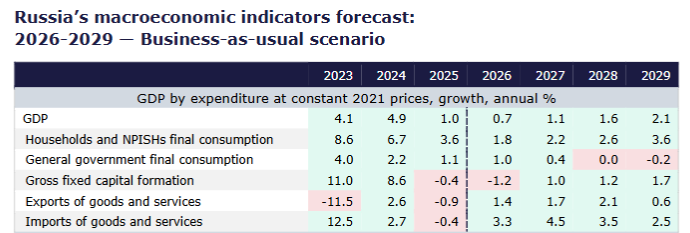
IEF-RAS: Quarterly Forecast of Macroeconomic Indicators of the Russian Federation, excerpt; July 30, 2026
According to the forecast, the drivers of growth in 2026 will be private household consumption (+1.8%) and government consumption (+1.0%). Gross fixed capital formation, on the other hand, will decline (-1.2%). Nor is any growth impetus expected from the “external sector.” Exports are rising more slowly (+1.4%) than imports (+3.3%).
IEF-RAS: Russia Will Be Spared a Recession in 2026 Due to the War in Iran
In the summary of its forecast, the IEF highlights the following thesis:
“The change in external conditions will spare the Russian federal budget from cuts and the Russian economy from a recession.”
The institute’s explanation of this thesis indicates that by “changes in external conditions,” the institute refers to the rise in export prices for Russian commodities as well as the increase in demand for Russian commodities resulting from the closure of the Strait of Hormuz due to the war in Iran. According to the institute, this has most likely prevented the onset of an “unfavorable scenario” for the Russian economy. In this “adverse scenario,” the government would have been forced to cut its budget spending quite sharply as early as 2026 due to declining oil and gas revenues. A simultaneous “controlled devaluation” of the ruble to further increase state oil and gas revenues would not have been able to prevent this.
The institute explains:
“The growth in export revenues and the stabilization of oil and gas revenues make it possible to meet this year’s planned deficit targets without reducing budget expenditures and without postponing the resolution of the budget balancing issue until 2027.”
According to the institute’s assessment, the “problem of balancing the budget” will therefore soon arise again. In its forecast, the institute assumes that the blockade of the Strait of Hormuz will be lifted in the second half of 2026. This will be accompanied by a decline in export prices and stagnation in foreign exchange earnings from exports from 2027 to 2029.
The institute also assumes that monetary policy will “gradually normalize.” The inflation rate will remain steadily above the central bank’s target of 4 percent due to a gradual devaluation of the ruble and inflationary pressures exceeding the growth of consumer demand.
wiiw expert Astrov plans to lower his Russia forecast “toward zero”
As early as the beginning of July, the “Vienna Institute for International Economic Comparisons (wiiw)” had already forecast a very similar trend in Russian economic output to that of the Institute for Economic Forecasts of the Russian Academy of Sciences (RAS) (see “Country Overview Russia”). Just over a month ago, it lowered its growth forecast for 2026 by another 0.3 percentage points to just 0.6% (IEF forecast: 0.7%). Next year, the wiiw expects growth to pick up to 1.3% (IEF forecast: 1.1%).
However, Vasily Astrov, the wiiw’s Russia expert, stated in late July during an interview with Eduard Steiner on the Russia podcast of the Austrian newspaper “Die Presse” that he would now lower his growth forecast for Russia even further (minute 17:30).
In the interview, Astrov does reiterate that he would not describe the current situation of the Russian economy as an “acute crisis.” An acute crisis typically involves a “spike in inflation,” a currency devaluation, or a double-digit or “significant” decline in GDP. According to Astrov, we are not seeing any of that in Russia at the moment. It is more a case of “stagnation.” Incidentally, he would now set his forecast for this year’s growth of the Russian economy even lower (“probably closer to zero”). “Either way,” he says, Russia is in a state of “stagnation.”
VEB Institute Estimate: GDP Grew in June
The research institute of the state-owned development corporation VEB has calculated, based on Rosstat figures, how real gross domestic product developed month-over-month on a seasonally and calendar-adjusted basis during the first half of the year. According to its estimate, GDP grew by 0.3% in June 2026 compared to the previous month, May.
Index of real gross domestic product,
seasonally and calendar-adjusted (Jan. 2014=100)
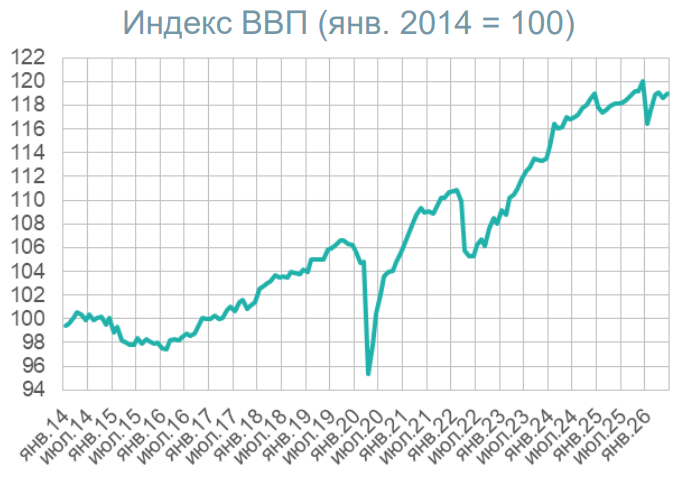
VEB Institute: Global Economic and Market Outlook (July 24–30, 2026), July 31, 2026
Regarding production trends across economic sectors, the VEB Institute notes: The main driver of growth in June was the construction sector. Freight transport, electricity, gas, and water supply, as well as wholesale and retail trade, also performed well. Mining, manufacturing, passenger transport, agriculture, the restaurant industry, and services, on the other hand, recorded a decline in production in June compared to May.
Compared to the same month last year (June 2025), GDP growth accelerated to 1.2% according to the VEB Institute’s estimate, slightly higher than the Ministry of Economy’s estimate (+1.1%; Interfax). In the second quarter of 2026, GDP rose by 0.9% year-over-year, according to both the VEB Institute and the Ministry. When comparing figures with the corresponding quarters of 2025, the impact of the “calendar effect” should be taken into account. In the second quarter of 2026, there were three more working days than in the same quarter of the previous year. In the first quarter of 2026, however, the number of working days was three days fewer than a year earlier.
BOFIT: “Mild Recovery” of the Economy After a “Weak Start” to 2026
The BOFIT research institute of the Bank of Finland, which focuses primarily on developments in the “emerging economies” Russia and China, notes in its latest weekly report, “BOFIT Weekly,” that Russia’s gross domestic product (GDP) fell by 0.2% year-over-year in the first quarter of 2026.
At the same time, the institute notes that, according to Rosstat, output in the five key economic sectors grew by 0.2% year-over-year from January through June (see also Finmarket.ru). According to BOFIT, this increase in the five “core sectors” of the economy (agriculture, industrial production, construction, freight transport, and wholesale and retail trade) indicates that overall economic output has “rebounded slightly” following a “weak start to the year.”
In fact, according to estimates by the Ministry of Economic Development, real gross domestic product grew by 0.9% year-over-year in the second quarter (RBC). However, due to the 0.2% decline in the first quarter, GDP for the first half of the year as a whole rose by only 0.3%, according to the ministry.
Growth in the first half of the year was driven primarily by the industrial sector
In its weekly report, BOFIT comments on the Rosstat data for the entire first half of 2026 as follows, among other things:
Growth in the first six months was driven primarily by industrial production. It rose by a total of 0.4% (Finmarket.ru). The increase was based almost exclusively on the rise in the production of defense-related goods in the “manufacturing sector.”
Specifically:
- “production of other transportation equipment” by about 32%,
- “production of other metal products” by 9%,
- “production of computers and optical equipment” by 4%,
- and “production of pharmaceutical products” by 14%.
Production in other sectors of the “manufacturing industry” as well as in mining declined slightly in the first half of the year.
The growth in industrial production has slowed in recent years
The following BOFIT chart shows the monthly trend in total industrial production and its two largest subsectors: “Mining and quarrying” and “Manufacturing.”
Industrial growth has slowed
Year-over-year changes in production (in %) for total industry, “Mining and Quarrying,” and “Manufacturing”
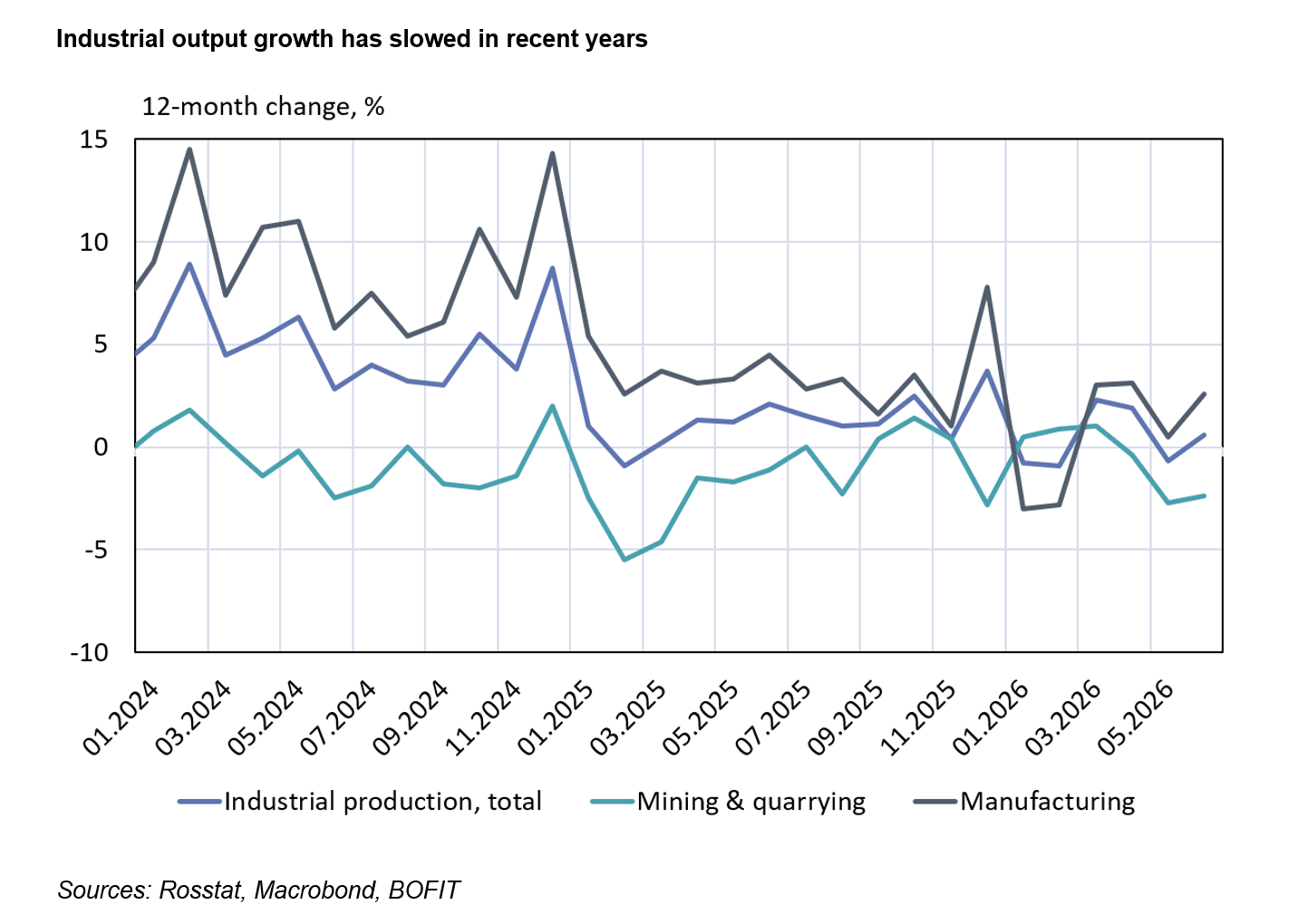
BOFIT, Bank of Finland: BOFIT Weekly, July 30, 26
Overall, industrial production rose by 0.6% in June 2026 compared to June 2025 (middle dark blue line). Production in the “Mining and Quarrying” sector, however, declined again (-2.4%; lower green line). Production in “Manufacturing,” on the other hand, rose by 2.6% year-over-year in June (upper black line).
BOFIT notes that the production losses caused by Ukraine’s drone attacks are particularly evident in the decline in “Production of Coke and Petroleum Products.” Here, production in June fell by about 12% compared to the previous month, May. It was 22% below the level reached one year ago in June 2025.
According to BOFIT, significantly higher real sales in the retail sector (+5.4%) and in the hotel and restaurant industry (+6.1%) also made strong contributions to overall economic growth in the first half of the year. However, the growth rate of other private services (+2.6%) slowed slightly.
An Overview of the Key Sectors’ Performance
Olga Belenkaya, chief economist at the publicly traded company FINAM, has once again compiled a detailed analysis of how the key economic sectors have performed over the past month and since the beginning of 2026. The following table also allows for a comparison with the economic situation one year ago, in June 2025.
Economic Indicators for June 2026 Compared to June 2025
Year-over-year changes in June 2026 and the first half of 2026, in %
| June 2026 / June 2025 |
June 2025 / June 2024 |
Jan.–June 2026 / Jan.–June 2025 |
Jan.–June 2025 / Jan.–June 2024 |
|
|---|---|---|---|---|
| Total industrial production | 0.6 | 2.1 | 0.4 | 0.8 |
| Mining | -2.4 | -1.1 | -0.5 | -2.8 |
| Manufacturing | 2.6 | 4.5 | 0.7 | 3.7 |
| Wholesale trade | 2.7 | -2.9 | 1.0 | -3.5 |
| Transportation Industry, Freight Handling | 1.9 | 1.5 | -0.6 | -0.3 |
| Construction output | 3.5 | 0.0 | -5.0 | 3.5 |
| Agricultural production | -2.9 | 1.5 | -0.8 | 1.1 |
| Retail/Services, Real Sales | 6.0 | 4.8 | ||
| Total retail | 7.3 | 3.4 | 5.4 | 3.1 |
| Food retail | 4.6 | 2.2 | 3.1 | 2.2 |
| Non-food retail | 9.8 | 4.6 | 7.6 | 3.8 |
| Paid services | 1.7 | 3.3 | 2.6 | 3.1 |
| Hospitality | 6.5 | 6.4 |
Wage income, nominal and real
| May 2026 / May 2025 |
May 2025/May 2024 |
Jan.–May 2026 / Jan.–May 2025 |
Jan.–May 2025/ Jan.–May 2024 |
|
|---|---|---|---|---|
| Average nominal wage | 10.1 | 14.5 | 13.3 | 14.3 |
| Average real wage | 4.5 | 4.2 | 7.2 | 3.8 |
Source: Olga Belenkaya; Finam.ru: Results for June and the first half of 2026; July 30, 2026
Olga Belenkaya: “The sustainability of consumption growth is uncertain”
In her analysis, Belenkaya takes a close look at consumer spending trends, among other things. She notes:
According to the Ministry of Economy, real total sales in retail, consumer services, and the food service industry rose by 6.0% year-over-year in June 2026. In the first half of 2026, growth in these consumer activities amounted to 4.8% compared to the previous year (+6.0% in the second quarter of 2026).
Annual growth in total retail sales slowed slightly in June compared to May, reaching 7.3%. Food sales rose by 4.6%, while non-food sales increased by 9.8% year-over-year—roughly twice as much.
However, commenting on these strong growth rates, Belenkaya notes: “The sustainability of this growth in consumer spending is uncertain.” She points out that wage growth has slowed.
Recommended Reading
German-Russian Chamber of Foreign Trade
- Despite Rising Inflation Expectations: Central Bank Cuts Key Interest Rate to 14%, July 28, 26
- Fuel Crisis: Top Exporter Russia Relies on Imports, July 21, 26; Gasoline Crisis in Russia, June 30, 26
- Russia’s Banks: Record Profits, Credit Crisis, and Bank Closures, July 14, 26
“Die Presse” Podcast: Russia – Gas, Sanctions, Oligarchs
- Has Ukraine finally struck a vital nerve in the Russian economy? Following the oil refineries, Ukrainian drone attacks are now setting fire to the logistics warehouses of Russia’s largest online retailer, Wildberries. Hundreds of thousands of business owners are affected. How badly has the economy been hit? Economist Vasily Astrov (WIIW) in conversation with Eduard Steiner; 47 min., July 29, 26
- “Will Ukrainian drones be the ones to bring down Putin?” Former Colonel Wolfgang Richter and economist Vasily Astrov (WIIW) discuss with Eduard Steiner how far Ukraine has advanced in weapons technology, the risk of escalation the West is currently sliding into with Russia, and how much of the Russian oil industry has already been destroyed (min. 18–34); 49 min., July 15, 2026
Current economic trends in June and the first half of the year; the economy as a whole
- russland.capital: Russia’s corporate balance sheets paint a mixed economic picture, August 1, 26
- Finam.ru; Olga Belenkaya: Results for June and the first half of the year: Slowing growth in wages and real incomes; Inflation risks also arise from attacks on warehouses; July 30, 26
- BOFIT, Bank of Finland: BOFIT Weekly: Weak first half for the Russian economy; EU expands sanctions; July 30, 26
- Finmarket.ru: According to data from the Ministry of Economic Development, Russian GDP grew by 1.1 percent year-over-year in June and by 0.3 percent in the first half of the year. July 29, 2026
- Finmarket.ru: Production in the key sectors of the Russian Federation rose by 1.8% in June and by 0.2% in the first half of the year. July 29, 2026
- Finmarket.ru: Russian retail sales rose by 7.3% in June. 07/29/26
- Finmarket.ru: Wage growth in Russia was 4.5% in May, following 5.1% in April. 07/29/26
- Finmarket.ru: Real disposable income for the Russian population rose by 1.5% in the second quarter. 07/29/26
- Finmarket.ru: Unemployment in Russia rose back to 2.2% in June after hitting a low of 2.1% in May; July 29, 2026
- InvestFuture; TASS: Revenue in the Russian restaurant industry rose by 6.5% in June 2026; July 29, 2026
- RBC.ru: The Ministry of Economic Development reported a significant increase in GDP growth in June. 07/29/26
- Vedomosti: The Ministry of Economic Development reported that Russian GDP grew by 1.1% in June. In May, the indicator rose by 0.3%. July 29, 2026
- Fnp.de; Christoph Gschoßmann; Putin Fights on Two Fronts: Central Bank Lowers Growth Forecast to Zero, July 29, 2026
- t-online: Self-made billionaire Tatjana Kim. Russia’s most powerful retailer; Ukrainian drones attack locations of the online retailer Wildberries; July 29, 2026
- Merkur.de; Carmen Mörwald: Limit: Russia’s economy is faltering. An expert is now warning of a possible escalation in Ukraine. “No matter what the terms”: Economist Astrow explains why peace would save Russia’s economy, July 28, 2026
- CMASF: Industrial production in June; July 27, 2026
- Kyiv School of Economics: Russia Chartbook: Stalled Domestic Borrowing Poses a Threat to Budget Financing; Energy Windfall Fades as Oil Prices Moderate, July 29, 2026
- Politcom.ru Weekly Report; Nikita Maslennikov: Economic Activity Is Cooling Off Again, July 24, 2026
- Trading Economics; Larissa Caser: Russia Industrial Production Rebounds in June, July 22, 2026
- FocusEconomics: Russia Industrial Production June 2026, July 22, 2026
- Finmarket.ru: Industrial production in Russia rose by 0.6% in June after falling by 0.7% in May, July 22, 2026
- FR.de; Nils Thomas Hinsberger: Putin’s Number Games: What the Kremlin Is Hiding When It Talks of “Stability,” July 26, 2026
- Focus online; Cedric Kienhöfer: Ukraine attacks “nerve centers of the Russian economy.” Several Ukrainian attacks hit warehouses belonging to the online retailer Wildberries, July 26, 2026
- Tagesschau.de, Silke Diettrich: Attacks on Wildberries. The war reaches “Russia’s Amazon,” July 25, 2026
- MDR interview with Vasily Astrov: War in Ukraine. Russia’s economy has been hit. The only winner of the war is the defense industry. But discontent prevails among the population; July 25, 2026
- Bond Guide: Ukraine is successfully taking jabs at Russia and putting pressure on its public finances. Russia is struggling with rising financing costs, a growing budget deficit, and new drone attacks on civilian logistics. At the same time, inflation remains high. Alexandra Prokopenko and Alexander Kolyandr report on this in their latest analysis for The Bell. July 25, 2026
- CMASF: Analysis of Macroeconomic Trends, July 24, 2026
- Reporter; Andrey Elistratov: An expert highlighted the main problem facing the Russian economy, July 23, 2026; Yuri Baranchik: Commentary on the CMASF’s macroeconomic baseline analysis, July 23, 2026
- russland.capital: Russia’s Business Association Warns of a Wave of Bankruptcies This Fall, July 23, 2026
- Politico.eu; Geoffrey Smith: Ukraine’s drone strikes are putting pressure on the Russian economy. As its refineries and warehouses burn, Russia’s financial markets are beginning to freeze, July 22, 2026
Economic Forecasts
- IEF-RAS: Quarterly forecast of macroeconomic indicators for the Russian Federation, July 30, 2026
- Kommersant; Dmitry Kuvalin, Deputy Director of the Institute for Economic Forecasting at the Russian Academy of Sciences: A Finger in the Sky. Why Macroeconomic Forecasts Are Unreliable; in: Kommersant: “Money.” Supplement No. 20, July 30, 2026
- Kommersant; Artem Chugounov: Consumers Are Losing Confidence, July 29, 2026
- Vedomosti: Sberbank has revised downward its inflation and GDP forecasts for the end of 2026. July 29, 2026
- Finmarket.ru: VTB has refined its profit forecast for 2026 and expects a profit of around 600 billion rubles. At the same time, it revised its macroeconomic forecasts, July 28, 2026
- Kommersant; Artem Chugunov: Between stabilization and a slight decline. The Russian Central Bank and analysts have updated their forecasts for the second half of 2026; July 27, 2026
- Finmarket.ru: The Central Bank of the Russian Federation has published its first forecast for economic growth in 2029—an increase of 1.5 to 2.5 percent, July 24, 2026
- Russian Central Bank: Bank of Russia’s medium-term forecast following the Bank of Russia Board of Directors’ key rate meeting on July 24, 2026, July 24, 2026
- Eurasian Fund for Stabilization and Development: Regional Economic Outlook, July 16, 2026
- russland.capital: Russia’s economy is barely growing anymore—high interest rates will remain in place longer, July 16, 2026
- Radio "Kommersant FM"; Leonid Pasternak: Inflation Has Rewritten the Budget. What Business Leaders Say About the Central Bank’s Economic Forecasts, July 16, 2026
Fuel Supply, Energy Sector
- bne Intellinews; Ben Aris: The Russia-Ukraine drone war shifts to crippling ports, August 1, 2026
- bne Intellinews: Ukraine’s refinery campaign is turning oil into Russia’s weakest economic link, Riddle Russia’s Vakhtang Partsvania argues that Kyiv’s shift from export terminals to refineries has found the one part of Russia’s oil sector that sanctions alone could never touch: domestic fuel supply, August 1, 2026
- DW.com; DW in Russian: Ukraine’s Attack on Wildberries: Causes and Consequences, including:
Oleg Loginov: Attacks on Wildberries: A Cascading Effect on the Russian Economy; Disrupting supply routes to the front lines is just one of the goals of the attacks, July 30, 2026 - Finmarket.ru: Gasoline prices in Russia rose by 0.56% from July 21 to 27, while diesel prices fell by 0.06%. July 29, 2026
- Interfax.com: Fuel situation in Russia stabilizing; several oil refineries operating again – Russian Deputy Prime Minister, July 27, 2026
- ntv.de; Caroline Amme: Moscow’s new gas station. Russia is buying back its crude oil from India—as refined gasoline; also available as a podcast titled “Learned Something New”; July 23, 2026
- russland.capital: Russia’s government reports easing tensions in the fuel market, July 22, 2026
- ntv.de; Max Borowski: Warning of a diesel shortage. Destruction of Russian refineries drives up European fuel prices, July 22, 26
- German-Russian Chamber of Foreign Trade; Analysis: Fuel Crisis: Top Exporter Russia Relies on Imports, July 21, 2026
- Meduza; Julia Starostina: How Much Damage Can Russia’s Fuel Crisis Do to the Economy? July 21, 2026
Price Trends
- Finmarket.ru: Gasoline prices in Russia rose by 0.56% from July 21 to 27, while diesel prices fell by 0.06%. July 29, 2026
- russland.capital: Russia’s inflation rises to 5.8 percent—the public expects nearly 15 percent, July 23, 2026
- Finanzmarktwelt; Josephine Bollinger-Kanne: Russia in the grip of a fuel crisis and a spiral of rising costs. The war in Ukraine is having an increasingly significant impact; July 15, 2026
- Russian Central Bank, Press Release: Inflation in Russia No. 6 (126) • June; July 15, 2026
- Bank of Russia: Price growth accelerates in June due to one-off factors, July 15, 2026
Monetary Policy: Reports on the Key Interest Rate Cut on July 24
- Politkom.ru; Marina Voitenko: The Russian Central Bank cut the key interest rate and sent a stronger signal, July 31, 2026
- Kommersant; Vitaly Gaidaev: The economy is waiting for changes. According to the Russian Union of Industrialists and Entrepreneurs (RSPP), the Central Bank’s high key interest rate is leading to a wave of bankruptcies. Kommersant: “Money.” Supplement No. 20, July 30, 2026, p. 8; July 30, 2026
- bne Intellinews, Ben Aris: Analysts are divided on how much further Russia’s key rate still needs to fall, July 28, 2026
- Merkur.de: Putin Fights on Two Fronts: Central Bank Lowers Growth Forecast to Zero, July 27, 2026
- Finam.ru; Victor Tunev, Truevalue Telegram channel: The Central Bank’s medium-term forecast continues to fall short of expectations for GDP growth. Although it has become more realistic with regard to the dynamics of M2, loans, and interest rates, July 27, 2026
- Lviv Herald; in cooperation with Prognoz News www.prognoznews.co.uk: Russia’s Economy Encounters the Limits of War, July 26, 2026
- russland.capital: Russia’s Central Bank Cuts Key Interest Rate to 14 Percent—While Warning of New Inflation, July 25, 2026
- Tagesschau.de, Björn Blaschke: Russian Central Bank Cuts Key Interest Rate Again, July 24, 2026
- Finam.ru; Dmitry Nikitin: Short-Lived Joy. What Impact Will the Central Bank’s Decisions Have on the Market and the Economy? July 24, 26
- Finam.ru; Olga Belenkaya: The Russian Central Bank—an unexpected cut in the key interest rate, an expected shift to a neutral stance, and a tightening of the macroeconomic forecast. The projected increase in the average key interest rate is rather moderate; July 24, 2026
Monetary Policy; Russian Central Bank: Key interest rate cut from 14.25 to 14.0 percent and new forecasts
- Bank of Russia: Statement by Bank of Russia Governor Elvira Nabiullina following the Board of Directors meeting on July 24, 2026, July 24, 2026
- Russian Central Bank: Bank of Russia cuts the key rate by 25 basis points to 14.00% p.a., July 24, 2026
- Russian Central Bank: Bank of Russia’s medium-term forecast following the Bank of Russia Board of Directors’ key rate meeting on July 24, 2026, July 24, 2026
Fiscal Policy; National Budget
- Financial Markets; Dói Ennoson: China Refuses to Help. Cash Crunch in the Kremlin: No More Buyers for Russia’s Bonds. Interest Rates Above 16 Percent, July 29, 2026
- Vedomosti: The Federal Tax Service expects further growth in non-oil and non-gas revenues for the Russian national budget, July 29, 2026; Federal Tax Service: The VAT increase to 22% brought 426 billion rubles into the state budget in the first half of the year; July 29, 2026;
- Fakti.bg, Milen Ganev: Politico: Russian Economy Collapses Under Pressure. Kyiv’s New Tactics: Massive Ukrainian Drone and Missile Attacks Bring the Kremlin’s Financial System to the Brink of Collapse. July 25, 2026
Foreign Trade, Sanctions
- Carnegie Europe; Rym Momtaz: Are the EU’s Watered-Down Russia Sanctions Better than None? The EU had to compromise to adopt a twenty-first sanctions package against Russia, exposing growing cracks in the union’s resolve. July 28, 2026
- Federal Agency for Civic Education; Sebastian Hoppe, Research Associate at the Center for Eastern European and International Studies (ZoiS): What Remains of Economic Relations Between the EU and Russia? July 29, 2026
Political Context
- Finanzmarktwelt; Josephine Bollinger-Kanne: Russia Between Economic Collapse and North Korea. A Return to a Command Economy—Russia Is Heading Toward a Collapse Similar to That of the Early 1990s; July 27, 2026
- Bloomberg Podcasts: Russia Faces Growing Pressure in Ukraine. Andrew Kramer, head of The New York Times’ Kyiv bureau, says the U.S.-backed talks expected next week offer a chance to resume stalled negotiations, but major disagreements over control of the Donbas region continue to block progress, July 25, 2026
- Der Standard interview by Florian Niederndorfer: Historian Timothy Snyder: “Putin is only continuing the war because of Trump,” July 26, 2026
- Kommersant.ru: “Put the whole thing on hold.” Kassym-Jomart Tokayev proposed marriage to Vladimir Putin and spoke about the war in Ukraine. On July 25, Russian President Vladimir Putin traveled to Omsk for the 22nd Russian-Kazakh Interregional Cooperation Forum. There, he met with Kazakh President Kassym-Jomart Tokayev, July 26, 2026