Russia's E-Commerce Market: Growth, Market Concentration, and New Regulations
In 2025, the Russian e-commerce sector generated total revenue of 11.5 bio. rubles—approximately 130 billion euros—a 28% increase over the previous year. Two marketplaces, Wildberries and Ozon, largely dominate the Russian market, while regulators and tax authorities are tightening their grip on the sector.
Market Size and Growth: 2025 Year-End Review
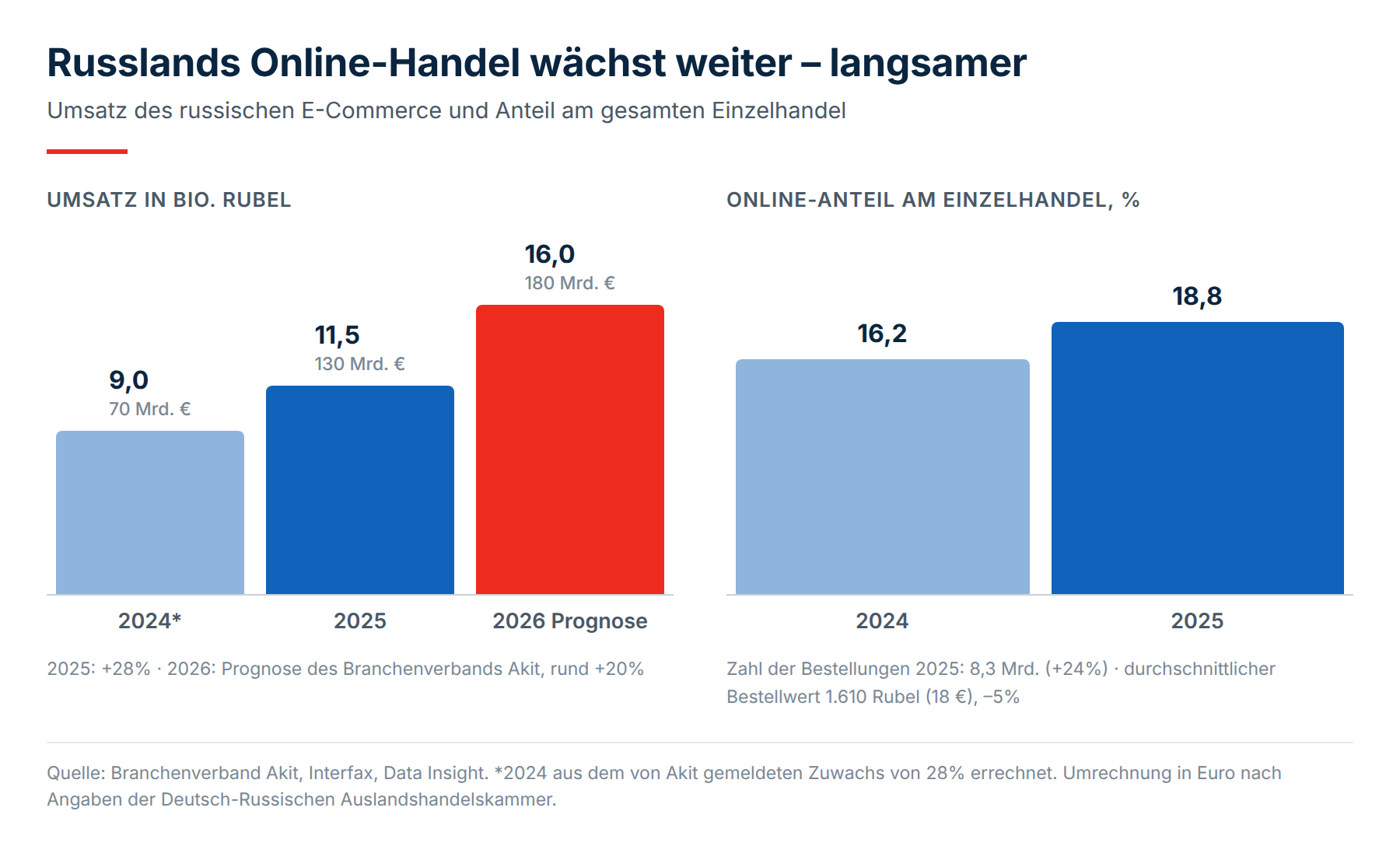
According to the industry association Akit, the Russian e-commerce market grew by 28% in 2025 to 11.5 trillion rubles (130 billion euros). The online share of total retail sales thus rose from 16.2% to 18.8%. Nearly all revenue remains within the country: 96.2% comes from domestic orders, while only 3.8% comes from cross-border purchases. The number of orders rose by 24% to 8.3 billion. According to industry analysts at Data Insight, more than half of sales in the non-food retail sector are already generated online.
Despite the record figures, growth is slowing and has fallen to 24%—the weakest growth in eight years. The average order value also fell by 5% to around 1,610 rubles, equivalent to 18 euros. Artem Sokolov, president of Akit, the leading industry association for Russian e-commerce, expects growth of around 20% by 2026. That would amount to 16 bio rubles (approx. 180 billion euros). “The rapid growth has transitioned into stable organic development,” Sokolov told the Interfax news agency. Fyodor Virin, founder of the market research firm Data Insight, expects that growth in 2026 will stem primarily from the shift from brick-and-mortar to online retail, rather than from additional consumer spending. “The winner will be whoever is better than the others at taking market share from competitors.” Unit sales are declining in nearly all non-food categories. Food and pet supplies remain the growth drivers. In 2025, the number of actively selling merchants declined for the first time, a sign of margin pressure on the platforms.
Graph: ostwirtschaft.de based on data from Akit, Interfax, and Data Insight
Product Categories and Regional Distribution
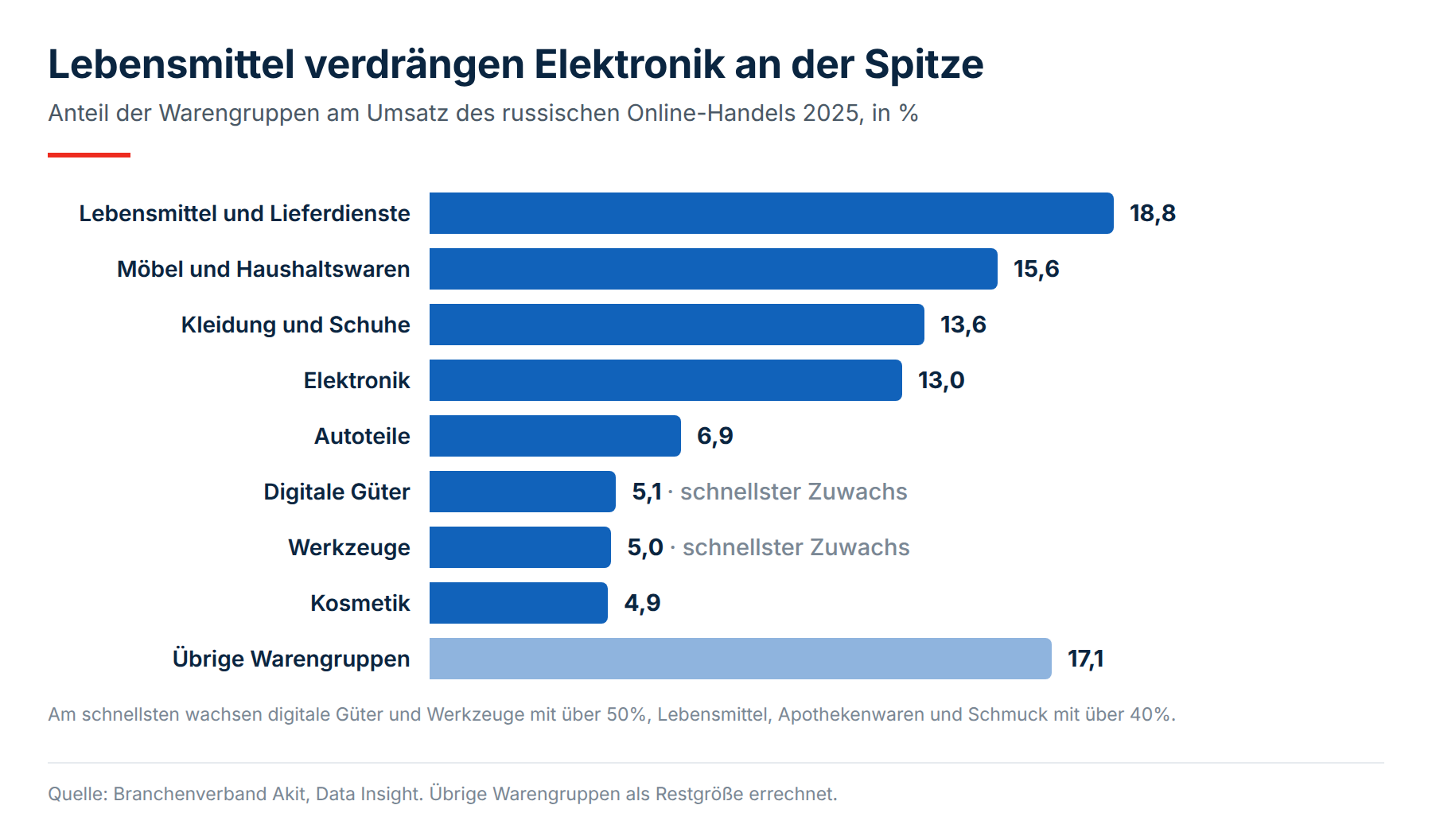
Food, including meal delivery, is now the largest product category in Russian e-commerce, accounting for 18.8% of revenue, ahead of furniture and household goods at 15.6%, clothing and shoes at 13.6%, and electronics at 13%. These are followed by auto parts at 6.9%, digital goods at 5.1%, tools at 5.0%, and cosmetics at 4.9%. Digital goods and tools are growing the fastest, at over 50%, along with food, pharmacy products, and jewelry, at over 40%. Electronics, once an online pioneer, is losing relative ground, however: the market is expanding into everyday consumer goods.
Graph: ostwirtschaft.de based on data from Akit and Data Insight
E-commerce is also becoming increasingly geographically dispersed. Moscow remains the largest single region, accounting for 16.5% of sales, but is losing market share. It is followed by the Moscow Oblast with 7.8%, St. Petersburg with 6.2%, and the Krasnodar Region with 4.8%. Akit reports the highest online penetration in local retail for remote regions such as Chukotka at 34.5%, and the fastest growth for Caucasus republics such as Chechnya and Ingushetia at over 100%. Online retail is thus expanding into areas where brick-and-mortar retail is sparse.
Market Concentration: Two Platforms Dominate
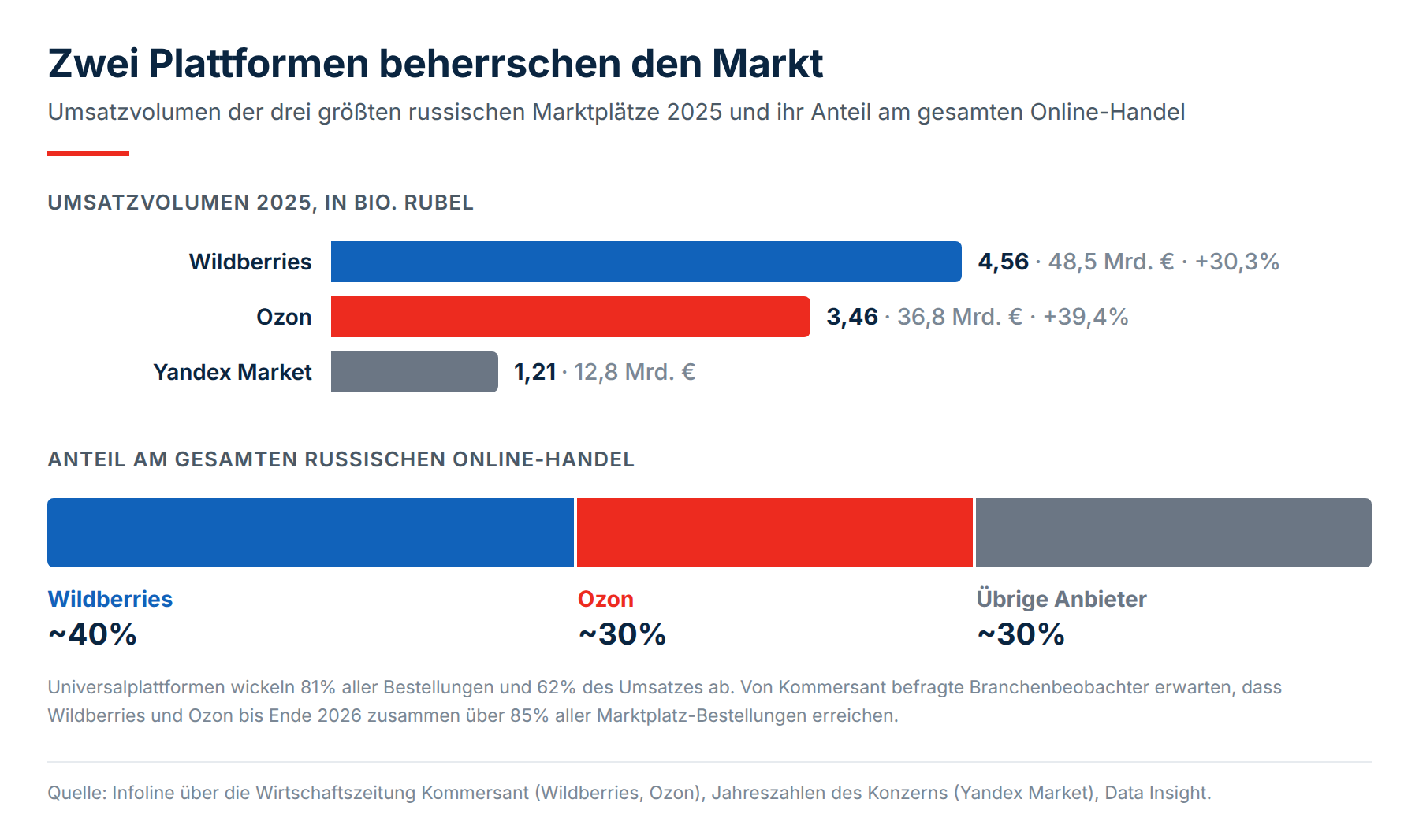
The Russian e-commerce market is a marketplace-driven market. According to Data Insight, universal platforms account for 81% of all orders and 62% of revenue. The business newspaper Kommersant, citing the market research agency Infoline, estimates Wildberries’ revenue in 2025 at 4.56 bio rubles (48.5 billion euros), an increase of 30.3%.
Ozon follows with 3.46 bio. rubles (36.8 billion euros) and 39.4% growth. Together with Yandex Market, the three largest players generated 8.59 bio. rubles (91 billion euros), but their 32.2% growth rate was only half as fast as in 2024.
In terms of the overall market, Wildberries thus accounts for about 40% and Ozon for about 30% of Russian online retail. Industry observers surveyed by the business newspaper Kommersant expect the two to together account for over 85% of all marketplace orders by the end of 2026.
Graphic: ostwirtschaft.de based on data from Infoline via Kommersant, annual figures from Yandex and Data Insight
The Market Leader Wildberries: History and Key Figures
The market leader’s story began in 2004 with German goods: English teacher Tatjana Bakaltschuk, now known as Kim, resold clothing from Otto and Quelle catalogs while on maternity leave; initially, she picked up the packages by Metro and bus, according to the Russian business portal vc.ru’s account of the company’s history.
With free shipping and pickup locations, Wildberries overtook its older rival Ozon around 2012 and has been the number one player in Russian e-commerce for years. The company expanded into neighboring countries early on, entering Belarus in 2012 and Kazakhstan in 2014. Today, according to its own figures, the group operates in twelve countries, including Georgia since 2024. Most recently, Wildberries expanded into Ethiopia. Forbes magazine has ranked Kim as Russia’s wealthiest woman for the fourth consecutive year, with a fortune of $7.1 billion.
Two years ago, a dramatic chapter unfolded in the company’s still-short history: The merger with the outdoor advertising holding company Russ to form the RWB Group escalated into a power struggle, during which Bakalchuk’s husband, Vladislav, stormed the Moscow headquarters in September 2024 with dozens of armed bodyguards; two security guards were killed. Following the divorce, a Moscow court awarded Kim the final 1% of her ex-husband’s stake in April 2025; since then, she has been the sole controlling shareholder of Wildberries OOO—the company that holds 65% of the RWB Group. The remaining 35% is held by the Russ advertising group, owned by brothers Levan and Robert Mirsojan. The latter serves as CEO of the merged conglomerate.
Economically, the conflict has not slowed the company down. The RWB Group increased its revenue in 2025 by 49% to 6.1 trillion rubles (64.7 billion euros), while net profit grew by 68% to 175 billion rubles (1.9 billion euros). Investments exceeded 310 billion rubles (3.3 billion euros).
Over one million merchants are registered with Wildberries, and approximately 94,000 pickup points handle 25 million orders per day during peak periods. Logistics space grew from 2.8 to 5.2 million square meters within a year. The group is also expanding its own bank, operates advertising and travel businesses, and is planning a Central Asian logistics hub in Uzbekistan for approximately $300 million.
Since July 18, however, the group has come under fire: Ukrainian drones struck nine logistics facilities; according to the company, 14.3% of its logistics infrastructure has been affected. Analysts estimate the total damage at up to 350 billion rubles (4 billion euros), with retailers bearing the brunt of the costs. In response, according to Kommersant, Wildberries is already seeking 100,000 m² of warehouse space in neighboring Kazakhstan.
Beyond the group itself, the attacks are altering the economic calculations for the entire Russian economy. According to calculations by the U.S. magazine Forbes, Wildberries and Ozon together account for about 8.5% of Russia’s GDP and employ over 5% of the workforce. The American news agency Bloomberg reports that retail groups such as X5 and Lenta are already rethinking their warehouse strategies and are considering smaller regional warehouses ranging from 10,000 to 30,000 square meters instead of large centralized warehouses. “Companies will have to trade efficiency for resilience,” warns Ekaterina Vlasova of Bloomberg Economics: Decentralized warehouses, redundant capacity, and higher security spending will mean permanently higher logistics costs, rising consumer prices, and a drag on long-term productivity growth.
Other Players: From Ozon to the Food Retail Sector
Ozon, which launched in 1998 as an online bookseller, nearly reached the break-even point in 2025. According to the group’s annual report, sales volume rose by 45% to 4.16 bio rubles (44.1 billion euros). The net loss shrank to 0.9 billion rubles (9.5 million euros), and the fourth quarter was already the third consecutive profitable quarter.
For 2026, the group is targeting 25% to 30% growth and its first annual profit. The financial business is the growth driver: Ozon Bank doubled its revenue to 195 billion rubles (2.2 billion euros), with 60% of card payments now processed outside the platform.
Yandex Market remains number three: According to its 2025 annual figures, the technology group’s e-commerce segment achieved a sales volume of 1.21 trillion rubles (12.8 billion euros).
Sberbank, whose e-commerce division was still in third place in 2024, is restructuring its loss-making marketplace Megamarket; it has closed warehouses and, since October 2025, has consolidated the business—including the delivery service Kuper—under new management. Fashion specialist Lamoda reported growth of 14% to a sales volume of 213 billion rubles (2.4 billion euros). The classifieds platform Avito reported that its revenue exceeded 100 billion rubles (1.1 billion euros) for the first time.
The online grocery sector is expanding rapidly: According to Infoline calculations, it grew by 27% to 1.6 bio. rubles (18 billion euros), led by the retail group X5 with 324 billion rubles (3.7 billion euros) in online revenue.
Next in the rankings is the express delivery service Samokat, which delivers more than 785,000 orders per day from 2,400 small warehouses. Behind them are Vkusvill, Ozon Fresh, and Yandex Lavka, each with just over 200 billion rubles (2.2 billion euros). The sector also plays a role in the labor market: About 4% of Russia’s workforce is employed in e-commerce-related jobs, and the number of pickup points across all platforms rose by 45% in 2025 to just over 226,000.
Regulation and Taxation: New Rules Effective October 2026
The new law on the platform economy will take effect on October 1, 2026. It requires marketplaces to enter into mandatory contracts with merchants and pickup point operators, provide 45 days’ notice of any changes that worsen terms, ensure transparent rankings, and establish expedited complaint procedures. In the future, platforms will no longer be allowed to pass on the burden of compliance with certification and labeling requirements to merchants.
The banking sector also provided a source of conflict. At the end of 2025, Sberbank CEO German Gref and VTB CEO Andrei Kostin accused the platforms of distorting competition by offering discounts for their own payment cards. According to a report by the business magazine Expert, the dispute ended with a compromise: product cards will display a uniform price in the future; discounts will remain permitted but must be available to all banks.
Comparison with the German Market
The German e-commerce sector is comparable in size to the Russian one but is barely growing anymore. In 2025, Russia’s e-commerce sector generated revenue equivalent to approximately 130 billion euros, while Germany’s, according to figures from the German Retail Association, generated 92.3 billion euros in net revenue—despite having slightly more than half the population. The German E-Commerce and Mail Order Association (bevh) reports gross merchandise sales of 83.1 billion euros for 2025—a 3.2% increase following four lean years—and hails this as a “ray of hope for the German economy.”
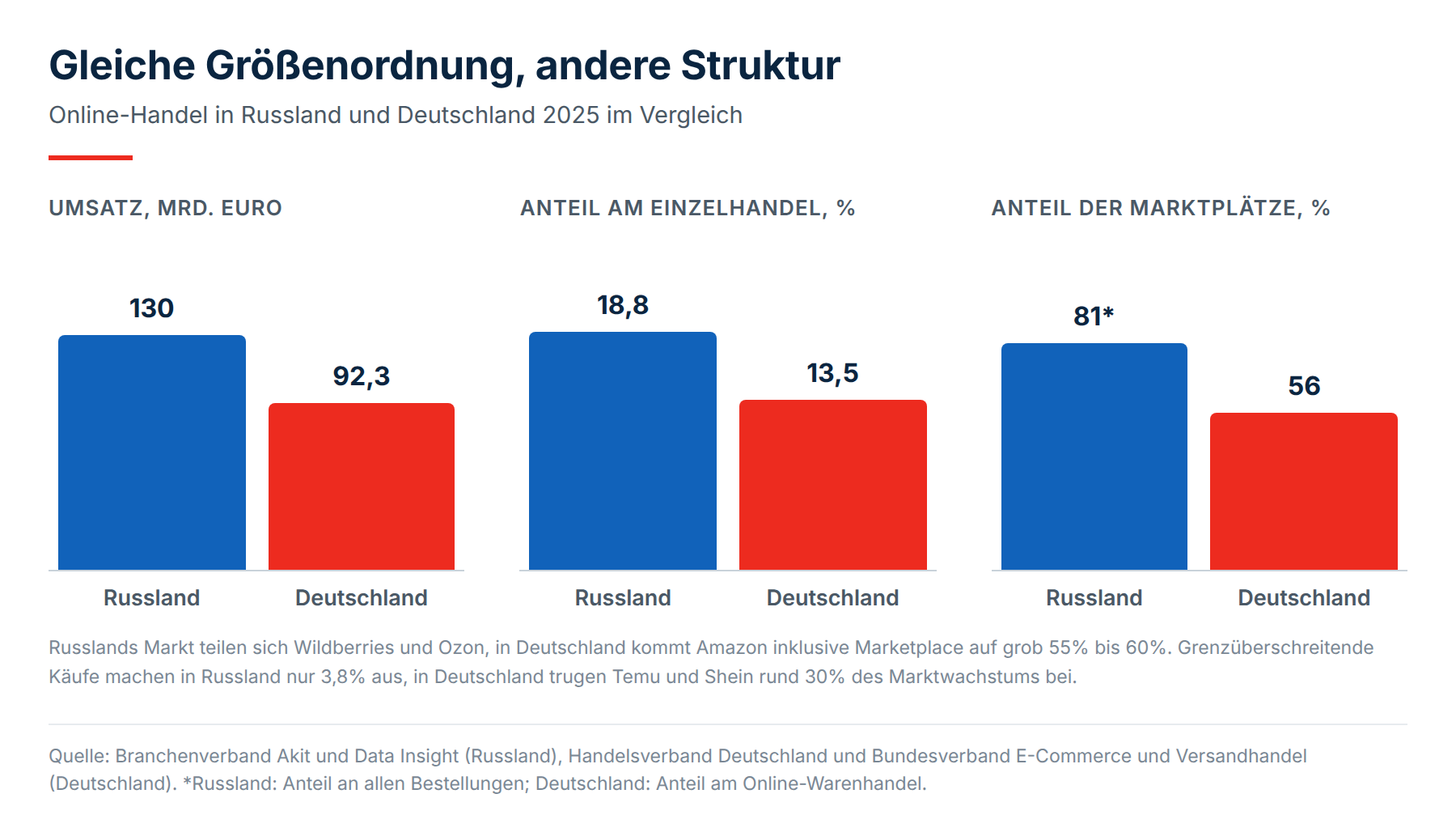
Graphic: ostwirtschaft.de based on data from Akit, Data Insight, the German Retail Association, and bevh
The record-breaking figure of 99.1 billion euros reached during the COVID-19 pandemic in 2021 was followed by two years of decline totaling nearly 20%, then stagnation. The pre-crisis level has not yet been regained.
The German Retail Association (HDE) puts the share of online sales at 13.5%, compared to 18.8% in Russia.
Structurally, the markets differ significantly. In Germany, 56% of online retail sales take place via marketplaces, dominated by a single corporation: According to figures from the HDE and estimates by the Swiss consulting firm Carpathia, Amazon—including its marketplace—accounts for roughly 55% to 60% of the market, followed by Otto and Zalando. In Russia, marketplaces account for 81% of orders, distributed primarily between the duopoly of Wildberries and Ozon.
Delivery methods, however, differ: According to a study by the package delivery service BPEX, 86% of German packages are delivered to the front door, while in Russia, pickup at collection points—where customers try on items and pay only afterward—dominates. Payment methods also differ between the two markets: In Germany, PayPal (28.5%) and purchase on account (25.8%) lead the list of payment methods; in Russia, according to the Central Bank, cashless payments account for 88.9% of retail transactions, processed via cards and the SBP fast-payment system.
In Germany, the Chinese platforms Temu and Shein—the only challengers to market leader Amazon—are growing at a double-digit rate, up 27% to 3.7 billion euros. According to bevh, they thus accounted for around 30% of total market growth. In Russia, by contrast, cross-border e-commerce plays virtually no role, with a market share of just 3.8%.
Customer growth also varies: In Germany, the number of online shoppers rose by only 1.2% in 2025, according to the retail association, almost exclusively among the over-55 age group. Russia’s platforms are gaining new customers in small towns and villages—at Ozon, one in every three packages is already being shipped to locations with fewer than 50,000 residents.
Source: German-Russian Chamber of Foreign Trade, Russia’s E-Commerce Market: Growth, Market Concentration, and New Rules, July 30, 2026.