Russia: Second-Quarter Results Fuel Higher Growth Expectations for 2026

Author: Klaus Dormann
In early August, as it does every month, the Interfax news agency surveyed analysts on economic trends in Russia. The average growth forecast continued to decline. Analysts now expect real gross domestic product growth, which had fallen to 1.0% in 2025, to halve to 0.5% this year. Just one month earlier, survey participants had still anticipated economic growth of 0.7% for 2026 (Finmarket.ru).
On August 12, however, the statistics agency Rosstat published a preliminary estimate indicating that total economic output rose by 1.3% year-over-year in the second quarter of 2026 (Finmarket.ru). According to Rosstat, this marks the strongest growth in Russia’s economy since the first quarter of 2025.
Quarterly trend in real gross domestic product, year-over-year
change in %
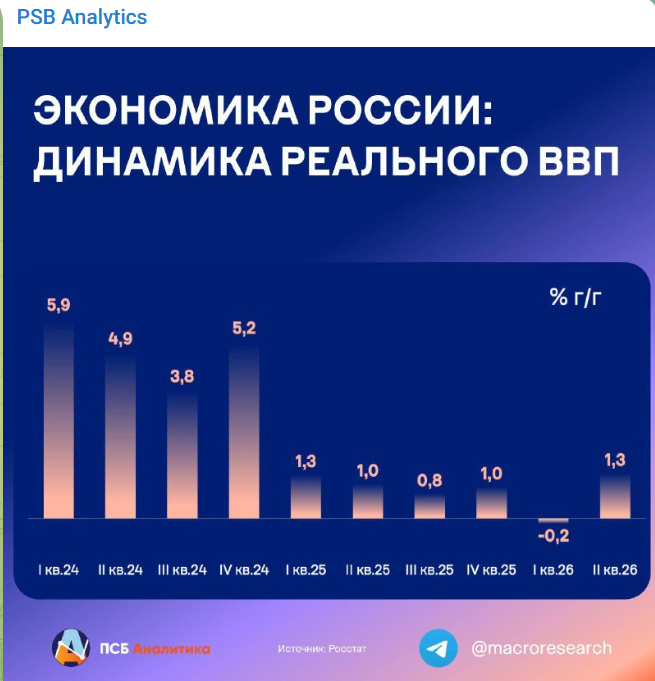
PSB Analytics: Rosstat estimated Russia’s real GDP growth in the second quarter of 2026 at 1.3% year-over-year; August 13, 2026
The rise in GDP in the second quarter also raised expectations among some experts for higher growth for the full year of 2026. However, several others are sounding a warning. They point to leading indicators recorded in July and early August, noting that the economic recovery in the second quarter was “unsustainable.” For example, business activity among private-sector companies has recently continued to decline. Growth in real consumer spending has also slowed.
Second-quarter GDP growth of 1.3% exceeded expectations
Rosstat’s estimate for second-quarter growth, at 1.3%, significantly exceeded both “market expectations” and the forecasts of the government and the central bank. The Ministry of Economic Development, in line with the “consensus” in the Interfax survey, had anticipated a noticeably lower GDP growth rate of 0.9%, while the Central Bank had projected 0.8%.
Based on the new Rosstat estimate, the Russian Ministry of Economic Development raised its estimate for economic growth in the first half of the year from 0.3% to 0.6% (TASS.ru). According to a press release from the ministry, Economy Minister Reshetnikov stated that the economy is recovering from the 0.2% decline in gross domestic product in the first quarter. The minister is quoted as saying that the recovery in growth rates, which began in March, is continuing “despite ongoing external pressure and restrictions in certain sectors” (Finmarket.ru). He was likely referring to the decline in production at oil refineries damaged by Ukrainian attacks.
GDP forecasts for 2026 range from complete stagnation to 1.2%
In the Interfax survey conducted in early August, participants’ forecasts for economic growth in 2026 ranged from 0.0% to 1.2% (Finmarket.ru).
Vladimir Eremkin, a senior researcher at the Laboratory for Structural Analysis at the “Presidential Academy of National Economy and Public Administration (RANEPA),” now believes it is possible that Russia will achieve economic growth in the range of 0.7% to 1.2% this year (Expert.ru). Deputy Prime Minister Alexander Novak, however, had reiterated at the St. Petersburg International Economic Forum in June that the Russian government expects growth to decline to 0.4% in 2026 (Prime.ru).
Despite the government’s downward revision of its forecast in May, the International Monetary Fund maintained its growth forecast of 1.1% for Russia in July. The Vienna-based OPEC Secretariat now also expects this growth rate for Russia in its “Monthly Oil Market Report.” Previously, it had even projected a 1.3% increase in GDP. An update to the government’s forecast is expected in September as part of the budget deliberations.
According to an Interfax survey conducted in early August, analysts expect the Russian economy’s growth to accelerate to 1.2% in 2027. This forecast is in line with the IMF’s forecast (1.1%). It is lower than the growth expectations of the Ministry of Economic Development (1.4%) and the Central Bank (1.5% to 2.5%).
GDP Forecasts for Russia, 2024–2027
Year-over-year change in real gross domestic product, in percent
| Forecast | Status | 2024 | 2025 | 2026 | 2027 |
|---|---|---|---|---|---|
| Interfax Analyst Survey | Aug. 12, 26 | + 0.5 | + 1.2 | ||
| OPEC Secretariat, Vienna | August 12, 26 | + 1.0 | + 1.1 | + 1.5 | |
| DekaBank, Frankfurt | August 6, 26 | + 1.0 | + 0.4 | + 0.8 | |
| Central Bank of Russia, Moscow | July 24, 26 | + 1.0 | + 0.0 to + 1.0 | +1.5 to +2.5 | |
| Eurasian Fund for Stabilization and Development | July 16, 26 | + 1.0 | + 0.6 | + 1.6 | |
| Central Bank Analyst Survey | July 15, 2026 | + 4.9 | + 1.0 | + 0.6 | + 1.3 |
| CMASF, Moscow | July 15, 26 | + 1.0 | +0.5 to +0.8 | +0.9 to +1.2 | |
| International Monetary Fund | July 8, 2026 | + 4.9 | + 1.0 | + 1.1 | + 1.1 |
| Helaba, Frankfurt | July 3, 26 | + 4.3 | + 1.0 | + 0.6 | + 1.0 |
| wiiw, Vienna | July 1, 26 | + 4.9 | + 1.0 | + 0.6 | + 1.3 |
| Russian Ministry of Economic Development | May 12, 25 | + 4.9 | + 1.0 | + 0.4 | + 1.4 |
RANEPA Expert Eremkin: The Economy Could Grow by Up to 1.2% in 2026
Following a 0.2 percent decline in real gross domestic product in the first quarter of 2026, Vladimir Eremkin, an economic expert at the Moscow-based “Presidential Academy RANEPA,” Vladimir Eremkin, had stated in an interview in early May that there was a risk the Russian economy could “slip into negative territory” in 2026 (Federal Press.ru). And when the European Commission raised its forecast for Russia’s economic growth in 2026 from 1.1% to 1.3% toward the end of May, he objected, saying this forecast should be considered overly optimistic. The EU forecast exaggerates the positive effects of the crisis in the Middle East on the Russian economy. It does not sufficiently take into account the consequences of the restrictive monetary policy measures imposed by the Russian Central Bank, Eremkin said in an interview with TASS.
However, Eremkin now considers growth in the Russian economy in the range of 0.7% to 1.2% in 2026 to be possible. He summarizes the current economic trend in “Expert.ru” as follows:
- Consumer demand is supported by savings that the population has accumulated in recent years thanks to accelerated wage growth.
- Production in the “manufacturing sector” is growing not only in the “defense sector” but also in “civilian sectors” such as mechanical engineering, the pharmaceutical industry, and the food industry. This positive growth trend is not attributable to massive economic stimulus programs.
- Inflation is at a “controlled level” of around 6%. This is the result of coordinated measures by the government and the central bank, which ensure a balance between promoting growth and curbing price increases.
- The labor market is proving “resilient.” High real wage growth continues to be recorded (+7.2% adjusted for inflation in the first five months of the year), accompanied by low unemployment.
- While the labor shortage is slowing growth, it is also driving productivity gains and process innovations. Due to the lack of workers, companies are simply forced to make more active use of new technologies.
Eremkin’s conclusion:
“Stable consumer demand, positive industrial performance, a gradual recovery in investment activity, and controlled inflation could create the conditions for economic growth in the range of 0.7% to 1.2% in 2026.”
Alexey Vedev: The government could raise its GDP forecast to 0.7 to 0.9%
Alexey Vedev, head of the “Financial Studies” department at the Gaidar Institute for Economic Policy in Moscow—who served as Deputy Minister of Economic Development from 2014 to 2017—also believes an upward revision of this year’s growth forecast for the Russian economy is possible. Commenting on the Rosstat estimate to the online magazine Readovka, he explained that the Ministry of Economic Development’s official forecast for this year could rise from the current 0.4% to 0.7 to 0.9% (absatz.media).
According to Vedev, two factors in particular are driving the current economic trend:
“The decline in investment is slowing economic growth, while rising consumption of goods and services is, on the contrary, boosting it. The government may have underestimated the sustainability of high consumer demand. The decline in deposit interest rates compared to last year has prompted the population to shift funds from their savings into consumer spending.”
Kommersant: Which Sectors Grew and Contracted in the Second Quarter
The business newspaper Kommersant reports that Rosstat’s preliminary estimate of overall economic growth in the second quarter is based on production reports from large and medium-sized companies in the non-financial sector. Rosstat will publish its first, more detailed GDP estimate for the second quarter on September 11. This estimate will take into account clarifications from companies and additional information from government agencies.
In September, Rosstat will also report not only on developments in the production sectors on the “input side” of gross domestic product, but also on developments on the “output side”—primarily consumption and investment (znanierussia.ru). Regarding Rosstat’s estimated annual rates of change in production for individual economic sectors in the second quarter, Kommersant reports:
- The strongest growth was recorded in retail (+7.2%) and food services (+6.2%). Production in freight transportation rose by 2.5%, and in wholesale by 2.4%.
- Within the industrial sector, production in “manufacturing” grew by 2%.
- In the “mining” sector, however, production fell by 1.9%. Production also declined in the construction industry (-1.6%) and in agriculture (-1.5%).
Raiffeisenbank: Production Trended Positively Almost Everywhere in Q2
Moscow-based Raiffeisenbank compared the year-over-year changes in production across key sectors in the second quarter with those in the first quarter on its Telegram channel “Focus Pocus.” It notes that production trends in the second quarter were more favorable than before in almost every sector. Previous increases in production accelerated, while previous declines either slowed or were replaced by increases. The bank cites the following examples:
- Growth in retail doubled from +3.5% in the first quarter to +7.2% in the second quarter.
- In freight transportation, the decline in production (-3.6%) turned into an increase (+2.5%), as it did in wholesale trade.
- In the construction sector, the decline narrowed to -1.6% in the second quarter (-10% in the first quarter).
The bank notes that the first war-related production problems in the oil refining sector emerged in the second quarter. However, a large portion of these production disruptions will not become apparent until the third quarter of 2026.
Compared to the first quarter, GDP rose by 0.5 percent in the second quarter
Raiffeisenbank has also estimated how real gross domestic product developed compared to the previous quarter. With Rosstat estimating annual growth of 1.3% in the second quarter of 2026, the bank reports that GDP rose by 0.5% on a seasonally adjusted basis compared to the first quarter of 2026 —after stagnating in the first quarter of 2026 at the same level as the fourth quarter of 2025.
Seasonally adjusted change in gross domestic product compared to the previous quarter, in %
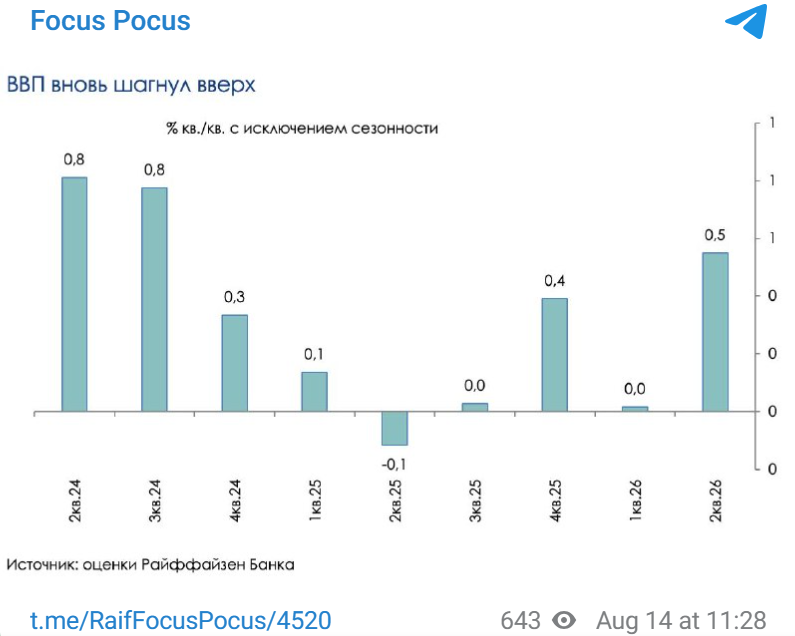
Raiffeisenbank: FocusPocus, Aug. 14, 26
“Temporary factors” drove GDP growth higher in the second quarter
Raiffeisenbank emphasizes that, following the 0.2% decline in real gross domestic product in the first quarter, a more positive trend in aggregate economic output was expected in the second quarter of 2026. It points to the disappearance of temporary special factors that weighed on economic activity in the first quarter of 2026 (an unusually cold winter; fewer working days).
However, according to the bank’s assessment, the “recovery” in aggregate economic output that occurred in the second quarter is clearly temporary. It is likely to weaken in the second half of the year.
Raiffeisenbank also notes that criticism from the Russian Central Bank—that the targeted slowdown in the Russian economy has not been sufficient so far—could now be reignited (and that its monetary policy will therefore remain restrictive for longer).
PSB Bank: Growth Could Stabilize at “Close to Zero” in 2026
Denis Popov, chief analyst at PSB Bank, takes a similarly “cautious” view of the Russian economy’s growth prospects this year as Raiffeisenbank. On the PSB Analytics Telegram channel, he commented on second-quarter growth:
“The statistics presented should be interpreted with caution, as the growth rates achieved do not appear sustainable.
Leading indicators for July point to a deterioration in the economic situation at the start of the third quarter.
In July, partly based on these indicators, we lowered our GDP growth forecast for 2026 from 0.5–1% to 0–0.5%… . We fear that the economy will stabilize at growth rates close to zero (up to 0.5% in the second half of the year). We do not expect a return to balanced growth in line with potential (2–2.5%) until 2027.”
Kommersant: Leading indicators signal a slowdown in growth
In his Kommersant report on second-quarter growth, Artem Chugunov also emphatically points out that some current leading indicators suggest a continuing slowdown in economic activity:
S&P Global’s “composite purchasing managers’ index,” which aggregates the results of business surveys in the “manufacturing” and service sectors according to their share of GDP, rose in July from 48.9 to 49.6 points (black line). However, this “composite index” remained below the “growth threshold” of 50 points for the fifth consecutive month. The index for the “manufacturing” sector stands at 50.7 points, above the growth threshold. The index for the “services” sector, however, reached only 49.0 points in July.
Purchasing Managers’ Indices from S&P Global
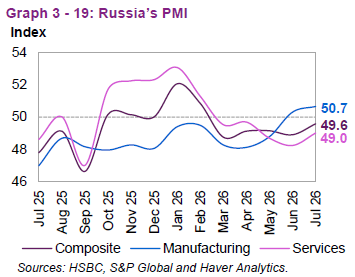
OPEC Secretariat, Vienna: Monthly Oil Market Report, August 12, 26
According to Chugunov, the “Composite Leading Index” from the HSE Development Center—the economic research institute of Moscow’s “Higher School of Economics”—paints a similarly weak picture of business activity trends. In July, it fell by 6.1 points to 165.8 index points, a decline of nearly 10 points over the past two months. The index is intended to signal “economic turning points.”
Composite Leading Index
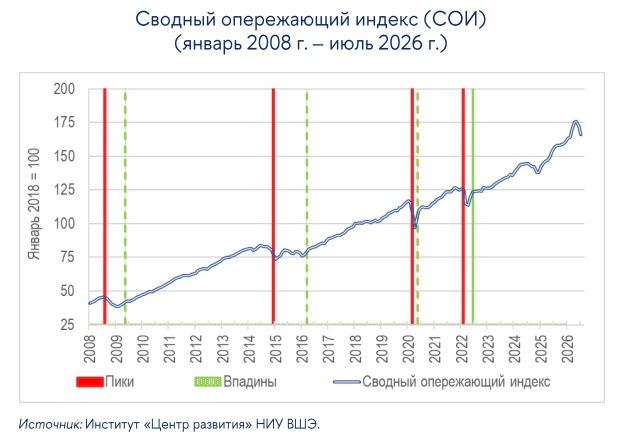
Higher School of Economics; Sergey Smirnov: Cyclical Indicators. SRI in July 2026: Decline due to the fuel crisis. REA in June 2026: Nearly flat growth, August 6, 2026
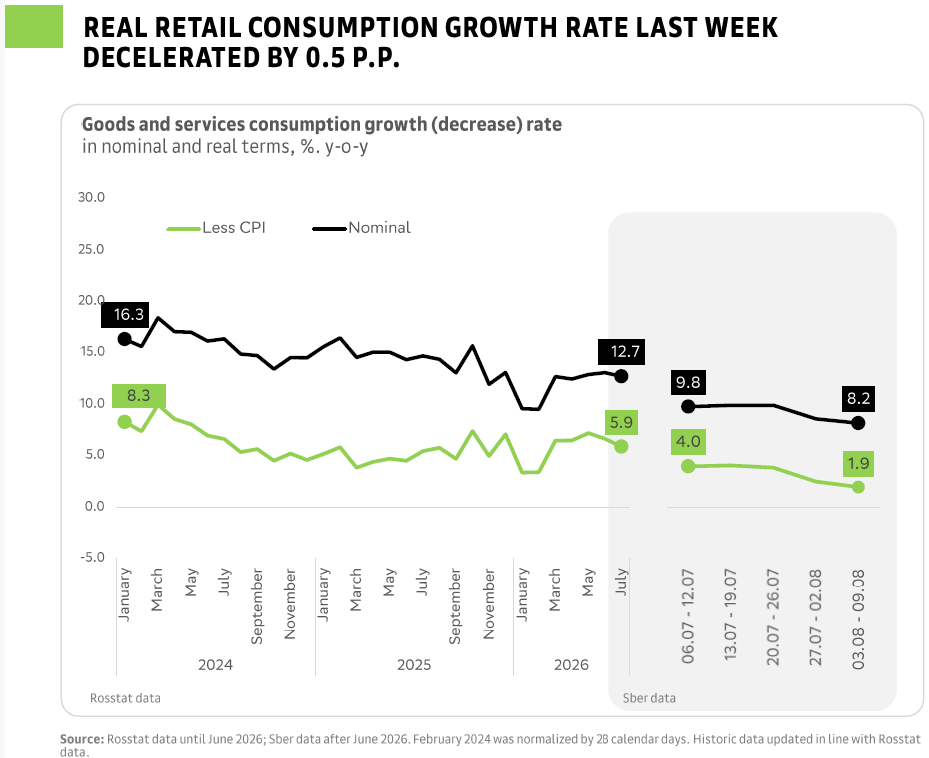
The latest “SberIndex” data on trends in private consumption show a slowdown in the annual growth of household spending. During the week of August 3–9, household spending on goods and services, adjusted for inflation, was only 1.9% higher in real terms than the previous year’s figure (see green line). The real growth rate of spending was thus significantly below the July average of 5.9% (SberIndex News, September 8, 26)
The annual real growth rate of spending on goods and services
fell by 0.5 percentage points to 1.9 percent last week
Sberindex: Retail Consumption, August 3–9, 2026, August 10, 26
Recommended Reading
Dismissal of VEB Chief Economist Andrei Klepach:
- The Bell: VEB.RF fired Chief Economist Andrei Klepach over a speech in which he predicted Russia’s defeat in a war of attrition and a social crisis, August 16, 26
- The Moscow Times: VEB fired Chief Economist Klepach because he had predicted Russia’s defeat in a “war of attrition” against the West, August 16, 2026
- IT BOLTWISE: VEB.RF fires economist Andrei Klepach: Doubts about victory in the war in Ukraine, Aug. 17, 2026
German-Russian Chamber of Foreign Trade:
- Russian Ruble: Summer Plunge Following Spring Rally, Aug. 11, 2026
- Despite Rising Inflation Expectations: Central Bank Cuts Key Interest Rate to 14%, July 28, 2026
- Fuel Crisis: Top Exporter Russia Relies on Imports, July 21, 26; Gasoline Crisis in Russia, June 30, 26
Current Economic Trends; Economy Overall
- CNBC; Sam Meredith: Russia’s economy has defied the skeptics. Cracks are getting harder to hide, August 15, 26
- Vzglyad.ru; Olga Samofalova: Who Is Behind Russia’s Unexpected GDP Growth? August 16, 26
- VEB Institute: Weekly Report on the Global Economy and Markets, Aug. 14, 26
- Deutsche Wirtschaftsnachrichten; Irtautė Gutauskaitė-Stanislovaitė: Russia’s War Economy Is Pushing the Civilian Sector to Its Limits, August 14, 2026
- absatz.media; Artem Vlasov: An economist shared an unexpected forecast for Russian GDP growth. Economist Vedev: Russia’s GDP forecast could be revised upward, August 14, 2026
- Gaidar Institute; Andrei Kaukin, Vladimir Kosarev, Anastasia Levchenko: Industrial Production Dynamics in Q2 2026, August 14, 2026
- Raiffeisenbank; Stanislav Murashov: Temporary factors boosted GDP growth in the second quarter of 2026, August 14, 2026
- bne Intellinews, Ben Aris: Russia’s economy rebounds 1.3% in the second quarter but budget strains deepen, August 13, 2026
- PSB Analytics; Denis Popov: Rosstat estimated Russia’s real GDP growth in the second quarter of 2026 at 1.3% year-over-year; August 13, 2026
- The Moscow Times: Russian Economy Returns to Growth, but Economists Warn Rebound May Be Short-Lived, August 13, 2026
- Regnum.ru: Experts have identified the main reasons for GDP growth in the first half of the year, August 13, 2026
- Vedomosti; Sergey Pakhomov: Russia’s GDP grew by 1.3% in the second quarter. In this context, Reshetnikov noted that the country’s economy has returned to a growth trajectory; Aug. 12, 2026
- TASS.ru: The Ministry of Economic Development reported that Russia’s annual GDP grew by 0.6% in the first half of the year. Consumer spending continues to rise. August 12, 2026
- Komsomolskaya Pravda; Natalia Varsegova: Russia’s economy grew by 1.3%: What caused the upturn? Ostapkovich: Industry made the main contribution to the growth of the Russian economy, Aug. 12, 2026
- Vzglyad: An expert attributed Russia’s GDP growth to economic stability. Expert Eremkin forecast growth of up to 1.2% in 2026, Aug. 12, 2026
- Expert.ru; Vladimir Eremkin, Senior Researcher at the Laboratory for Structural Analysis at the Institute of Economic Research (IPEI) of the Russian Presidential Academy of National Economy and Public Administration (RANEPA): GDP has grown again. Are there reasons for optimism? August 12, 2026; FederalPress; Elena Butyrina: Interview with Vladimir Eremkin, RANEPA: “The risks to the Russian economy in 2026 are high, but their consequences can be managed.” May 3, 26
- Kommersant; Artem Chugunov: Rosstat has revised economic growth upward. The GDP estimate for the second quarter exceeded the estimates of the Central Bank and the Ministry of Economic Development; Aug. 12, 26
- Finmarket: Russian GDP grew by 1.3% in the second quarter; Aug. 12, 26
- Finmarket.ru; Interfax consensus forecast: Analysts estimate industrial production growth in Russia at 0.3% for July, inflation at 0.65%, and the annual forecast has been raised to 6.6%; Aug. 12, 26
- OPEC Secretariat, Vienna: Monthly Oil Market Report, August 12, 2026
- VEB Institute: GDP Index for June 2026, August 6, 2026
- Fitch Ratings: Supply bottlenecks will continue to put pressure on Russia’s economy, August 5, 2026
- Atlantic Council; Charles Lichfield and Brendon Chen: Russia will sacrifice its civilian economy on the altar of the war effort, August 5, 2026
- Interfax.com: Central Bank expects Russian year-over-year GDP growth to slow to 0.5% in Q3 from 0.8% in Q2, August 5, 2026
- IEF RAS: Short-Term Analysis of GDP Trends; August 4, 2026
- KSE Institute: Sanctions and the Russian Economy: 2026 Mid-Year Assessment by KSE Institute, August 4, 2026
- Kyiv School of Economics: Russia Chartbook: Stalled Domestic Borrowing Poses a Threat to Budget Financing; Energy Windfall Fades as Oil Prices Moderate, July 29, 2026
- New Eurasian Strategies Centre; Sergey Aleksachenko: Slow Decline: Russia’s Economy Is Worsening, but Neither Collapse Nor Recovery Is Likely, July 21, 2026
Fiscal Policy; National Budget
- BOFIT Weekly Review 33/2026: Higher oil prices boost Russia’s export earnings, but fiscal deficit widens, August 14, 2026
- Finam.ru; Vyacheslav Vasyutin; Telegram Channel Editor Headlines: Russia’s Oil and Gas Exports Prove Resilient, but Risks Are Mounting; August 12, 2026
- russland.capital: Russia’s budget deficit grows – Sber pays record dividend to the state, August 12, 2026
- Finam.ru: Russia’s budget deficit rose to 2.8% of GDP in the January–July period, August 11, 2026
- Finmarket.ru: The National Welfare Fund fell by 383.3 billion rubles in July; August 10, 2026
- Forbes.ru; Arpine Asatryan: The federal budget deficit totaled 6.46 trillion rubles in January–July; August 11, 2026
- Anadolu Agency: Russia’s federal budget deficit climbs over 32% in January–July; August 11, 2026
Wildberries
- BILD; Julius Nieweier: Billions in economic losses. Russia’s “Amazon” keeps going up in flames! Putin faces a wave of bankruptcies, August 16, 2026
- The Military Show; Video: Ukraine’s Strike Against Wildberries: No One Saw THIS Coming—Now It’s Creating Ripples! How Ukraine Is Shaking Up Russia’s Economy With Targeted Attacks on Wildberries—With Consequences for Putin, Merchants, and Consumers, 19 min., Aug. 11, 2026
- russland.capital: Wildberries Under Fire: When a Marketplace Becomes an Economic Risk, August 10, 2026
Fuel Supply, Energy Sector
- Politkom.ru; Nikita Maslennikov: Fuel Prices, the Ruble Exchange Rate, and Forecasts for 2026, August 13, 2026
- The Hague Centre for Strategic Studies, HCSS; Jilles van den Beukel, Lucia van Geuns: From Sanctions to Drone Warfare: The Slow Erosion of Russia’s Oil Sector, August 11, 2026
- capital.de; Martin Morcinek: Attacks on Refineries. How Ukrainian Drones Are Slowing Down Russia’s War Economy, August 8, 2026
Foreign Trade, Sanctions
- BOFIT Weekly Review 33/2026: Higher oil prices boost Russia’s export earnings, but fiscal deficit widens, August 14, 2026
- Finam.ru; Vyacheslav Vasyutin; Telegram Channel Editor Headlines: Russia’s Oil and Gas Exports Prove Resilient, but Risks Are Mounting; August 12, 2026
- Atlantic Council; Charles Lichfield and Brendon Chen: Russia will sacrifice its civilian economy on the altar of the war effort, August 5, 2026
Political Context
- Inosmi.ru; Berliner Zeitung; Ben Aris: No Electricity and No Protection: How Putin Is Dooming Ukraine to a Terrible Winter. BZ: Original article, August 12, 2026
- t-online; Patrick Diekmann: Escalation in the Black Sea. It’s spiraling out of control, August 12, 2026
- IPG Journal; New York Times; Thomas Graham: Of all times. Both Ukraine and Russia are paying an ever-higher price for the war. That is precisely where the chance for peace might lie. The path to the negotiating table may lie through exhaustion on the battlefield; August 11, 2026
- Der Standard; Florian Niederndorfer: “40-Day Operation.” Even as Kyiv reduces its economy to rubble, Putin shows no sign of backing down; August 11, 2026
- Focus.online; Cedric Kienhöfer: New poll. Public sentiment in Russia is shifting regarding the war in Ukraine; Aug. 11, 2026