Russia: Despite High Oil Prices, Growth Remains Weak and the Budget Deficit Is High
Author: Klaus Dormann
Just how weak the Russian economy’s growth was in the first half of the year remains quite controversial. The “Institute for Economic Forecasting of the Russian Academy of Sciences” (IEF-RAS) estimates the increase in real gross domestic product in June and in the second quarter to be significantly higher than the research institute of the state development corporation VEB. The Federal State Statistics Service (Rosstat) is expected to publish a preliminary estimate of overall economic output growth for the second quarter on August 12 (TradingEconomics).
Those who expected that the sharp global rise in energy prices following the war in Iran would also lead to an increase in oil and gas revenues for the Russian federal budget have been proven wrong so far. In the first seven months, however, these revenues were about 17% lower than a year ago.
IEF RAS: Russia’s GDP grew by 1.2% in the second quarter
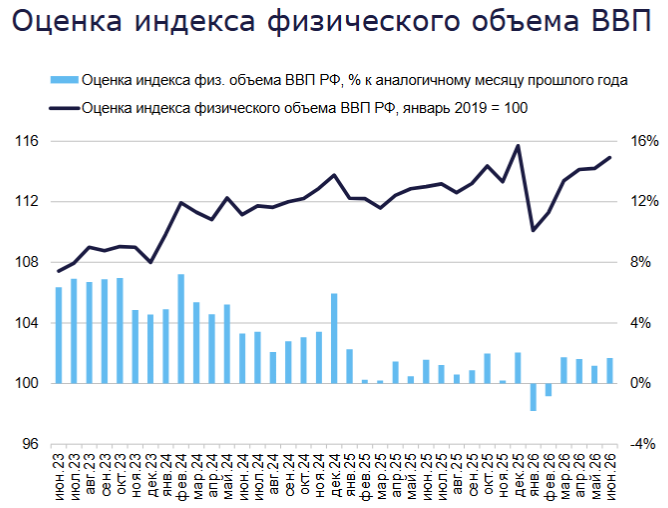
The “Institute for Economic Forecasting of the Russian Academy of Sciences” (IEF-RAS) estimated last week in its monthly “Short-Term Analysis of Gross Domestic Product Trends” that real annual economic growth in the second quarter of 2026 stood at 1.2%. The annual increase in real gross domestic product accelerated to 1.7% in June (see the blue column on the right in the figure below).
Estimate of the monthly trend in real gross domestic product
: black line—real GDP index, Jan. 2019=100
; blue bars—estimate of year-over-year GDP change in percent
IEF RAS: Short-Term Analysis of GDP Trends; Aug. 4, 26
The black line shows that the real gross domestic product index, which had nearly stagnated in May, rose again in June. The IEF estimates the seasonally adjusted GDP increase in June compared to May at 0.6%.
The institute emphasizes that the most important outcome of economic development in the second quarter of 2026 was the recovery in production following the decline at the beginning of the year; production in the “civilian” sectors of the economy is stabilizing. The economy is growing despite the impact of a number of unfavorable factors. Among these, the IEF cites sanctions, as well as the effects of the increased tax burden and restrictive monetary policy. It identifies the military attacks on oil refineries and warehouses in Russia as “new stress factors.”
The VEB Institute estimates growth to be lower than the IEF
In its “GDP Index” for June 2026, published on August 6, the research institute of the state-owned development corporation VEB estimates the annual growth rate of the Russian economy in the second quarter of 2026 not at 1.2%, as does the “Institute for Economic Forecasts,” but at only 0.9% (in line with the Russian Ministry of Economic Development, according to Interfax). Andrey Klepach has been VEB’s chief economist since 2014. He previously served, among other roles, as Deputy Minister of Economic Development.
According to the VEB Institute’s estimate, real GDP in June did not rise by 0.6% compared to May, as projected by the IEF, but by only half that amount, 0.3% (seasonally and calendar-adjusted).
According to the VEB Institute, real GDP in June 2026 was only 1.2% higher than in the same month of the previous year; the IEF Institute, on the other hand, estimates the annual growth rate at 1.7%.
The Central Bank expects growth to slow in the third quarter
In the first quarter of 2026, real gross domestic product was 0.2% lower than in the previous year, according to Rosstat. In the second quarter, however, annual growth of 0.8% was achieved, according to an estimate by the Russian Central Bank. This is shown by the gray bars in the following chart from the Central Bank (the black dots indicate that the annual growth rate fell from 4.9% in 2024 to 1.0% in 2025).
Real Gross Domestic Product, annual rate of change in percent*
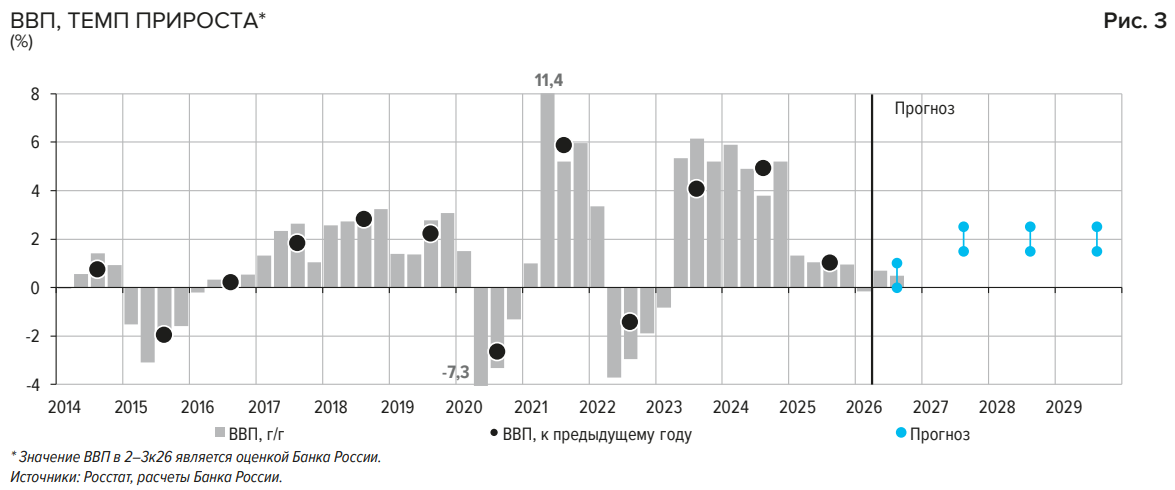
* The GDP figure for the second and third quarters of 2026 is an estimate by the Bank of Russia.
Sources: Rosstat, calculations by the Bank of Russia.
Bank of Russia: Commentary on the Bank of Russia’s Medium-term Forecast
, PDF
, August 5, 2026
The central bank has also published a forecast for GDP growth in the third quarter. In a commentary on its “Medium-Term Forecast,” updated in July, the central bank notes that economic activity likely slowed in July at the start of the third quarter. It now expects annual economic growth to slow to 0.5% for the third quarter as a whole.
For 2026 as a whole, real gross domestic product is expected to range between complete stagnation and 1.0% growth, according to the central bank’s “Medium-Term Forecast” (blue dots in the central bank’s chart above).
“Kyiv School of Economics”: Slowing Growth Despite High Energy Prices
The “Sanctions Hub of Excellence” at the Kyiv School of Economics published a new edition of its semi-annual analysis of the Russian economy in early August. The analysis, titled “Sanctions and the Russian Economy,” examines, among other things, the impact of the global rise in energy prices following the start of the war in Iran in late February on the Russian economy. The KSE Institute addresses the following points, among others:
While the sharp rise in energy prices provided Russia with considerable additional revenue, the short-term outlook for economic development improved only slightly.
However, when considering the impact of rising energy prices on the Russian federal budget, it is important to note that the Russian government spent approximately 620 billion rubles between April and June to curb domestic fuel prices and significantly increased subsidies for energy companies. Taking these increased expenditures into account, only about 0.8 trillion rubles remained of the 1.6 trillion rubles increase in Russian government revenue from the oil and gas sector in the second quarter.
Furthermore, Ukrainian attacks on Russian refineries and energy infrastructure further limited Russia’s ability to capitalize on rising global energy prices. At the height of Ukraine’s attacks, approximately 40% of Russia’s refining capacity was affected. Gasoline production fell by about 25% below the June 2025 level.
Growth in the Russian economy continues to be hampered by restrictive monetary policy, weaker domestic demand, and labor shortages. Sanctions are limiting access to technology.
Growth has declined significantly in many sectors of the economy
The KSE Institute summarizes the current economic situation in Russia as follows:
Developments in the “manufacturing sector” remain highly uneven:
While “defense-related” sectors are benefiting from government contracts, production in “civilian” sectors has slowed considerably.
At the same time, ongoing Ukrainian attacks on refineries have triggered a “fuel crisis.” Logistics costs have been driven up, and fuel supplies to agriculture, transportation, and industry have been disrupted.
Consumer-oriented sectors have lost momentum because high borrowing costs and a slower rise in real incomes are weighing on household demand. As a result, retail and market-oriented services lost momentum after two years of rapid growth.
This trend was exacerbated by Ukrainian attacks on the logistics infrastructure of “Wildberries,” Russia’s largest e-commerce platform. By the end of July, repeated drone attacks had damaged about 10% of the company’s warehouse capacity. The company’s distribution network—which also supplies many small and medium-sized enterprises—was severely disrupted as a result.
Construction activity has also slowed, as high financing costs continue to dampen residential construction and private investment.
Unexpectedly High Federal Budget Deficit in the First Half of 2026
The KSE Institute reports on the development of the Russian federal budget:
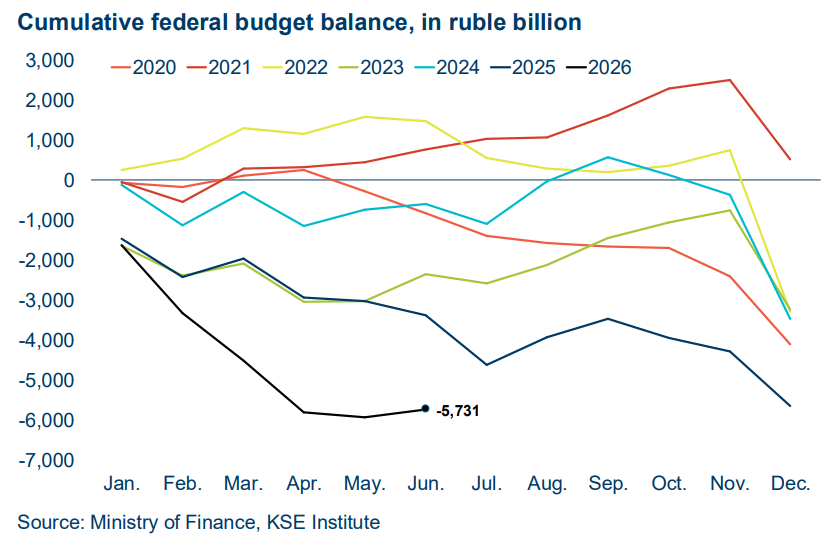
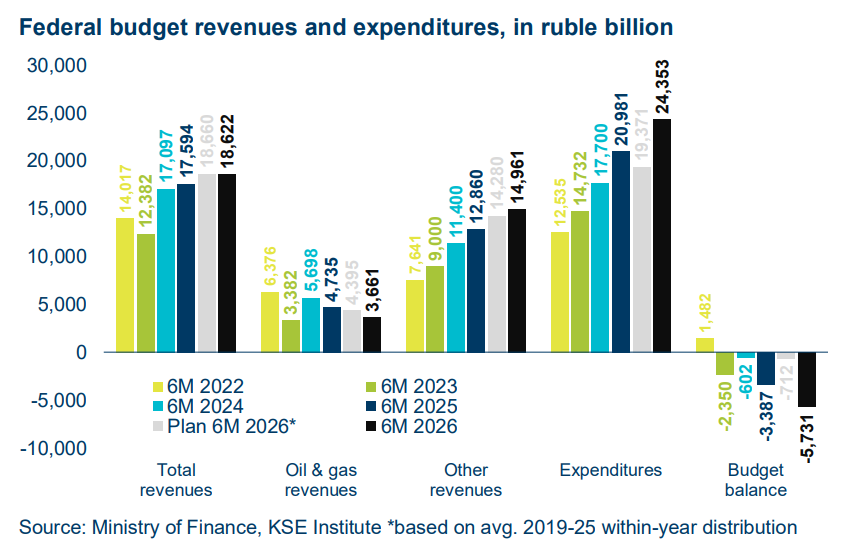
In the first half of 2026, the deficit reached approximately 5.7 trillion rubles, or 2.7% of GDP. This means that, even in the first half of the year, it already exceeded the deficit planned for the entire year of 2025. It was 51% higher than projected in the original budget (3.8 trillion rubles; 1.6% of GDP). Although the budget has since been revised, the new deficit target was also exceeded by 19%.
Cumulative balance in the federal budget, in trillions of rubles
Kyiv School of Economics: Russia Chartbook: Stalled Domestic Borrowing Poses Threat to Budget Financing; Energy Windfall Fades as Oil Prices Moderate, July 29, 2026
Financing the budget deficit is becoming increasingly difficult for Russia. In the first half of the year, the Ministry of Finance relied heavily on domestic borrowing and its cash reserves, while the “National Welfare Fund” was used only to a limited extent.
Toward the end of the period, rising borrowing costs and weaker demand from domestic banks led to a lack of buyers at government bond auctions (see videos from TLDR News EU: Russia Suspends Bond Auctions: Could Putin Default? July 23, 26; “Russia’s Bond Yields Spike: Is Putin in Trouble?” July 8, 26). Although the government can still borrow through state-owned banks, it can do so only at a higher cost.
The conflict between monetary policy and fiscal policy has intensified
The KSE Institute views the Russian Central Bank’s monetary policy as being at odds with the sharp increase in spending to finance war expenses:
The Russian Central Bank is attempting to curb the inflation triggered by high war expenditures through a restrictive monetary policy. In contrast, the government continues to increase spending and borrowing to finance the war.
Concerns about “fiscal dominance” are growing. Recent legislative changes allow spending and public debt to exceed the limits set in the previous budget law. Persistently high interest rates could further restrict private-sector activity.
Russia’s outlook remains dependent on energy markets
According to the KSE Institute, the performance of the Russian economy in the second half of 2026 will depend largely on the pace of “normalization” in global energy markets and the continuation of Ukrainian attacks on Russian energy infrastructure. The institute outlines the following two scenarios:
A continuation of the “global oil crisis” would continue to support Russian exports and government revenues. However, this would neither resolve the “fuel crisis” in Russia nor reduce the budget deficit to a sustainable level.
A rapid return to a supply surplus in the global oil market would mean lower oil revenues for Russia. With the economy continuing to stagnate, Russia would face growing fiscal problems.
Federal budget revenues from the oil and gas sector have declined
Despite the rise in energy prices following the start of the war in Iran in late February, government revenues from the oil and gas sector in the Russian federal budget fell significantly again in the first half of 2026 compared to the previous year.
At 3.66 trillion rubles in the first 6 months of 2026, they were 22.7% lower than a year earlier. The KSE Institute published the following overview on this topic.
Federal Budget:
Revenues, Expenditures, and Balance in Trillions of Rubles
Kyiv School of Economics: Russia Chartbook: Stalled Domestic Borrowing Poses Threat to Budget Financing; Energy Windfall Fades as Oil Prices Moderate, July 29, 2026
Atlantic Council: Oil and gas revenues were about one-third lower than in 2024
Charles Lichfield, director of the Atlantic Council’s GeoEconomics Center, and his colleague Brendon Chen also point to the decline in oil and gas revenues in the Russian federal budget. They report:
While the closure of the Strait of Hormuz this year gave Russia the opportunity to sell its oil at higher prices, these price-driven increases in revenue were offset by a decline in export volumes.
In early 2026, Ukrainian drone attacks also crippled 30 to 45 percent of Russia’s refining capacity, leading to fuel shortages in Russia and lower oil exports by sea.
Western sanctions were also tightened, including through a lower oil price cap imposed by the European Union and new measures against supporters of the shadow fleet.
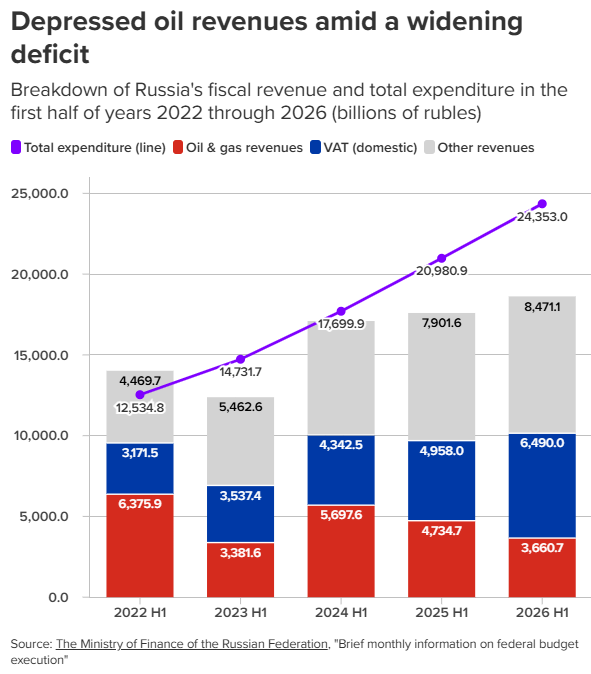
As a result, Russia’s federal budget revenues from the oil and gas sector fell to 3.661 trillion rubles in the first half of 2026. This amounted to only about 64 percent of the revenue recorded in the first half of 2024 (see red bars in the figure below).
Trends in the Russian Federal Budget:
First Half of 2022 to First Half of 2026
Total Expenditures: blue line
Revenue from the oil and gas sector: red bars
Revenue from value-added tax: blue bars
Other revenue: gray bars
Atlantic Council; Charles Lichfield and Brendon Chen:
“Russia Will Sacrifice Its Civilian Economy on the Altar of the War Effort
,” August 5, 2026
Oil and gas revenues were also lower in the first seven months
Kommersant summarized the latest developments in federal budget revenues from the oil and gas sector, including July, as follows:
According to the Ministry of Finance, oil and gas revenues from January through July totaled 4.595 trillion rubles. This was 17% lower than in the previous year. This was due to low prices in the first two months of the year. Before the war between the U.S. and Iran, Russian oil prices in January and February ranged from $40 to $45 per barrel.
Given the decline in oil prices in recent months, the prospects of reaching the planned oil and gas tax revenue target of 8.9 trillion rubles for 2026 appear uncertain. After the average price of Urals crude oil (Trading Economics) rose to $94.9 per barrel in April, it fell to $86.5 in May, according to the Ministry of Economic Development, to $63.5 in June, and to $59 in July per barrel. In the first seven months, the average price of Russian Urals crude stood at $66.6—above the $59 per barrel budgeted.
The Central Bank expects the average annual price to decline further. Its updated medium-term forecast from July 24 projects an Urals oil price of $60 per barrel this year and $50 next year. In a commentary on this forecast dated August 5, the central bank noted: “Despite the temporary price increase due to the supply shock caused by the conflict in the Middle East and the closure of the Strait of Hormuz, oil prices are expected to continue falling once the situation normalizes.”
In addition to the oil price, the ruble exchange rate also influences the level of oil and gas revenues. The 2026 budget was based on an exchange rate of 92.2 rubles per dollar. However, according to the Central Bank, the actual average exchange rate for the seven-month period was significantly lower, at 76.5 rubles per dollar (meaning that for every U.S. dollar earned from oil and gas exports, the budget received lower-than-planned revenues in rubles).
Another factor influencing the budget’s oil revenues is actual production volumes. Russian government agencies do not publish data on this. In its summary of the August 5 policy rate discussion, the Central Bank merely noted that “damage to oil refineries led to a decline in the production of petroleum products and in demand for crude oil. The capacity of the transportation and port infrastructure was insufficient to divert the freed-up crude oil volumes for export. As a result, oil production also declined.”
Recommended Reading
German-Russian Chamber of Foreign Trade:
- Despite Rising Inflation Expectations: Central Bank Cuts Key Interest Rate to 14%, July 28, 26
- Fuel Crisis: Top Exporter Russia Relies on Imports, July 21, 26; Gasoline Crisis in Russia, June 30, 26
- Russia’s Banks: Record Profits, Credit Crisis, and Bank Closures, July 14, 26
“Die Presse” Podcast: Russia—Gas, Sanctions, Oligarchs:
- Has Ukraine finally struck a vital nerve in the Russian economy? Following the oil refineries, Ukrainian drone attacks are now setting fire to the logistics warehouses of Russia’s largest online retailer, Wildberries. Hundreds of thousands of business owners are affected. How badly has the economy been hit? Economist Vasily Astrov (WIIW) in conversation with Eduard Steiner; 47 min., July 29, 26
Current economic trends; the economy as a whole
- VEB Institute: GDP Index for June 2026, August 6, 2026
- Fitch Ratings: Supply bottlenecks will continue to put pressure on Russia’s economy, August 5, 2026
- Atlantic Council; Charles Lichfield and Brendon Chen: Russia will sacrifice its civilian economy on the altar of the war effort, August 5, 2026
- Interfax.com: Central Bank expects Russian year-over-year GDP growth to slow to 0.5% in Q3 from 0.8% in Q2, August 5, 2026
- IEF RAS: Short-Term Analysis of GDP Trends; August 4, 2026
- KSE Institute: Sanctions and the Russian Economy: 2026 Mid-Year Assessment by KSE Institute, August 4, 2026
- mosregtoday.ru; Alisa Zolotova: PSB Zero Scenario: Can Economic Growth Be Expected by the End of the Year? August 3, 2026
- oilprice.com; Simon Watkins: Russia Is Running Out of Soldiers, Oil, and Time, August 3, 2026
- Kommersant.ru; Artem Chugunov: Consumers Are Preventing a Decline in GDP, August 2, 2026
- Kommersant.ru: Russian Economic Growth Continues to Slow, August 2, 2026
- russland.capital: Russia’s Corporate Financial Statements Paint a Mixed Economic Picture, Aug. 1, 2026
- Nezavisimaya Gazeta, Anastasia Bashkatova: The domestic economy is on a long deceleration path. Growth in Russians’ real disposable income has slowed by a factor of six; July 30, 2026
- Jamestown.substack.com; John C. K. Daly: Central Bank and Finance Ministry Warn Putin of War’s Impact on Economy, July 30, 2026
- Finam.ru; Olga Belenkaya: Results for June and the First Half of the Year: Slowing Growth in Wages and Real Income; Inflation Risks Also Arise from Attacks on Warehouses; July 30, 2026
- BOFIT, Bank of Finland: BOFIT Weekly: Weak First Half for Russian Economy; EU Expands Sanctions; July 30, 2026
- Kyiv School of Economics: Russia Chartbook: Stalled Domestic Borrowing Poses a Threat to Budget Financing; Energy Windfall Fades as Oil Prices Moderate, July 29, 2026
- New Eurasian Strategies Centre; Sergey Aleksachenko: Slow Decline: Russia’s Economy Is Worsening, but Neither Collapse Nor Recovery Is Likely, July 21, 2026
Fiscal Policy; National Budget
- Kommersant, Vadim Visloguzov: The Budget Absorbs Expensive Oil, August 5, 2026
- ProFinance.ru: Russia’s oil revenues reached their highest level in 15 months; August 5, 26
- Oil Capital; Ekaterina Krasovskaya: Oil and gas revenues in the Russian national budget totaled 934.0 billion rubles in July; August 5, 2026
- Ministry of Finance: Information on the Generation and Use of Additional Oil and Gas Revenues in the 2018–2026 Federal Budget; Published in the section: Information on Additional Oil and Gas Revenues in the Federal Budget; Published: May 8, 2026; Updated: August 5, 2026
- The Moscow Times: Russian Banks Lack Cash to Buy Government Debt, Sberbank Executive Says, July 31, 26
- Gaidar Institute; Ilya Sokolov: The federal budget has a safety margin, but balancing it is becoming more difficult. The short-term sustainability of the federal budget is not in question, even despite a fairly significant current deficit and the suspension of debt financing in July 2026. Meanwhile, the risks of falling short on non-oil and gas revenues are increasing, volatility in commodity revenue flows is rising, and geopolitical uncertainty persists; July 30, 2026
- Nezavisimaya Gazeta, Anastasia Bashkatova: Instead of oil production, the budget got inflation. Value-added tax has become the main source of revenue for the state treasury, July 29, 2026
- Moscow Times; Tatyana Rybakova: Where Can Russia Find More Money for War? July 29, 2026
- Finanzmarktwelt; Dói Ennoson: China Refuses to Help. Cash Crunch in the Kremlin: No More Buyers for Russia’s Bonds. Interest Rates Above 16 Percent, July 29, 2026
- Vedomosti: The Federal Tax Service expects further growth in non-oil and non-gas revenues for the Russian state budget, July 29, 2026; Federal Tax Service: The VAT increase to 22% brought 426 billion rubles into the state budget in the first half of the year; July 29, 2026
- Joe Blogs; Video: Russia Posts Record Losses, Video, 12 min.; Russia reported a budget deficit of $74 billion for the first half of 2026—a deficit higher than that for all of last year. How can Russia still avert a budget crisis? Given increasing attacks on refineries, restricted exports of gasoline, diesel, and kerosene, disruptions to trade in the Sea of Azov, ongoing Western sanctions, and further increases in military spending, the outlook appears to be worsening rather than improving; July 28, 2026
- Fakti.bg, Milen Ganev: Politico: Russian Economy Collapses Under Pressure. Kyiv’s New Tactics: Massive Ukrainian Drone and Missile Attacks Are Pushing the Kremlin’s Financial System to the Brink of Collapse. 07/25/26
- TLDR News EU: Russia Suspends Bond Auctions: Could Putin Default? Russia’s bond yields continue to rise; yet, no one wants to buy them. In this video, we’re taking a look at what a recent announcement by the Kremlin regarding the issuance of bonds means and why it’s genuinely bad news for Putin; July 23, 2026; Russia’s Bond Yields Spike: Is Putin in Trouble? With Russia’s borrowing costs spiking, Putin’s war machine once again appears to be in trouble. In this video, we’re taking a look at the turmoil in Russia’s bond market and what it means for Putin strategically, July 8, 2026;
- Reuters: Russia’s 2026 budget deficit may exceed projections by $12.85 billion due to higher spending, July 16, 2026; Yahoo Finance, Reuters, Semen Ruban: Russia’s budget deficit to exceed forecasts by nearly US$13 billion – Reuters, July 16, 2026
- russland.capital: Russia’s budget deficit remains larger than planned – despite a slight easing in June, July 10, 2026
- Russian Ministry of Finance: Monthly Briefing on Federal Budget Execution (cumulative since the beginning of the year, in billions of rubles); Section: Federal Budget of the Russian Federation, July 9, 2026
Fuel Supply, Energy Sector
- Reservists’ Association; Loyal magazine; Julia Egleder: A Hard Blow to the Shadow Fleet; It is the lifeline of the Russian economy: the shadow fleet, through which the Russian regime exports its crude oil to consumer countries. But at the moment, this fleet is weakened; August 3, 2026
- bne Intellinews; Ben Aris: The Russia-Ukraine drone war shifts to crippling ports, August 1, 2026
- bne Intellinews: Ukraine’s refinery campaign is turning oil into Russia’s weakest economic link; Riddle Russia’s Vakhtang Partsvania argues that Kyiv’s shift from export terminals to refineries has targeted the one part of Russia’s oil sector that sanctions alone could never touch: domestic fuel supply, August 1, 2026
- DW.com; DW in Russian: Ukraine’s Attack on Wildberries: Causes and Consequences, including:
Oleg Loginov: Attacks on Wildberries: A Cascading Effect on the Russian Economy; Disrupting supply lines to the front is just one of the goals of the attacks, July 30, 2026 - Finmarket.ru: Gasoline prices in Russia rose by 0.56% from July 21 to 27, while diesel prices fell by 0.06%. July 29, 2026
Warnings of a banking crisis and high corporate debt
- Atlantic Council; Charles Lichfield and Brendon Chen: Russia will sacrifice its civilian economy on the altar of the war effort, August 5, 2026
- russland.capital: When the Internet Goes Down: Russians Are Holding More Cash Again. Aug. 4, 26
- Econsonline.en; Vlasta Demyanenko: Should We Expect a Storm? Russian Banks and the Challenges of the New Reality. Participants at the Financial Congress discussed whether risks to financial stability had increased and to what extent banks were prepared to meet new challenges, July 28, 2026
- russland.capital: Russian corporate debt rises to record levels, July 8, 2026
Price Trends
- Joe Blogs: Russia Out of Control; Russia’s inflation is showing worrying signs of spiraling out of control. We analyze the latest inflation charts and discuss what this means for an economy already facing slowing growth, record budget deficits, labor shortages, and mounting financial pressure, August 5, 2026
- Finmarket.ru: Gasoline prices in Russia rose by 0.56% from July 21 to 27, while diesel prices fell by 0.06%. July 29, 2026
- russland.capital: Russia’s inflation rises to 5.8 percent—the public expects nearly 15 percent, July 23, 2026
- Finanzmarktwelt; Josephine Bollinger-Kanne: Russia in the grip of a fuel crisis and a spiral of spending. The war in Ukraine is having an increasingly significant impact; July 15, 2026
- Russian Central Bank, Press Release: Inflation in Russia No. 6 (126) • June; July 15, 2026
- Bank of Russia: Price growth accelerates in June due to one-off factors, July 15, 2026
Monetary Policy
- Raiffeisenbank, Fokus Pocus: The Central Bank explained its decision on the key interest rate, Aug. 7, 26
- Politkom.ru; Nikita Maslennikov: The Russian Central Bank cut the key interest rate and sent a stronger signal, July 31, 2026
- Kommersant; Vitaly Gaidaev: The economy is waiting for changes. According to the Russian Union of Industrialists and Entrepreneurs (RSPP), the Central Bank’s high key interest rate is leading to a wave of bankruptcies. Kommersant: “Money.” Supplement No. 20, July 30, 2026, p. 8; July 30, 2026
- Bank of Russia: Commentary on the Bank of Russia’s Medium-term Forecast, PDF, August 5, 26
- Bank of Russia: Summary of the Key Rate Discussion released, August 5, 2026
- Bank of Russia: Statement by Bank of Russia Governor Elvira Nabiullina following the Board of Directors meeting on July 24, 2026, July 24, 2026
- Bank of Russia: Bank of Russia cuts the key rate by 25 basis points to 14.00% per annum, July 24, 2026
- Bank of Russia: Bank of Russia’s Medium-Term Forecast Following the Bank of Russia Board of Directors’ Key Rate Meeting on July 24, 2026, July 24, 2026
Foreign Trade, Sanctions
- Atlantic Council; Charles Lichfield and Brendon Chen: Russia will sacrifice its civilian economy on the altar of the war effort, August 5, 2026
- OENB Policy Brief 2026/4; Paul Ramskogler, Klaus Vondra: The War in the Middle East and the Price of Oil—Are Current Prices and High Volatility the New Normal? (PDF, 472 kB) 10 pp.; August 5, 2026
- Kyiv School of Economics; KSE Institute: Sanctions and the Russian Economy: 2026 Mid-Year Assessment by KSE Institute, August 4, 2026
- Inosmi.ru; Stratfor, USA: It is unlikely that the new U.S. sanctions will have an impact on Russian oil exports or Moscow’s military strategy. August 4, 2026; Original article;
- Inosmi.ru; Responsible Statecraft, USA: The U.S. would lose the most if the Senate votes for sanctions for PR reasons; August 4, 2026; Original article
- Inosmi.ru; Al Arabiya UAE: LNG Wars: From Freeport to Arctic LNG 2 to Damietta. Al Arabiya: LNG has become a key element in the geopolitical struggle between Russia and the United States; Aug. 4, 2026; Original article
- oilprice.com; Simon Watkins: Russia Is Running Out of Soldiers, Oil, and Time, August 3, 2026
- Carnegie Europe; Rym Momtaz: Are the EU’s Watered-Down Russia Sanctions Better than None? The EU had to compromise to adopt a twenty-first sanctions package against Russia, exposing growing cracks in the union’s resolve. July 28, 2026
- Federal Agency for Civic Education; Sebastian Hoppe, Research Associate at the Center for Eastern European and International Studies (ZoiS): What Remains of Economic Relations Between the EU and Russia? July 29, 2026
Political Context
- Alexander Graf Lambsdorff, former German ambassador to Moscow, on the “Ronzheimer” podcast: Inside Moscow: Putin Is Planning a Nasty Surprise. Lambsdorff recounts his first encounter with Vladimir Putin and his conversations with members of the opposition. He explains why, in his view, Putin’s war harms Russia’s own interests, why Ukraine is now able to deal Moscow a serious blow, and how great the danger is of further Russian mobilization and new tensions with NATO, Aug. 2, 26
- BR24; Possoch explains: Putin Under Pressure: Must He Risk Everything Now? Russia is losing tens of thousands of soldiers every month in the war in Ukraine. New recruits are coming from prisons, from poorer regions of Russia, or even from abroad. At the same time, discussion about a new mobilization is growing. Must Putin now trigger the next stage of escalation? Video, 15 min., July 30, 2026
- Finanzmarktwelt; Josephine Bollinger-Kanne: Russia Between Economic Collapse and North Korea. A Return to a Controlled Economy—Russia Is Heading Toward a Collapse Like That of the Early 1990s; July 27, 2026