The growth outlook for the Russian economy is dimming
Author: Klaus Dormann
Although Russia’s total economic output rose by 1.3% year-over-year in the second quarter of 2026, annual GDP growth for the first half of the year as a whole was only 0.6% due to the decline in real gross domestic product in the first quarter.
In its latest weekly report, “BOFIT Weekly,” the BOFIT research institute of the Bank of Finland states that, following a “weak first half of the year,” the outlook for the Russian economy has dimmed in light of falling oil prices and Ukraine’s drone attacks.
The trends in public finances and inflation are also contributing to this. BOFIT states:
“Economic imbalances have continued to worsen, and risks have increased. The rapid growth in government spending and skyrocketing deficits have made it more difficult to manage public finances and have fueled inflation. Rising fuel prices have also accelerated inflation, as Ukrainian drone attacks have reduced Russian production capacity.”
Retail and services are performing relatively well
Regarding the trend in fixed investment, BOFIT cites the Russian Central Bank’s latest economic survey. It showed a slight recovery in fixed investment from the low point at the beginning of the year. The most positive investment figures were recorded in the retail and services sectors, as well as in the consumer goods industry. Investment in the construction industry, on the other hand, continued to decline in the second quarter. The raw materials industry also saw weak growth in fixed investment, although there was a slight improvement compared to the low point at the beginning of the year.
According to BOFIT, similar differences between sectors are evident in production trends:
“According to preliminary figures, growth in the second quarter was largely driven by higher retail sales and increased service sector output, while production in the raw materials mining and construction sectors declined by nearly 2% compared with the previous year.”
Industrial production was only 0.1% higher in the first 7 months than in the previous year
The Russian Federal State Statistics Service (Rosstat) released its first data on the Russian economy’s production trends for the second half of the year last week in its report on industrial production trends in July. Key findings (Finmarket.ru):
Annual growth in industrial production slowed to 0.4% in July 2026, after reaching 0.7% in June according to revised data. The increase in industrial production in July was thus slightly better than analysts had expected in a consensus forecast compiled by Interfax in early August (0.3%).
The following interactive chart from the Barcelona-based research firm “FocusEconomics” shows, with the blue dots, the decline in the annual growth rate of industrial production from 0.7% in June to 0.4% in July 2026 (scale on the left side of the figure).
However, when comparing the first seven months of 2026 as a whole with the same period in the previous year (January through July 2025), industrial production was only 0.1% higher.
Monthly Trends in Industrial Production
: Year-over-Year Changes in Percent
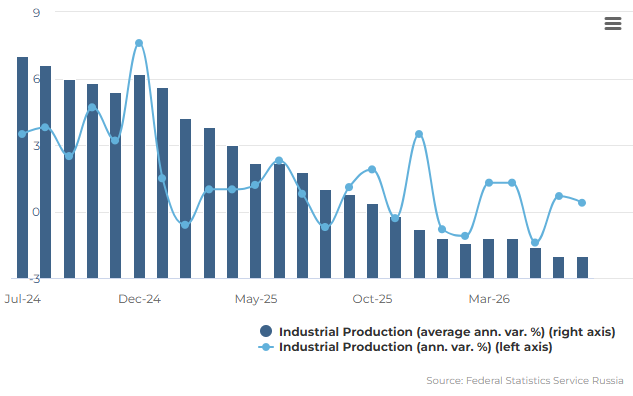
Black bars: Annual change over the last 12 months in %; right scale
Blue dots on a blue line: Change from the same month of the previous year in %; left scale
FocusEconomics: Russia Industrial Production July 2026, August 26, 2026
The black bars in the figure show the average annual increase in production over the previous twelve months. At the end of 2025, in December, industrial production had still risen by 1.1% compared with the same period a year earlier. However, from August 2025 to July 2026, industrial production rose by only 0.5% compared to the period from August 2024 to July 2025.
Growth in the “manufacturing sector” has so far prevented a recession
Within the industrial sector, production in the “manufacturing sector” was 0.5% higher in the January–July 2026 period than in the same period of the previous year. In contrast, production in the “mining and extraction of raw materials” sector fell by 0.9% during the same period.
In July, growth in the “manufacturing sector” stood at 2.4% year-over-year, following growth of 2.8% in June (blue line in the following chart from PSB Bank).
The “Mining and Extraction of Raw Materials” sector, on the other hand, recorded a 2.6% decline in production in July 2026, following a decline of 2.6% in June (red line).
Total industrial production (white bars),
“Mining” (red line), and “Manufacturing” (blue line);
Year-over-year changes in percent
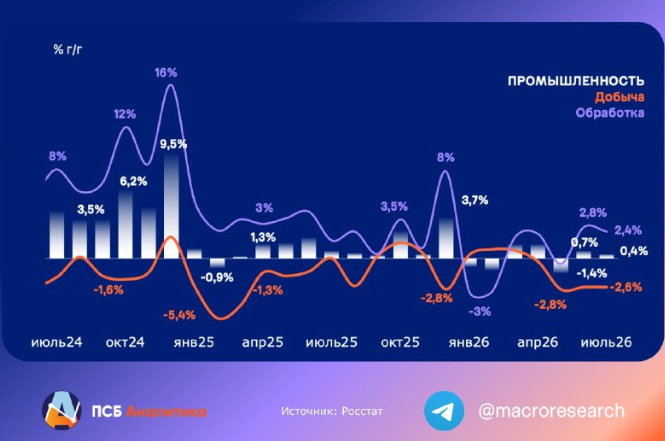
PSB Analytics: Industrial Production in July, August 27, 26
According to Rosstat estimates, industrial production in July 2026, adjusted for seasonal and calendar factors, grew by 0.1% overall compared with the previous month (following a 0.2% increase in June).
Overall economic growth is likely to remain weak
BOFIT concludes regarding the trend in industrial production in July: The latest industrial production figures indicate that growth in overall economic output remained “subdued” in July. Compared to previous months, the seasonally adjusted production volume remained essentially unchanged.
PSB Bank also notes on its Telegram channel:
“Given the high importance of industry to the Russian economy, real GDP growth in July will be quite weak, although moderate economic growth is likely to continue given the high and stable level of consumer spending. We maintain our forecast of real GDP growth near zero (in the range of 0–0.5%) through the end of 2026.
The Central Bank will take the weak economic performance into account when setting the key interest rate, so a scenario of further moderate monetary easing in September cannot be entirely ruled out. Next Wednesday (September 2), Rosstat will publish the complete statistical data for July, and the Ministry of Economic Development will provide an assessment of real GDP growth.”
Production outside the defense industry is lower than at the beginning of 2022
The Finnish Central Bank’s research institute once again draws attention to the highly divergent performance of sectors within the “manufacturing industry” since the start of the war in Ukraine in 2022 with the following chart. BOFIT emphasizes:
“As in previous years, growth in ‘manufacturing’ was largely driven by war-related sectors (red line), while production in most other sectors continued to decline (blue line). Seasonally adjusted production volumes in sectors not directly linked to war-related spending were lower this summer than in early 2022.”
The “manufacturing sector” continues to
follow two diverging paths
red line: war-related sectors; blue line: rest of the manufacturing sector
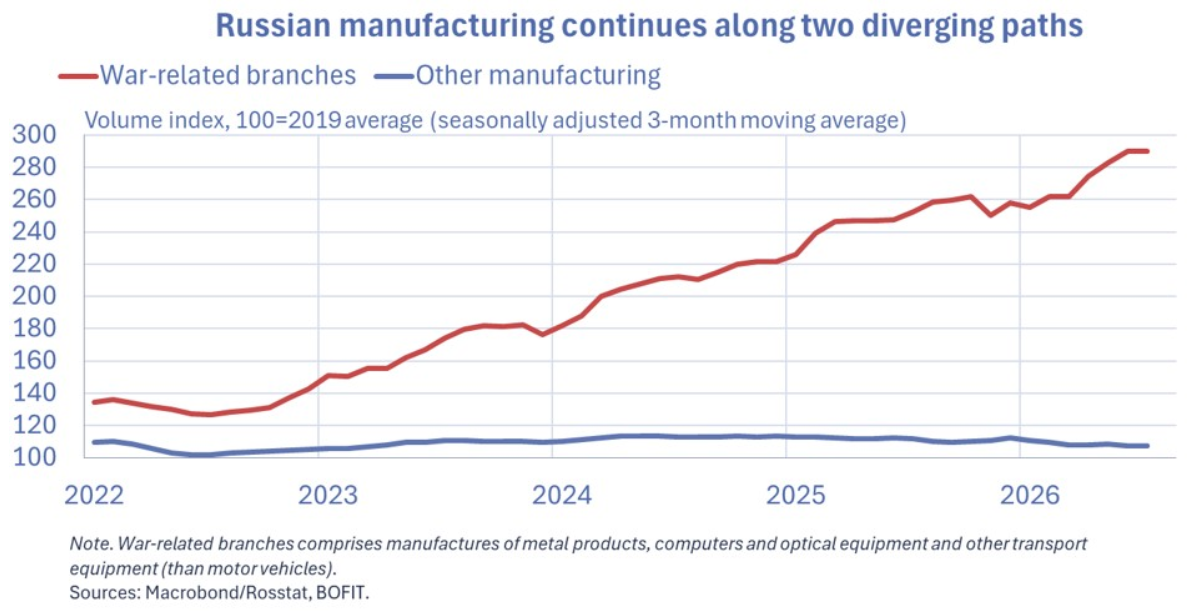
BOFIT, Bank of Finland Weekly Review 35/2026: Russia’s diverging economic trends continue, Aug. 28, 26
“Defense production” has continued to grow strongly so far in 2026 as well
The economic sectors classified by BOFIT in the figure above as “war-related industries” recorded the following growth rates in the period January–July 2026 compared to the period January–July 2025 (Finmarket.ru):
- Production of other transportation vehicles and equipment (including aircraft, shipbuilding, etc.): +22.9%.
- Production of metal products (excluding machinery and equipment): +10.9%;
- Production of computers, electronic, and optical products: +4.2%.
At the same time, production of pharmaceuticals and materials for medical and veterinary use rose by 13.9%.
Slump in Production at Refineries
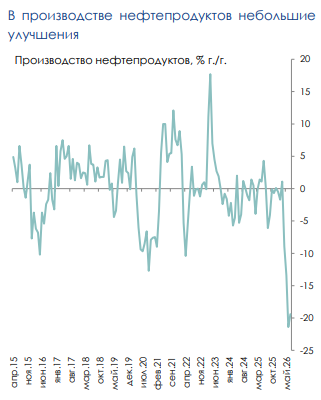
The sharpest decline in January–July 2026, compared with the same period in 2025, was in the “coke and petroleum products” sector. Due to Ukrainian attacks on Russian refineries, it was 9.2% lower than in the first seven months of the previous year. According to Meza Net, production of petroleum products and coke fell by 19.3% year-over-year in July (see the following figure from Raiffeisenbank).
Production of petroleum products, % year-over-year
Raiffeisenbank: RAIF Daily Focus, August 27, 2026
Janis Kluge, a Russia expert at the German Institute for International and Security Affairs (SWP), stated in a Deutsche Welle podcast at the end of August that he could no longer rule out the possibility that the Russian economy might slip into a recession this year due to the consequences of Ukraine’s attacks (minute 18).
The Minister of Industry and Trade, Anton Alikhanov, however, reported to President Putin in a video released on August 27 by russland.RU, that in recent years there has been an increase in industrial production, investment, and the scale of new capacity coming online (see also: en.Kremlin.ru: Meeting with Minister of Industry and Trade Anton Alikhanov; August 26, 2026).
BOFIT: Production has varied significantly by region since 2021
In its weekly report, the Bank of Finland’s Institute highlights that the war in Ukraine has had a major impact on the regional development of production in Russia.
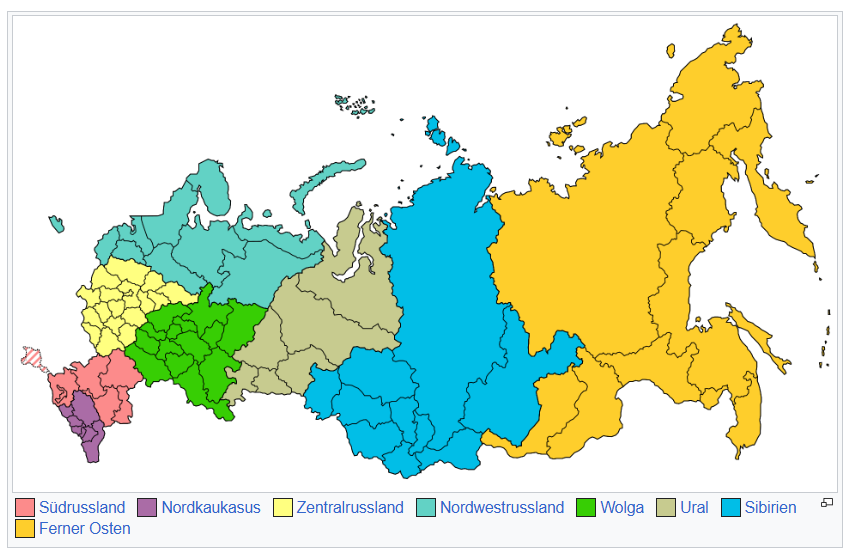
In a regional comparison of the eight Russian “federal districts,” the production indicator calculated by Rosstat for the five “core sectors” of the Russian economy (agriculture, industry, construction, trade, and transportation) has evolved very differently following Russia’s invasion of Ukraine. When comparing production in the first half of 2026 with production levels in the first half of 2021, BOFIT notes:
Four federal districts recorded growth in production, namely “Central Russia,” “Northwest Russia,” “Volga,” and “Far East.”
In the remaining federal districts (Southern Russia, North Caucasus, Urals, and Siberia), the level of production in the first half of 2026 was lower than that of the first half of 2021.
Federal Districts of the Russian Federation
Wikipedia: Federal District
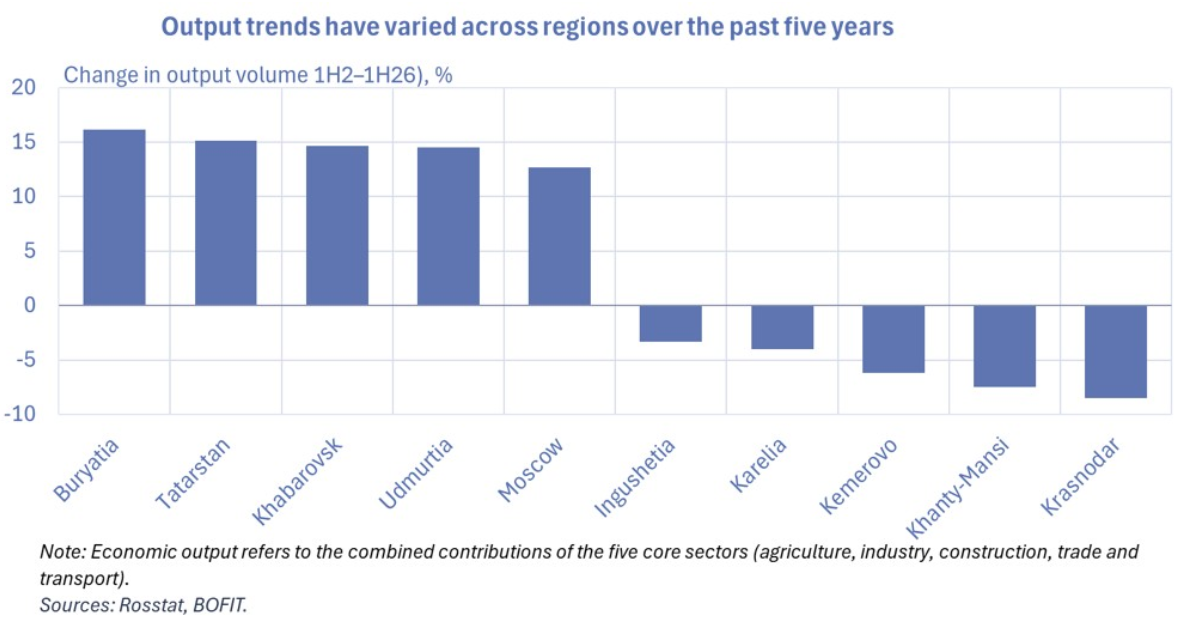
BOFIT illustrates the impact of the war in Ukraine on production trends since 2021 by comparing production trends in individual “regions” within the “federal districts” (see the figure below).
The strongest growth in production was recorded in regions that benefited from the expansion of the “military-industrial complex” (e.g., in Udmurtia and Tatarstan), in Russia’s major cities (Moscow and St. Petersburg), as well as in regions in the Far East that are carrying out large-scale projects to develop natural resources (Magadan and the Jewish Autonomous Region).
Production in the “core sectors” of the Russian economy by region
Real change from first half of 2026 to first half of 2021, in percent
BOFIT, Bank of Finland Weekly Review 35/2026: Russia’s diverging economic trends continue, August 28, 2026
The weakest growth was observed in regions bordering Ukraine (e.g., Bryansk and Krasnodar), in the impoverished regions of southern Russia (Ingushetia, Karachay-Cherkessia), as well as in resource-producing regions heavily affected by Western sanctions against Russian exports (e.g., Komi, Kemerovo, and the Khanty-Mansi Autonomous Okrug).
Recommended Reading
German-Russian Chamber of Foreign Trade:
- New Russian Economic Model Aims to Bring About a Turnaround, August 28, 2026
- Alexander Schochin: “We Will Never Return to Business as Usual,” August 25, 2026
- Chinese Oil Imports: Russia Overtakes Saudi Arabia, August 18, 2026
Podcasts
- Janis Kluge, German Institute for International and Security Affairs (SWP), on the Deutsche Welle podcast with Thomas Kohlmann: “Russia’s leadership has a real problem with the costs of the war,” columns of smoke rising from refineries, burning warehouses, and long lines at gas stations in many parts of Russia—how severe are the economic consequences? Audio, 25 min., August 28, 2026
- Andrey Gurkov, journalist, on the “Ronzheimer” podcast: Putin’s most important conquest is collapsing. With Andrey Gurkov. Paul Ronzheimer speaks with Andrey Gurkov about the consequences of the Ukrainian attacks. Is a banking crisis looming? How is the budget deficit evolving? What did Klepach predict? Is the Russian economy reaching a critical point? 44 min., Aug. 21, 26
Weekly and Monthly Reports from Research Institutes
- BOFIT, Bank of Finland Weekly Review 35/2026: Russia’s diverging economic trends continue, Aug. 28, 26
- Politcom.ru Weekly Report; Nikita Maslennikov: A New Investment Cycle—A Way Out of the Growth Crisis, August 27, 2026
- Economic Expert Group: Economic Analysis, July 2026, August 21, 2026
Industrial Production in July
- PSB Analytics: Industrial Production in July, August 27, 26
- Raiffeisenbank: Data Revisions Make Industrial Growth Appear More Modest, August 27, 2026
- Meza, Kyiv: Russia’s Coke and Petroleum Product Output Fell 19.3% in July Amid Refinery Disruptions, August 27, 2026
- FocusEconomics: Russia Industrial Production July 2026, August 26, 2026
- Finmarket.ru: Industrial production rose by 0.4% in July, while it increased by 0.1% in the January–July period; August 26, 2026
- en.Kremlin.ru: Meeting with Minister of Industry and Trade Anton Alikhanov; August 26, 2026
Overall Economic Development
- Bond Guide: Four Years of War: What Has Become of Former Western Companies in Russia. More than 500 international companies have withdrawn from Russia since the start of the Russian invasion of Ukraine, writing off assets totaling approximately $170 billion, according to an analysis by Denis Kasyanchuk for The BELL, Aug. 29, 26
- Deutsche Welle; Oleg Loginov, Nikita Oshuev: DW users on life in Russia: “People are mad as hell”; Official polls suggest public sentiment in Russia is deteriorating as economic pressure mounts. DW asked its users to share their experiences; August 27, 2026
- argumenti.ru: Russia has solidified its position as the world’s fourth-largest economy by GDP. August 26, 2026; naked-science.ru; Vyacheslav Govorun: Infographic: How the balance of power in the global economy will change by 2030, August 26, 2026
- newdaynews.ru; Sberbank expects a slowdown in Russian economic growth and rising inflation, Aug. 25, 2026
- Russia News: Gasoline Shortages, Grain Piles Up: Russia’s Economy Under Logistical Strain; Aug. 26, 2026
- Russia.News: Two Towers, Seven Pillars: The Kremlin Seeks Growth, August 23, 2026
- FR.de; Stephanie Schoen: Russia’s Economy in Distress: Is Putin Escalating the War in Ukraine? 08/23/26
- Op-online.de in cooperation with newsweek.com; Matthew Cannon and Dave Siminoff: Gasoline Shortages, Inflation, Drone Attacks: Putin Is Losing Public Support Ahead of the Election. The state of the Russian economy is now a “burden” for Putin, according to Sergei Guriev; August 23, 2026
- Bond Guide: Russia’s New Economic Plan: It’s the Same Old One. According to journalist Pyotr Mironenko and The Bell, Russia’s economy remains under pressure, Aug. 22, 2026
- russland.capital: Russia’s investments are becoming more domestic—but not necessarily more private, August 20, 2026
- Russian Union of Industrialists and Entrepreneurs (RSPP): RBC interview with RSPP President Alexander Shokhin; RBC: Alexander Shokhin: We will never return to the status quo. In an RBC interview, the chairman of the Russian Union of Industrialists and Entrepreneurs (RSPP) discussed how to overcome the investment slump, why the stock market can be developed using assets seized by the state, and why anyone involved in VAT chains may face tax claims, August 20, 2026
- informpskov.ru; Andrey Razumov: “Our Own for Our Own.” Russia’s economy is increasingly based on its own foundations; Meeting of the Presidential Council for Strategic Development and National Projects; August 20, 2026
- Vedomosti; Elena Mukhametshina: What Vladimir Putin Said at the Meeting of the Council for National Projects. The President Devoted Considerable Attention to the State of Regional Budgets; Aug. 20, 2026
- Kommersant, Maria Ezhovkina: Putin on Economic Growth, Regional Support, and a New Investment Cycle. Putin: Terrorist Attacks Are Affecting Growth Rates in Russia; Putin Described Russia’s Economic Development as “Modest but Positive,” August 19, 2026
Wildberries, Ozon; “Warehouse War”
- Frankfurter Rundschau; Felix Busjaeger: Drone strategy slows Russia’s economy. Attacks on Wildberries, Ozon, and Lukoil. Putin responds with a threat of nationalization; August 29, 2026; Russia News: Companies that fail to protect themselves from drones risk state control, August 26, 2026
- Kyiv StratCom Forum; SPRAVDI.org: How Strikes on Wildberries Are Destroying Russia’s Military Logistics and Economy, August 26, 2026
- CNBC; Sam Meredith: Ukraine is targeting Russia’s retail giants. Ozon is the next economic pressure point; Aug. 25, 2026
- BZ; Ben Aris: Putin’s Revenge: “You Wanted to Destroy Our Economy—Now Yours Is Burning,” August 25, 2026
- bne Intellinew; Ben Aris: Ukraine opens a second front against Russian e-commerce, with four Ozon warehouses hit in three days, August 24, 2026
Fuel Supply, Energy Sector
- Japan Times, Reuters: Russia’s gasoline output drops to 70% of domestic demand, Aug. 29, 2026
- russland.capital: Russia’s fuel market remains tight—gas stations call for a longer export ban, Aug. 26, 2026
- iSANS: Russia’s Energy Sector in July 2026, August 24, 2026
Warnings of a banking crisis and high corporate debt
- The Moscow Times: Russians Are Rushing for Cash. Should the Kremlin Be Worried? August 26, 2026
- TLDR News EU: Withdrawals Surge: Is Russia Headed for a Banking Crisis? August 21, 2026
Fiscal Policy; National Budget
- National Security Journal; Shay Bottomley: Putin Made a Historic Mistake and the Russian Economy May Never Be the Same Again. Russia is not bankrupt. The Kremlin can still rely on traditional measures to raise funds. Instead, it faces a liquidity problem, August 30, 2026
- The Bell; Pyotr Mironenko: The Budget Deficit Is Widening; August 26, 2026
- bne Intellinews; Ben Aris: Russia’s budget deficit has already surpassed last year’s full-year total with five months remaining. The July figure widened the year-to-date deficit by approximately RUB 0.7 trillion, August 23, 2026
- Politcom.ru; Nikita Maslennikov: The Budget Deficit in the Context of Macroeconomic Dynamics, August 20, 2026
Foreign Trade, Sanctions
- bne IntelliNews Lambda: The EU’s trade with Russia has reversed. But despite the sanctions, the EU continues to import two products in the same volumes as before the war. August 27, 2026
- Inosmi.ru: The EU Allows the Resale of Russian LNG: Experts Are Skeptical About the Possibility of Procuring Alternative Gas. BZ: The EU has allowed companies to resell Russian LNG to other countries. August 25, 2026; Original article: Berliner Zeitung
- Finam.ru: Sanctions have cost the Russian economy 2.9 trillion rubles over three years. The Russian economy lost an average of 0.7% of its GDP per year. Aug. 25, 2026
- German Eastern Business Committee: Growth markets in the East are boosting the economy; German Eastern Business Committee; Tables: German Trade with the East, 1st Half of 2026; Top 25 Foreign Trade Partners, First Half of 2026; Aug. 25, 2026; Christian Himmighoffen: Central and Eastern Europe Offsets Export Losses in the U.S. and China; Aug. 13, 2026
Political Landscape; BR24: Russia-Ukraine War in the News Ticker
- BILD; Paul Ronzheimer: Putin’s Attack on NATO? Finnish President Contradicts Germany. President Alexander Stubb (58) met with BILD. Exclusive interview with Paul Ronzheimer, August 29, 2026
- BR24, Peter Jungblut: “Scare Stories”: Is Putin Planning an Attack on Europe? U.S. media claim that CIA Director John Ratcliffe flew to Moscow to warn Putin against attacking NATO countries. The Kremlin insists this has “nothing to do with reality”; August 27, 26
- Merkur.de; Lukas Richter: “Then Putin Is Finished”: Expert Warns of the Kremlin’s Greatest Fear; Bill Browder Sees Growing Pressure on Putin, August 27, 2026
- Tagesschau.de; Florian Kellermann, ARD Kyiv: Russia is targeting the economy—with massive consequences; Attacks on steel mills or ships carrying grain—Russia is exploiting its air superiority, Aug. 26, 26
- Tagesschau.de: Hungary classifies Russia as a threat; a break with Orban’s foreign policy; August 26, 2026
- Frankfurter Rundschau; Florian Naumann: Russia Stumbles: Former Partner Armenia Demonstratively Turns Toward the EU—and Takes a Dig at Putin, August 25, 2026
- merkur.de; Simon Schröder: Empty shelves in Kyiv, burning ports: How Russia aims to bring Ukraine to its knees economically; August 25, 26
- BR24; Peter Jungblut: “Something Has Broken”: Can Putin Still Trust His Elite? The war of aggression against Ukraine …is having increasingly severe repercussions on everyday life in Russia. According to several Russian commentators, dissatisfaction with Putin is growing; August 24, 2026
- CNN; Nathan Hodge: It’s ‘Black August’ in Russia, but Putin is sweeping this summer’s crisis under the rug, August 23, 2026
- BR24 Interview: Prof. Gerhard Mangott on the war in Ukraine. The security expert from the University of Innsbruck: Although Ukraine is causing significant damage in Russia with its drones, it cannot defend Kyiv due to a lack of defensive missiles! What problems does corruption cause? Aug. 21, 26
Dismissal of VEB Chief Economist Andrey Klepach:
- novayagazeta.eu; Denis Morokhin: It’s not just Klepach. The VEB chief economist was fired for his disappointing forecasts, but many high-ranking officials agree with him; List; August 27, 2026
- rbc.ru: Andrey Klepach Became an Expert for the STANNUM Alliance. Andrey Klepach accepted the invitation from Alliance Chairman Leonid Gilchenko to become a STANNUM expert. The STANNUM Alliance of Strategic Metals continues to work on forming an expert council on strategic metals; August 26, 26
- Sergey Aleksashenko; Video: starting at 4:00 min. – Klepach’s dismissal. Companies have joined forces to help Putin. There is a gasoline crisis, but not a catastrophe; August 24, 26
- Center for Liberal Modernity; Understanding Russia; Edward Lucas: Cracks in the System; Russia’s elites are beginning to say the unspeakable: The war is a catastrophe. The most recent example is the scandal surrounding economist Andrei Klepach; Aug. 18, 2026
The day's most important Russian economic stories. Free, in your inbox three times a week.
Mon, Wed, Fri. Double opt-in, no tracking, unsubscribe anytime. By subscribing you consent to the processing of your email address as described in our Privacy Policy.