The Caspian Sea is shrinking, primarily due to climate change
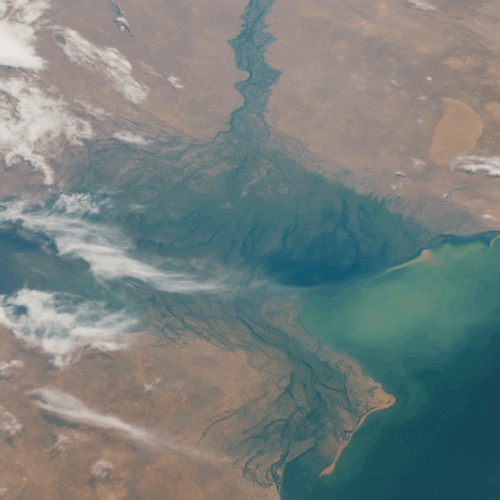
Climate change is the primary driver of the falling water level of the Caspian Sea and has a greater impact than human activities such as the construction of dams upstream. Water policy researcher Anoush Nouri Esfandiari made this assessment on July 22.
The Caspian Sea, the world’s largest inland sea, borders Azerbaijan, Iran, Turkmenistan, Kazakhstan, and Russia. Its water level has been falling steadily for years. This decline can no longer be explained solely by natural fluctuations and has significant consequences for shipping, fishing, and coastal tourism in the five riparian states.
Climate Change More Significant Than Dams
Esfandiari does not dispute that water withdrawals from the rivers that feed the Caspian Sea contribute to the decline in water levels. In her assessment, however, the effects of climate change clearly outweigh these factors.
“Water withdrawals from the rivers that flow into the Caspian Sea certainly influence the falling water level. As far as I know, however, the Volga, which provides more than 80% of the inflow, is predominantly equipped with dams that primarily serve shipping. Water withdrawal there is comparatively limited,” said Esfandiari.
“That is why, in my view, climate change remains the decisive factor in the shrinking of the Caspian Sea. Its influence is significantly greater than that of other factors.”
Limited Impact of Iranian Measures
Regarding Iran’s measures, Esfandiari explained that the country has built numerous dams on the Caspian Sea’s tributaries, particularly on the Sefidrud and its tributaries. This regulates a significant portion of the water flow.
However, since these rivers account for only a small portion of the total inflow compared to the Volga, the impact of Iran’s measures on the water level of the entire Caspian Sea is limited.
The Role of the Volga
More than 80% of the inflow comes from the Volga. Its course in Russia is influenced by numerous dams and regulation facilities. These impound large volumes of water for hydropower, irrigation, and industrial use before the river reaches the Volga Delta near Astrakhan. Additional water diversions via the Volga-Don Canal further reduce the inflow to the Caspian Sea.
Water-intensive agriculture and industry in Russia and Azerbaijan are also exacerbating the situation. Since 2022, Russia has expanded irrigation in the Volga Basin to increase domestic grain production. According to experts, this trend has been fueled by the war against Ukraine and the resulting sanctions, which have disrupted trade flows and food imports.
Zaur Shiriyev, a visiting scholar at the Carnegie Russia Eurasia Center, explained in an article for Carnegie that these developments have increased water consumption in the upper Volga and further reduced the inflow to the Caspian Sea.
Coastal pollution remains another problem
In addition to falling water levels, Esfandiari identified pollution of coastal waters as one of the Caspian Sea’s most significant environmental problems.
Although projects to collect and treat wastewater are being implemented, their completion is taking years. At the same time, the population in the northern Iranian provinces, particularly in Mazandaran, is growing, further increasing the pollution of coastal waters.
Groundwater and Water Consumption in Iran
Regarding the state of groundwater reserves in Tehran, Esfandiari explained that last year’s above-average rainfall had not brought about any fundamental improvement.
“This year’s rainfall may have slightly reduced the pressure on the aquifers. However, groundwater resources do not recover quickly, so no rapid improvement is to be expected.”
Incentive and penalty systems designed to reduce water consumption are also only effective to a limited extent, as water consumption in many residential complexes is tracked collectively, meaning individual consumers receive few direct incentives.
Furthermore, the high water consumption in Tehran is not attributable solely to private households. Industry, green spaces, and water losses in the distribution network also play a significant role.
Use of Treated Wastewater Stalls
According to Esfandiaris, treated wastewater was originally intended to be used more extensively for irrigating public green spaces. The necessary infrastructure for this is largely in place.
However, implementation has stalled due to a lack of coordination between the city administration and the water utilities.
“As far as I know, the use of treated wastewater for irrigating green spaces remains unresolved. The city council should have taken on a more active mediating role here,” said Esfandiari.
A successful solution could serve as a model for other major Iranian cities.
Varying Impacts of the Drought
Regarding this year’s drought on the Iranian Central Plateau, Esfandiari explained that the situation varies greatly from region to region.
While the southern part of the country has received above-average rainfall, many other regions have seen no significant improvements. Therefore, it is not possible to make a uniform assessment for the entire Central Plateau.