Will Russia's weak GDP growth double next year?
Author: Klaus Dormann
It’s here—the Russian government’s “Forecast of Socioeconomic Development of the Russian Federation for the Year 2027 and for the Planning Period of 2028 and 2029.” The “Ministry of Economic Development” has raised its forecast for Russia’s economic growth this year from 0.4% to 0.6%. Minister Maxim Reshetnikov announced this at a government meeting on September 24. He had already announced this increase in early September.
The Russian government’s new growth forecast for 2026 is barely higher than the forecasts published last week by Western observers. Both the OECD and the London-based “European Bank for Reconstruction and Development” have now estimated this year’s growth of the Russian economy at 0.5 percent. In their “Joint Economic Assessment” published on Thursday, the five leading German economic research institutes also expect economic growth in Russia to halve to just 0.5% this year.
There is now a broad “consensus” that the Russian economy will grow only very weakly this year. However, it remains a matter of debate whether growth will remain this weak or pick up noticeably as early as next year, reaching 1.4% as expected by the government. As before, the government expects growth to accelerate further to 1.9% in 2028 and to 2.4% in 2029.
Minister of Economic Development: The government’s forecast is “rather conservative”
Maxim Reshetnikov, Minister of Economic Development, emphasized during the cabinet meeting that the government’s forecast remains “rather conservative” overall. The “external price environment”—by which he likely meant oil price trends in particular—could prove to be more favorable than anticipated.
Reshetnikov stressed that the government’s economic policy must focus on increasing the economy’s flexibility and resilience and getting investment back on track. With regard to high lending rates, he emphasized that “the proposed budget structure creates room for easing monetary policy and reviving investment activity.” However, he added that “active structural reforms” are also necessary for sustainable growth (Finmarket.ru).
Consumption Drives Growth
The minister highlighted the importance of consumer demand as the “backbone of economic growth.” According to the forecast, total retail sales will rise by 4.6% in real terms in 2026, compared with the 0.8% the ministry had expected in the spring. The forecast for real wage growth this year was revised upward from 2.2% to 4% (Reuters).
A ministry representative added that the second factor driving consumption growth is an unexpectedly rapid decline in the savings rate. In 2025, it stood at 16.6%. This year, a decline to 9.5% is expected (the previous forecast was 14.3%).
Industrial production will not grow again until next year
According to the forecast, industrial production will decline by 0.2% overall this year—a significant downward revision from the 0.6% growth rate projected in the spring. According to the Federal State Statistics Service (Rosstat), industrial production remained flat year-over-year from January through August 2026 (0.0%). In August, it was 0.6% lower than in the previous year (Finmarket.ru).
Russia: Industrial
Production—Year-over-Year Change in %
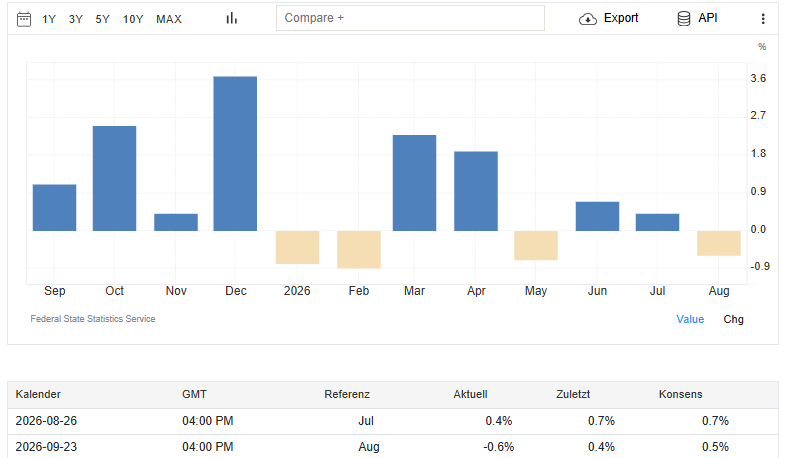
TradingEconomics: Russia Industrial Production, September 23, 26
The forecast for industrial growth next year, however, was raised from 2.1% to 2.2%, and the forecast for 2028 was raised from 2.4% to 2.7% (Vedomosti.ru).
Investment, which has been declining sharply, will not begin to rise noticeably until 2028
The ministry has significantly revised its investment forecast downward for the current year (-5.4% compared to -1.5% in the spring forecast). The decline in investment had already begun last year (-2.3% in 2025), a ministry spokesperson explained, according to Vedomosti. Investment trends are influenced, among other factors, by general uncertainty and the Central Bank’s key interest rate forecast. The ministry forecasts a minimal recovery in investment for 2027, with an increase of 0.2%. For the years 2028 through 2029, investment growth is expected to accelerate to 2.5% and 3%, respectively.
According to the forecast, net exports will contribute an average of 0.2 percentage points per year to GDP growth over the next three years (Expert.ru).
Inflation will fall to the target of 4 percent by the end of 2027
The ministry has now raised its forecast for the annual increase in consumer prices in December 2026 from 5.2% to 6.8%. However, this forecast still falls within the Central Bank’s forecast range, which anticipates a price increase of 6 to 7 percent by the end of 2026.
The main reason for the higher inflation forecast for 2026 is rising fuel prices, which are affecting the prices of other goods, a representative of the Ministry of Economic Development told Vedomosti. He added that the fuel crisis’s impact on overall price trends is “still quite weak.” The devaluation of the ruble is also contributing to accelerating inflation. One potential factor that could temper price increases is the difficulty in exporting grain (due to the war in Ukraine). The higher domestic supply of grain could lead to lower prices.
For the period from 2027 to 2029, the ministry expects inflation to return to the target rate of 4%.
“Conservative” Oil Price Forecasts by the Russian Government
Economy Minister Maxim Reshetnikov emphasized at the government meeting that the government had taken into account the sharp fluctuations in oil prices when raising its forecasts. Oil price trends largely reflect current developments “around the Arabian Peninsula.”
The following chart from the weekly report of the Research Institute of the Moscow-based VEB Development Corporation shows this year’s price trends for Brent crude (green line) and Urals crude (red line) since the spring. Most recently, according to this figure, the Urals price was no longer lower than the Brent price but, at $114, was higher than the Brent price of $107 (see also: TradingEconomics: Urals Oil; dpa-AFX). The difference between the prices of Brent and Urals turned negative (the blue area in the chart shows this “discount” as a percentage, left scale).
Oil Price Trends in U.S. Dollars per Barrel Since March 2026
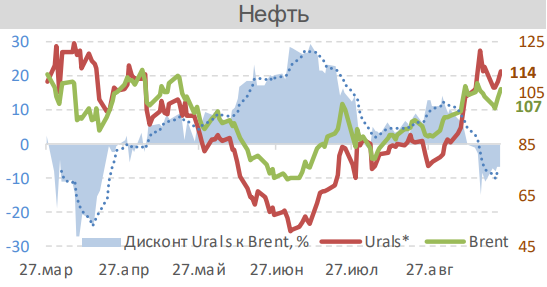
VEB Institute: Global Economy and Markets, September 25, 2026
According to the government’s forecast, the annual average price of Brent crude oil is expected to rise to $85.7 in 2026. While the price of Urals crude oil will also rise, it will remain significantly lower than that of Brent oil, trading at $61.2. Compared to the May forecast, the price forecast for Brent crude was raised much more sharply than that for Urals crude because, according to the minister, the government now expects a larger discount for Urals crude relative to the Brent price.
Starting in 2027, the government estimates that crude oil prices will slowly decline. The price of Brent crude oil will fall to $73 per barrel in 2027 and continue to decline to $66 by 2029. The price of Urals crude oil will decrease by about one U.S. dollar annually starting in 2027: from $53 per barrel in 2027 to $52 in 2028 and $51 in 2029.
For 2027, the government expects 1.4% growth, while the EBRD forecasts only 0.7%
Next year, according to the government’s assessment, Russia’s weak economic growth will more than double, rising from 0.6% to 1.4%. The “Joint Economic Forecast” by German institutes also expects real gross domestic product to rise by 1% at that time. However, the OECD and the EBRD do not anticipate any noticeable acceleration in economic growth in 2027. According to their estimates, Russia’s GDP will grow by only 0.6% (OECD) or 0.7% (EBRD) next year—almost as weakly as this year.
GDP Forecasts for Russia, 2025–2027
: Year-over-Year Change in Real Gross Domestic Product (Percent)
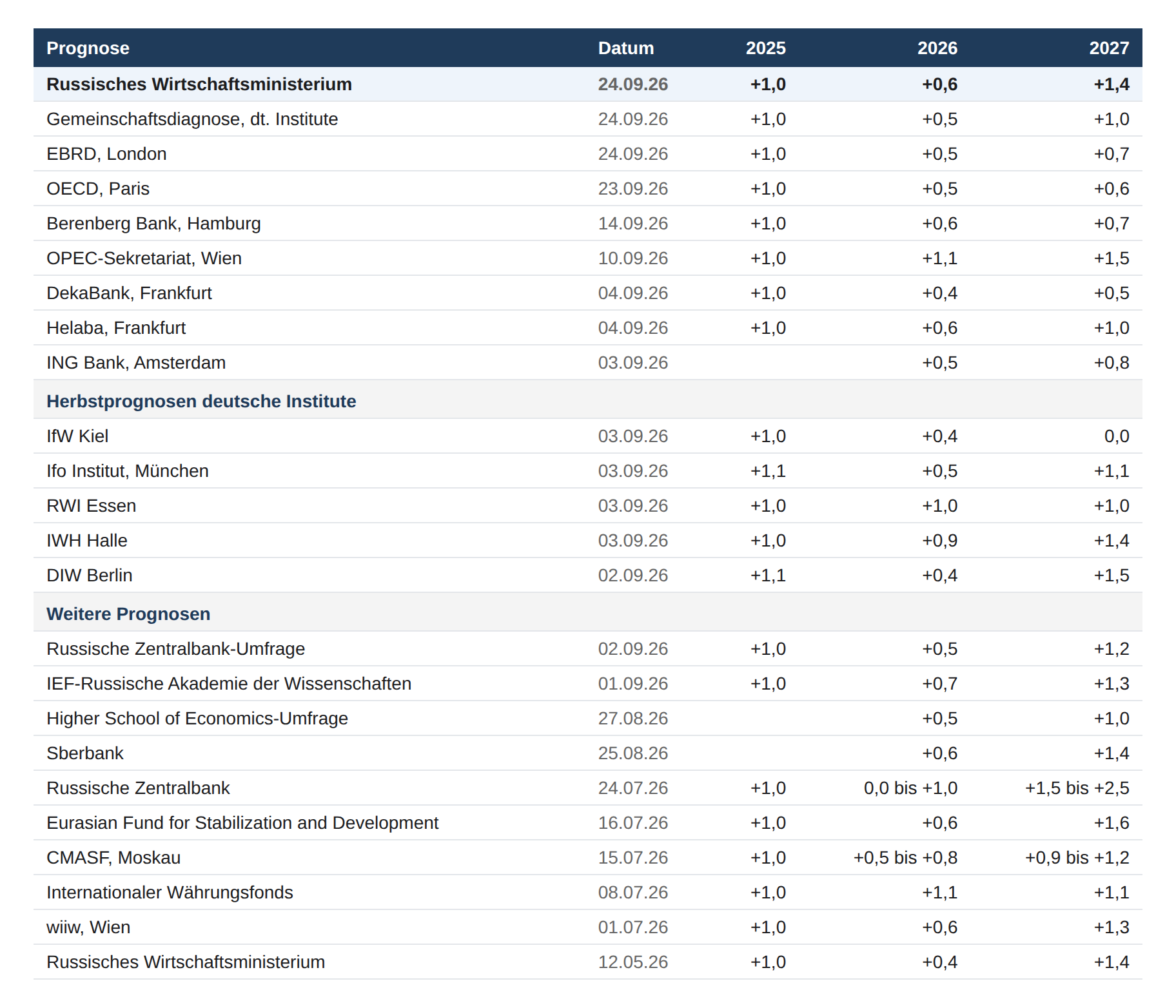
Compiled by: Klaus Dormann; as of: September 24, 2026
Russia’s growth remains much weaker than global growth
For 2027, the Russian government forecasts—as it did in May—an acceleration in GDP growth to 1.4%. Even with this increase, the IMF estimates that Russia’s economic growth will still remain well below that of the global economy. In the July edition of its “World Economic Outlook,” the IMF projected global economic growth of 3.4% for 2027.
In their recently updated “Joint Economic Assessment,” German economic research institutes forecast global economic growth of 2.5% for next year, while they estimate that Russia’s economic output will rise by only 1% during the same period. In 2028 as well, Russia’s economic growth, at 1%, will lag far behind global growth, which is projected to be 2.5% again.
In the discussion among the German institutes regarding their forecast for this year’s Russian economic growth in the “Joint Forecast,” the arguments put forward by the Kiel Institute for the World Economy, the Munich-based ifo Institute, and the Berlin-based DIW apparently prevailed. In their individual “Fall Forecasts” published in early September, these three institutes had already estimated growth in Russia for 2026 at just 0.4% and 0.5%, respectively.
The five institutes’ forecasts for Russia’s economic growth next year varied widely in their “Fall Forecasts.” While the Kiel-based IfW expected “zero growth” in 2027—indicating complete stagnation in aggregate economic output—the Berlin-based DIW anticipated an acceleration in growth to 1.5% for next year.
The German institutes do not expect the inflation rate to fall to 4%
Unfortunately, the institutes did not provide any further explanation of their forecasts regarding the development of the Russian economy in their joint assessment. The table on global economic trends only offers an assessment of inflation trends in Russia.
The institutes expect the rise in consumer prices to decline from 8.7% in 2025 to 6.4% this year. For 2027 and 2028, they expect a 5.5% increase in prices in Russia each year. They therefore assume that the Russian Central Bank will not reach its inflation target of 4% by 2028.
The Russian government, on the other hand, like the Russian Central Bank, forecasts that the annual inflation rate in Russia will fall to the target of 4 percent as early as December 2027 and remain at that level in 2028. As shown in the first row of the table below, the Central Bank expects the annual inflation rate to fall from 6 to 7% in December 2026 to 4% at the end of each of the years 2027 through 2029. Starting in 2028, the inflation target of 4 percent will also be met on an annual average basis (second row of the table).
Medium-Term Forecast of the Russian Central Bank (Excerpt)
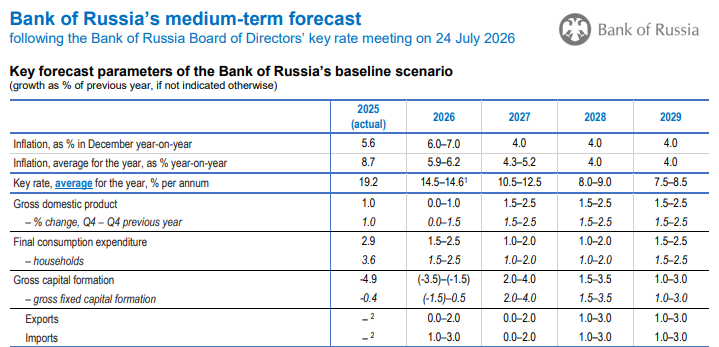
Russian Central Bank: Bank of Russia’s medium-term forecast following the Bank of Russia Board of Directors’ key rate meeting on July 24, 2026; excerpt; July 24, 2026
Current price trends: The annual inflation rate most recently stood at 6.2%
According to the VEB Institute’s weekly report, the annual increase in consumer prices fell to 6.2% in the week ending September 21, compared with 6.3% the previous week. In December 2025, the inflation rate had fallen to just 5.6%, as shown in the following figure. In May 2026, it was even slightly lower at 5.3%. In August, however, it reached 6.3% again compared to the same month the previous year (Finmarket.ru; Trading Economics).
The colored bar segments in the following figure show the contribution of food (light green), non-food items (gray), and services (blue) to the overall increase in consumer prices. The red line shows the rate of change in industrial producer prices.
Year-over-year increase in consumer prices, in percent
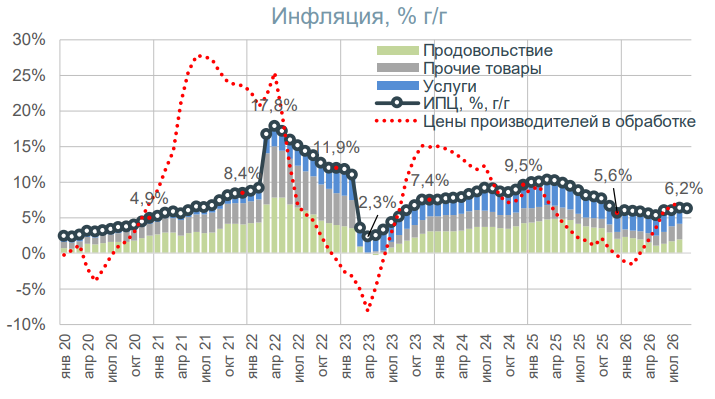
VEB Institute: Global Economy and Markets, Weekly Report, September 25, 26
EBRD: Russia’s Economy Will Continue to Grow Only Very Sluggyly in 2027
Although the London-based development bank EBRD has not supported investments in Russia since the start of the war in Ukraine in 2022, it continues to publish forecasts on the development of the Russian economy. The bank justifies this by noting that developments in the Russian economy have a significant impact on many countries where it operates, particularly in Central Asia and the Caucasus.
Last week, the EBRD lowered its forecasts for Russian economic growth in 2026 and 2027—originally published in early June—by 0.3 percentage points each. In its “Regional Economic Prospects” report, the EBRD now expects GDP growth in Russia to be only 0.5% in 2026. In 2027, it is projected to be barely higher at 0.7%. Furthermore, “downside risks” to these forecasts could arise from further sanctions and renewed damage to Russia’s logistics and energy infrastructure.
Regarding the development of the Russian economy in 2025 and 2026, the EBRD notes in summary:
Russia’s real economic growth fell from 4.9 percent in 2024 to 1 percent in 2025. Against the backdrop of slowing momentum in the private sector, the trend in aggregate economic output became increasingly dependent on public spending, including military spending.
During the first half of 2026, aggregate economic output rebounded in the second quarter with a 1.3 percent increase in real gross domestic product, following a 0.2 percent decline in the first quarter. In contrast, industrial production remained weak. Business sentiment remained subdued.
Although the rise in consumer prices slowed to 6% in July 2026, leading to a cut in key interest rates, price pressures persist due to labor shortages and government spending programs.
High defense spending has led to an increase in Russia’s budget deficit and greater dependence of the budget on domestic borrowing. Thanks to higher oil prices, Russia’s external economic position remained “robust.”
Ukraine’s economy will also grow more slowly in 2026
In Ukraine, the EBRD now expects growth of only 1.5% in 2026—a decrease of 0.7 percentage points compared to the June forecast. The EBRD lowered its forecast for the coming year even more sharply, from 4% to 2.5%.
EBRD: Growth in Ukraine
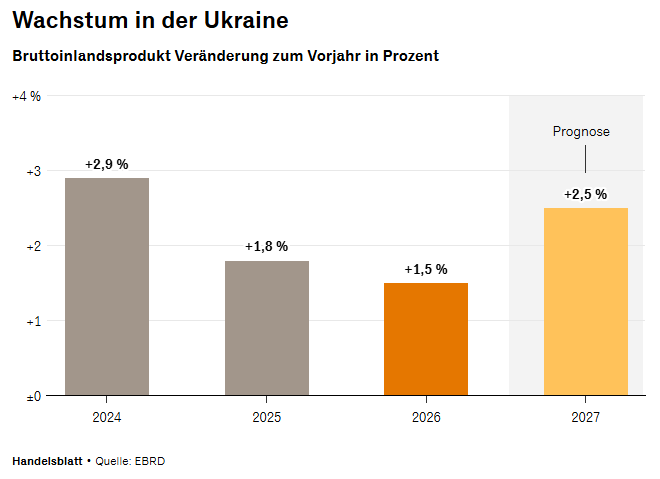
Handelsblatt; C. Volkery: Ukraine. “The Economy Is Plummeting”—Putin’s Attacks Are Ruining Ukraine; Sept. 24, 26
The EBRD cites the blockade of Ukrainian exports via the Black Sea as the main reason for the weaker economic growth in Ukraine. EBRD Chief Economist Beata Javorcik told the Handelsblatt that following Russian attacks on ships and port facilities, Ukraine’s grain and vegetable oil exports plummeted by more than half in August. Exports are at their lowest level since August 2022.
Will Russian currency reserves now be used to benefit Ukraine?
According to the Handelsblatt, there is a new 23 billion euro shortfall in Ukraine’s defense budget this year. The government has proposed various budget consolidation measures to parliament, but there is resistance to tax increases.
EBRD economist Javorcik believes that, ultimately, international lenders remain the only solution to the budget problems. In Kyiv, officials now expect EU member states to bring forward some payments from the 90-billion-euro aid loan for the country. This loan was originally intended to last until the end of 2027. However, it has been apparent for some time that the loan will be exhausted before then.
As a result, some EU member states have initiated renewed discussions about accessing frozen Russian assets. Approximately 200 billion euros in Russian central bank assets are held by the financial services provider “Euroclear” in Belgium. In the long term, there is no other solution than to access the Russian assets to finance Ukraine, says a high-ranking EU diplomat. The alternative would be an additional burden on European taxpayers, and most heads of government want to avoid that, according to the Handelsblatt.
Recommended Reading
German-Russian Chamber of Foreign Trade
- State vs. Business: External Administration and Nationalization of Assets, Sept. 21, 26
- Eastern Economic Forum 2026: Quotes and Results, September 8, 2026
- Consumption Instead of Investment: Potential Growth in Russia Higher Than in Germany, 09/03/26
Podcasts, Videos
- russland.capital: Putin Sees Inflation Under Control—Higher Rates Still Ahead, September 18, 2026; featuring a russland.ru video with German subtitles: Putin Holds Meeting on Economic Issues; September 18, 2026
- “Die Presse” correspondent Stefan Scholl on the news podcast “What Matters”! In conversation with Klemens Patek: Is Putin going all out now? In Russia, everyone is just waiting to see what happens after the elections; with transcript; also on YouTube; 22 min, September 18, 2026
Economic Forecasts
- Tsargrad.Pro: The government expects GDP growth of 1.4% for 2027. However, that is not yet enough to bring the economy up to the global average; September 25, 26
- Finmarket.ru: The Ministry of Economic Development has raised its inflation and GDP growth forecasts for this year; September 24, 26
- Reuters; Darya Korsunskaya: Russia plans a series of tax hikes in 2027–29 to fund military spending; September 24, 2026
- Vedomosti; Ksenia Kotchenko: The Ministry of Economic Development raised its GDP growth forecast for 2026 and maintained it for the next three years. The inflation estimate was also significantly increased due to fuel costs; September 24, 2026
- Kommersant: The Ministry of Economic Development has presented a draft macroeconomic forecast for the period 2027–2029; September 24, 2026
- Russian Government: Government meeting on September 24, 2026; Opening remarks by Prime Minister Mikhail Mishustin; Report by the Minister of Economic Development, Maxim Reshetnikov, on the socioeconomic development forecast for 2027 and the planning period of 2028 and 2029; Report by Finance Minister Anton Siluanov on the draft federal law “On the Federal Budget for 2027 and for the planning period of 2028 and 2029,” September 24, 2026
- German Economic Research Institutes: Joint Economic Assessment, September 24, 2026
- European Bank for Reconstruction and Development (EBRD): EBRD Cuts Growth Forecasts as Energy Costs, Drought, and Food Security Risks Weigh on Its Regions; Regional Economic Prospects; September 24, 2026
- NTV: OECD: Global GDP will grow by 2.9% this year; September 23, 2026
- Finam.ru: The OECD has raised its forecast for global GDP growth this year to 2.9%; includes a table of GDP forecasts; September 23, 2026
- Finmarket.ru: The OECD has raised its forecast for global GDP growth in 2026 to 2.9% and lowered it to 3% for 2027. September 23, 2026
- OECD: OECD Economic Outlook, Interim Report September: Weathering Successive Shocks, September 23, 2026
- Interfax.ru: The president expects Russian GDP growth in 2026 to be within 1%. September 17, 2026
- Interfax.ru: Indexing rates for housing and utilities will increase inflation by 0.7 percentage points, bringing it closer to the upper limit of the Central Bank’s 7% forecast; September 16, 2026
- Institute for Economic Forecasting of the Russian Academy of Sciences (IEF-RAS): Short-Term Analysis of GDP Trends; September 11, 26
- OPEC Secretariat, Vienna: Monthly Oil Market Report, September 10, 26
Fiscal Policy; National Budget
- bne Intellinews, Ben Aris: Russia’s 2027 budget plans a RUB5.5tn deficit as the economy stalls, September 26, 2026
- RBC.ru: Mishustin: Domestic demand will be the main driver of Russian GDP growth; September 24, 26
- Finam.ru: Russia’s budget deficit will amount to about 2% of GDP annually over the next three years. Priorities include social obligations, defense, support for the military, and technological leadership; September 24, 26
- Finam.ru; Elena Aleshina: The budget and its parameters. What is known so far? 09/22/26
- Forbes; Georgy Peremitin: Sberbank forecasts a budget deficit of 1.6 trillion rubles, which exceeds the government’s estimates, 09/22/26
- live.euronext.com; Reuters; Darya Korsunskaya, Elena Fabrichnaya: Russia will have a budget deficit not exceeding 3% of GDP in 2026, says Finance Minister, September 21, 2026
- Vedomosti; Anna Vinogradova: Siluanov: The National Welfare Fund will be replenished by up to 1 trillion rubles by the end of the year; September 21, 2026; Vedomosti; Ksenia Naumchik: Siluanov: The Ministry of Finance has based its calculations on an oil price of $50 per barrel, September 21, 2026
- Yahoo Finance; Reuters: Putin says Russia’s 2027 budget deficit is projected at around 2% of GDP, September 16, 2026
- U24 Media; Katherina Popilnichenko: War in Ukraine. Russia Spends a Record $125 Billion on the Military in the First Half of 2026, Nearly 44% of the Federal Budget, September 9, 2026
- Finam.ru; Olga Belenkaya: Thanks to dividend income, the Ministry of Finance was able to achieve a budget surplus in August, September 9, 2026
Overall Economy
- VEB Institute: Global Economy and Markets, September 25, 26
- Raiffeisenbank; Fokus-Pocus: Industrial production plunged below zero again, September 24, 2026
- Finmarket.ru: Industrial production in Russia fell by 0.6% in August; September 23, 2026
- Politkom.ru; Nikita Maslennikov: Global Economy—Increasing Risks; 09/24/26
- Russia Analyses; Heli Simola (Bank of Finland Institute for Emerging Economies (BOFIT)): Beyond Overall Growth: Russia’s Uneven War Economy; September 22, 2026
- Kommersant, Artem Chugunov: Private Consumption Is Reluctant to Cool Off, September 22, 2026
- The Moscow Times; Tatiana Rybakova: Russia Has a Labor Shortage. So Why Can’t Anyone Find a Job? September 18, 2026
- Kommersant.ru; Artem Chugunov: Industry Has Lost Some of Its Optimism; September 18, 2026
- Finmarket.ru: Putin: Russia’s GDP growth will be within 1% this year; September 18, 2026
Energy Sector, Fuel Supply
- dpa-AFX: Oil prices extend gains significantly—Brent rises above $107, September 24, 2026
- Global Banking & Finance Review: Russia cuts natural gas output and export forecasts; September 23, 2026
- Focus; Lars-Eric Nievelstein: Russia Must Do Without Refineries Producing 290,000 Barrels of Oil Per Day; September 18, 2026
- Frankfurter Rundschau; Bedrettin Bölükbasi: Why the attacks on Russia’s economy play into Putin’s hands – a dangerous strategy? September 16, 26
- rt.com: Giving up Russian gas cost Germany 50 billion euros – media, September 12, 2026
- KSE Institute: Russian Oil Tracker August 2026: Strikes on oil infrastructure and the diesel export ban reduced shipments of crude and oil products through the Black Sea by 26% and 47%, respectively, September 2, 2026
Foreign Trade, Sanctions
- RT.de: Forced Administration of Russian Subsidiaries of European Corporations – Why Now? September 22, 2026
- Tagesschau.de: Swiss food conglomerate Nestlé placed under forced administration in Russia, September 18, 2026
- BBC, Bernd Debusmann: Trump signs sweeping Russia sanctions bill, September 19, 2026
- Charlotte Observer; Patricia Zengerle, Reuters: U.S. House passes Russia sanctions bill championed by Graham, sending it to Trump, September 17, 2026
- RBC.ru: The U.S. House of Representatives has passed Graham’s sanctions bill against Russia. 262 members of Congress voted in favor, 159 against. 09/17/26
- bne Intellinews; Ben Aris: “Russia’s oil refining down, but shortages drive up revenues anyway,” CREA Monthly Report on Fossil Fuel Exports, September 11, 2026
Monetary Policy
- russland.capital: Putin sees inflation under control—higher rates still to come, 09/18/26
- Politkom.ru; Nikita Maslennikov: The regulatory authority took a tactical pause; September 17, 2026
- Interfax.ru: Indexing rates for housing and utilities will increase inflation by 0.7 percentage points, bringing it closer to the upper limit of the Central Bank’s 7% forecast; September 16, 2026
- Kommersant.ru; Artem Chugunov: Stable inflation won’t drop anytime soon; September 16, 2026
- russland.capital: Expensive Gas, Expensive Loans: Russia’s Central Bank Pauses Interest Rate Cuts; with a russland.ru video of the Central Bank’s press conference, September 12, 2026
- russland.news; Video: Central Bank Governor on monetary policy; press conference on the results of the Monetary Policy Committee meeting. Participants include Bank of Russia Governor Elvira Nabiullina and Bank of Russia Deputy Governor Alexei Zabotkin; September 12, 2026.
- bne intellinews, Ben Aris: Russia’s Central Bank Stops Cutting Rates and Blames the Refineries, September 11, 2026
- Finam.ru; Olga Belenkaya: Why did the Russian Central Bank leave the interest rate at 14%? What will determine decisions for the rest of the year? September 11, 2026
- Finam.ru; Olga Belenkaya: The Russian Central Bank expects a pause in key interest rate cuts and a toughening of rhetoric. The regulator has once again failed to send a clear signal regarding future measures. September 11, 2026
- Handelsblatt: Russian Central Bank maintains high key interest rate. 09/11/26
- Bank of Russia: Statement by Bank of Russia Governor Elvira Nabiullina following the Board of Directors meeting on September 11, 2026, September 11, 2026
- Bank of Russia; Press Release: Bank of Russia Keeps Key Rate at 14.00% p.a., September 11, 2026
- Finmarket.ru: Deflation in Russia stood at 0.08% in August. The annual inflation rate accelerated from 5.98% in the previous month to 6.33%; September 11, 2026
State Duma Election; Political Environment
- BR24: Russia (Topic Page)
- fr.de; Newsweek: Putin uses his party’s record victory as a mandate for war – economist Guriev warns against mobilization, September 22, 2026
- The Moscow Times: United Russia Set for Record Majority in Parliament in First Elections During the War, 09/21/26
- Handelsblatt, dpa: Parliamentary Elections in Wartime. Voting in Russia Concludes—How Did Putin’s Party Fare? President Putin Seeks Confirmation of His War Course. September 20, 2026
- The Independent; David McHugh: Putin’s war economy is under strain. One thing is keeping it afloat. Frictions in Russia’s wartime economy are growing; September 19, 2026
- ORF.at, News: Duma election as a Kremlin simulation, September 18, 2026
- CNBC; Sam Meredith, Anniek Bao: Putin braces for election stress test as Russians ‘feel the pain’ of a struggling economy; Sergei Guriev told CNBC that Russians are increasingly feeling the economic pain of the war in Ukraine as growth stalls, taxes rise, and the Kremlin runs a significant budget deficit; September 17, 2026