Metro in Russia: Receivership for a Wholesaler Operating at a Minimal Level
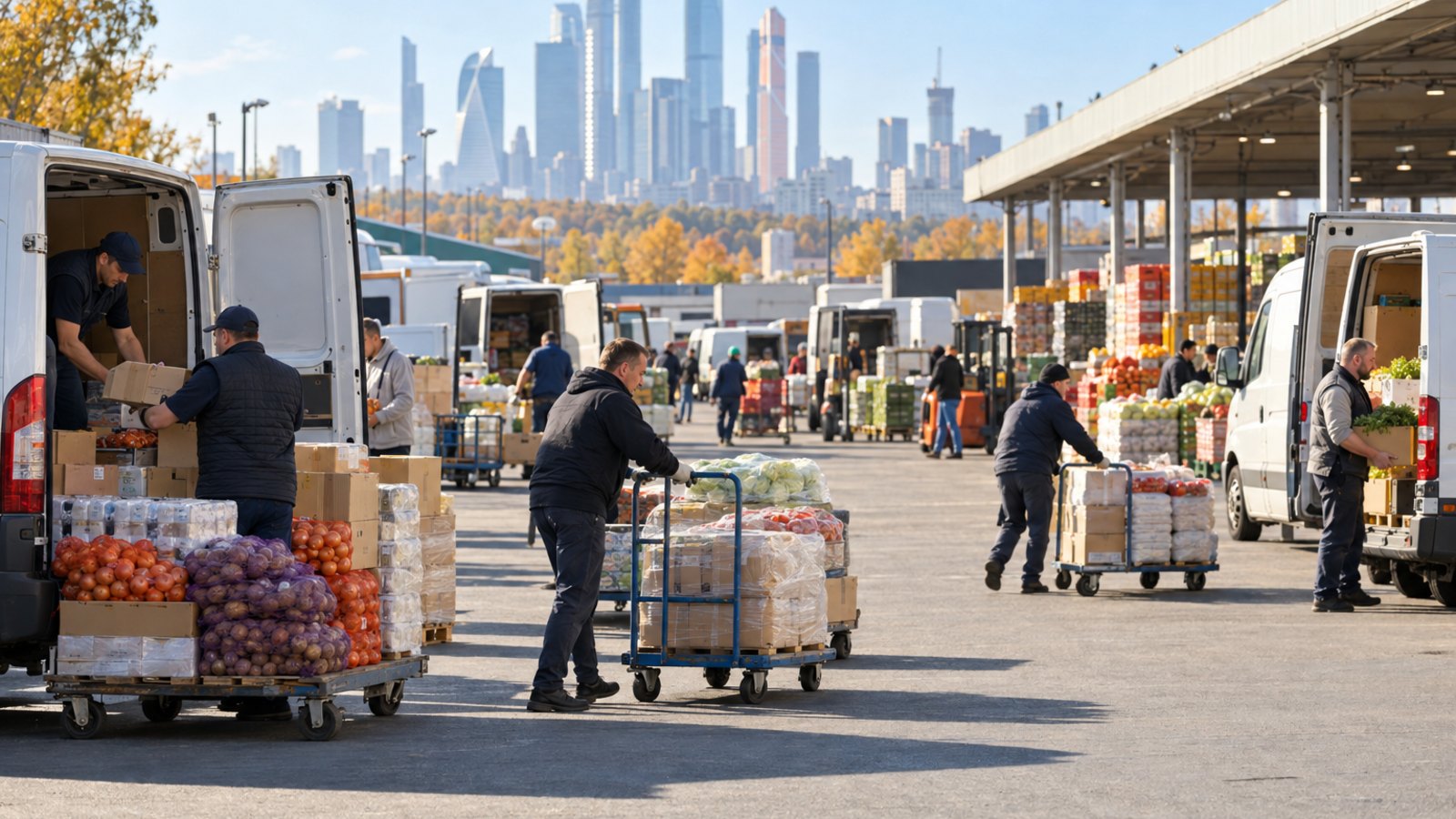
Metro AG has lost control of its Russian operations. A presidential decree dated September 28 places the Russian Metro companies under temporary administration. The administrator is a company owned by Johannes Tholey, the company’s country manager. This affects 91 wholesale markets, approximately 9,000 employees, and annual revenue of 260 billion rubles—about 2.8 billion euros. The figures show a wholesaler that is maintaining its revenue but losing margins and ground to the competition.
The Company’s Own Regional Head Becomes Administrator
Vladimir Putin signed Decree No. 689 on September 28. It supplements the list attached to Decree No. 302 of April 2023, which regulates the temporary administration of foreign assets. Three companies are affected: the retail company OOO Metro Cash and Carry, the logistics subsidiary Metro Warehouse Noginsk, and the real estate company Retail Property 5. The retail company is owned by two Dutch Metro holding companies, which hold 54.45% and 45.55%, respectively.
AO UK Torg Rus will assume management. It was registered on September 8, just under three weeks before the decree was issued. The founder and CEO is Johannes Tholey. He has been leading Metro Russia since March 2023, according to the business newspaper Vedomosti. Previously, he worked for X5 and headed Auchan Russia from 2019 to 2022.
Metro AG stated that ownership formally remains with the group. However, it no longer has “operational control over METRO Russia.” The consequences of the decree are currently being analyzed. Kremlin spokesman Dmitry Peskov justified the move on September 29 by citing the growing involvement of “unfriendly countries” in hostilities against Russia. He noted that the measure is reversible, though the Kremlin currently sees no conditions for doing so.
According to a tally by the RBC news agency, Metro is the 28th foreign corporation whose Russian assets have been placed under temporary administration since April 2023. Eleven of these cases have occurred this year. On September 17, the measure affected Auchan, Nestlé, FM Logistic, and Lemana Pro, the former Leroy Merlin chain. In those cases, the state appointed an external management company. At Metro, the company’s own management remains in place.
Olga Sorokina of the consulting firm O2 Consulting therefore describes this to Vedomosti as a “softer transition of corporate control.” She does not see this as preparation for a sale. Attorney Alexander Bayev of the law firm Kosenkov and Suvorov sees the purpose elsewhere. According to Bayev, the model limits the influence of foreign owners on corporate decisions and profit distribution. It does not interfere with day-to-day operations.
In Düsseldorf, the decree coincides with a leadership change. On September 23, Metro announced that CEO Steffen Greubel would step down effective September 30. Starting October 1, CFO Eric Riegger will lead the group, according to Wirtschaftswoche.
260 billion rubles in revenue, 1.7% net margin
The Russian Metro subsidiary increased its revenue by 4.1% in 2025 to 260.3 billion rubles (approximately 2.8 billion euros). Net income fell by 32.1% to 4.4 billion rubles (approximately 47 million euros), according to the financial service Finmarket, based on Russian accounting standards. Gross profit rose by only 2.6% to 55.9 billion rubles. By contrast, selling expenses grew by 10.8% to 48 billion rubles. Profit from sales operations fell by 29% to 7.9 billion rubles.
The financial statements in the state balance sheet register GIR BO show the longer-term trend. In 2021, Metro generated 221.2 billion rubles in revenue in Russia and earned 14.1 billion rubles. By 2025, revenue had risen by 18%. According to Rosstat, consumer prices rose by just under 40% during the same period. In real terms, therefore, the business contracted. Profit fell by 69%.
With a net margin of 1.7%, Metro ranked at the lower end of the major grocery retailers in 2025, according to an analysis by the research firm INFOLine. X5 posted a margin of 2%, Lenta 3.5%, and Globus 5.5%. Of the other reported chains, only the discount retailer Swetofor had a lower margin at 1.5%. Magnit reported a loss.
Metro AG reports Russia as a separate segment. Its fiscal year ends on September 30. In fiscal year 2024/25, Russia generated 2.6 billion euros in revenue, accounting for 8% of consolidated revenue, according to the annual report. Adjusted EBITDA has fallen from 231 million to 135 million euros since 2021/22. The margin thus dropped from 8% to 5.2%. Nevertheless, Russia contributed a solid 11% of the group’s adjusted EBITDA.
In the first nine months of 2025/26, revenue in Russia (in euros) grew by 10.3% to 2.14 billion euros. This increase was almost entirely due to exchange rate effects. In rubles, Metro grew by only 1%, while food inflation recently stood at around 5%. For the full year, Metro expects revenue in Russia to remain at the prior-year level and EBITDA to be slightly lower.
Hardly any money is flowing back to Germany. The Russian subsidiary paid a total of 38 billion rubles in dividends to its owners in 2022 and 2023. It had approved a total of 58.4 billion rubles. According to the financial statements, no cash dividends have been paid since 2024. Metro AG states that capital transactions with group companies outside Russia require regulatory approval. As of the end of June 2026, the Russian subsidiaries held 152 million euros in cash.
Ranked 9th, Growth Below Market Average
In the first half of 2026, Metro generated 118.8 billion rubles in revenue, up 0.5% from the previous year. This is shown in a ranking by INFOLine published by the newspaper Kommersant. Metro thus ranks 9th among the largest food retailers. The top 10 grew collectively by 11.6% to 6.76 bio rubles. In the second quarter, Metro’s revenue rose by 1.3% to 62.1 billion rubles, INFOLine CEO Mikhail Burmistrov told Vedomosti.
The gap to the top is wide. Market leader X5 increased its revenue by 10.5% to 2.48 trillion rubles in the first half of the year, the company reported. Magnit grew by 12.8% to 1.89 trillion rubles. Lenta’s revenue rose by 26.2% to 648.5 billion rubles due to acquisitions. Among the growing chains in the top 10, none grew as slowly as Metro. Svetofor and Auchan saw their revenue decline.
The store network is shrinking. Metro currently lists 91 wholesale stores in 51 regions. As of September 30, 2025, the annual report still listed 93; the number remained unchanged for three years. In June 2025, Metro announced it would close one market each in Omsk and Vologda. The company cited the priority of delivery as the reason.
Greubel described this approach in the *Handelsblatt* in September 2024: “We are no longer making strategic investments there; the business is isolated.” He continued: “We’re keeping it on the back burner.” At the time, he also warned: “There’s a high risk that we’d be forced out if we were to make our withdrawal plans public.”
The format itself is under pressure. Hypermarkets grew by only 0.1% in the first quarter of 2026, according to INFOLine. In June, Lenta acquired O’Key’s 75 hypermarkets. As a result, Lenta now controls 41.5% of the segment, up from 33.2%.
Competition from Three Sides
The cash-and-carry competitor Selgros has disappeared from the market. Its Russian subsidiary was sold to the Arosa-Logistika Group in December 2024. By mid-2025, it had closed all of its hypermarkets. In July 2026, the consulting firm Molga filed for the company’s bankruptcy.
Lenta is making the most direct inroads into the business customer segment. Its Lenta Pro program had approximately 200,400 business customers at the end of 2024, 23% more than the previous year. Metro itself reports more than 300,000 business customers and over 5 million retail customers.
The second front is marketplaces. B2B marketplaces and online stores generated approximately 2 billion rubles in revenue in 2025—11.1% more than the previous year—according to estimates by the consulting firm Strategy Partners. Wildberries opened its platform to all businesses in June 2025. The number of business customers subsequently grew 2.2-fold within three months. Ozon counts the restaurant, hotel, and retail industries among its most important corporate customers—exactly Metro’s target customers.
INFOLine attributed Metro’s weaker growth in the third quarter of 2025 to a slowdown in B2B business. This was compounded by declining online sales to retail customers via the Kuper delivery service. Metro is countering this with its own delivery service. Delivery revenue in Russia rose from 492 million euros in fiscal year 2021/22 to 685 million euros in 2024/25. That represents a good quarter of the country’s total revenue. According to Metro, the online share already exceeded 31% in the first quarter of 2025/26.
The third front is independent retail. Metro supplies more than 126,000 traditional retailers and over 1,200 partners of the Fasol franchise brand, said Operations Director Olga Parshina in September. According to Parshina, the segment is shrinking, but Metro is growing there by more than 5%. Competition is intensifying. According to INFOLine, the X5 franchise Okolo generated 66 billion rubles in revenue in 2025—7.8 times the previous year’s figure—and opened 3,251 stores. Awokado, the franchise of distributor Sladkaya Zhizn, generated 65.7 billion rubles in revenue. Fasol grew by 3.8%.
Metro is responding with a restructuring. Through agreements with major food manufacturers, Metro is acting as their official distributor for independent retailers. Fasol partners will be managed by key account managers going forward. Parts of the infrastructure will be eliminated, Parschina said.
Customers Under Tax and Cost Pressure
Metro generates more than half of its revenue from small and medium-sized businesses, Parschina said in November 2025. These customers are directly affected by the tax reform. Since January, a 22% VAT rate has been in effect instead of 20%. For many staple foods, the rate remains at 10%. At the same time, the revenue threshold below which companies in the simplified USN tax system do not pay VAT has been lowered. In 2026, it stands at 20 million rubles instead of 60 million rubles and will drop to 10 million rubles by 2028. Many business owners temporarily suspended their operations to stay below the thresholds, Parshina said.
The number of companies is shrinking. Since the beginning of the year, 12,000 to 15,000 companies have been closing each month for economic reasons, Kommersant reports, citing the Sber Center for Macro Research. That’s about three times as many as in previous years. For the first time in at least nine years, there are more closures than new business start-ups.
The restaurant industry is also growing more slowly. Its revenue rose by 6.2% to 3.45 bio rubles from January through July 2026, the TASS news agency reported, citing Rosstat. In July, the increase was only 5.1%. Loans remain expensive for small businesses. Following the Central Bank’s meeting on September 11, the key interest rate stands at 14%.
What Metro Russia Is Worth
Burmistrov values the Russian business at 75 to 80 billion rubles, or roughly 780 to 830 million euros. Olga Sumishchevskaya of the consulting firm One Story puts the figure at 50 to 80 billion rubles, according to Kommersant. By way of comparison: Annual revenue in 2025 was 260 billion rubles.
Real estate forms the core of the business. Metro owns 89 of the 93 locations at that time, Greubel said in 2024. The real estate is valued at a three-digit million amount on the balance sheet. Long-term segment assets in Russia stood at 548 million euros as of September 30, 2025. According to its own statements, Metro has reduced its ties to its Russian subsidiary since 2022. Denis Astafyev of SharesPro told Kommersant that the key risk is access to the brand, IT systems, international procurement, and the group’s expertise.
The accounting treatment remains unclear. If a parent company loses control over a subsidiary, IFRS 10 requires deconsolidation. Metro AG has not yet commented on this. Its fiscal year ends on September 30—the same day as Greubel’s term in office.
The German competitor Globus is taking a different approach. Its Russian subsidiary increased revenue by 5% in 2025 to 165.6 billion rubles. Net income grew by 12% to 7.4 billion rubles. With 22 stores, Globus thus earns more than Metro, which has 91. In April, Globus announced a new hypermarket in Tula for the summer. Another one is scheduled to open in Selenograd starting in 2027.
Sources: Metro AG 1, 2, 3; GIR BO; Pravo.gov.ru; INFOLine 1, 2; Kommersant 1, 2, 3, 4; Vedomosti 1; Retail.ru 1, 2, 3; Finmarket (all RU sources except Metro AG)