Europe's Trade with Russia: From the Pipeline Business to the Phase-Out of Gas
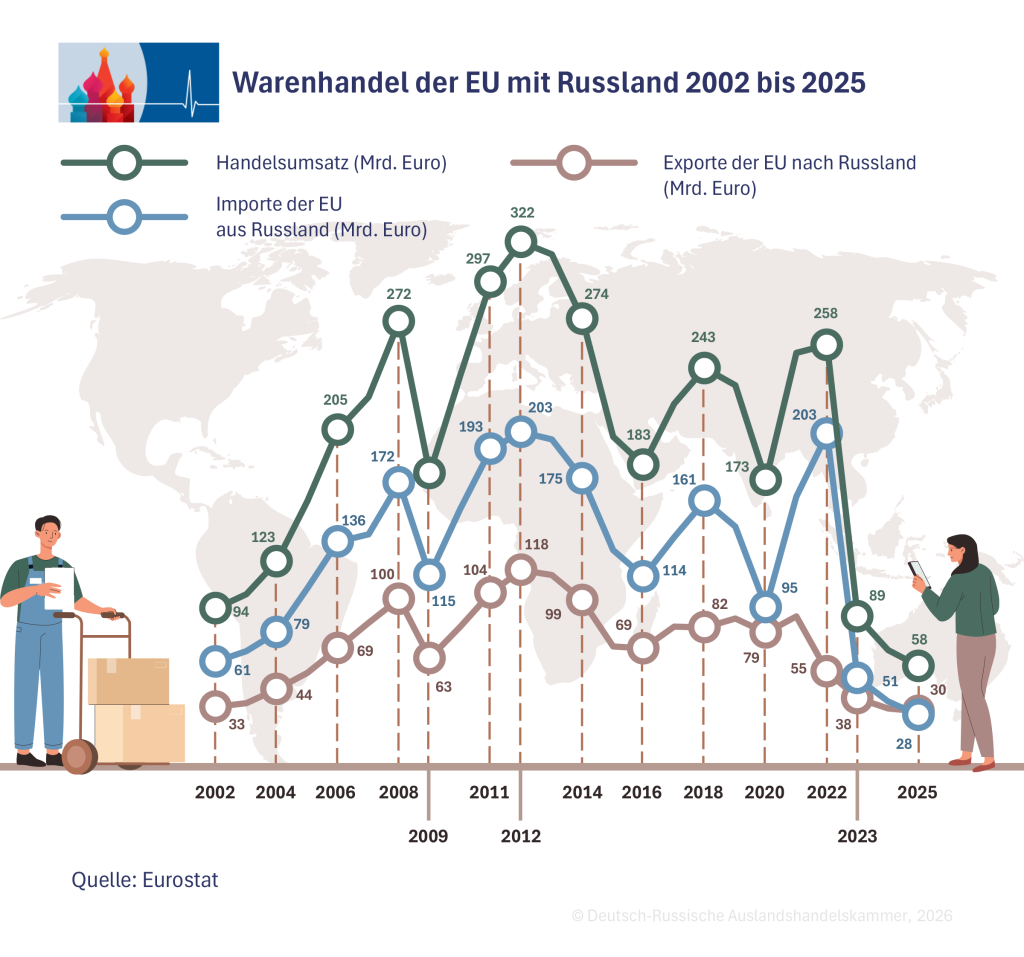
For more than three decades, the EU was Russia’s most important trading partner. In the record year of 2012, the two sides traded goods worth 321.5 billion euros; by 2025, that figure had fallen to just 58.3 billion euros—less than one-fifth of the previous amount. Russia’s ranking among the EU’s trading partners dropped from fifth to 19th.
After the collapse of the Soviet Union, Western Europe became Russia’s main trading partner. In 2008, the EU accounted for 52.3% of Russia’s foreign trade. Sanctions, counter-sanctions, and the ruble crisis weighed on trade starting in 2014. Between 2021 and 2025, it shrank by more than three-quarters. In 1986, West Germany was the Soviet Union’s largest Western trading partner; in 2025, Germany remains Russia’s largest trading partner within the EU. However, Germany’s share of trade fell from 22% in 2021—the year before the crisis—to 13% of EU trade with Russia.
Soviet Era: Tubes for Gas, Cars from Togliatti
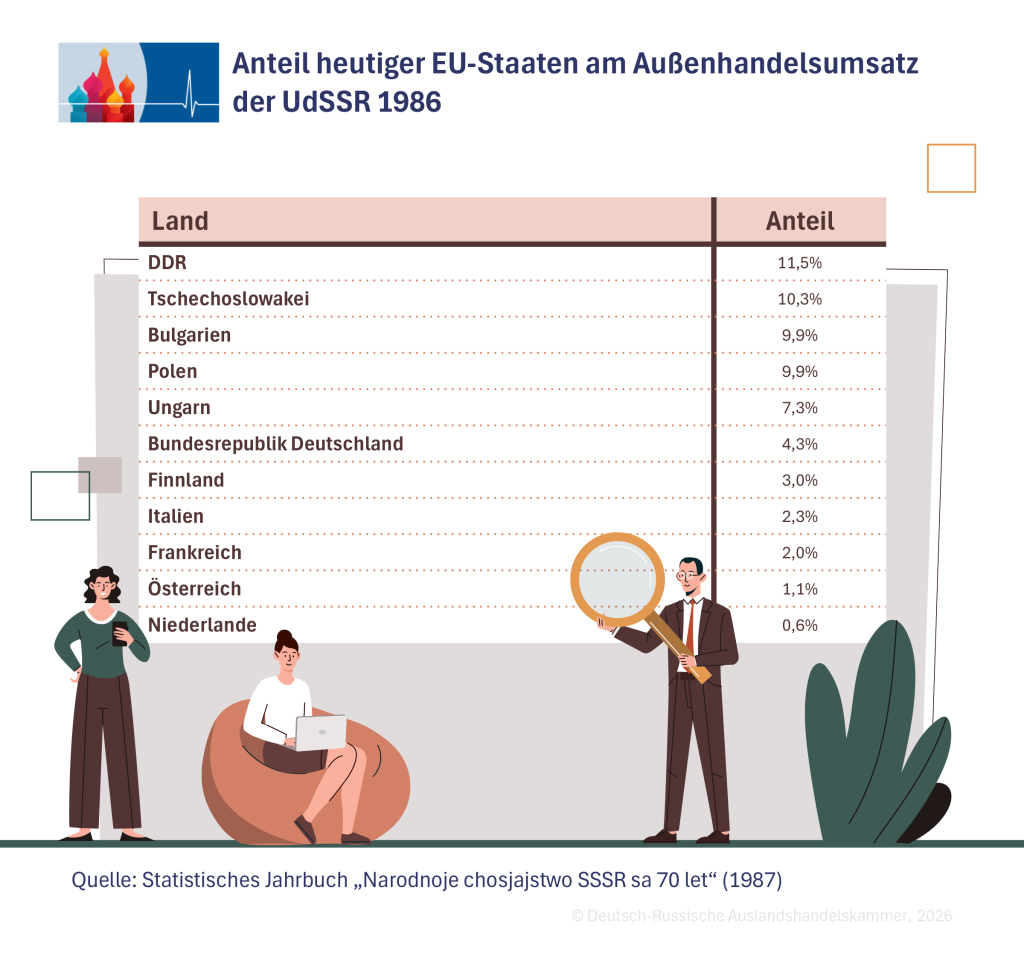
The Soviet Union conducted the majority of its foreign trade with the socialist states of Eastern Europe; in 1986, the most important partner was the GDR, accounting for 11.5% of trade volume. Among Western countries, West Germany led with 4.3%, ahead of Finland (3.0%), Italy (2.3%), France (2%), and Austria (1.1%), according to the Soviet anniversary yearbook “The Economy of the USSR in 70 Years.”
In trade with the West, Italy and Austria were among the pioneers. On August 15, 1966, the Italian automaker Fiat signed a contract to build a car plant on the Volga River. In April 1970, the first WAZ-2101 cars—a replica of the Fiat 124—rolled off the assembly line in Togliatti.
On June 1, 1968, Austria became the first Western European country to sign a gas agreement with the USSR. Three months later, the first gas began flowing, according to the energy company OMV. In December 1969, Italy’s state-owned company ENI agreed to supply 6 billion cubic meters per year over 20 years; the first gas flowed in May 1974.
The Federal Republic of Germany followed suit on February 1, 1970, with the natural gas pipeline deal. The German side committed to supplying more than 1 million metric tons of large-diameter pipes, while Moscow pledged to supply 3 billion cubic meters of gas annually, according to the German Committee on Eastern European Economic Relations. The first Soviet gas reached both German states in 1973. By 1980, deliveries had risen to 10.7 billion cubic meters for the Federal Republic and 6.5 billion cubic meters for the GDR. Finland has been using Soviet natural gas since January 1974, and France has been receiving it since 1976.
On November 20, 1981, Ruhrgas signed a contract in Essen for long-term deliveries from Siberia. Washington lifted a U.S. embargo against European suppliers in 1982 after five months. In January 1984, the first gas flowed through the 4,451-kilometer-long Urengoy–Pomary–Uzhhorod pipeline to Europe, according to the RIA Novosti news agency.
Finland had the closest economic ties to the Soviet Union. The two countries settled their trade through a bilateral clearing system, meaning they did not use freely convertible currencies. From 1952 to 1980, the USSR accounted for about 15% of Finnish exports. “Finland is the only country of its kind for which the USSR was, at least at times, the most important trading partner,” writes Pekka Sutela of the BOFIT Institute for Eastern European Studies at the Bank of Finland. The share of exports reached a record high of just under 27% in 1982. On January 1, 1991, the Soviet Union ended the clearing arrangement.
From 1991 to 2013: The EU Is Russia’s Most Important Partner
“Since the collapse of the USSR, the European Union has been Russia’s number one trading partner,” explains Russian economist Valery Sumarokov. On December 1, 1997, the Partnership and Cooperation Agreement between the EU and Russia entered into force.
With the enlargements of 2004 and 2007, the countries of Central and Eastern Europe, including the Baltic states, joined the EU. The EU’s share of Russia’s foreign trade rose from less than 37% in 2000 to 52.3% in 2008.
According to data from Eurostat, the EU’s statistical office, trade between the current 27 EU member states and Russia grew from 94.1 billion euros in 2002 to 272.3 billion euros in 2008—nearly tripling. In 2009, the year of the global financial crisis, it fell to 178 billion euros. Trade reached a record high in 2012 at 321.5 billion euros: The EU exported goods worth 117.9 billion euros and imported goods worth 203.6 billion euros. On August 22 of that same year, Russia joined the World Trade Organization (WTO).
At the same time, infrastructure expanded. Beginning in 1999, the Russian gas monopoly Gazprom supplied gas via the Yamal–Europe pipeline through Belarus and Poland. On November 8, 2011, German Chancellor Angela Merkel and then-Russian President Dmitry Medvedev inaugurated the Nord Stream Baltic Sea pipeline in Lubmin; with the addition of a second line in 2012, it reached a capacity of 55 billion cubic meters.
Crimea Shock: Sanctions, the Ruble Crisis, and Withdrawal
On July 31, 2014, the Council of the EU adopted its first sectoral sanctions against Russia in response to Crimea’s annexation by Russia. The sanctions restricted major state-owned banks’ access to the European capital market. They also banned the supply of technology for deep-sea, Arctic, and shale oil production. Moscow struck back a week later: With Government Decree No. 778 of August 7, 2014, Russia banned the import of meat, dairy products, fish, fruits, and vegetables from the EU. EU agricultural and food exports to Russia fell by half, from 11.6 billion euros in 2013 to 5.3 billion euros in 2015. Poland was hit the hardest, with a decline from 1.25 billion to 0.4 billion euros, followed by Lithuania, which fell from 1.37 billion to 0.49 billion euros. German agricultural exports fell from 1.59 billion to 0.87 billion euros.
At the same time, oil prices fell, and the ruble plummeted. On December 16, 2014, the Russian Central Bank raised the overnight policy rate from 10.5% to 17%. On an annual average, the euro appreciated from 42.4 rubles in 2013 to 68 rubles in 2015, according to the Central Bank’s official exchange rates. As a result, European goods became 60% more expensive for Russian buyers. EU exports to Russia fell from 114.8 billion euros in 2013 to 69.3 billion euros in 2016. Machinery exports fell from 25.8 billion to 15.0 billion euros, while vehicle exports dropped from 14.8 billion to 6.6 billion euros. Overall, trade between 2013 and 2016 shrank from 313.9 billion euros to 183.2 billion euros.
The Russian auto market plummeted by 36% in 2015 to 1.6 million vehicles. On March 18, 2015, the American company General Motors completely withdrew its then-subsidiary Opel from Russia and shut down the plant in St. Petersburg.
A number of German companies also withdrew after 2014. The number of companies with German capital participation fell by 7% in 2015 to 5,580.
2017 to 2021: Investments Despite Sanctions
Starting in 2017, trade began to grow again. EU trade with Russia rose from 183.2 billion euros in 2016 to 243.2 billion euros in 2018, according to Eurostat data. In 2020, the year of the COVID-19 pandemic, trade fell to 173.8 billion euros, but then rebounded to 252.8 billion euros in 2021.
The largest investments went toward energy projects. The French company Total, now TotalEnergies, held a 20% stake in Yamal LNG. The project has been exporting liquefied natural gas from the Arctic since late 2017. In May 2018, Total purchased an additional 10% stake in the follow-up project, Arctic LNG 2, which has a planned capacity of 19.8 million metric tons per year. Through its approximately 19% stake in the operator Novatek, the group held an effective economic interest of about 21.5% in the project. On December 1, 2017, the Austrian company OMV acquired a 24.99% stake in the West Siberian Yuzhno-Russkoye gas field from Uniper for 1.72 billion euros. In April 2017, Uniper, Wintershall, OMV, Engie, and Shell each committed up to 950 million euros to Nord Stream 2, together covering half of the estimated costs of 9.5 billion euros.
The automotive industry also expanded its presence. In late 2016, Renault acquired a majority stake in Russia’s largest automaker, AvtoVAZ, through a capital increase.
On April 3, 2019, Daimler opened its first Mercedes plant near Moscow in the presence of President Vladimir Putin. The company invested more than 250 million euros in a plant with an annual production capacity of 25,000 to 30,000 cars. Under a special investment agreement, the Swabian automaker was granted a 0% corporate tax rate through 2025.
According to the Bundesbank, German direct investment reached more than 3.2 billion euros in 2018—the highest level since 2008. The previous year, the figure was 1.6 billion euros, and in 2019, 2.1 billion euros were invested. Nevertheless, the number of German companies in Russia continued to decline, standing at 3,651 at the end of 2021—42% fewer than in 2011.
In 2021, the EU remained the largest trading partner, accounting for 35.9% of Russia’s foreign trade. Germany accounted for 7.3%, the Netherlands for 5.9%, and Italy for 4%, according to an analysis by the consulting network FinExpertiza cited by the Russian business newspaper RBC.
Since 2022: Trade at its lowest level since 1999
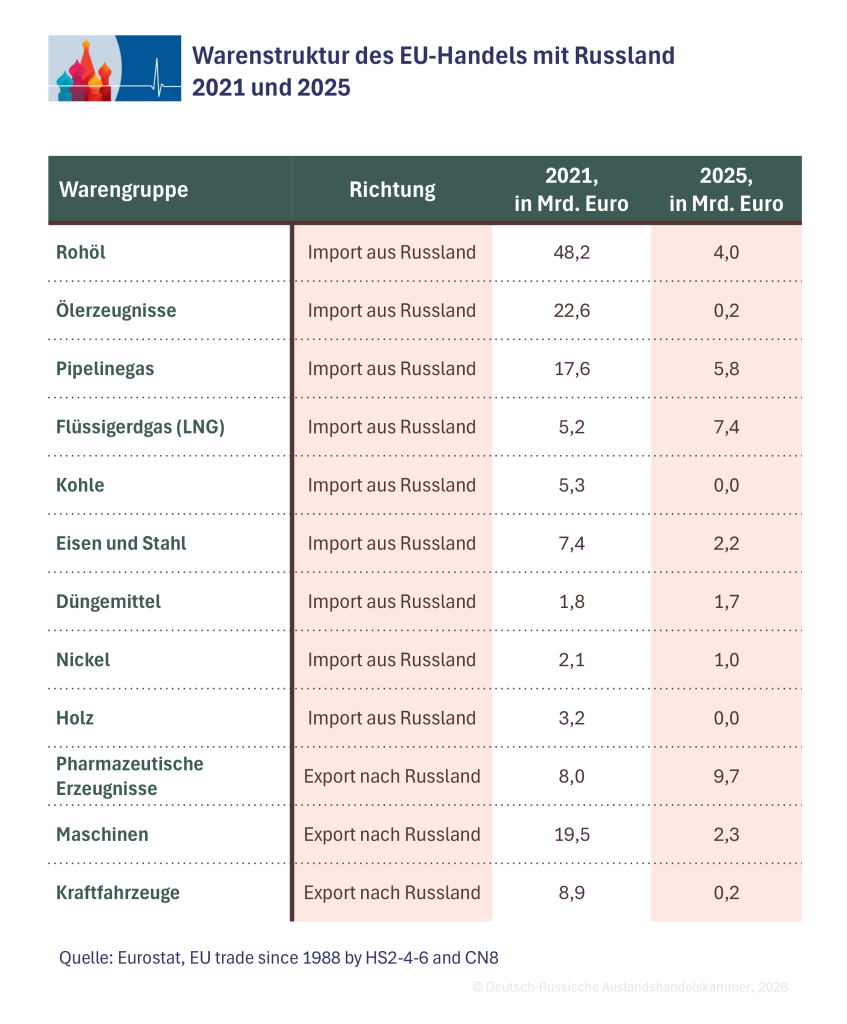
In 2022, two-way trade between Russia and the EU rose to 257.6 billion euros due to high energy prices. It then plummeted: to 89.1 billion euros in 2023, 68.2 billion euros in 2024, and 58.3 billion euros in 2025. Crude oil imports from Russia fell from 48.2 billion euros in 2021 to 4 billion euros, while imports of liquefied natural gas rose from 5.2 billion to 7.4 billion euros. Conversely, pharmaceutical exports grew to 9.7 billion euros, while machinery exports fell from 19.5 billion to 2.3 billion euros.
In the first half of 2026, trade in goods between Russia and the EU fell by 13% to 26.9 billion euros. This is the lowest half-year figure since 1999, according to calculations by the daily newspaper Kommersant based on Eurostat data. Russia exported goods worth 12.2 billion euros to the EU. The EU exported goods worth 14.8 billion euros to Russia, resulting in a trade surplus of 2.6 billion euros. Germany remained the largest trading partner with 3.8 billion euros, ahead of France, Belgium, the Netherlands, and Hungary.
Russian exports continued to plummet: crude oil by 51%, iron and steel by 43%, and fertilizers by 74%. EU exports, by contrast, remained nearly stable with a decline of 1.3%, as pharmaceutical shipments rose by 21% to 5.7 billion euros.
German-Russian Trade: 90% Drop Since 2012
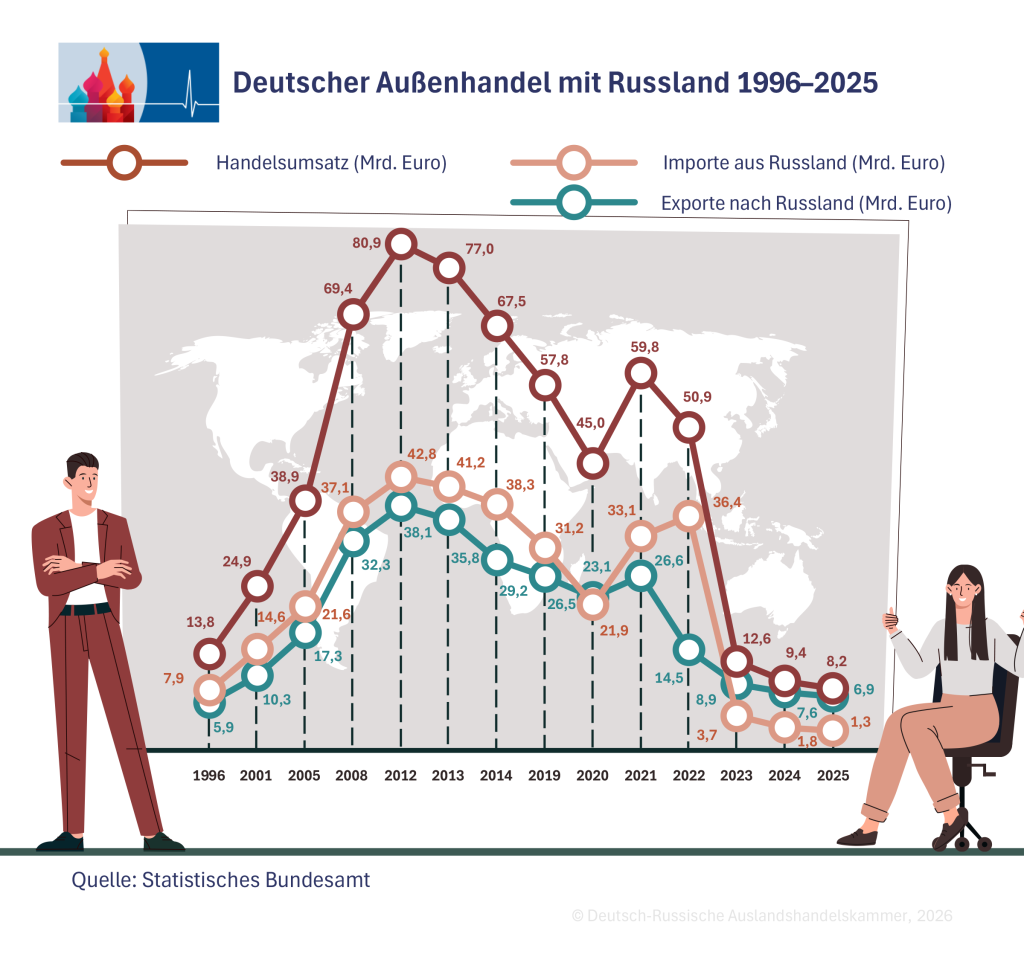
German-Russian trade grew from 13.8 billion euros in 1996 to 24.9 billion euros in 2001 and 69.4 billion euros in 2008, according to data from the Federal Statistical Office. Trade peaked in 2012 at 80.9 billion euros. At that time, Germany exported goods worth 38.1 billion euros to Russia and imported goods worth 42.8 billion euros. Russia accounted for 4.1% of Germany’s foreign trade, according to the Federal Statistical Office.
In 2014, the year the EU imposed its first sector-specific sanctions, trade volume fell to 67.5 billion euros, and in 2020—the year of the COVID-19 pandemic—it dropped to 45 billion euros. By 2021, it had recovered significantly to 59.8 billion euros, and Russia ranked 13th among Germany’s trading partners, according to data from the German Committee on Eastern European Economic Relations. Oil and gas accounted for 59% of imports, totaling 19.4 billion euros. The most important export goods were machinery, at 5.8 billion euros, and motor vehicles and parts, at 4.4 billion euros.
Exports fell by 45% to 14.5 billion euros in 2022, while imports rose to 36.4 billion euros due to high energy prices. Germany recorded a trade deficit with Russia of 21.8 billion euros. A year later, bilateral trade plummeted to 12.6 billion euros, and Russia fell from 14th to 38th place among Germany’s trading partners. This was followed by 9.4 billion euros and 45th place in 2024, as well as 8.2 billion euros and 48th place in 2025. Exports fell by 9% to 6.9 billion euros in 2025, while imports dropped by 31% to 1.3 billion euros. In the first half of 2026, Russia slipped to 49th place. Exports fell by 2.8% to 3.4 billion euros, while imports dropped by 23% to 0.5 billion euros.
The composition of trade has also changed significantly. The most important export commodity today is pharmaceuticals, totaling 2.5 billion euros—36% of shipments in 2025 and 6.6% more than in the previous year. Machinery totaled 0.8 billion euros, 87% less than in 2021. Among imports, metals lead the way at 0.42 billion euros, just ahead of food and animal feed at 0.38 billion euros. Oil and gas from Russia now appear in German statistics at only 1.5 million euros.
Germany Remains in the Lead, Other Gas Importers Gain Ground
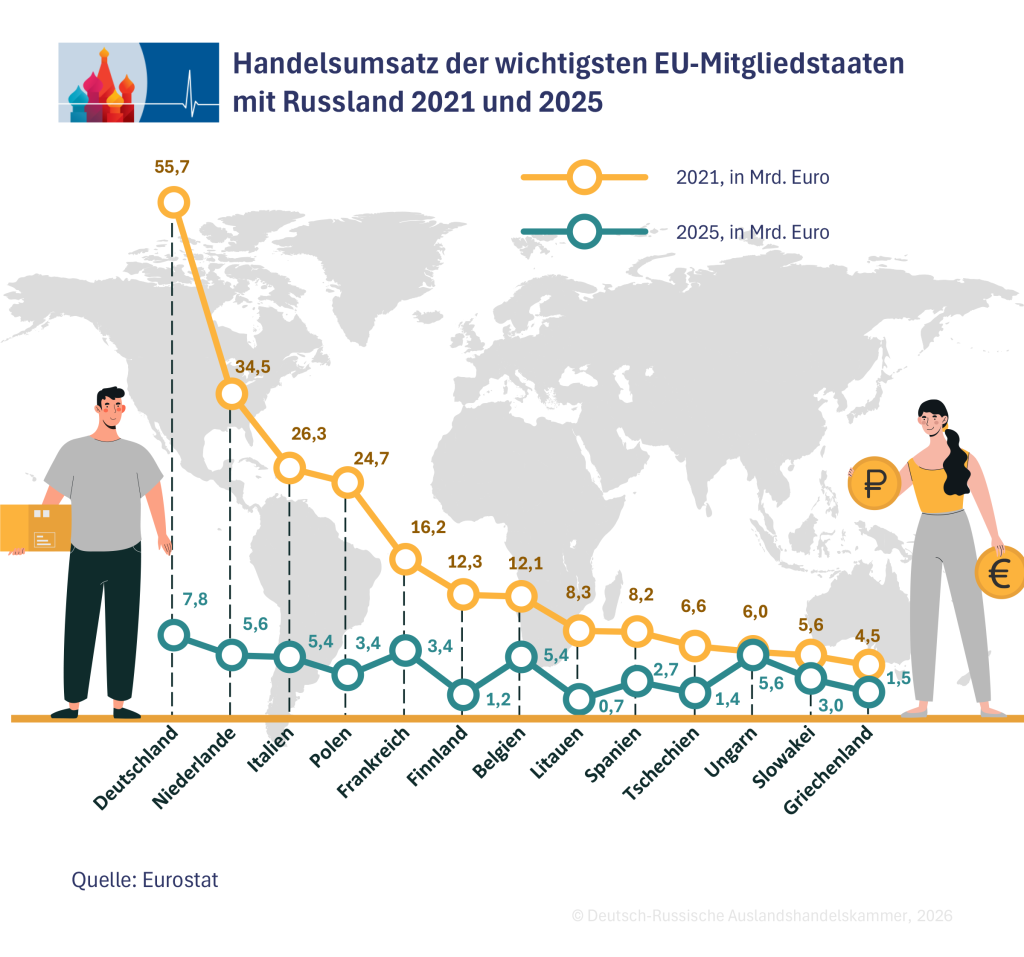
In 2021, Germany accounted for 22% of EU-Russia trade, totaling 55.7 billion euros. It was followed by the Netherlands at 34.5 billion euros, Italy at 26.3 billion, Poland at 24.7 billion, and France at 16.2 billion euros. Behind them were Finland (12.3 billion), Belgium (12.1 billion), Lithuania (8.3 billion), Spain (8.2 billion), and the Czech Republic (6.6 billion euros).
According to Eurostat, Germany remained Russia’s most important EU trading partner in 2025, with 7.8 billion euros and a 13% share of trade between Russia and the EU. The Federal Statistical Office, which classifies imports by country of origin, puts the figure at 8.2 billion euros. France moved up from fifth to second place with 6.1 billion euros, and Hungary moved up from eleventh to fourth place with 5.6 billion euros. Next are the Netherlands (5.6 billion), Belgium and Italy (5.4 billion each), Poland (3.4 billion), Slovakia (3.0 billion), Spain (2.7 billion), and Greece (1.5 billion euros). Hungary’s trade with Russia is only 7% below the 2021 level.
In 2025, France imported goods worth 4 billion euros from Russia and exported goods worth 2.1 billion euros. Hungary recorded 4.7 billion euros in imports and 0.8 billion euros in exports, while Slovakia recorded 2.8 billion euros in imports and 0.2 billion euros in exports. Italy and Germany, on the other hand, are primarily exporters: Italy exported goods worth 3.7 billion euros and imported goods worth 1.6 billion euros, while Germany exported goods worth 6.9 billion euros and imported goods worth 0.9 billion euros.
Gas accounts for the bulk of EU imports. In June 2026, Belgium purchased Russian gas worth 268 million euros, France 258 million, and Hungary 218 million euros. Hungary and Slovakia are the only EU countries that receive pipeline gas. Eurostat records an import in the EU country where the goods enter free circulation within the Union. If regasified LNG is transported further, it is therefore considered intra-EU trade. The German state-owned company SEFE, formerly Gazprom Germania, also has liquefied natural gas from its contract with Yamal LNG unloaded at European ports. In German import statistics, oil and gas from Russia will appear in 2025 at only 1.5 million euros.
The sharpest declines in trade are being recorded by Russia’s immediate neighbors. Finland’s trade fell from 12.3 billion to 1.2 billion euros, Lithuania’s from 8.3 billion to 0.7 billion, and Poland’s from 24.7 billion to 3.4 billion euros.
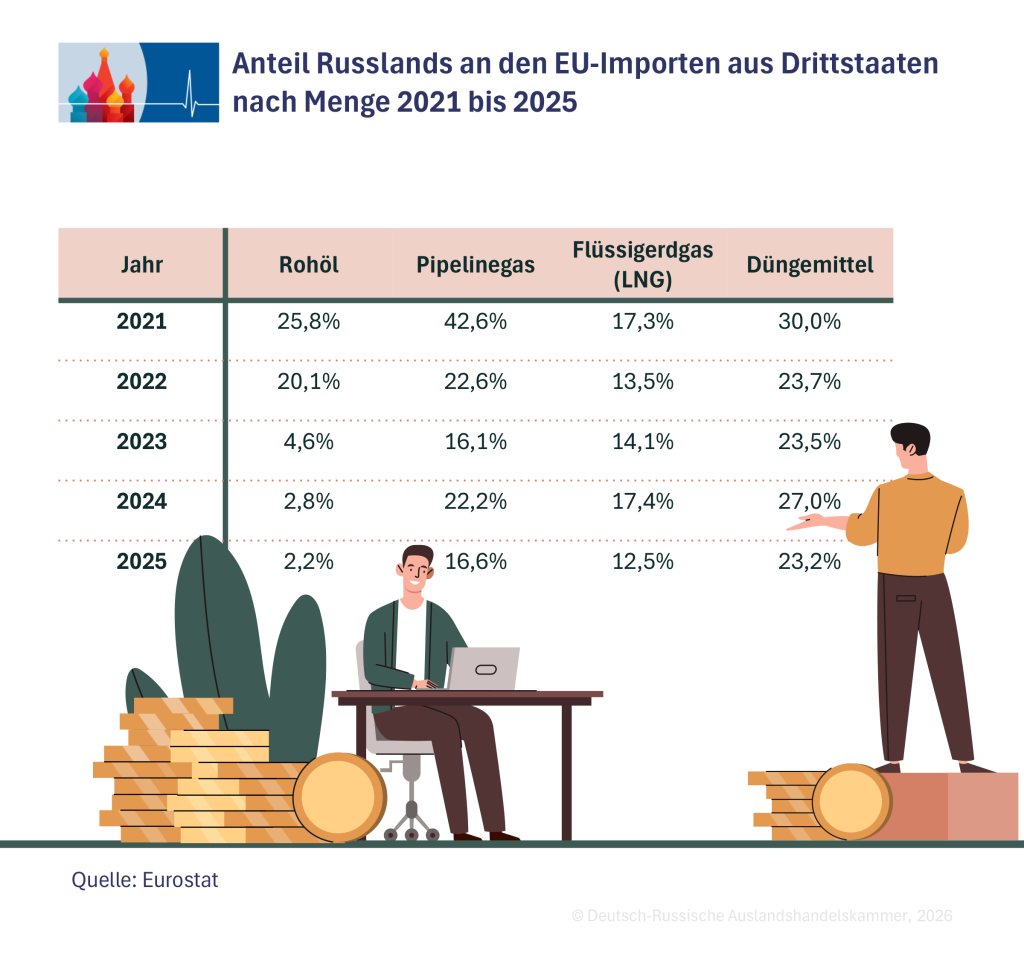
According to the Council of the European Union, Russia’s share of the EU’s gas imports fell from 45% in 2021 to 13%, and its share of oil imports fell from 27% to less than 3%. In the first half of 2026, LNG imports remained at the previous year’s level at 4.5 billion euros, while pipeline gas imports fell by 10% to 2.9 billion euros.
With the gas ban, nearly half of the EU’s remaining imports from Russia will be eliminated in 2027. Meanwhile, Moscow is shifting its foreign trade eastward. In 2025, Asia accounted for 73.4% of Russia’s foreign trade, while Europe accounted for 18.6%, according to the Interfax news agency. Prime Minister Mikhail Mishustin even put the share of foreign trade in September accounted for by countries classified as “friendly” and not imposing sanctions on Russia at 85%.
Source: German-Russian Chamber of Foreign Trade, Europe’s Trade with Russia: From the Pipeline Business to the Gas Phase-Out, October 1, 2026.
This article was prepared for the German-Russian Chamber of Foreign Trade.