Turkish Diesel Prices Under Pressure

The tax buffer for diesel prices in Turkey has been exhausted. Since March 20, the special consumption tax (ÖTV) on diesel has been zero—meaning that, for the first time, price increases are being passed on to consumers without any cushion.
This is due to the sharp rise in oil prices and refining margins. Just a few days after the tax adjustment, another price increase of 6.6 lira per liter was announced. The tax mechanism previously used to cushion the costs is therefore no longer effective.
In early March, the government had still been trying to dampen price pressure through the so-called “Echelle-mobile” system. Under this system, 75 percent of price increases were offset by lower taxes. But this leeway has now been exhausted.
Before the adjustment, the diesel tax stood at 13.90 lira per liter. With this buffer now completely eliminated, international price fluctuations are directly impacting prices at the pump.
Prices Are Rising Rapidly
The consequences are clear: Since the end of February, diesel in Turkey has become 57 percent more expensive, and gasoline 37 percent more expensive. There is no relief in sight so far, as both crude oil prices and refining margins remain high.
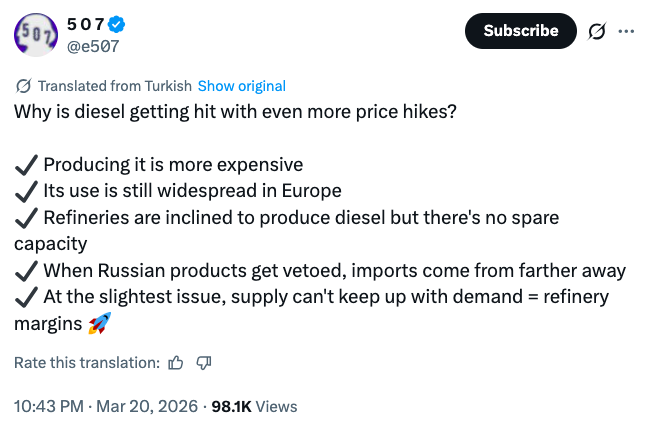
Tweet from @e507: Why are diesel prices rising faster than gasoline prices? Gasoline margins are rising more slowly because Europe and Turkey are net exporters of gasoline.
Pricing is based on a complex formula that includes international product prices, exchange rates, taxes, and margins. In addition to the excise tax, which has now been eliminated, value-added tax (VAT) remains in place—a point that critics have long described as a hidden double tax.
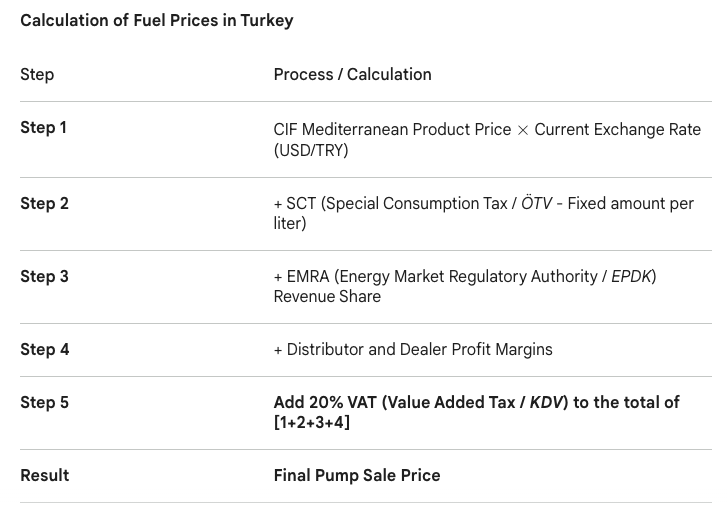
Table: Calculation of fuel prices in Turkey.
Without the previous tax mechanism, diesel would actually be significantly more expensive: according to experts, the price per liter would currently be about 16.7 lira higher.
Despite this cushioning effect, pressure on consumers and the economy is mounting. This is because fuel is a key cost factor in Turkey—from transportation and production to food.
This trend suggests that the price shock will increasingly be reflected in inflation. No quick relief is currently in sight.
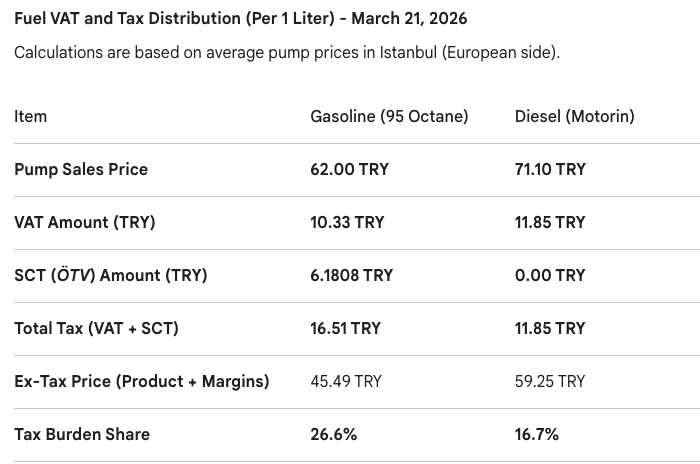
Table: Tax burden on fuel prices in Turkey (as of March 21).