The New Silk Road runs through Miami
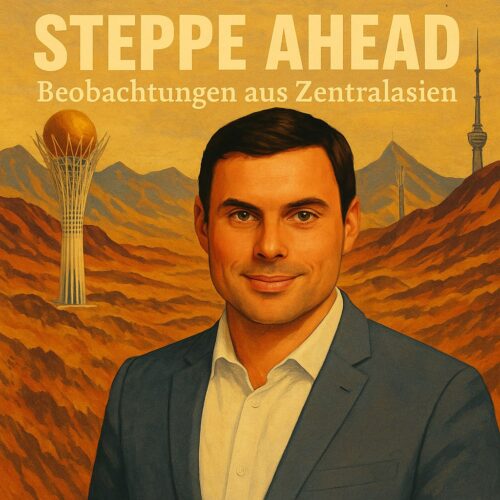
Central Asia Column “Steppe Ahead”
Author: Thorsten Gutmann

It was a bombshell just before the turn of the year 2025 that largely went unnoticed in the capitals between Berlin and Brussels, but caused a diplomatic sensation in Astana and Tashkent. In the week before Christmas, Donald Trump picked up the phone to speak with Kazakh President Kassym-Jomart Tokayev and Uzbek President Shavkat Mirziyoyev. The result: an informal invitation to the 2026 G20 summit in Miami.
What may seem like an impulsive gesture at first glance is a highly pragmatic move. While Western Europe often still views the “Stan states” with a mixture of condescension and unease, Washington has long recognized that the center of gravity in Eurasia is shifting.
Realpolitik instead of finger-wagging: A snapshot of the mood on the ground
When I speak with young people here on the ground in the cafés of Tashkent or the coworking spaces of Astana, I encounter a perspective that differs fundamentally from the European perception. While Trump’s brash approach is often sharply criticized in Germany, his determination is very well received in Central Asia.
The younger generation views the U.S. almost without exception in a positive light. They see America as a land of strength, technological excellence, and economic opportunity. Europe, on the other hand, is viewed with increasing skepticism. A sense of disappointment often resonates in these conversations. They look at a continent grappling with migration crises, economic stagnation, and a profound search for identity.
Many young Uzbeks and Kazakhs perceive a certain European double standard: a patronizing tone on political issues, while their own economic momentum is flagging. Trump, on the other hand, does not deliver moral lectures, but makes offers based on economic realism. This is seen as a sign of respect on equal terms.
The End of Geopolitical One-Sidedness
The invitation to Miami is an acknowledgment of a new reality: the region has emancipated itself as a “middle power.” The global upheavals since 2022 have served as a catalyst. Kazakhstan, in particular, has emphasized its position under international law and its territorial integrity. In Astana and Tashkent, there is now a consistent effort to diversify partners in order to secure their own sovereignty.
Trump is exploiting this quest for independence with strategic precision. While the German economy laboriously attempts to bureaucratically revive the route via the Caspian Sea bypassing Russia—the so-called “Middle Corridor”—Washington is creating facts on the ground.
Raw materials and billion-dollar deals: The hard facts
Behind the scenes of diplomacy lie massive economic interests:
- Energy security: Kazakhstan supplies over 40% of the world’s uranium. For the U.S., Astana is thus a systemically important partner for its own energy independence.
- Critical minerals: At the C5+1 summit in November 2025, deals worth billions were already secured to break China’s dominance in rare earths.
- Uzbekistan as a growth market: With growth rates of around 6%, the country is attracting massive amounts of capital; last year alone, agreements worth over $100 billion were announced with international partners.
A wake-up call for Berlin
When Tokayev and Mirziyoyev sit at the G20 table in Miami in 2026, it is far more than just symbolic. It is proof that the U.S. is willing to break with old protocols to secure strategic resources and influence.
For the German economy and institutions such as the German Committee on Eastern European Economic Relations, this is a wake-up call. While Germany has excellent contacts, it risks falling behind in the face of the speed and ideology-free pragmatism of U.S. diplomacy.
Central Asia is no longer the “backwater” of Eurasia. It is the crucial corridor of a new world order. And while Europe is still debating moral standards, Trump has already assigned the seats at the table in Washington.