Russian Central Bank Cuts Key Interest Rate Despite Higher Inflation Forecast
Author: Klaus Dormann
Although Ukrainian attacks on Russian oil refineries have led to a spike in inflation and rising inflation expectations, the Russian Central Bank further lowered its key interest rate on Friday from 14.25% to 14.0%. At the same time, it raised its forecast for the rise in consumer prices by the end of 2026 to 6.0% to 7.0%. Previously, in its “Medium-Term Forecast,” it had projected a significantly lower inflation rate of 4.5% to 5.5% for December.
The central bank lowered its forecast for this year’s economic growth by half a percentage point to a range of 0.0% to 1.0%. It therefore no longer rules out the possibility that overall economic output will stagnate completely in 2026, while the inflation rate at the end of 2026 is likely to be higher than a year earlier, at 6 to 7%. The Russian government had already lowered its forecast for the growth of Russia’s gross domestic product in 2026 to just 0.4% in mid-May.
For the years 2027 through 2029, the Central Bank expects the annual growth rate to recover to 1.5 to 2.5%. Andrew Osborn, Reuters’ chief correspondent for Russia, however, points out in a Reuters podcast on the current problems facing the Russian economy that a “steady deterioration” in economic performance can be observed.
The latest key interest rate cut came as a surprise to many experts
In analyst surveys conducted ahead of the interest rate decision, most participants had expected the Central Bank to leave the key interest rate unchanged at 14.25% in light of rising fuel prices and heightened inflation expectations. However, the Central Bank cut it again by 0.25 percentage points. It was the tenth consecutive rate cut. Since June 2025, the key interest rate has been lowered by a total of seven percentage points from a long-standing high of 21 percent.
Russian Central Bank Key Interest Rate in Percent per Year
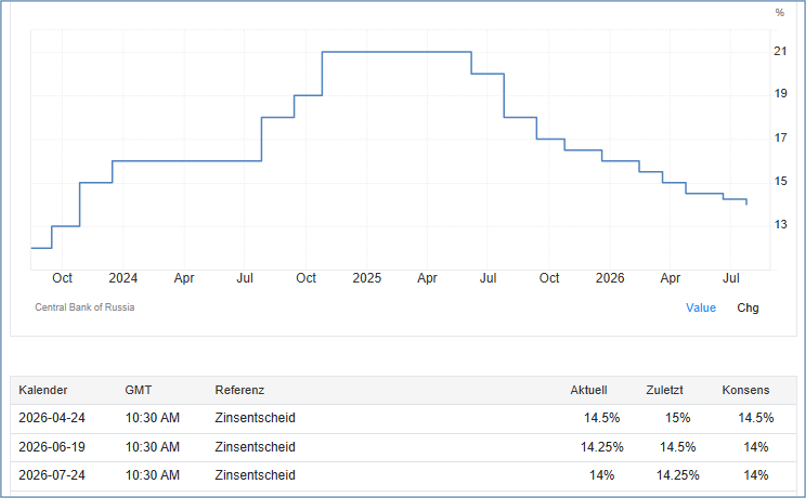
Trading Economics: Russia Key Interest Rate, July 25, 26
The Central Bank significantly raised its inflation forecast
In its “Medium-Term Forecast,” last updated in April, the Central Bank had previously expected the rise in consumer prices to fall to 4.5 to 5.5% by December 2026. However, it now expects an inflation rate of 6% to 7% by the end of 2026 (December 2025: +5.6%). According to Reuters, it cited “the significant rise in fuel prices” as the reason. Gasoline prices rose by 16% from January to June.
June saw a sharp spike in inflation. According to Rosstat, Russia’s consumer price index rose by 0.9% compared to the previous month, a significantly faster pace than in May (+0.2% compared to April).
The annual inflation rate—the increase compared with the same month a year earlier—accelerated to 6.0% in June (+5.3% in May). Ukrainian attacks on warehouses belonging to the mail-order company Wildberries (Tagesschau.de) are likely to trigger further price increases.
Year-over-year, from 2025 to 2026, the consumer price index is projected to rise by 5.9% to 6.2%, according to the central bank’s new forecast (see the second row of the table below). In April, the Central Bank had estimated the average inflation rate for 2026 to be significantly lower, at 5.1 to 5.6%.
Medium-Term Forecast of the Russian Central Bank (Excerpt)
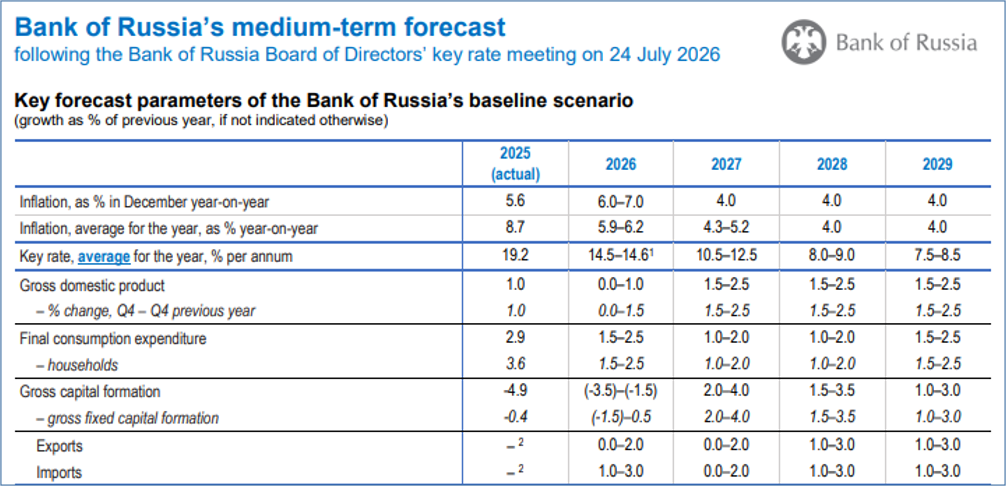
Russian Central Bank: Bank of Russia’s medium-term forecast following the Bank of Russia Board of Directors’ key rate meeting on July 24, 2026; excerpt; July 24, 2026
Central Bank: “One-time factors” drove the rise in prices
Reuters notes that households’ inflation expectations rose to their highest level since March 2022. They increased from 12.4% in June to 14.7% in July. “If they remain this high, this could hinder a sustained slowdown in inflation,” the central bank explained.
In its press release announcing the interest rate cut, the central bank noted that the sharp rise in prices and higher inflation expectations were primarily caused by “one-time factors.”
In her statement on the key interest rate decision, Central Bank President Nabiullina said the Central Bank expects companies to restore their production capacity before the end of the year. She said:
“As the fuel market stabilizes, inflation expectations are likely to decline. They already showed a similar trend in response to the VAT increase, falling fairly quickly after a brief rise. …
In light of the recent rise in fuel prices and the resulting price increases for other goods, we have revised our inflation forecast for this year upward to 6.0–7.0%. Once the effects of temporary factors have subsided and thanks to the monetary policy being pursued, inflation will fall back to 4% in 2027 and subsequently stabilize at the target level.”
Attacks on online retailers could accelerate inflation
During the press conference (video), Nabiullina noted that the attacks on the warehouses of the online retailer Wildberries could lead to further price increases (Vedomosti).
Nabiullina explained how monetary policy should respond to these “supply shocks” as follows: “Yes, the current price increase is possible due to these supply shocks, but the key question is whether these supply shocks will lead to a rise in persistent inflationary components. In other words, whether they have knock-on effects that force us to take monetary policy measures.” She added: “Not every supply shock requires a monetary policy response” (Finam.ru).
Nabiullina assumes that insurance companies have sufficient capital to cover the claims. They do not need support from the central bank (Min. 35).
According to Focus Online, Finnish security expert Henri Vanhanen called the attacks on Wildberries a blow to the “nerve centers of the Russian economy.” Wildberries is considered Russia’s largest online retailer. More than 80 million people in Russia use the platform. In addition, more than one million companies sell their goods through it. Therefore, according to Vanhanen’s assessment, the consequences of the attacks extend far beyond the company itself. Ukraine justifies its attacks by claiming that Wildberries’ logistics system also includes products needed for the manufacture of combat drones (V online news).
The RSPP business association criticizes: Investments are becoming unprofitable
Alexander Murychev, vice president of the Russian Union of Industrialists and Entrepreneurs (RSPP), noted in a commentary on the Central Bank’s decisions that borrowing costs for companies remain high at the current key interest rate—at around 18 to 20 percent per year or more.
“Under these conditions, a significant portion of investment projects, particularly in industry, are not economically viable. The high cost of debt is hindering the modernization and automation of production, the renewal of fixed assets, capacity expansion, and the implementation of long-term investment programs,” he explained.
Murychev is calling for a revision of the inflation target. He believes that achieving the 4% target is practically impossible in the near future.
“Strictly adhering to the inflation target at any cost is already having a negative impact on the investment cycle. Capital expenditures are expected to have fallen by 14.3% in the first quarter of 2026, while GDP growth remains extremely low, amounting to just 0.2% in the first five months of this year.”
The point is not to abandon the goal of price stability, but rather to find a more balanced relationship between fighting inflation and economic recovery. The economy needs conditions under which lower inflation is not achieved by accepting a decline in investment and a weakening of domestic demand. This is reported by Finam.ru.
Real GDP could stagnate completely in 2026, with investment declining
The Central Bank lowered its GDP growth forecast for 2026 to 0.0–1.0% (April: 0.5–1.5%). In the following years through 2029, the Russian economy is expected to grow by 1.5 to 2.5% annually, according to the Central Bank’s assessment, which it says corresponds to the long-term growth potential of the Russian economy.
GDP Forecasts for Russia, 2024–2027
: Year-over-Year Change in Real Gross Domestic Product, in Percent
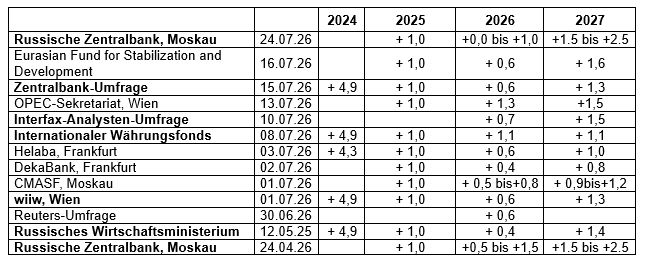
Compared to the Central Bank’s April forecast for 2026, the forecast for the increase in total consumer spending was raised by one percentage point, from 0.5 to 1.5% to 1.5 to 2.5%.
The forecast for gross investment, however, has deteriorated significantly. Instead of an increase of 1.0 to 3.0%, a decline of 3.5 to 1.5% is now expected.
In terms of foreign trade, growth in both exports and imports of 0.5 to 2.5% each was previously expected for 2026. Now, the central bank forecasts that imports will rise more sharply (1.0 to 3.0%) than exports (0.0 to 2.0%)
President Putin Remains Confident: The Economy Is “Stable”
Reuters reports that on July 22, during a meeting with Central Bank Governor Elvira Nabiullina and government officials, President Putin assured them that the economy is stable despite “external attempts” to destabilize the situation in the fuel and energy sectors as well as in some other sectors. Putin emphasized:
“The difficulties we are currently experiencing in the fuel market are certainly temporary and will not affect overall economic development,” reports Tagesschau (see also: en.kremlin.ru; russland.capital).
According to Reuters, ahead of the key interest rate decision, Putin also stated that a key interest rate cut “should and will be a natural process, based on macroeconomic indicators and economic stability.” Reuters quotes a comment by economist Yevgeny Kogan on this: “An interesting coincidence: as soon as the president raised expectations of an interest rate cut, they immediately began to materialize.”
Reuters Podcast: “Russia’s War Economy Is Running Out of Steam”
In contrast to the confident Russian president, Andrew Osborn, Reuters’ chief correspondent for Russia, paints a picture of a rather battered Russian economy in an interview with host Carmel Crimmins on the “Reuters Economic World Podcast” (“Econ World”):
Osborn believes there likely won’t be a “sudden collapse” of the Russian economy. However, economists closely tracking economic developments believe a “steady deterioration” is underway. According to Osborn, the current fuel crisis is “a serious new problem” for Russia. It will take quite a long time to repair all the refineries. In any case, the attacks on the refineries have brought the situation to “a new level of strain.”
An Overview of Russia’s Economic Problems
In the introduction to the podcast, Reuters highlights the following major problems facing the Russian economy:
Spending on the war in Ukraine is no longer stimulating economic growth; instead, it is straining public finances and putting pressure on the labor market.
Ukrainian attacks on Russian energy infrastructure are testing the morale of the Russian population. They have caused fuel shortages in one of the world’s largest energy producers and are forcing Russians to stand in line to fill their tanks.
Four years after invading Ukraine, Russia is reaching the limits of its war-fueled boom. Economic output is stagnating and inflation is rising again as Ukrainian attacks drive up fuel prices.
Below is a summary of the analysis by Chief Correspondent Andrew Osborn:
Financial pressure on the Russian population is growing
While we’re not seeing any dramatic developments, there are definitely signs of growing financial pressure on people. Prices have risen, and last year, significantly more people filed for personal bankruptcy.
The cost of living is rising noticeably for people, and they are increasingly struggling. This is also confirmed by opinion polls. Last month, a Gallup poll showed that Russians were more pessimistic about the economic situation than they have been in the last 20 years.
There has not been—and there will not be—an economic collapse
Many people predicted a de facto collapse of the Russian economy at the start of the conflict and in the years that followed. That did not happen. Nor does it look as though it will happen.
Following the inevitable shock in 2022—the first year of the war—caused by the imposition of Western sanctions, Russia has massively expanded its industrial capacity and defense sector. This has boosted the economy and created new jobs. To the surprise of many, the economy grew quite strongly in 2023 and 2024. Growth exceeded 4%.
However, output in the Russian economy has peaked
But last year, that began to change: Growth had slowed to just 1%. In 2026, the slowdown—or rather, stagnation—in production is continuing. Only modest growth of 0.4% is now forecast.
Russian government officials themselves have publicly stated that they have shifted the economy to a kind of war economy. They ramped up production, and now it has peaked. They say themselves that it cannot be increased any further.
There are bottlenecks in the labor market
Members of the government are also speaking quite openly about the problem of labor shortages. There are reportedly more than 2 million jobs that cannot be filled—for example, in the construction industry or the service sector. The authorities are therefore trying above all to encourage people from South Asia—for example, from India—to come to Russia and take on these jobs, partly because, of course, many Russian men have gone off to war. President Putin regularly mentions that more than 700,000 soldiers are fighting in Ukraine. And, of course, there have also been heavy losses.
The sanctions are placing an additional burden on Russia
The economy is also, of course, being burdened by the sanctions, which are being tightened further and further and are forcing Russia to constantly adapt. However, Russia has acted very flexibly and cleverly in circumventing the sanctions. Economic ties with China and the “Global South” have grown closer. The country now sources goods from nations with which it previously had no trade relations. And Russia is now selling oil and gas to countries that were not previously supplied on this scale, particularly China and India.
Other problems include high interest rates and the strong ruble
Another problem for the Russian economy—and one that Russian companies and businesspeople are complaining about more and more loudly—is the cost of credit, namely the high key interest rates. They currently stand at just over 14% (as of mid-July). Although they have fallen significantly from their peak of 22%, the Russian economy is still hoping for even lower rates. The goal is to bring them down to at least 12%. High interest rates naturally make borrowing to finance investments very expensive. As a result, investment programs are being scaled back.
Another point of criticism is the strong ruble, which is also weighing on the economy. It is, therefore, a combination of factors that is now taking effect and slowing down the economy. The government states that it is trying to manage the “cooling off” of the economy—and that is exactly what is happening right now. But the “pressure” on the economy is currently extremely high, probably higher than at any other time since the war began in 2022.
Attacks on Russian refineries are significantly impacting the economy
Ukraine’s attacks on refineries across Russia are significantly impacting the Russian economy and the energy sector. The attacks have led to fuel shortages, which Russia is now frantically trying to resolve.
Fuel prices are rising. Efforts to curb inflation are being undermined. The inflation rate, which had previously been reduced from around 10% to just over 5%, is being driven back up.
Of course, whether interest rates can continue to be lowered—which economic experts view as crucial for the economy—depends on how inflation develops. It appears that further interest rate cuts will be difficult to achieve. Borrowing costs are therefore expected to remain high. This will weigh on the Russian economy.
The war has come much closer to people’s lives
Disruptions to the fuel supply are, of course, also causing stress among the Russian population. People are angry and worried. Until now, Russian authorities had been very successful at shielding people from the war—especially in major cities like Moscow and St. Petersburg. That has changed this year. The war has come much closer to people in Russia’s major cities.
Fuel shortages are driving up inflation
The fuel supply problems are likely to persist for some time. There are no signs whatsoever that Ukraine will ease up on this campaign. On the contrary, it even appears to be intensifying. From Ukraine’s perspective, this strategy of specifically targeting all refineries is quite clever.
Russia—like any other country—relies on gasoline and other fuels. In Russia, many goods are transported by road across this vast country—the largest in the world by land area. Shortages of gasoline and other fuels mean higher costs for this transportation.
Simply put, this in turn fuels inflation. This is exactly what the central bank wants to avoid, as it makes it more difficult to lower interest rates and borrowing costs—which the Russian economy is urgently seeking to do. So far, the authorities have been quite successful in bringing down inflation.
The rise in oil prices was a boon for Russia
The conflict in the Middle East has driven up oil prices. That was, of course, good for Russia. We’ve seen a sharp rise in oil and gas revenues, most recently when the conflict reached its peak and oil prices were also at their highest.
However, the budget deficit is unexpectedly high
The budget deficit exceeded the target, at least in the first five months of this year. Russia, however, has a “safety net” in the form of the “National Wealth Fund.” This fund has been tapped into several times since 2022. It serves as a kind of reserve for hard times, designed to cover budget deficits or unforeseen expenses. However, more than half of the liquid assets have already been depleted.
If you compare Russia’s national debt with that of European economies—such as France or the United Kingdom, which are heavily indebted—Russia’s debt is not as high. In the past, the Russian government has always focused on building up reserves.
The Russian government is seeking new sources of revenue
To finance rising government spending, it was decided to expand taxation on small and medium-sized enterprises. This has caused a great deal of discontent in the business community. We have seen that quite a few companies have had to close as a result, particularly in Moscow—the capital and by far the wealthiest city in Russia.
But the Russian government is, of course, looking for other ways to fill its coffers, given that military spending is so high. A slight tax increase was an obvious step. In addition, the tax authorities are trying to sell off state assets. For example, one of Moscow’s most important airports was sold.
According to experts, Russia is not on the brink of a “banking crisis”
Some economists point out that Russian banks have had to take on, to a significant extent, tasks normally performed by the state, such as lending to consumers and defense contractors.
Due to the war and rising living costs, some of these loans naturally carry risks. With consumer loans in particular, it is often the case that repayment cannot be made as quickly as the respective agreements actually stipulate. Consequently, there is a prevailing impression that the proportion of “bad loans” is rising, particularly among consumers, who are now facing a heavier financial burden than before. With regard to the much larger loans to defense and state-owned enterprises, for example, the major bank VTB recently announced that it would increase its capital reserves—as a buffer against these risks and inflation.
However, according to experts, Russia is not on the verge of a “banking crisis.” The proportion of non-performing loans is—at least for now, as they say—“manageable.” Since many of these are state-owned enterprises, the loans can, to a certain extent, be shifted around or refinanced. Loan terms can be adjusted, and repayments can be deferred.
President Putin is under pressure to get the economy back on track
In Russia’s tightly controlled political system, President Putin is, of course, not subject to the same pressure as politicians in the West. Nevertheless, he too faces a certain amount of pressure: parliamentary elections are coming up in September. It is important to the government that these elections proceed smoothly and that public sentiment remains reasonably stable. Like any country in the run-up to elections, it, too, needs a certain sense of satisfaction.
For President Putin, the economy is, of course, important. The war in Ukraine—what he calls a “special military operation”—is his project. He is accountable for it. He is clearly the commander-in-chief, and the economy is unquestionably crucial to keeping the war machine running.
Russia has successfully adapted to many sanctions…
We have recently seen signs that some of the sanctions are indeed beginning to have a greater impact. But Russia has successfully adapted to many of the sanctions imposed or found ways to circumvent them. It has found alternative trading partners. They’ve essentially told the European Union: “Okay, if you don’t want to buy our oil and gas, then we’ll just find someone else to sell it to.” And then India steps in, and they sell it to India. We’ve seen this happen often. Even in the face of the EU’s announced new sanctions, Russia remains, as always, fairly unfazed and says, “We’ve seen it all before and will adapt.”
… and has become increasingly dependent on China
China has become enormously important to the Russian economy. Shortly before the war began in 2022, Russia and China sealed their so-called “partnership without borders.” Throughout the war, Russia has purchased many necessary goods from China, including supplies for its war machine.
It is a very “pragmatic” trade relationship. It’s important to note that China also sells many products to Ukraine—which, of course, helps Ukraine defend itself against Russia. So China supplies both sides, but one can hardly overestimate how important China is in supporting the Russian economy. China enables Russia to import goods that it used to source from the West but can no longer obtain from there.
Recommended reading:
German-Russian Chamber of Foreign Trade:
- Fuel Crisis: Top Exporter Russia Relies on Imports, July 21, 26; Gasoline Crisis in Russia, June 30, 26
- Russia’s Banks: Record Profits, Credit Crisis, and Bank Closures, July 14, 26
- Experts: Is Russia’s Economy on the Brink of Collapse? July 9, 26
Monetary Policy: Reports on the Key Interest Rate Cut on July 24
- Lviv Herald; in cooperation with Prognoz News www.prognoznews.co.uk: Russia’s Economy Encounters the Limits of War, July 26, 2026
- russland.capital: Russia’s Central Bank Cuts Key Interest Rate to 14 Percent—While Warning of New Inflation, July 25, 2026
- Tagesschau.de, Björn Blaschke: Russian Central Bank Cuts Key Interest Rate Again, July 24, 2026
- Finam.ru; Dmitry Nikitin: Short-Lived Joy. What Impact Will the Central Bank’s Decisions Have on the Market and the Economy? July 24, 26
- Finam.ru; Olga Belenkaya: The Russian Central Bank—an unexpected cut in the key interest rate, an expected shift to a neutral stance, and a tightening of the macroeconomic forecast. The projected increase in the average key interest rate is rather moderate; July 24, 2026
- Vedomosti: Nabiullina: Prices Could Rise Due to Attacks by Ukrainian Forces on Wildberries Warehouses, July 24, 2026; Vedomosti; Mikhail Belyaev: Nabiullina’s Key Statements Following the Central Bank’s Interest Rate Cut. Fuel inflation accelerated, and the forecast for interest rate trends was raised, July 24, 2026; Vedomosti: Nabiullina: The Central Bank’s policy aims to lower mortgage rates, July 24, 2026
- The Moscow Times: Russian Central Bank Warns of Higher Inflation as It Lowers Key Rate to 14%, July 24, 2026
- Reuters: Elena Fabrichnaya and Gleb Bryanski: Russian central bank cuts key rate by 25 bps to 14% as Ukrainian drones hit the economy, July 24, 2026; Translated by MarketScreener: Russian Central Bank Cuts Key Rate by 25 Basis Points to 14% – Ukrainian Drones Hit the Economy, July 24, 2026
- Handelsblatt: Russian Central Bank Supports Sluggish Economy with Another Interest Rate Cut, July 24, 2026
- Investing.com, Senad Karaahmetovic: Russian Central Bank cuts key interest rate to 14%, July 24, 2026
Russian Central Bank cuts key interest rate from 14.25 to 14.0 percent and releases new forecasts
- Bank of Russia: Statement by Bank of Russia Governor Elvira Nabiullina following the Board of Directors meeting on July 24, 2026, July 24, 2026
- Russian Central Bank: Bank of Russia cuts the key rate by 25 basis points to 14.00% p.a., July 24, 2026
- Russian Central Bank: Bank of Russia’s medium-term forecast following the Bank of Russia Board of Directors’ key rate meeting on July 24, 2026, July 24, 2026
Preliminary Reports on the Key Rate Decision on July 24
- russland.capital: Business Association Does Not Expect Another Rate Cut, July 8, 2026
- Finam.ru; Post-meeting analysis: The central bank has pulled the emergency brake. Could it now follow up with an interest rate hike? July 5, 2026
Economic Forecasts:
- Bank of Russia: Bank of Russia’s medium-term forecast following the Bank of Russia Board of Directors’ key rate meeting on July 24, 2026, July 24, 2026
- Eurasian Fund for Stabilization and Development: Regional Economic Outlook, July 16, 2026
- russland.capital: Russia’s economy is barely growing—high interest rates will remain in place longer, July 16, 2026
- Radio “Kommersant FM”; Leonid Pasternak: Inflation Has Rewritten the Budget. What Entrepreneurs Say About the Central Bank’s Economic Forecasts, July 16, 2026
- Kommersant.ru; Artem Chugunov: Prices Are Putting Pressure on Forecasts. Economic Forecasts and Inflation Expectations Have Deteriorated; July 16, 2026
- Alfa Bank; Alexey Devyatov: Central Bank Macroeconomic Survey: Analyst Forecasts. Analysis of the July Survey Results, July 15, 2026
- Interfax.com: Analysts slightly lower their 2026 Russian GDP growth forecast and substantially raise their inflation outlook, July 15, 2026
- Central Bank Analyst Survey: Macroeconomic Survey of the CBR, Survey Calendar; July 15, 2026
- Vedomosti: First Vice President of Gazprombank: GDP could rise by 1.3%. July 15, 26
- OPEC Secretariat, Vienna: Monthly Oil Market Report, July 13, 2026
- Finmarket.ru; Interfax Survey: Analysts forecast a 0.1 percent decline in industrial production in Russia for June, with inflation at 0.85 percent, July 10, 2026
Price Trends
- russland.capital: Russia’s inflation rises to 5.8 percent – the public expects nearly 15 percent, July 23, 26
- Finanzmarktwelt; Josephine Bollinger-Kanne: Russia in the Grip of a Fuel Crisis and a Spiral of Spending. The War in Ukraine Is Having an Increasingly Severe Impact; July 15, 2026
- Bank of Russia, Press Release: Inflation in Russia No. 6 (126) • June; July 15, 2026
- Bank of Russia: Price growth accelerates in June due to one-off factors, July 15, 2026
- Vedomosti: The Central Bank has analyzed the impact of rising fuel prices on inflation in July, July 15, 2026
- Vedomosti.ru: Zabotkin: The Central Bank will not “ignore” fuel prices, July 14, 2026
- Kommersant: Following the price surge in June, the Central Bank expects a moderate rise in prices, July 14, 2026
- Russian Central Bank; Alexey Zabotkin, Deputy President: Telegram channel “Notes on the Economy”: Price growth accelerated in June. What are the components of inflation today? Will a return to a downward trend be possible? July 14, 2026
- Pravda.de: Rosstat recorded a record increase in gasoline prices in the Russian Federation: nearly 20% for the year and 6.88% for June, July 11, 2026
- SberCIB Investment Research: Inflation in Russia in 2026: Trends and Forecasts. We discuss price trends since the beginning of the year as well as forecasts from analysts, the Central Bank of Russia, and the Ministry of Economic Development, July 10, 2026
- Meduza.io; Rosstat: Gasoline prices rose by 6.9% in June, and diesel prices by 7.1%. Source: Interfax; July 10, 2026
- Interfax.com: Inflation in Russia accelerates to 0.87% in June, annual inflation to 6.02%, July 10, 2026
Current Economic Trends
- FR.de; Nils Thomas Hinsberger: Putin’s Number Games: What the Kremlin Is Hiding When It Talks of “Stability,” July 26, 2026
- Focus online; Cedric Kienhöfer: Ukraine attacks “nerve centers of the Russian economy.” Several Ukrainian attacks hit warehouses belonging to the online retailer Wildberries, July 26, 2026
- Tagesschau.de, Silke Diettrich: Attacks on Wildberries. The war reaches “Russia’s Amazon,” July 25, 2026
- MDR interview with Vasily Astrov: War in Ukraine. Russia’s economy has been hit. The only winner of the war is the defense industry. But discontent prevails among the population; July 25, 2026
- Bond Guide: Ukraine is successfully taking jabs at Russia and putting pressure on its public finances. Russia is struggling with rising financing costs, a growing budget deficit, and new drone attacks on civilian logistics. At the same time, inflation remains high. Alexandra Prokopenko and Alexander Kolyandr report on this in their latest analysis for The Bell. July 25, 2026
- Reporter; Andrey Elistratov: An expert pointed out the main problem facing the Russian economy, July 23, 2026; Yuri Baranchik: Commentary on the CMASF’s macroeconomic baseline analysis, July 23, 2026
- russland.capital: Russia’s Business Association Warns of a Wave of Bankruptcies This Fall, July 23, 2026
- Trading Economics; Larissa Caser: Russia’s Industrial Production Rebounds in June, July 22, 2026
- Politico.eu; Geoffrey Smith: Ukraine’s Drone Strikes Pile Pressure on Russian Economy. As Its Refineries and Warehouses Burn, Russia’s Financial Markets Are Starting to Freeze, July 22, 2026
- Interfax.com: State of the Russian economy; key sectors remain stable despite attempts to destabilize the fuel market—Putin, July 22, 2026
- en.kremlin.ru: Meeting on economic issues, July 22, 2026
- Marketpower.pro: The Center for Macroeconomic Analysis and Short-Term Forecasting (CMASF) has identified signs of stagflation in the Russian economy. Experts are assessing the risks of an economic slowdown amid persistently high inflation, July 20, 2026
- Banki.ru, Maria Queen: Experts have warned of a near-stagflationary situation in the Russian economy. According to the report “Study 2: Inflation and Anti-Inflation Policy” by the Center for Macroeconomic Analysis and Short-Term Forecasting (CMASF), as reported by the newspaper “Vedomosti,” the Russian economy is already in a near-stagflationary situation. July 20, 2026
- TASS.ru: Expert Eremkin expects the Russian economy to grow by 0.7% by the end of the year. According to the senior researcher at the Presidential Academy, the investment lull will end, but the basis for recovery remains the same. July 20, 2026
- Focus Online; Lars-Eric Nievelstein: Oil and gas exports too low. Fuel crisis triggers stagflation in Russia; July 18, 2026
- Reuters podcast “Econ World”; Host Carmel Crimmins speaks with Andrew Osborn, Reuters chief correspondent for Russia: The price of war. Russia’s growth is flagging and inflation is rising as Ukrainian attacks push up fuel prices. Russia is paying an ever-higher price for President Vladimir Putin’s war in Ukraine. Economic growth is stagnating, and inflation is rising again as Ukrainian attacks drive up fuel prices; 36 min.; July 16, 2026
- russland.capital: Kremlin describes Russia’s economy as stable despite weak growth, July 17, 2026; russland.capital: Russia’s economy caught between expensive money and expensive gasoline, July 15, 2026
- Interfax.ru: Analysts at the Bank of Russia noted a resumption of economic growth in the second quarter, July 15, 2026
Fuel Supply, Energy Sector
- ntv.de; Caroline Amme: Moscow’s New Gas Station. Russia is buying back its crude oil from India—as refined gasoline; also available as a podcast titled “Learned Something New”; July 23, 2026
- russland.capital: Russia’s government reports easing tensions in the fuel market, July 22, 2026
- ntv.de; Max Borowski: Warning of a diesel shortage. The destruction of Russian refineries is driving up European fuel prices, July 22, 2026
- German-Russian Chamber of Foreign Trade; Analysis: Fuel Crisis: Top Exporter Russia Relies on Imports, July 21, 2026
- Meduza; Julia Starostina: How Much Damage Can Russia’s Fuel Crisis Do to the Economy? July 21, 2026
- Eurasia Daily Monitor; Vadim Shtepa: Russian Fuel Crisis Driving Discontent, July 21, 2026
- ntv; Christian Hermann: The Hunt for Gasoline and Diesel. Telegram Is Russia’s New Gas Station, July 19, 2026,
- bne IntelliNews; Ben Aris: Fuel Crisis Hitting Russia’s Real Economy as Agricultural Peak Season Approaches, July 18, 2026
- ntv News: Is Putin Running Out of Gas? Ukraine Hits Russia’s Oil Industry, Video, July 17, 2026
- The Moscow Times: Russia Prepares to Import Diesel Fuel After Gasoline, July 17, 2026
- RBC Ukraine; Daryna Vialko: Russia to import diesel after gasoline as fuel crisis deepens, media reports, July 17, 2026; Russia’s fuel crisis deepens as drone attacks send prices to record highs. July 15, 2026
- Financial Post; Bloomberg News: Russian Fuel Prices Soar as Drone Attacks Curb Refinery Output; with chart; July 15, 2026
- MDR aktuell; Putin’s War – Interviews and Background, Rebecca Barth: New Drone Strategy Puts Pressure on Russia. Ukraine is increasingly using drones to attack the Russian energy sector, July 15, 2026; MDR aktuell, Lilia Becker: Fuel Crisis in Russia; Audio, 3 min., July 10, 2026
- Blick.ch, Patrik Berger: Putin’s Gasoline Crisis Gets Crazier, July 15, 2026
- Kommersant; Artem Chugunov: Gasoline Prices Are Approaching the Threshold. The Central Bank and Analysts Assess the Economic Impact of the Situation on the Fuel Market; July 14, 2026
The day's most important Russian economic stories. Free, in your inbox three times a week.
Mon, Wed, Fri. Double opt-in, no tracking, unsubscribe anytime. By subscribing you consent to the processing of your email address as described in our Privacy Policy.