Nuclear Power for Astana: Rosatom Builds, the World Watches
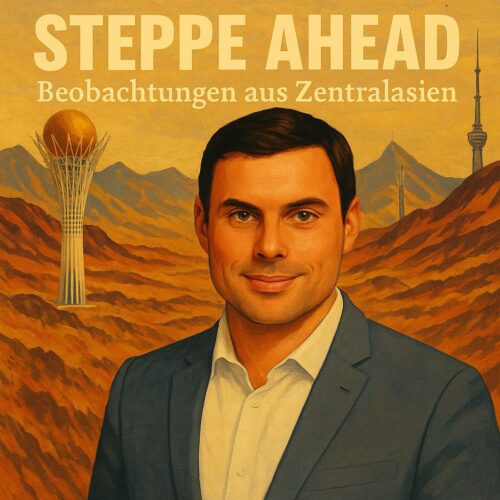
Steppe Ahead – The Column on Geopolitics, Economics, and Innovation in Central Asia
Author: Thorsten Gutmann

Kazakhstan is venturing into the nuclear age—and is relying on a long-standing partner: Russia. More specifically, Rosatom, the state-owned nuclear giant that builds reactors worldwide, supplies fuel, and sees itself as a strategic bridge-builder. On June 14, the Kazakh nuclear regulatory authority announced that Rosatom will lead an international consortium to build the country’s first nuclear power plant.
Construction will take place in Ulken, a semi-abandoned town on Lake Balkhash—a place caught between the past and the future. Two reactors are scheduled to go online there by 2035. The planned total capacity is 2.4 gigawatts—enough to supply millions of people with electricity. And: a symbolic powerhouse for a country that is currently the world leader in uranium exports but does not generate its own nuclear power.
Rosatom prevailed in a high-stakes bidding process against companies from China, France, and South Korea. All bidders had submitted comprehensive proposals: ranging from financing and localization to training and social responsibility. But the contract went to Moscow—apparently in part because Rosatom offers state export financing as part of the package. Financing talks with Russia are already underway.
Kazakhstan, the world’s leading uranium exporter
In 2023, Kazakhstan exported over 26,800 tons of natural uranium—accounting for nearly half of the global market. Nevertheless, the country must either import electricity or operate coal-fired power plants at full capacity. The new nuclear power plant is intended to resolve this energy policy imbalance.
But the construction is not just an infrastructure project—it is political. Despite the war in Ukraine, Russia remains a sought-after partner. President Tokayev is consciously balancing: on the one hand, good relations with Moscow and Beijing; on the other, openness toward the West. A consortium with international partners—China, France, South Korea—is intended to symbolize this balance. Observers believe, however, that in the end, Rosatom will build the power plant largely on its own.
The population is divided. Approval for the construction was obtained via a referendum—a first. Distrust of nuclear technology runs deep. Semipalatinsk, Soviet nuclear bomb tests, the BN-350 reactor on the Caspian Sea—the country’s nuclear history is heavily burdened.
Since the decommissioning of the last reactor in 1999, no nuclear power has been generated in Kazakhstan. But the situation has changed. Industry, digitalization, climate goals—they all demand baseload energy. The West’s nuclear phase-out is not a model for Astana, but a warning.
The timing of the announcement is also intriguing: just a few days before Chinese President Xi Jinping’s visit to Kazakhstan. Coincidence? Hardly. The message: Kazakhstan remains open, but chooses its own partners.
Conclusion: Rosatom delivers not only technology, but influence. For Kazakhstan, the nuclear power plant is a step toward energy independence—but also a balancing act between power blocs. Just how much sovereignty the country can preserve in the process will become clear not only when the reactor goes online—but in every decision leading up to that point.