Kazakh-Russian Economic Relations: Energy Resources Take Center Stage

The Central Asian republic of Kazakhstan is known to many people in Europe primarily through the satirical film “Borat” by director Sacha Baron Cohen, who plays the lead role of the Kazakh TV journalist Borat Sagdayev in this American comedy, an eccentric character through whom the viewer literally learns nothing about Kazakhstan.
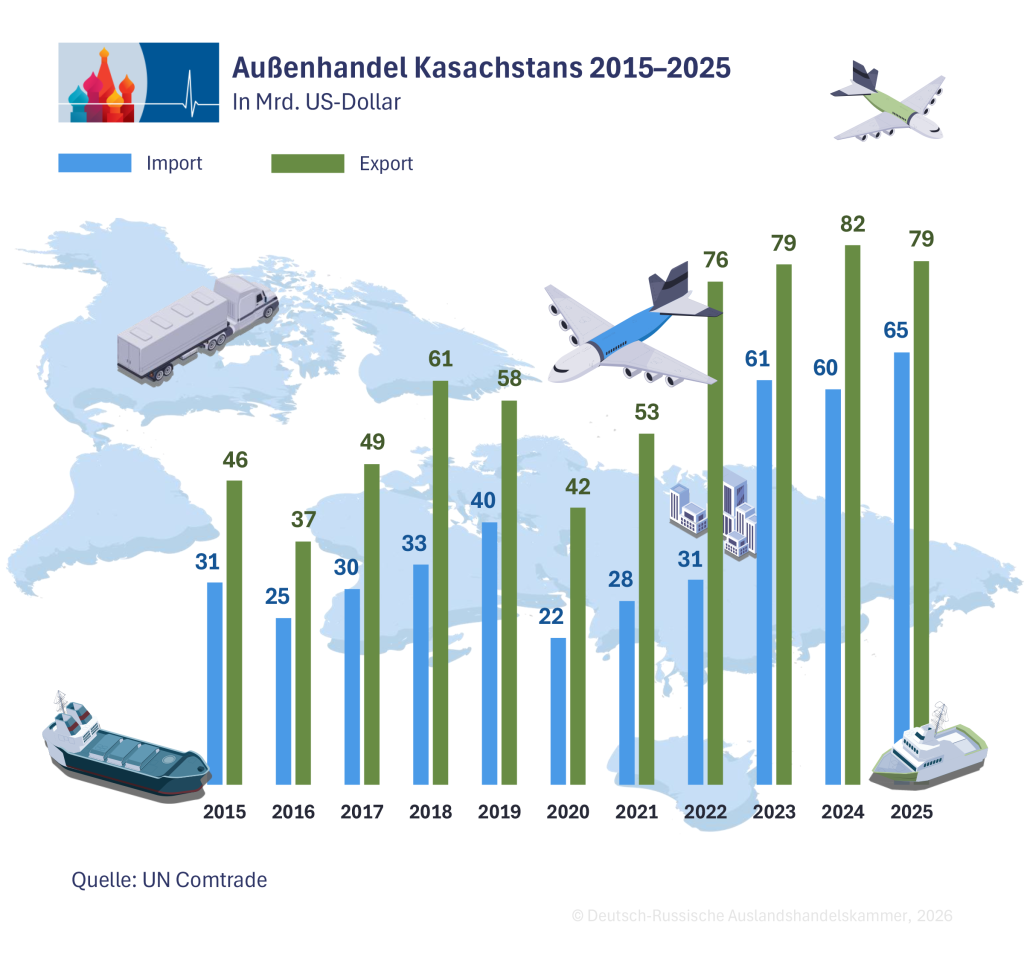
Yet the country—which is more than seven times larger than Germany in terms of area—has much to offer, not only in terms of its landscape but also economically. Kazakhstan has increased its foreign trade sevenfold since gaining independence. The former Soviet republic, with a population of around 21 million, is one of Russia’s most important foreign trade partners. Russia shares the world’s longest land border with Kazakhstan, stretching 7,600 kilometers.
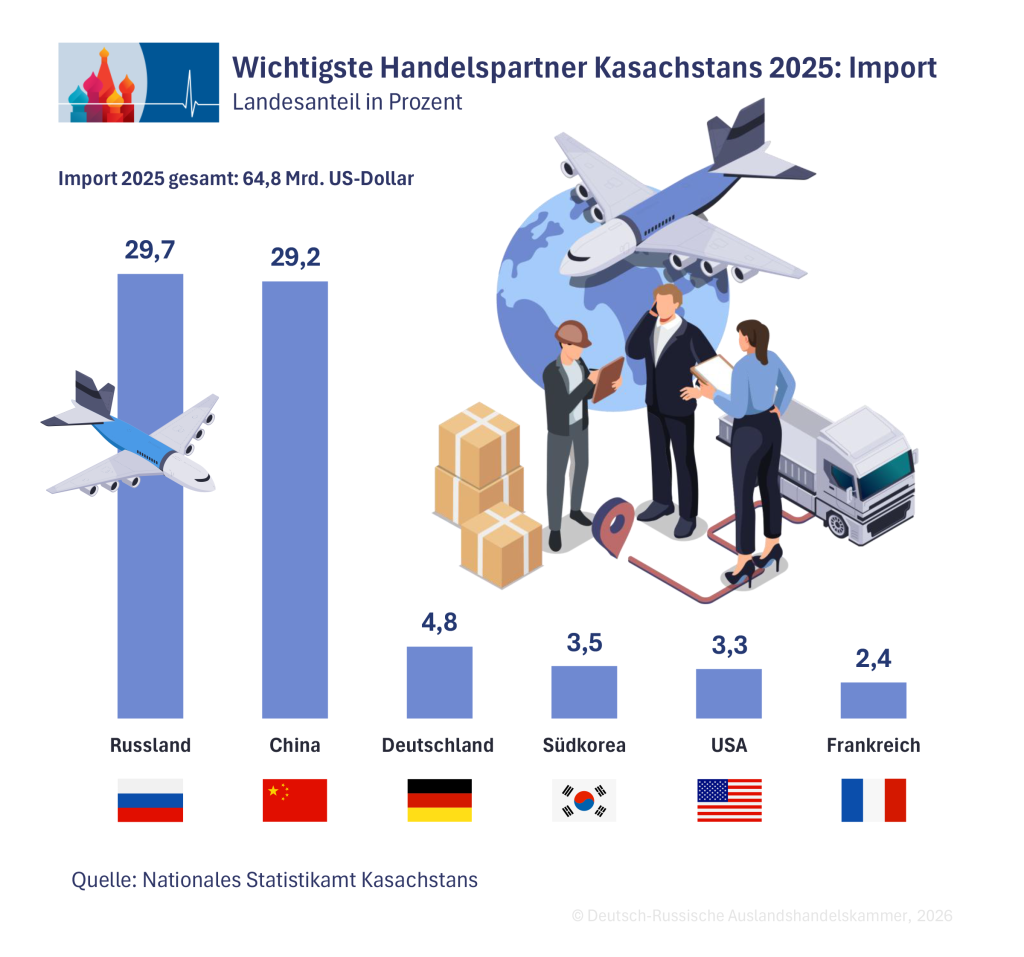
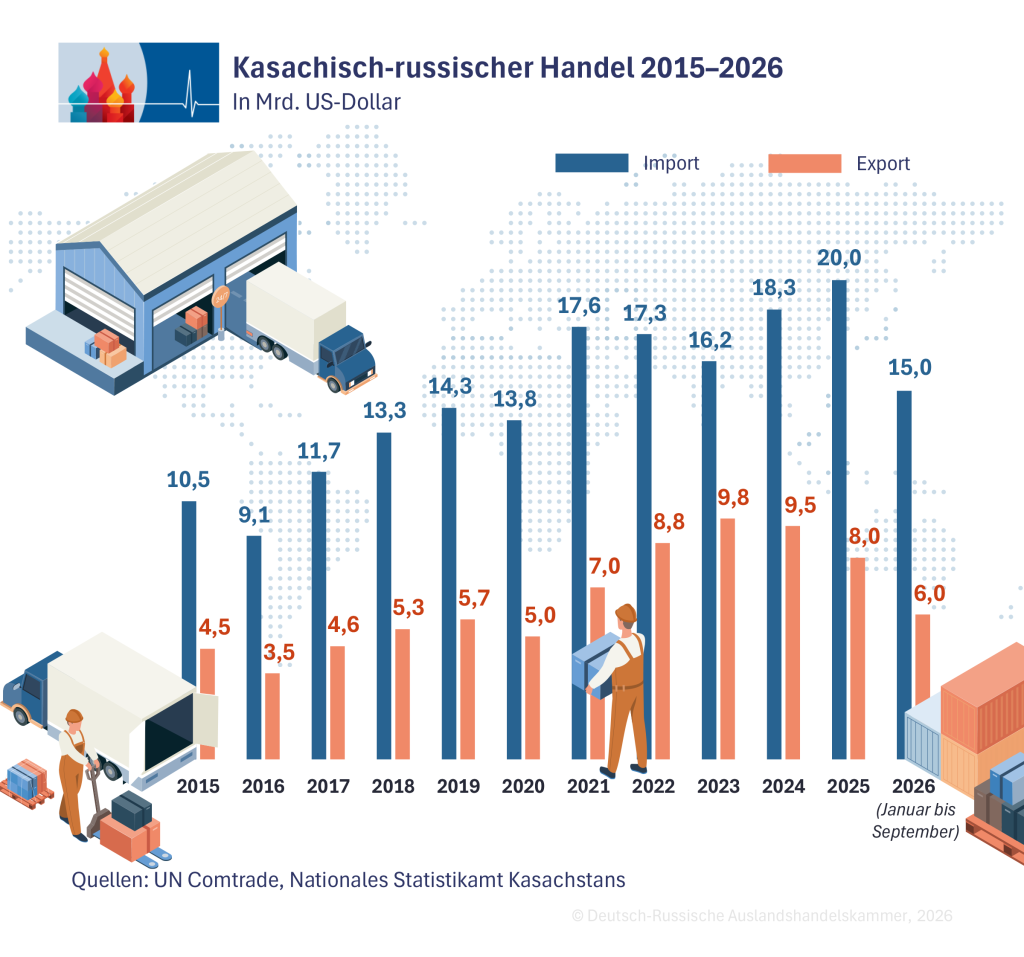
Trade between the two countries totaled $27.7 billion in 2025. This represented a slight decline from 2024, when the trade volume stood at $27.8 billion. A closer look at the trade balance shows that Kazakhstan’s exports to Russia declined, while imports from Russia increased. Kazakh exports to the Russian Federation totaled approximately $8.2 billion in 2025, representing a year-over-year decline of about 14%. Kazakh imports from Russia, on the other hand, rose by 6.5% to $19.5 billion. Kazakhstan’s imports are largely concentrated among its two largest trading partners. Russia accounts for 29.7% of these imports, and China for 29.2%.
At the same time, Chinese investments benefit Russian-Kazakh trade through synergy effects resulting from infrastructure improvements. Along with the Netherlands and Russia, China is one of the largest investors in Kazakhstan. The oil and gas industry forms the foundation of Chinese investments. China’s state-owned energy company has been involved in oil and gas production in the Aktobe region since 1997. In addition, there are investments in the Petrokazakhstan Oil Products refinery in Shymkent.
The People’s Republic is also investing in roads, rail lines, and logistics centers. Of central importance here are the Khorgos Eastern Gate logistics complex and the Kazakh-Chinese logistics terminal at the Port of Liangyungang on the Yellow Sea. In addition, Chinese capital is flowing into the oil industry, mechanical engineering, and the chemical industry. China’s investments in Kazakhstan are part of Beijing’s New Silk Road concept, the mega-project known as the Belt and Road Initiative (BRI), launched in 2013 by President Xi Jinping. It aims to expand China’s trade routes to Europe, Africa, and other Asian countries. The goal is to systematically integrate production, trade, and logistics.
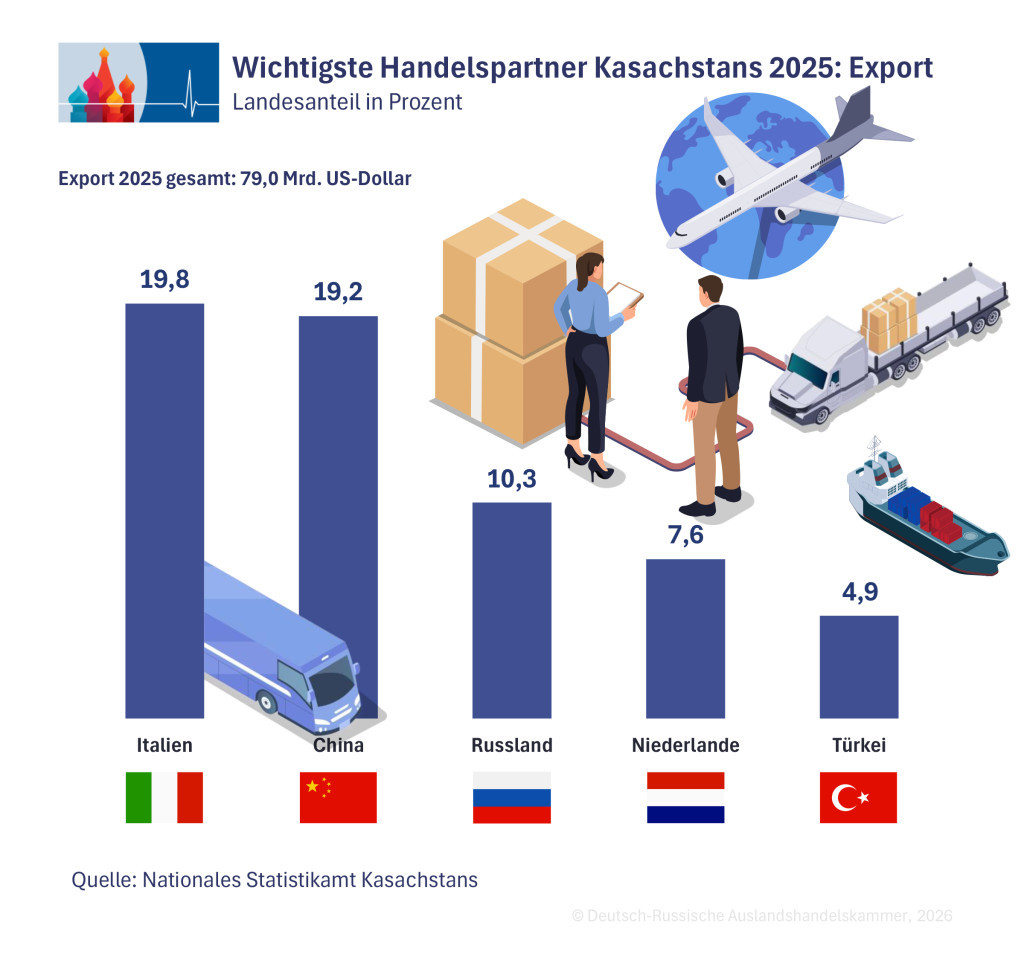
Russia accounts for 20% of Kazakhstan’s foreign trade. The most important Kazakh export to Russia is oil, which accounts for 46.5% of total exports. In addition, uranium for nuclear power plants plays a significant role, accounting for about 15%, followed by steel (13%) and alumina (4.2%).
The fact that both countries have been members of the Eurasian Economic Union since 2015 has a positive effect on bilateral trade. During Russian President Vladimir Putin’s visit to his Kazakh counterpart Kassym-Jomart Tokayev in May 2026, the Russian head of state emphasized cooperation within this economic union. Both sides set a goal of increasing annual trade to $30 billion by 2030. In an article for the government newspaper *Kazakhstanskaya Pravda* shortly before his visit, Putin cited the country’s geographic location and its “enormous logistical potential” as positive factors “for the development of a North-South and Europe-West China international transport corridor.”
Putin sees the energy sector and mechanical engineering as key areas of cooperation. During his trip to Kazakhstan, the Russian and Kazakh energy ministries signed an agreement to increase the transit of Russian oil to China through Kazakhstan by 2.5 million metric tons annually. In addition, the two energy ministries agreed on the processing of Russian oil in Kazakhstan, with 70% of the end products—primarily gasoline and diesel—to be delivered to Russia.
Furthermore, both countries agreed to build a nuclear power plant in Balhash in the southeastern part of the country. A contract for the construction work was signed in early September on the sidelines of the Eastern Economic Forum in Vladivostok. Construction of the project, with an estimated cost of 16 billion U.S. dollars, is scheduled to begin in 2027. The consortium responsible for building the power plant is led by the Russian state-owned corporation Rosatom.
Russia is thus consolidating its role as a leading exporter of nuclear technology. The agreements between the two countries cover not only the expansion of the nuclear industry but also radiation safety and nuclear medicine. Kazakhstan is entering the field of civilian nuclear energy with the aim of diversifying its energy supply, which has thus far been based on fossil fuels.
Nevertheless, 54.4% of Kazakhstan’s total exports still consist of crude oil and petroleum products. And in the Kazakh oil industry, the U.S. holds a significantly stronger position as an investor than Russia. Chevron holds a 50% stake in the country’s most important oil field, while the Russian company Lukoil holds only a 5% stake there. U.S. corporations Chevron and ExxonMobil also hold significant stakes in the two other major oil fields, Kashagan and Karachaganak. For Kazakhstan, the U.S. has been an attractive partner since the early 1990s because it brought modern production technology, management expertise, and Western safety standards.
Growing Diversification of Trade
Trade between Kazakhstan and Russia saw a 48% increase between 2020 and 2024. In the early years of trade between the two countries—both of which emerged after the collapse of the Soviet Union—trade volumes remained modest. In 1995, it stood at just $4.3 billion; it wasn’t until 2006 that trade volume rose to $12.8 billion, growing to $27.7 billion by 2025.
However, there is an imbalance, with Russia holding a trade surplus. Russian exports to Kazakhstan, at $19.5 billion annually, are roughly twice as large as Kazakh exports to Russia, which stood at $8.2 billion. The Russian Federation primarily supplies processed industrial and consumer goods, while Kazakh exports consist mainly of raw materials, metals, and industrial intermediate goods.
Kazakhstan specializes in the supply of copper and copper cathodes, copper ores, and copper concentrates. However, trade is becoming increasingly diverse. Kazakh companies are increasingly supplying rubber, fertilizers, and basic chemicals, as well as pharmaceuticals. Exports of perfume and cosmetics from Kazakhstan to Russia are becoming increasingly important for trade. In addition, since 2022, there has been a rise in exports of electronic goods such as smartphones, computers, televisions, as well as passenger cars and automotive parts. These were often re-exports intended to circumvent Western sanctions against Russia.
The Russian Federation, on the other hand, primarily sells machinery, equipment, vehicles, and automotive parts to Kazakhstan. In 2025, Russia doubled its automobile exports to Kazakhstan, reaching a total value of 62.8 million U.S. dollars. Russian vodka is very popular among Kazakhs. In 2023, the steppe country—which experiences cold winters—became the largest importer of the high-proof Russian beverage.
As part of the diversification of its foreign trade relations, trade with Germany and the EU is also becoming increasingly important for Kazakhstan. With a volume of $2.8 billion, Germany is the third-largest importer of goods from Kazakhstan, after China and Russia. German interest in Kazakhstan has grown even further since February 2022. Germany is Kazakhstan’s most important trading partner within the EU. In 2025, the volume of trade between Germany and Kazakhstan totaled 8 billion euros. Germans primarily export machinery, mechanical equipment, reactors, and boilers to Kazakhstan, as well as pharmaceutical products, vehicles, and optical, medical, and technical equipment. Kazakhstan, on the other hand, primarily supplies Germany with oil and petroleum products, iron and steel, inorganic chemicals, and wood and wood products.
Strong Position of Russian Investors
Russia’s investments in Kazakhstan also provide a stable foundation for the development of trade. In terms of the volume of direct investment, Russia is the largest foreign investor in the Republic of Kazakhstan. According to the Russian president, cumulative Russian investments in Kazakhstan from 2005 through the end of last year totaled $29.4 billion. Putin noted that 40% of all Kazakhstani companies with foreign capital are joint ventures with Russian partners. Russian investors are involved in approximately 70 major projects, including in the automotive, heavy machinery, and chemical industries. Collectively, companies with Russian capital in Kazakhstan provide more than 60,000 jobs.
These major projects also include investments by Gazprom in Kazakhstan’s gas supply network for end users, which still has room for development. The Russian government supplements these direct investments by providing training to 60,000 Kazakh students, many of whom are expected to work later in joint Russian-Kazakh companies. There are 23,000 such companies throughout Kazakhstan. Investors active in Kazakhstan include firms from 76 regions of Russia.
Growth Sectors: Agriculture and Food
Chinese investments, such as those by the Dalian Hesheng Holding Group, have also significantly increased Kazakhstan’s capacity to process agricultural products. This has also boosted exports to Russia. Kazakhstan produces 15–20 million metric tons of grain annually, primarily wheat. Trade in agricultural products between Russia and Kazakhstan grew by 15.5% in 2025, reaching $3.95 billion. Kazakhstan has significantly increased its exports of margarine, ice cream, and rapeseed to Russia. From January through November 2024 alone, imports of Kazakh butter into Russia tripled.
In return, Russia primarily supplies Kazakhstan with candy and chocolate products, which have been very popular there since the Soviet era. One curious development is the fiftyfold increase in flower exports from Kazakhstan to Russia in 2024, reaching 28,000 metric tons. This increase can only be explained by a rise in re-exports—that is, the re-export of goods previously imported from another country—as a result of European Union (EU) sanctions.
Historical Roots of Economic Interdependence
The economies of Russia and Kazakhstan have been closely intertwined since what is now Kazakhstan was gradually incorporated into the Russian Empire from 1731 to 1865. The expansion of rail lines connected to the Trans-Siberian Railway between 1894 and 1906 gave a powerful boost to the economic development of the greater Kazakh region. As a result, increasing amounts of grain, wool, cotton, and livestock were transported by rail. As a result, the nomadic population became increasingly sedentary. Mining and industry emerged in the steppe landscape. By the end of the Tsarist era, the railroad had already made Kazakhstan an integral part of the Russian economic sphere.
This integration continued during the Soviet era through the expansion of mining—including coal and ore extraction—and the development of light industry, the food industry, and power plants. Despite setbacks caused by a famine in the early 1930s resulting from poor decision-making, Kazakhstan’s industrialization and modernization continued throughout the entire Soviet era.
Sources: TASS, Kommersant, Rossiyskaya Gazeta, National Statistics Office of Kazakhstan (all RU); GTAI
- $20.1 billion surplus: Kazakhstan’s exports are growing 4.5 times faster than imports
- 2.5 million metric tons to Schwedt: Kazakhstan requests resumption of Druzhba pipeline deliveries
- Kazakhstan’s economy grows by 4.5% through October: Manufacturing rises by 9.3%, inflation stands at 9.2%
Source: German-Russian Chamber of Foreign Trade, Kazakh-Russian Economic Relations: Energy Resources Take Center Stage, November 23, 2026.
This article was prepared for the German-Russian Chamber of Foreign Trade.
Earlier coverage: Central Asia
- Kyrgyzstan: Economic Growth at 10.5% Through October · November 19, 2026
- Uzbekistan: $65 billion in investments by 2027 · November 18, 2026
- Kazakhstan: Key interest rate at 15.75%; IMF warns of overheating · November 16, 2026
- Tajikistan: Talks in Moscow on Sangtuda-1 and Debt · November 13, 2026