World Bank: Russia's growth to drop to just 0.9 percent in 2025
Author: Klaus Dormann
This week marks the joint annual meeting of the International Monetary Fund and the World Bank. On October 14, the IMF will publish its new “World Economic Outlook,” which will also include forecasts for the Russian economy. The World Bank released a new country report on Russia about a week ago.
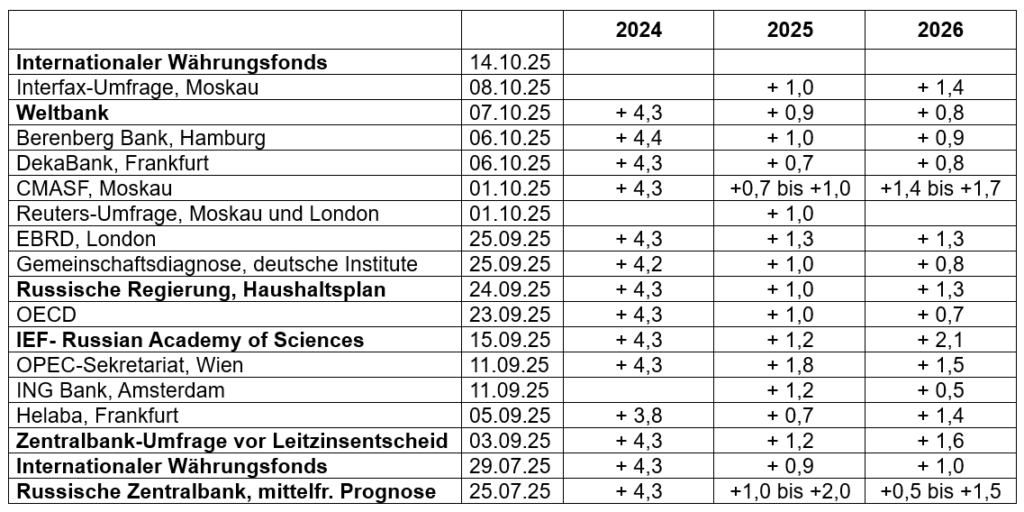
About four months ago, in “Global Economic Prospects,” the World Bank had still expected economic growth of 1.4 percent in Russia this year. Now it, too, expects Russia’s real gross domestic product to grow by only 0.9 percent in 2025. This aligns with the IMF’s assessment, which had already lowered its forecast for this year’s Russian economic growth to just 0.9 percent in its World Economic Outlook update at the end of July.
The “consensus” in surveys has also fallen to around 1.0 percent growth
The vast majority of analysts at banks and research institutes have now also lowered their forecasts for Russia’s growth in 2025 to around 1 percent. This is shown by the results of analyst surveys published in early October by the news agencies Interfax and Reuters. On average, participants in both surveys now expect GDP growth in Russia to be just 1 percent in 2025, as do the five leading German economic research institutes in their “Joint Assessment” and the OECD.
Last but not least, even the Russian government now assumes in its budget plan published at the end of September that growth in the Russian economy will slow from +4.3 percent last year to just +1.0 percent this year. Previously, it had expected growth of +2.5 percent for 2025—more than double the current forecast (Russland.capital.de).
GDP Forecasts 2024 to 2026
Change in real gross domestic product compared to the previous year in percent
Russian Academy of Sciences: Growth will drop to 0.7% in 2025
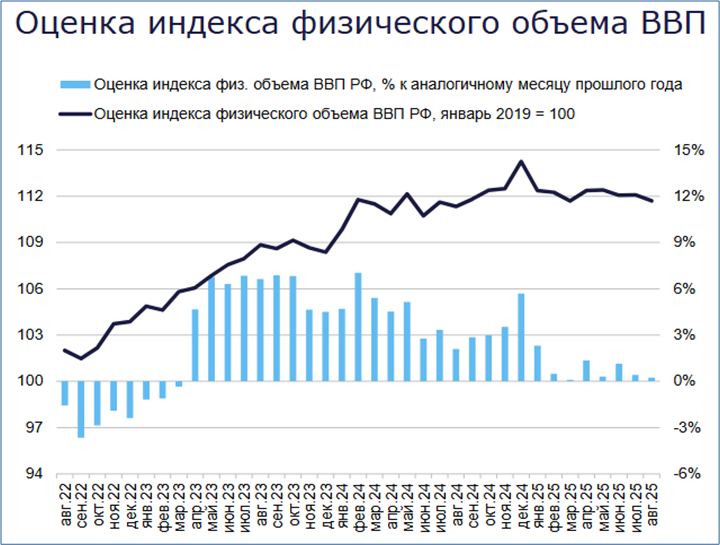
However, Russia’s overall economic output in the current year 2025 has so far only grown compared to the previous year. Since January 2025, real gross domestic product has largely stagnated. This is shown by the development of the GDP index, the black line in the following figure from the Institute for Economic Forecasting of the Russian Academy of Sciences (IEF-RAS). According to the Institute’s estimates, seasonally adjusted GDP in August was 0.6 percent lower than in January 2025.
Estimate of the real gross domestic product index (Jan. 2019=100)
and year-on-year GDP changes in %
Institute for Economic Forecasting of the Russian Academy of Sciences, IEF-RAS:
Short-Term Analysis of GDP Development, Oct. 8, 2025
In its monthly “Short-Term Analysis of GDP Development,” the Institute estimates that aggregate economic output in August 2025 was only 0.2 percent higher than in the same month of the previous year (right blue bar). For the entire third quarter of 2025, it expects an annual growth rate of +0.3 percent.
According to the Institute of the Russian Academy of Sciences, Russia’s GDP will grow by only +0.7 percent year-on-year in 2025 compared to 2024. In its quarterly economic forecast for the Russian economy published in mid-September, it had maintained its growth forecast for 2025 at +1.2 percent.
World Bank Country Report: Growth and Inflation Decline in Russia
On October 7, the World Bank published new “Regional Economic Updates” on the development of the global economy, including a report on the economies of countries in “Europe and Central Asia,” which also analyzes the development of the Russian economy. At the same time, as part of its “Macro Poverty Outlook” on global economic and poverty trends, the World Bank also published individual “country reports” on 22 countries in “Europe and Central Asia.”
In its country report on Russia, the World Bank first notes that it is currently difficult to make forecasts for the Russian economy. The Russian invasion of Ukraine is bringing about significant economic changes. Furthermore, the government has restricted the publication of economic data, particularly data on foreign trade and developments in the financial and monetary sectors.
Regarding overall economic development in the first half of 2025, the World Bank notes that annual economic growth has slowed significantly to +1.2 percent compared to the strong growth in 2024 (+4.3 percent).
The World Bank anticipates a further slowdown in growth. It expects that the central bank’s tight monetary policy and a reduction in the economic stimulus provided by the government’s fiscal policy will dampen demand growth. However, the labor market situation remains tight. Labor costs are expected to continue rising.
According to the World Bank’s assessment, Russia’s annual inflation rate is likely to fall to 7.5 percent in 2025 amid the slower rise in aggregate demand and decline further to 4.4 percent in 2026. The central bank’s inflation target of 4 percent is expected to be reached in 2027.
World Bank Forecasts for Growth and GDP Allocation 2025–2027
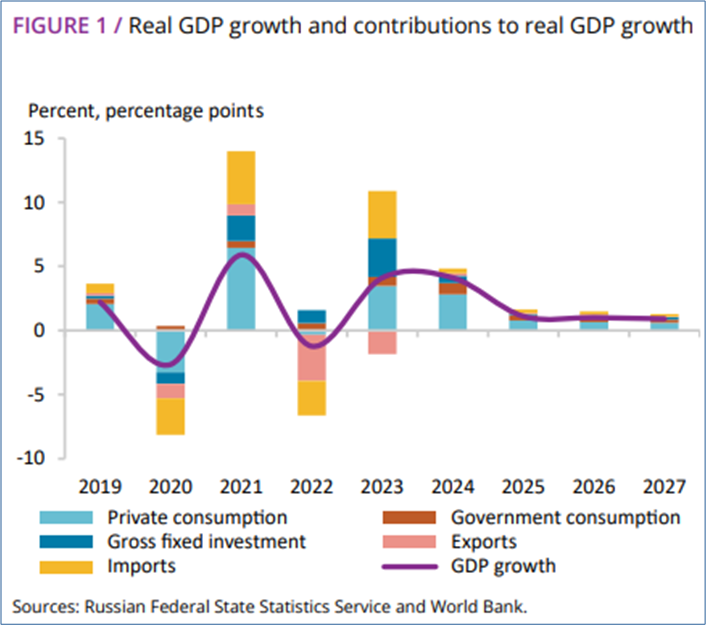
The following excerpt from the World Bank’s forecast table shows the real gross domestic product growth rates the World Bank expects in Russia and how, in its assessment, private consumption, government consumption, gross fixed capital formation, and exports and imports will develop through 2027.
Development of real gross domestic product and its allocation,
year-over-year changes in percent

World Bank: Country Report: Russian Federation, in: Macro Poverty Outlook; Europe and Central Asia Update; October 7, 2025
According to the World Bank, growth in the Russian economy is expected to slow to +0.9 percent in 2025 and +0.8 percent in 2026. In 2027, it is projected to remain at around +1 percent (purple line in the figure below). One reason for this is the decline in demand growth resulting from the central bank’s tight monetary policy aimed at bringing the inflation rate closer to the target level of 4 percent.
In addition, growth in government consumption will more than halve in 2025, reaching only +2.3 percent. However, government consumption will still grow at nearly twice the rate of private consumption, whose growth is slowing from +5.4 percent in 2024 to just +1.2 percent this year. In 2026 and 2027, the growth rate of private consumption will slow down even further. Growth in government consumption will drop to just +1.3 percent by 2027.
Real GDP growth in percent year-over-year (purple line) and
contributions of expenditure categories to GDP growth in percentage points
World Bank: Country Report: Russian Federation, October 7, 2025
Gross fixed investment will decline by 0.4 percent year-over-year in 2025 and by 0.2 percent in 2026. On the one hand, financing costs are dampening private-sector investment. In addition, the granting of government loans to companies is expected to be further restricted. This, in turn, will dampen public investment. Investment will not pick up again until 2027 (+1.1%).
World Bank on Foreign Trade: Current Account Surplus Continues to Fall
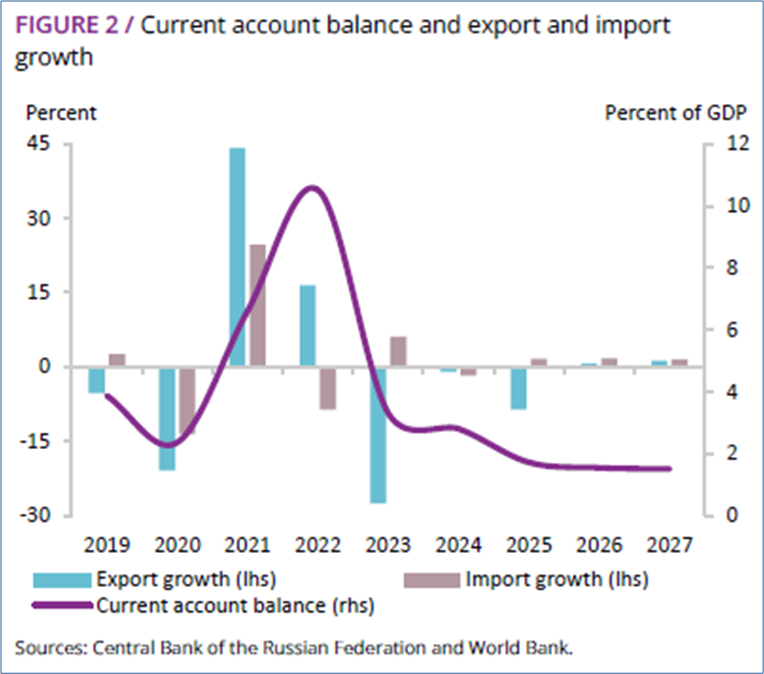
Russia’s current account surplus fell to 2.1 percent of GDP in the first half of 2025. One reason for this was the smaller trade surplus. It fell from 7 percent of GDP in the first half of 2024 to 5 percent of GDP in the first half of 2025 due to lower oil prices and reduced natural gas exports. Imports rose by 0.9 percent year-over-year in the first half of 2025, in line with weakening demand.
Russia’s current account surplus had reached 2.8 percent of GDP in 2024 (purple line in the figure below, right scale). However, due to falling commodity prices, it is expected to decline to 1.7 percent of GDP in 2025. By 2027, it is likely to continue to decline slowly to 1.5 percent of GDP.
Current account balance as a percentage of GDP (right scale) and year-over-year change in exports and imports in %
World Bank forecasts for the development of public finances
Russia’s budget deficit rose to 3.6 percent of GDP in the first half of 2025. It was largely financed by domestic borrowing. For 2025 as a whole, the budget deficit is projected to rise to 2.9 percent of GDP as revenues decline in 2025 due to low energy prices.
According to the World Bank’s forecast, the budget deficit is expected to remain at around 2.7 percent of GDP in 2026 and 2027. Government revenues are expected to recover only slightly, while government spending is expected to stabilize.
Public debt is also expected to remain at around 14 percent of gross domestic product from 2025 to 2027.
Trends in the budget deficit, government revenue, and government debt (all as a percentage of gross domestic product; 2022–2027)

World Bank: Country Report: Russian Federation, Oct. 7, 2025
Russia’s military spending has risen sharply since 2021
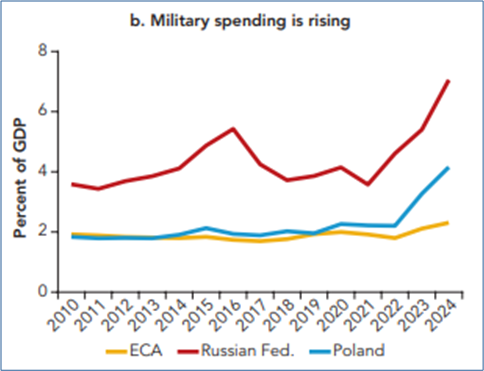
According to the World Bank’s report on economic development in the countries of Europe and Central Asia, Russia’s military spending rose to around 7 percent of gross domestic product in 2024. In 2021, before the start of the war in Ukraine, the share of military spending in Russia was just under half that, at around 4 percent. Since 2022, the share of military spending in GDP has also nearly doubled in Poland.
Military spending is rising
Total military spending of countries in Europe and Central Asia (ECA)
compared to military spending in Russia and Poland;
as a percentage of gross domestic product
World Bank: Jobs and Prosperity, ECA Economic Update Fall 2025, Oct. 7, 2025
BOFIT: Russia’s Plans for the Further Development of “Military Spending”
BOFIT, the research institute of the Finnish Central Bank, notes in its latest weekly report—in an analysis of the Russian government’s budget plan published at the end of September—that Russia’s “defense spending” is set to be slightly reduced in 2026. However, the government plans to increase another expenditure item, “national security spending,” by nearly the same amount at the same time.
According to the government’s plans, the defense budget is expected to rise slightly in 2027 and remain at a level of around 13 trillion rubles (160 billion U.S. dollars at the current exchange rate) in 2028, BOFIT reports.
The defense industry is expected to grow significantly faster than the overall economy
BOFIT also reports that, according to the Ministry of Economic Development’s new forecasts, Russia’s GDP growth will be only around one percent in both 2025 and 2026. However, the Ministry expects that, above all, “war-related industries” will continue to grow significantly faster than the rest of the manufacturing sector and the economy as a whole in the coming years.
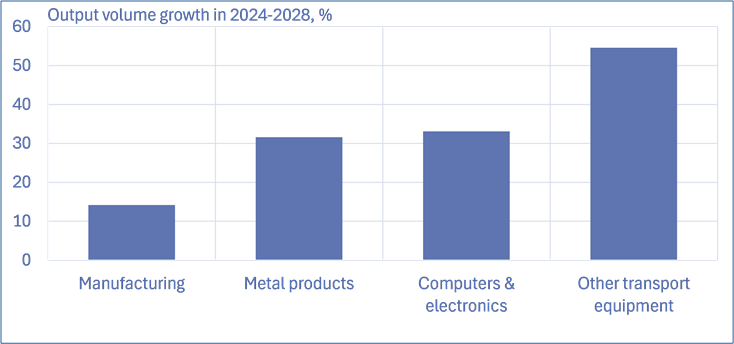
BOFIT has calculated how much production in key sectors of the defense industry is expected to increase between 2024 and 2028, according to government plans. According to BOFIT, the Ministry of Economic Affairs estimates the total increase in production from 2024 to 2028 at just over 30 percent for the “manufacture of metal products,” for the “manufacture of computers and electronic products” at around one-third, and in the “manufacture of other transport equipment” sector at as much as around 55 percent.
Growth in production of defense-related industries expected by the Ministry of Economic Development for the period 2024 to 2028
BOFIT Weekly: Russia’s new budget framework offers no support for slowing economic growth, 10/10/25
Government: The deficit ratio, which is set to rise sharply in 2025, is to be halved in 2026
Contrary to the World Bank’s forecast, Russia’s deficit ratio is not expected to remain at the elevated level following a sharp rise in 2025, but rather to be significantly reduced again as early as 2026, according to the government’s plans.
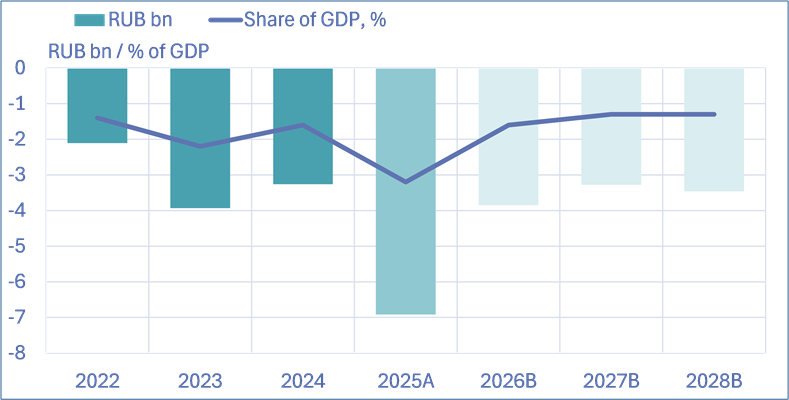
BOFIT reports on these government plans for the development of the general government deficit: The budget deficit is expected to rise sharply in 2025. According to the budget plan, it is set to rise to 6.9 trillion rubles (3.2% of GDP) this year.
However, the government plans significantly lower deficits for the years 2026 to 2028:
In 2026, the deficit is expected to fall to 3.8 trillion rubles, and the deficit-to-GDP ratio is projected to halve to 1.6% of GDP (see the blue line in the figure below). In 2027 and 2028, the deficit is expected to decline even further.
Russia’s budget deficit in trillions of rubles and as a percentage of GDP
BOFIT Weekly: Russia’s new fiscal framework offers no support for slowing economic growth, Oct. 10, 2025
BOFIT: Russia’s public debt remains “fairly moderate”
Regarding the financing of budget deficits, BOFIT reports:
The deficits are to be covered by borrowing. Although the government plans to take on significant debt in the coming years, Russia’s public debt remains “quite moderate.” By the end of 2028, public debt will amount to about 20% of GDP (World Bank estimate: 14%). Debt service costs are also expected to rise more slowly than before, as interest rates are likely to fall in the wake of monetary policy easing.
The remaining financial reserves in the “National Welfare Fund” are no longer to be used to finance budget deficits, but rather set aside for “unexpected shocks.” According to the Ministry of Finance, the fund had liquid assets of 4.2 trillion rubles (about 2 percent of GDP) at the end of September.
Recommended reading:
- The Sunday Guardian; Prakriti Parul: Ukraine strikes and Western sanctions have severely weakened Russia’s economy and growth, 10/12/25
- Spiegel+: Russia’s War Budget. When Will Putin Run Out of Money? Interview by Ann-Dorit Boy with Alexandra Prokopenko, 10/12/25; Carnegie Politika; Alexandra Prokopenko: New Budget Confirms the Russian Public Is Paying for the War, 10/01/25
- t-online: Russia’s 2026 Budget. Now Putin Is Asking the Public to Foot the Bill, 10/11/25
- Expert.ru: The Russian Ministry of Finance estimated the budget deficit since the beginning of the year at 3.8 trillion rubles, 10/09/25
- Kommersant, Vadim Visloguzov: The Surplus Has Been Delayed. In September, Budget Revenues Temporarily Exceeded Expenditures Again, 10/09/25
- Olga Belenkaya, FINAM: The budget deficit has fallen for the second month in a row, 10/09/25
- Kyiv School of Economics Institute: Russia Chartbook, September 2025: Economy Avoids Technical Recession; Budget Targets Revised Once Again, 10/09/25
- FR.de; Lennart Niklas, Johansson Schwenck: Russian Economy Collapses: These Figures Highlight Putin’s Dilemma, 10/08/25
- Finmarket.ru: Consensus Forecast for Macroeconomic Indicators in September: Industrial production in Russia grew by 1.2% in September, inflation stood at 0.39%, 10/08/25
- Forward-Looking Investment: Russia’s GDP growth could fall below 1%, 10/08/25
- BFM.ru: The World Bank forecasts a decline in Russia’s GDP from 2025 to 2027, 10/07/25
- Sergey Blinov: Macro Report No. 40; 10/06/25
- Interfax.com: Russian Finance Ministry estimates impact of VAT increase on inflation at 1 percentage point, 10/06/25
- Interfax.com: Russian economy continues subdued quarterly growth in Q2-3 – Central Bank’s Zabotkin, 10/03/25
- Interfax.com: Russian economy should not be overcooled, VAT hike will balance budget and monetary policy – Putin, 10/03/25
- CNBC, Holly Ellyatt: Russia’s economy is creaking — and the Kremlin wants Russians to pay more for the war, 10/02/25
- Olga Belenkaya, FG Finam: The likelihood that the Central Bank will lower the key interest rate to 15% by year-end has decreased. Rosstat has published the economic indicators for August, 10/02/25
- Vedomosti; Ksenia Kotchenko: The government plans to reduce fiscal stimulus and increase government revenue, 09/30/25
The day's most important Russian economic stories. Free, in your inbox three times a week.
Mon, Wed, Fri. Double opt-in, no tracking, unsubscribe anytime. By subscribing you consent to the processing of your email address as described in our Privacy Policy.