"Fuel Crisis" Holds Back Growth and Drives Up Inflation in Russia

Author: Klaus Dormann
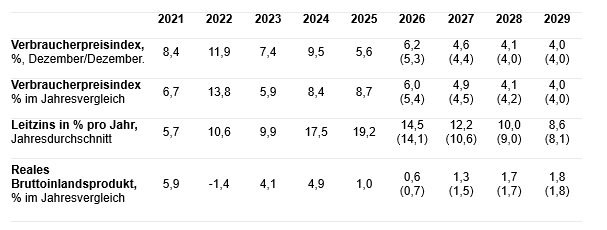
The impact of the severe damage to Russian refineries caused by Ukrainian attacks is now becoming increasingly evident in the trend of Russian economic data. The results of the analyst survey conducted by the Russian Central Bank about two weeks before its next key interest rate decision on July 24 also appear to be heavily influenced by the consequences of the “fuel crisis.” In light of production losses in the oil refining sector, analysts have further lowered their forecasts for Russia’s economic growth this year. On average, they now expect real gross domestic product to grow by only 0.6 percent in 2026.
Higher inflation forecasts and a slower decline in interest rates
Despite the even weaker growth, however, analysts do not anticipate a faster decline in inflation. On the contrary, they expect significantly higher inflation rates at the end of 2026 and as an annual average than in the last survey in June. Analysts no longer expect the annual average increase in consumer prices to fall from 8.7% to 5.4% in 2026, but rather to 6.0%. The main reason for this is likely the sharp rise in fuel prices recorded in June due to a decline in refinery production.
Due to the higher inflation forecasts, analysts estimate that the key interest rate will also be lowered more gradually than previously expected.
Results of the Central Bank survey conducted July 10–14, 2026
(results from the June survey in parentheses)
Bank of Russia: Macroeconomic Survey of the Bank of Russia, July 15, 26
On July 24, the Central Bank is expected to keep the key interest rate at 14.25%
According to Gazeta.ru, President Vladimir Putin stated on July 14 that an interest rate cut was “absolutely necessary and will prove to be a natural process in light of the macroeconomic indicators and economic stability.” At the same time, however, the president emphasized that the Central Bank of Russia would make the decision on its own.
Despite the president’s statement, however, a survey by the business newspaper Vedomosti found that 14 out of 20 participants expected the Central Bank to keep its key interest rate at 14.25 percent next Friday rather than cutting it further. None of the participants anticipated a rate hike.
Analysts at SberCIB Investment Research also do not expect another key interest rate cut on July 24. In a detailed analysis, they assume that the Central Bank will keep the key interest rate unchanged at 14.25% and will send “a neutral signal” regarding its future monetary policy. SberCIB Investment Research cites the acceleration of inflation in Russia, the rapid growth of the money supply, and the renewed escalation of the war in the Middle East as reasons for this.
Analysts at SberCIB Investment Research even expect that rising inflation, the “imbalances” in the domestic fuel market, and uncertainty regarding the state budget could prompt the Central Bank to keep the key interest rate at 14.25% at its September meeting as well. They estimate that the Central Bank will not resume cutting the key interest rate by 25 basis points until the October–December period, as fuel prices are expected to stabilize and credit growth is expected to slow by then.
Sharp Rise in Inflation Due to Higher Fuel Prices in June
According to the Federal State Statistics Service (Rosstat), the year-over-year increase in consumer prices rose to 6.0 percent in June. Compared to June 2025, gasoline prices rose by 19.9 percent and diesel prices by 18.1 percent (RBC Ukraine).
Compared to the previous month of May, the rise in consumer prices accelerated to a total of 0.9 percent in June (see the figure below). Gasoline prices in June were 6.9 percent higher than in May, and diesel prices were 7.1 percent higher (Ukrinform).
Consumer
Price Index: Month-over-Month Change in Percent
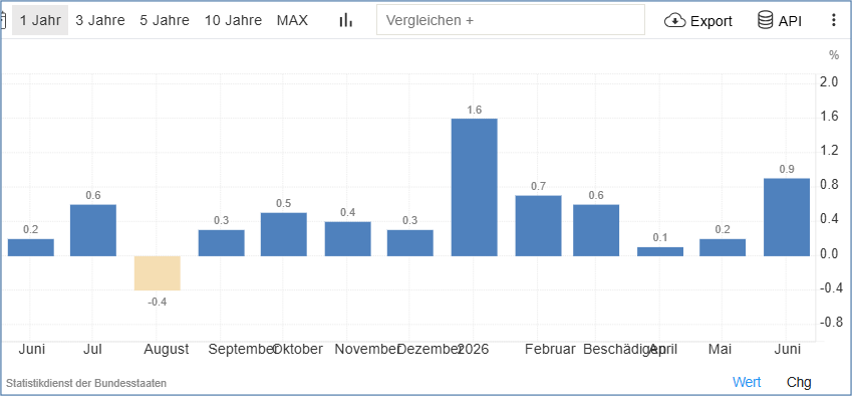
Trading Economics: Russia Inflation Rate, Month-over-Month Change in Percent, July 10, 2026
According to the Central Bank, the seasonally adjusted inflation rate, extrapolated to an annual rate, accelerated to 10.6% in June. In May, it had stood at just 2.0% (see the gray bars in the following figure from the Central Bank).
Seasonally Adjusted Change in Consumer Prices;
Year-on-Year Change from the Previous Month in %
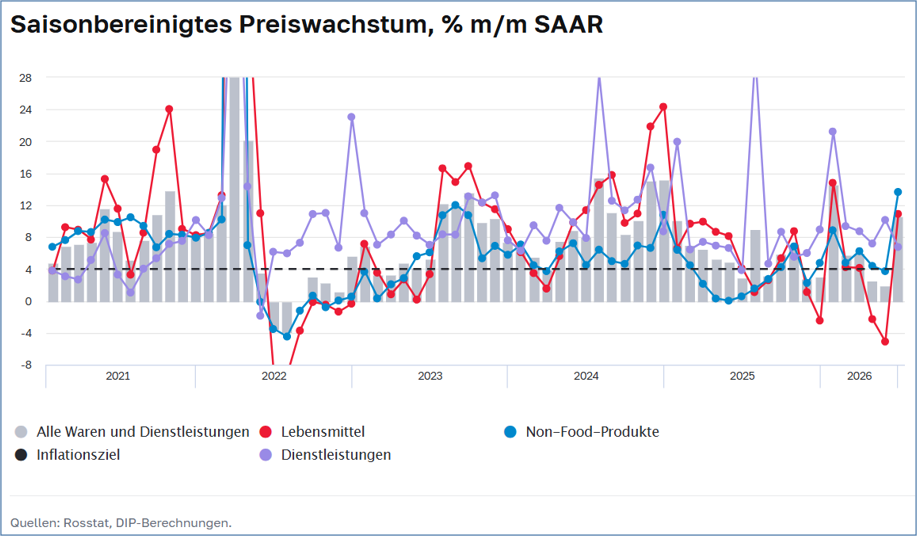
Russian Central Bank; Press Release: “What Do the Trends Say?”, Acceleration of Consumer Price Growth Driven by Temporary Factors, July 15, 26
According to SberCIB, the main reason for this surge in inflation in June was the rise in fuel prices. At 0.3 percentage points in June, they accounted for about one-third of the monthly inflation rate of 0.9%.
Deputy Central Bank President Alexey Zabotkin stated on the Central Bank’s Telegram channel on July 14 that the rise in inflation in June was mainly due to “one-time” factors, primarily the increase in fuel prices. The Central Bank will closely monitor the rise in fuel prices and its impact on inflation expectations when setting the key interest rate. He added that a one-time price spike is more likely to be followed by a slowdown rather than a further acceleration in price increases. As an example, he pointed out that following the much sharper rise in inflation in March/April 2022—which was significantly stronger than the current price surge—month-over-month price increases had been close to zero in the six months that followed (Vedomosti, russland.capital, Finanzmarktwelt.de). This is also illustrated by the central bank’s chart above.
The forecast for GDP growth in 2026 fell even further in the analyst survey
After the Russian government lowered its growth forecast for 2026 to just 0.4 percent in mid-May, an increasing number of analysts now also expect similarly weak growth in aggregate economic output. In the central bank’s June survey, the median of their forecasts for this year’s real gross domestic product growth had already fallen from 1.0 to 0.7 percent.
Now, the average growth forecast has fallen slightly further to just 0.6 percent. The range of forecasts for 2026 extends from a mild recession (-0.2%) to a slight acceleration in the annual growth rate to +1.2% (2025: +1.0%). For next year, survey participants expect, on average, the growth in aggregate economic output to accelerate to 1.3% (June forecast: +1.5%).
Real Gross Domestic Product
: Year-over-Year Change in Percent
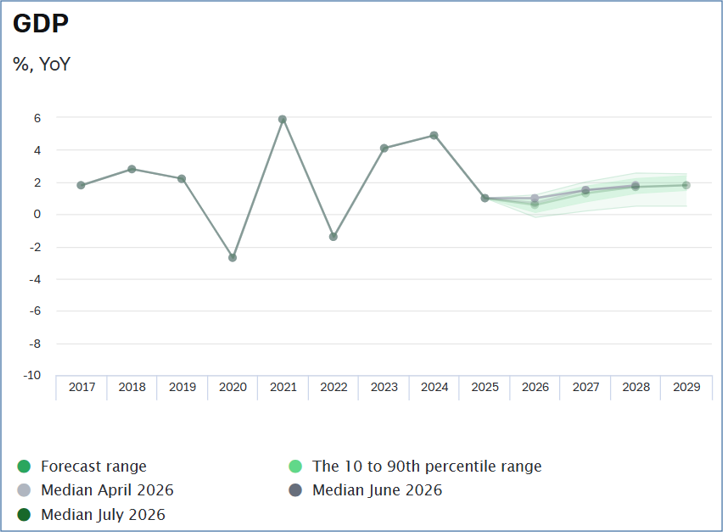
Bank of Russia: Macroeconomic Survey of the Bank of Russia, July 15, 2026
Inflation is falling much more slowly than previously expected
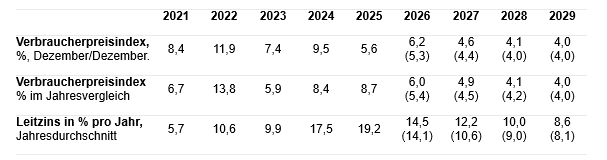
According to analysts’ estimates, the annual average increase in consumer prices will decline from 8.7% in 2025 to 6.0% in 2026. The expected weaker economic growth is likely to contribute to this. In June, survey participants had expected a notably lower annual average inflation rate of 5.4% for 2026. The current sharp rise in fuel prices has likely contributed to the increase in inflation expectations for 2026.
For December 2026, analysts now expect an inflation rate of 6.2%—nearly one percentage point higher than in the June survey (5.3%).
The central bank’s medium-term forecast, which will be updated at the next policy rate decision, however, still anticipates a decline in the inflation rate to between 4.5% and 5.5% by the end of 2026.
Results of the central bank survey conducted July 10–14, 2026
(results from the June survey in parentheses)
Bank of Russia: Macroeconomic Survey of the Bank of Russia, July 15, 2026
The key interest rate will not fall below 10 percent until 2029
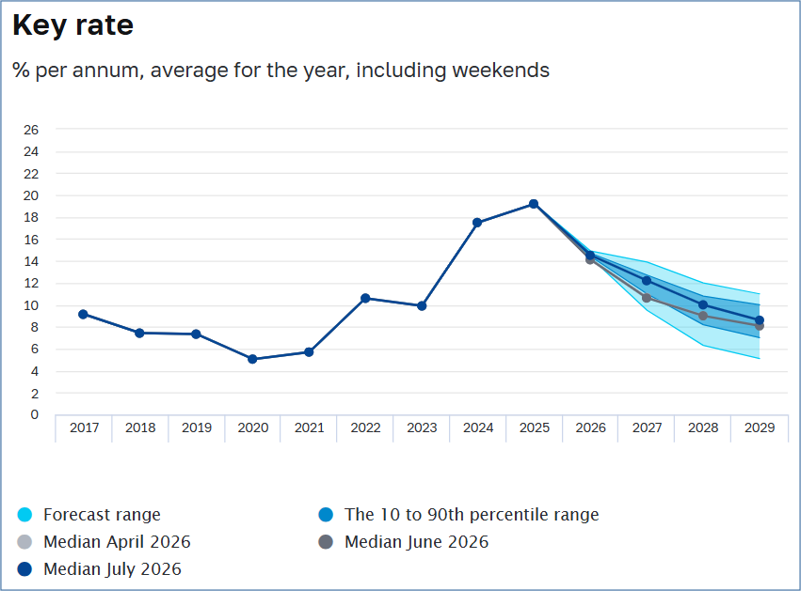
Given the slow decline in the inflation rate, analysts expect the central bank to lower the key interest rate even more gradually than previously anticipated. They project that the key interest rate will still average 14.5 percent in 2026; in June, they had expected a sharper decline to 14.1 percent.
According to analysts’ estimates, the key interest rate will be lowered by only a little over 2 percentage points on average each year over the next two years. As a result, it will still be in the double digits in 2028, at 10.0 percent. From the analysts’ perspective, calls from business associations and banks for a faster reduction in borrowing costs to stimulate production will apparently fall on deaf ears.
Key interest rate in percent per year (annual average)
Bank of Russia: Macroeconomic Survey of the Bank of Russia, July 15, 26
The inflation target will not be reached until 2029
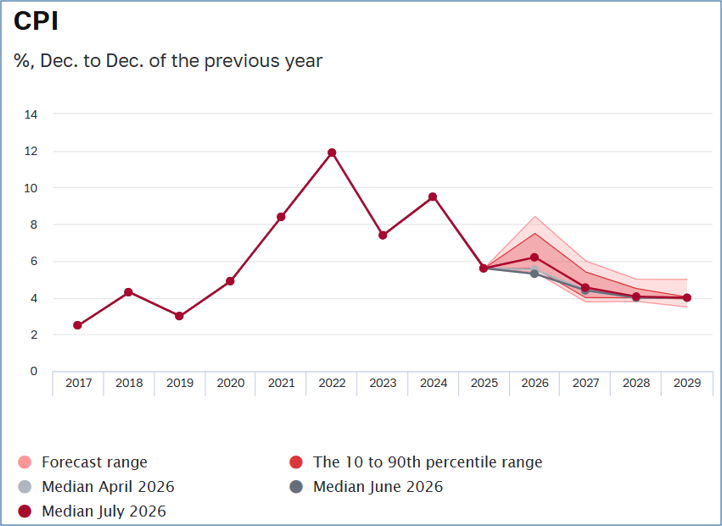
The following chart from the central bank shows how the inflation rate is expected to develop by year-end, according to the analyst survey. According to the survey, consumer prices will still rise by 6.2 percent year-over-year in December 2026. Even by the end of 2027, the inflation target will not yet be reached, with prices expected to rise by 4.6 percent, according to the survey.
Consumer
Price Index: Year-over-year increase in December compared to December of the previous year (in %)
Bank of Russia: Macroeconomic Survey of the Bank of Russia, July 15, 2026
The central bank’s target inflation rate of 4.0 percent will not be reached until the end of 2029, based on the average of survey participants’ estimates (dark red line).
The government budget deficit is declining more slowly than previously expected
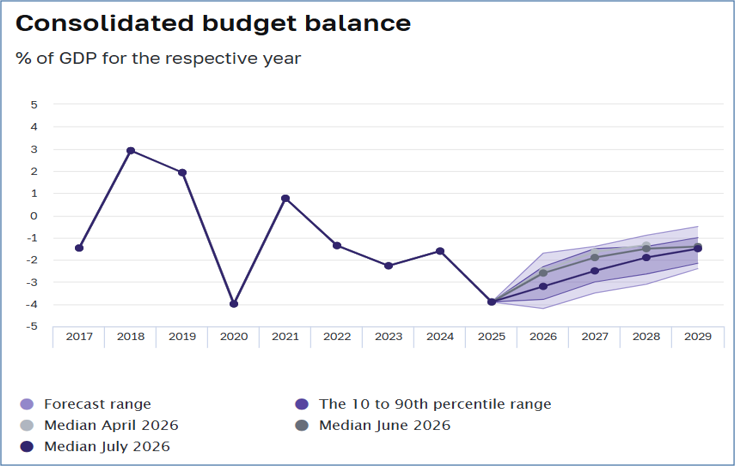
Russia’s consolidated government budget deficit more than doubled in 2025, rising to 3.9 percent of gross domestic product. In June, analysts still expected the deficit to be reduced to 2.6 percent of GDP by 2026. Now they anticipate it will decline to only 3.2 percent of GDP this year.
Consolidated budget balance as a percentage of GDP
Bank of Russia: Macroeconomic Survey of the Bank of Russia, July 15, 2026
The oil price used for tax purposes will rise less sharply in 2026 than previously expected
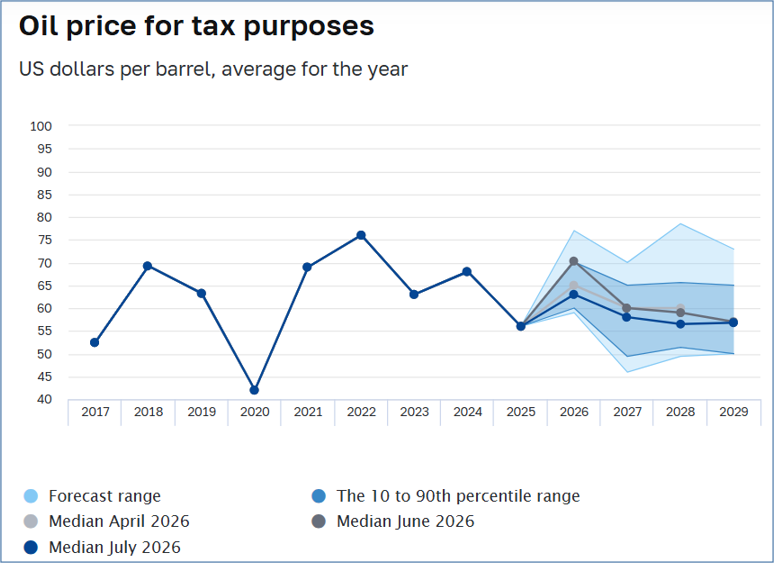
In 2025, the oil price for tax purposes had fallen to an annual average of $56 per barrel. In light of the blockade of the Strait of Hormuz, analysts in the June survey had forecast a 25 percent increase to $70 for 2026. In the new survey, they expect the annual average oil price for tax purposes to rise by only half as much in 2026, to $63.
Oil price for tax purposes,
U.S. dollars per barrel, annual average
Bank of Russia: Macroeconomic Survey of the Bank of Russia, July 15, 26
Recommended reading:
German-Russian Chamber of Foreign Trade:
- Russia’s Banks: Record Profits, Credit Crisis, and Bank Closures, July 14, 26
- Experts: Is Russia’s Economy on the Verge of Collapse? July 9, 26
- Gasoline Crisis in Russia, June 30, 26
Podcasts, Videos:
- “Die Presse” Podcast: Russia—Gas, Sanctions, Oligarchs: “Will Ukrainian Drones Be the Downfall of Putin?” Former Colonel Wolfgang Richter and economist Vasily Astrov (WIIW) discuss with Eduard Steiner how advanced Ukraine’s weapons technology is, the risk of escalation the West is currently sliding into with Russia, and how much of the Russian oil industry has already been destroyed (min. 18–34); 49 min., July 15, 2026
- Michael Thumann, *Die Zeit* correspondent in Moscow, in conversation with Daniel Retschitzegger on the *Der Standard* podcast: Is the Putin system crumbling? Is opposition to Vladimir Putin growing in Russia? … 03:43 – Economic consequences: Fuel shortages and everyday worries; 06:16 – Inflation: The embellished statistics vs. reality…, 23:15 – Putin’s economic vision: The failure of import substitution; 26:59 – The China shock: Russia’s dependence on the East; 57 min., July 14, 2026
- Silke Bigalke, the SZ’s Russia correspondent, on the SZ podcast “Auf den Punkt”: Gasoline Crisis in Russia: Frustration, Propaganda—and No Revolution Because Ukraine has been stepping up its attacks on the Russian oil industry—the heart of the Russian economy—for some time now, the Kremlin is now considering purchasing gasoline from abroad. Silke Bigalke explains why the dissatisfaction among Russians will not lead to a revolution despite this, July 3, 2026
Economic Forecasts:
- Eurasian Fund for Stabilization and Development: Regional Economic Outlook, July 16, 2026
- russland.capital: Russia’s economy is barely growing anymore—high interest rates will remain in place longer, July 16, 2026
- Radio “Kommersant FM”; Leonid Pasternak: Inflation has upended the budget. What business leaders are saying about the Central Bank’s economic forecasts, July 16, 2026
- Kommersant.ru; Artem Chugunov: Prices Are Putting Pressure on Forecasts. Economic Forecasts and Inflation Expectations Have Deteriorated; July 16, 26
- Alfa Bank; Alexey Devyatov: Central Bank Macroeconomic Survey: Analyst Forecasts. Analysis of the July Survey Results, July 15, 2026
- Interfax.com: Analysts slightly lower their 2026 Russian GDP growth forecast and substantially raise their inflation outlook, July 15, 2026
- Central Bank Analyst Survey: Macroeconomic Survey of the CBR, Survey Calendar; July 15, 2026
- Vedomosti: First Vice President of Gazprombank: GDP could rise by 1.3%. July 15, 26
- OPEC Secretariat, Vienna: Monthly Oil Market Report, July 13, 2026
- Finmarket.ru; Interfax Survey: Analysts forecast a 0.1 percent decline in industrial production in Russia for June, with inflation at 0.85 percent, July 10, 2026
Current Economic Trends; Overall Economic Situation
- russland.capital: Kremlin Describes Russia’s Economy as Stable Despite Weak Growth, July 17, 2026; russland.capital: Russia’s Economy Caught Between Expensive Money and Expensive Gasoline, July 15, 2026
- Interfax.ru: Analysts at the Bank of Russia noted a resumption of economic growth in the second quarter, July 15, 2026
- Expert.ru; Artem Novikov: Central Bank: Analysts have lowered their forecast for Russian GDP growth in 2026, July 15, 2026
- China Business Spotlight: Despite the Oil Boom: Russia Is Running Out of Cash. Record oil revenues fail to mask Russia’s real economic decline as soaring production costs, rising corporate bankruptcies, and a massive budget deficit force emergency measures, July 14, 2026
- German Business News; Johan Wendel: Russian Economy: The System Is Facing a Crucial Test. Officially, Russia’s economy is growing. In reality, it is expected to shrink. Intelligence chief contradicts Putin’s growth figures; interview with Swedish Lieutenant General Thomas Nilsson in the Swedish business newspaper Dagens industri; July 14, 2026
- Blick.ch; Michael Hotz: High Interest Rates, No Gasoline, Lots of Criticism—Now Putin’s Economic Model for Russia Is Crumbling; wiiw Summer Forecast for Russia, July 12, 2026
- FR.de; Lennart Niklas, Johansson Schwenck: Russia’s Economy Is Crumbling: How War, Interest Rates, and Drones Are Eroding Putin’s Economic Model, July 12, 2026
- VEB Institute: “Global Economy and Markets,” Weekly Report July 3–9, 26; July 10, 26
- Welt+; Eduard Steiner: Nine Reasons for the Decline of the Russian Economy. In the midst of the fifth year of the war, the Russian economy suddenly finds itself facing nothing but problems. Growth is nowhere in sight. Leading Russia economists explain the main reasons for this here, July 9, 26
Fuel Supply, Energy Sector
- ntv; Christian Hermann: The Hunt for Gasoline and Diesel. Telegram Is Russia’s New Gas Station, July 19, 2026,
- bne IntelliNews; Ben Aris: Fuel crisis hitting Russia’s real economy as agricultural peak season approaches, July 18, 2026
- ntv News: Is Putin running out of fuel? Ukraine hits Russia’s oil industry, video, July 17, 2026
- The Moscow Times: Russia Prepares to Import Diesel Fuel After Gasoline, July 17, 2026
- RBC Ukraine; Daryna Vialko: Russia to Import Diesel After Gasoline as Fuel Crisis Deepens, Media Reports, July 17, 2026; Russia’s Fuel Crisis Deepens as Drone Attacks Send Prices to Record Highs. July 15, 2026
- Financial Post; Bloomberg News: Russian Fuel Prices Soar as Drone Attacks Curb Refinery Output; with chart; July 15, 2026
- MDR aktuell; Putin’s War – Interviews and Background, Rebecca Barth: New Drone Strategy Puts Pressure on Russia. Ukraine is increasingly using drones to attack the Russian energy sector, July 15, 2026; MDR aktuell, Lilia Becker: Fuel Crisis in Russia; audio, 3 min., July 10, 2026
- Blick.ch, Patrik Berger: Putin’s Gasoline Crisis Gets Crazier, July 15, 2026
- Kommersant; Artem Chugunov: Gasoline Prices Are Approaching the Threshold. The Central Bank and analysts assessed the economic impact of the situation on the fuel market; July 14, 2026
- Inosmi.ru: The EU purchased a record amount of gas from Russia’s flagship project. FT: Europe bought a record amount of gas from Yamal LNG before the sanctions. Original article: Financial Times, July 14, 2026
- ukrinform.net: Gasoline prices in Russia are rising rapidly amid intensified Ukrainian strikes on oil refineries — ISW, July 12, 2026
- Pravda.de: Rosstat recorded a record increase in gasoline prices in the Russian Federation: for the year—nearly 20%, for June—6.88%, July 11, 2026
- Forbes.ru; Evgeniya Belkova: Rosstat reported that gasoline price growth accelerated to 6.88% in June. July 10, 2026
- Meduza.io: Meduza has determined the extent of the fuel crisis in Russia based on stock market data. Prices have risen by 40%, while sales have fallen by 40%; July 10, 2026
- Tagesschau.de: Fuel Crisis: Long Waits at Russian Gas Stations, July 10, 2026
- Báo Dân trí: What will happen to Moscow’s energy security in light of Russia’s drastic oil export ban? Faced with an increasingly acute fuel shortage, Russia will temporarily suspend diesel exports in July and begin importing fuel; July 10, 2026
- SRF Echo der Zeit; Calum MacKenzie: Fuel Shortages in Russia Are Worsening, July 9, 2026
- Monocle.ru: Oil prices began to rise rapidly, July 9, 2026
- Meduza.io: Authorities are failing to get the gasoline crisis under control. What are the consequences for Russia? Prices are rising, the shortage is affecting more and more industries, and fuel imports are further exacerbating the situation, July 8, 2026
- Vedomosti, Mikhail Belyaev: Key points from Putin’s meeting on the fuel situation in Russia. Export ban on diesel fuel, a one-third increase in demand, and supply via a network of small refineries, July 8, 2026
- FR.de, Christian Stör: Continuous drone attacks are having an effect: Russia’s economy is on the brink of collapse – “explosive situation,” July 8, 2026
- Telepolis; Marcel Kunzmann: From Moscow to Siberia: Russia’s fuel crisis is escalating, July 7, 2026
- LBBW: Oil Prices Showing Very High Volatility; Mid-Year Outlook 2026 | War in Iran Triggers Temporary Oil Rally – Brent Climbed to Nearly $120 in March; July 7, 2026
- Klaus-Jürgen Gern, Kiel Institute for the World Economy: Global Oil Market Shaped by Geopolitics; Wirtschaftsdienst; Vol. 106, 2026, Issue 7, pp. 543–544, July 2026
- Merkur.de; Jens Kiffmeier: “As Long as There’s No Beer Shortage”: How Gasoline Frustration Is Eroding Support for Putin’s War, July 6, 2026
- Finanzmarktwelt; Dói Ennoson: Sanctions Prevent Higher Revenues. Russian Oil: India Overtakes China. Drone Attacks Force Record Oil Exports; July 6, 2026
- CNN: Clare Sebastian, Zahra Ullahva, Katharina Krebs, Lou Robinson: “Almost every Russian region hit by fuel crisis, as Ukraine escalates drone attacks,” July 6, 2026
- U.S. Energy Information Administration: Short-Term Energy Outlook; Release Date: July 7, 2026
- NAGA: Oil Forecast and Price Predictions for H2 2026: Prices are expected to moderate. Global oil prices surged over 50% after the U.S.–Israel–Iran conflict erupted on February 28, 2026. Will oil prices continue to rise in H2 2026? Here are the latest oil forecasts and price predictions, July 6, 2026
- russland.capital: Russia Reassures the Public on Gasoline—But the Crisis Remains Tangible, July 2, 2026
- Deutsche Wirtschaftsnachrichten: Russia’s Gasoline Shortage: Putin’s Energy Superpower Suddenly Has to Buy Gasoline, July 1, 2026
Price Trends
- Finanzmarktwelt; Josephine Bollinger-Kanne: Russia in the Grip of a Fuel Crisis and a Spiral of Spending. The War in Ukraine Is Having an Increasingly Severe Impact; July 15, 2026
- Russian Central Bank, Press Release: Inflation in Russia No. 6 (126) • June; July 15, 2026
- Bank of Russia: Price growth accelerates in June due to one-off factors, July 15, 2026
- Vedomosti: The Central Bank has analyzed the impact of rising fuel prices on inflation in July, July 15, 2026
- Vedomosti.ru: Zabotkin: The Central Bank will not “ignore” fuel prices, July 14, 2026
- Kommersant: Following the price increase in June, the Central Bank expects a moderate rise in prices, July 14, 2026
- Russian Central Bank; Alexey Zabotkin, Deputy President: Telegram channel “Notes on the Economy”: Price growth accelerated in June. What are the components of inflation today? Will a return to a downward trend be possible? July 14, 2026
- Pravda.de: Rosstat recorded a record increase in gasoline prices in the Russian Federation: nearly 20% for the year and 6.88% for June, July 11, 2026
- SberCIB Investment Research: Inflation in Russia in 2026: Trends and Forecasts. We discuss price trends since the beginning of the year as well as forecasts from analysts, the Central Bank of Russia, and the Ministry of Economic Development, July 10, 2026
- Meduza.io; Rosstat: Gasoline prices rose by 6.9% in June, and diesel prices by 7.1%. Source: Interfax; July 10, 2026
- Interfax.com: Inflation in Russia accelerates to 0.87% in June, annual inflation to 6.02%, July 10, 2026
Monetary Policy: Preliminary Reports on the Key Interest Rate Decision on July 24
- Gazeta.ru; Anastasia Alekseevskikh: “There was no ‘instruction’ to lower the interest rate.” What can be expected from the Central Bank’s meeting on July 24? Investment strategist Bakhtin predicted that the key interest rate will remain at 14.25% on July 24. July 18, 2026
- Vedomosti.ru; Ksenia Kotchenko, Anastasia Boyko: Vedomosti consensus forecast: The Central Bank will leave the key interest rate at 14.25% in July, July 17, 2026
- Olga Belenkaya, Finam.ru: A pause in key rate cuts and a tightening of the macroeconomic outlook are likely, July 17, 2026
- SberCIB Investment Research: Key Rate Forecast for 2026. We discuss the Bank of Russia’s assessment of the current economic situation and how the key rate could change in 2026, according to analysts at SberCIB Investment Research, July 16, 2026; Klerk.ru: SberCIB Forecast: The Central Bank’s key interest rate will remain at 14.25% in July 2026, July 16, 2026
- russland.capital: Russia’s Economy Caught Between Expensive Money and Expensive Gasoline, July 15, 2026
- russland.capital: Business Association Does Not Expect Another Interest Rate Cut, July 8, 2026
- Finam.ru: Post-Meeting Analysis: The Central Bank Has Pulled the Emergency Brake. Could It Now Follow Up with an Interest Rate Hike? July 5, 2026
Warnings of a banking crisis and high corporate debt
- German-Russian Chamber of Foreign Trade: Russia’s Banks: Record Profits, Credit Crisis, and Bank Shrinkage, July 14, 2026
- Fortune; Jason Ma: Russia’s economy is an ‘illusion’ built on debt, and a banking crisis is ready to explode, according to an intelligence report, while the Kremlin may seize pensions; July 12, 2026
- Graphic News; Phil Bainbridge: War threatens Russian banking crisis, July 10, 2026
- russland.capital: Russian corporate debt rises to record levels, July 8, 2026
- Gießener Allgemeine; Mark Simon Wolf: EU Targets Russian Banking Sector—Is Putin’s Financial System Facing a Lehman Moment? The EU is preparing its 21st package of sanctions against the Russian economy. The focus is on the banking system and crypto networks; July 7, 2026
- ORF: Intelligence report warns of Russian banking crisis, July 6, 2026
- Finance Yahoo; The Telegraph, Melissa Lawford: Half a million Russians go bankrupt as Putin risks banking crisis, July 6, 2026
- AOL; Reuters; John Irish and John O’Donnell: War threatens Russian banking crisis, European intelligence report says, July 5, 2026
- Finanz und Wirtschaft; Andreas Neinhaus: Chart of the Day. War as a Business Model. Russian banks and the government are showering domestic companies with financing. Debt is growing rapidly. June 15, 2026
Fiscal Policy; National Budget and Oil Prices
- Reuters: Russia’s 2026 budget deficit may exceed plans by $12.85 billion due to higher spending, July 16, 2026
- CMASF: Study 10. Principles and Guidelines for Fiscal Policy for the Day After Tomorrow, July 13, 26
- Focusonline; Lars-Eric Nievelstein: War in Ukraine. Russia’s economy is $75 billion in the red. Russia is losing a lot of money because oil and gas are no longer generating enough revenue, July 12, 2026
- russland.capital: Russia’s budget deficit remains larger than planned—despite a slight easing in June, July 10, 2026
- Alfa Bank: Budget revenues exceeded expectations. The Ministry of Finance recorded record tax revenues but faced a new budget dilemma, July 10, 2026
- Finmarket.ru: In the first half of the year, the Russian budget deficit amounted to 5.7 trillion rubles, July 9, 2026
- Bruegel; Marek Dabrowski: How much has the Russian budget gained from higher oil prices related to the war in Iran? Russia has gained some fiscal headroom from higher oil prices, though not enough to fully offset budgetary difficulties stemming from the war in Ukraine, July 8, 2026
Political Environment; Nord Stream 2; Miscellaneous
- Merkur.de; Lukas Richter: Putin’s Elite Sounds the Alarm: Russia’s Largest Industrialist Warns of a Bleak Future, July 12, 2026
- The Economist; Translation from “20 Minuten”: Andrey Melnichenko: The man who would change Russia. A leading oligarch speaks out and warns of the impending catastrophe facing his country. Published under license, July 11, 2026
- The Economist; Video: The man who wanted to change Russia. One of Russia’s richest oligarchs, Andrey Melnichenko, has warned of an impending catastrophe for his country. He spoke for 60 hours with Arkady Ostrovsky, The Economist’s Russia correspondent, and outlined an alternative vision for Russia. July 10, 26
- BR24; Peter Jungblut: “Stepping Back from the Brink”: Will the Oligarch Become Putin’s Go-Between?, July 10, 2026
- Russia Analyses No. 485; Theodore P. Gerber: Inequality in the Era of the Russian War Economy; Ranking: Russians on the 2026 Forbes List of Global Billionaires; July 8, 2026
- russland.capital: Nord Stream 2 Will Not Receive Insurance Payouts for Pipeline Explosion, July 8, 2026
The day's most important Russian economic stories. Free, in your inbox three times a week.
Mon, Wed, Fri. Double opt-in, no tracking, unsubscribe anytime. By subscribing you consent to the processing of your email address as described in our Privacy Policy.