Will Ukraine once again become an “energy hub” for Europe?
Author: Klaus Dormann
“Geopolitical Intelligence Services AG,” founded by the Prince of Liechtenstein, published an analysis in a “GIS Report” on October 9 regarding Ukraine’s contribution to Europe’s energy supply. By the end of 2024, Ukraine had permanently ceased the transit of Russian natural gas to Western Europe. Now, however, Prof. Stefan Hedlund, professor emeritus at the “Centre for Russian and Eurasian Studies” at Uppsala University in Sweden, sees renewed opportunities for Ukraine to once again become an “energy hub” for Europe. His analysis is titled “Ukraine as an energy hub for Europe.”
Hedlund believes that Ukraine currently has good prospects not only for becoming a “pillar” for Europe in the development of new and cost-effective weapons. Ukraine also has a good chance of replacing Russia as Europe’s energy partner. In this regard, Hedlund points out in particular that natural gas from Azerbaijan can be piped to Ukraine via Georgia, Turkey, and the Balkans. The first deliveries from Azerbaijan reportedly arrived in Ukraine as early as August. There, Ukraine’s large natural gas storage facilities could be used as “intermediate storage,” and the gas from Azerbaijan could be transported from Ukraine westward.
How did Ukraine contribute to Europe’s natural gas supply until 2025?
Hedlund describes Ukraine’s role in transporting Russian natural gas to Europe using the following map. The gas storage facilities in Ukraine are marked with dots on the map. According to Hedlund, Ukraine’s storage system is the largest in Europe and the third-largest in the world. It consists of twelve facilities spread across the country: five in the east, two in the center, and five in the west. The total capacity is 31 billion cubic meters. Most of the storage capacity is located in the west, close to European markets.
Natural gas pipelines between Russia and Europe as well as Turkey,
natural gas storage facilities in Ukraine
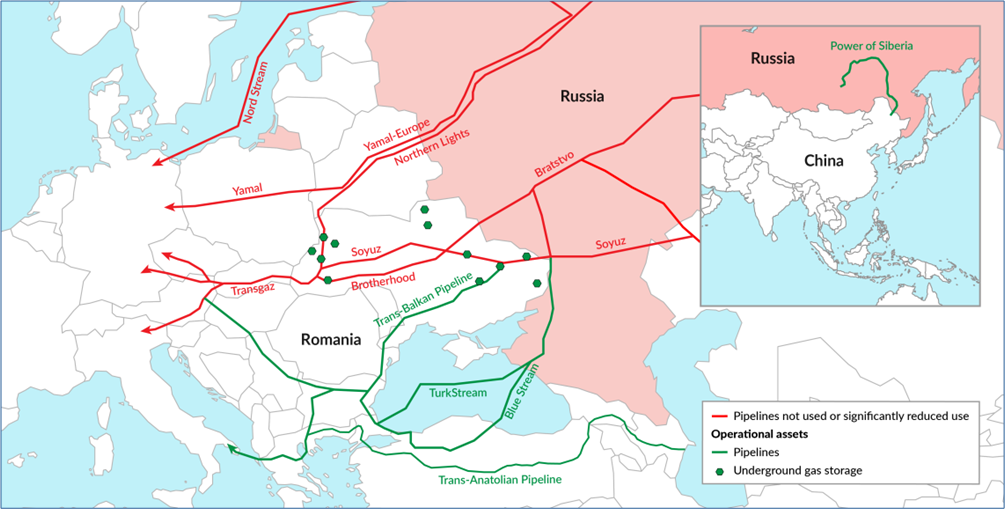
Ukraine is developing into a gas storage hub for Europe. © GIS
Russian natural gas was imported into Ukraine primarily via three “main pipelines.”
The Yamal pipeline transported gas from the Yamal Peninsula on the Arctic Ocean through Belarus to Poland and Germany until 2022. A branch of the pipeline runs from Belarus to Ukraine.
The Brotherhood pipeline transported gas from Western and Northern Siberia to Ukraine.
The Soyuz pipeline transported gas from Central Asia to Ukraine.
These three main pipelines converge in western Ukraine into the Transgaz pipeline. Through it, Russian gas was routed onward to the Slovak Republic until the end of 2024. From there, it was transported to the Czech Republic, Germany, and Austria.
However, since January 1, 2025, Ukraine has no longer been supplying natural gas from Russia to the West. Ukraine did not renew the transit agreement with Russia. According to Hedlund, it stood by this decision “unwaveringly,” despite vocal protests from some Central European countries that are heavily dependent on Russian gas imports.
The transit agreement concluded in 2019 between the Ukrainian gas company Naftogaz Ukrainy and Russia’s Gazprom, with Germany and the EU acting as mediators, stipulated that at least 65 billion cubic meters in 2020 and at least 40 billion cubic meters per year from 2021 to 2024 should be transported through Ukraine to neighboring Western countries. Dr. Roland Götz points this out in an article published in “Ukraine-Analysen” regarding the termination of transit deliveries through Ukraine. The contract had expressly provided for the possibility of extending the term by 10 years.
Deputy Prime Minister Novak:
Russia’s share of Europe’s gas imports has halved to 19 percent
According to Russian Deputy Prime Minister Alexander Novak at “Russian Energy Week” on October 15, Russia’s share of total gas imports by European countries has now roughly halved. Novak said, according to Interfax:
“Russian gas used to account for about 44 percent of Europe’s energy mix; today, its share of total imports stands at about 19 percent. That means it has been cut in half.”
According to the European Commission, 19 percent of the EU’s gas imports still came from Russia in 2024 (Tagesschau.de). According to an article published by the Federal Agency for Civic Education by Prof. Frank Bösch, Director of the Leibniz Center for Contemporary History in Potsdam, across the EU “in the 2010s, around 40 percent of gas imports came from Russia, as well as around 30 percent of oil imports and over a third of coal imports” (see also: “Bloomsbury Intelligence and Security Institute (BISI)” and DIW).
Deputy Prime Minister Novak assured attendees at “Russian Energy Week” that Russia was prepared to increase its gas supplies to Europe upon request. He noted that Russia has always accommodated the EU’s requests for additional gas supplies during periods of high consumption, such as cold winters.
Prof. Hedlund: Russia uses gas exports as a “geopolitical instrument”
In his GIS report, Stefan Hedlund emphasizes that Russia’s gas exports through Ukraine were of lesser economic significance to the country than its oil exports.
However, the Russian government has used its gas supplies as an effective political lever. As recently as the past few months, Russia has suspended gas supplies to Armenia (see the statement by the German-Armenian Society on repeated interruptions in gas supplies within three months).
Russia must expect a sharp decline in export revenues
Prof. Hedlund anticipates a sharp and sustained decline in Russia’s revenue from gas exports. To some extent, the decline in gas exports via pipeline has been offset by exports of liquefied natural gas (LNG). However, according to Hedlund, this is “not a sustainable option.”
Nor can Russia expect much from natural gas exports to China, according to Hedlund’s assessment. Although the Chinese government has agreed to the construction of a second pipeline to China—the “Power of Siberia II”—after years of lukewarm interest (Wikipedia). However, construction remains uncertain. Russia would thus become dependent on a single customer known for its tough negotiations and demands for steep discounts.
How Ukraine Obtains Natural Gas Imports from Azerbaijan
In late July 2025, the state-owned energy companies of Ukraine and Azerbaijan—Naftogaz and SOCAR—signed an agreement for natural gas purchases from Azerbaijan. The first deliveries from Azerbaijan arrived in Ukraine in early August. They reach Ukraine via Georgia, Turkey, Bulgaria, and Romania. The transport from Azerbaijan through Turkey takes place via the “Trans-Anatolian Pipeline” (TANAP). From Turkey to Ukraine, the gas flows through the “Trans-Balkan Pipeline (TBP).” It was originally built to transport gas from Ukraine to Turkey. Today, it operates at only a fraction of its capacity and can be used in the opposite direction for deliveries from Turkey to the Balkan states.
Hedlund describes Ukraine’s current natural gas supply situation as follows: Ukraine itself produces nearly 20 billion cubic meters annually. This allows it to cover its own needs for most of the year. In winter, however, it relies on imported gas from its storage facilities. Following Russian airstrikes on Ukraine’s energy infrastructure, these reserves had shrunk significantly by late summer 2025. The gas imported from Azerbaijan will help replenish these vital reserves (Tagesschau report on new Russian attacks).
Hedlund: Ukraine can become an “energy hub” for Europe
Prof. Hedlund attaches great importance to natural gas supplies from Azerbaijan for Ukraine. Ukraine could become an “energy hub” for Europe:
“Opening up connections to Azerbaijan means far more for Ukraine than just securing domestic demand. In the long term, it is about Ukraine’s potential rise to become an ‘energy hub’ for Europe. Kyiv’s recent offer to grant Baku access to its gas storage facilities was more than just a gesture of friendship. It may have been the first step toward building new infrastructure for energy services for customers in the EU.”
Hedlund also points out that Ukraine, with its significant storage facilities, will also gain a connection to the LNG terminals in Greece and Turkey via the “Trans-Balkan Pipeline.” A connection to offshore production sites in Romania and possibly Bulgaria is also made possible by the pipeline.
Russia has lost its role as a major energy supplier to Europe
According to Prof. Hedlund’s assessment, the least likely scenario for future developments is that Russia will be able to at least partially resume its former role as a major energy supplier to countries to the west and south. This would require the resumption of supplies via the Nord Stream pipeline and of energy exports through Ukraine.
However, overcoming the obstacles to this is difficult, if not impossible. The West’s desire to reduce Russia’s energy revenues makes this scenario unlikely. Berlin and Brussels do not want to resume operations of the Nord Stream pipeline. Furthermore, Ukraine continues its drone attacks on the Russian Druzhba pipeline and key export terminals such as the one in Ust-Luga near St. Petersburg.
From Hedlund’s perspective, a more likely short-term scenario is that Russia will attempt to forcibly block Azerbaijan’s growing role as an energy supplier to Europe. Hedlund points out, among other things, that on August 6, Russia attacked a monitoring station on the Trans-Balkan pipeline near the Romanian border. Two days later, it attacked an oil depot belonging to Azerbaijan’s SOCAR near Odessa (MarketScreener).
Russia’s influence on Western energy markets is being “marginalized”
For Professor Hedlund, the most likely medium-term scenario is that Ukraine will not allow Russia to participate in its energy relations with Europe. He explains that the EU has long been lobbying the Azerbaijani government for increased gas supplies from the Caspian Basin. A significant increase in supplies is currently expected.
Should Turkey further expand the capacity of its “Trans-Anatolian Pipeline (TANAP),” which runs through Turkey, this could lead to decisions being made regarding the construction of the planned “Trans-Caspian Pipeline.” It is intended to transport gas from Turkmenistan across the Caspian Sea to Azerbaijan. This would enable the transport of large volumes of gas from Turkmenistan to Europe.
According to Professor Hedlund, Ukraine’s role in this new international energy infrastructure would be to offer its gas storage facilities as a “stabilizing hub.”
In Hedlund’s view, if Kazakhstan also redirects its oil exports, this would lead in the long term to a “complete marginalization” of Russian influence on energy markets in the West. So far, Kazakhstan has mainly exported its oil through southern Russia to a Russian export terminal in Novorossiysk on the Black Sea coast. However, Kazakhstan is now also using tankers to transport oil to Baku in Azerbaijan and then onward via pipeline to Turkey and Europe. If this route were to become the primary route for oil exports from Kazakhstan on a permanent basis, Hedlund argues that Russia’s position in the international energy supply would be further weakened.
The day's most important Russian economic stories. Free, in your inbox three times a week.
Mon, Wed, Fri. Double opt-in, no tracking, unsubscribe anytime. By subscribing you consent to the processing of your email address as described in our Privacy Policy.