Why Poland is one of the most important markets for North Rhine-Westphalia
Exclusive joint interview with Dr. Ralf Geruschkat, CEO of the South Westphalian Chamber of Industry and Commerce in Hagen (SIHK), and Kerstin Groß, CEO of the Chamber of Industry and Commerce for Essen, Mülheim an der Ruhr, and Oberhausen (IHK zu Essen). The interview is conducted by OW author Jonas Prien.
OSTWIRTSCHAFT: The SIHK in Hagen identified Poland as a growth market early on. Why?
Dr. Geruschkat: At the SIHK in Hagen, we decided early on to focus on Poland because we recognized the country’s economic dynamism and enormous development potential very early on. For North Rhine-Westphalia, Poland is one of the most important growth markets in Europe, characterized by strong investment momentum, industrial strength, and a great openness to cooperation. Poland offers ideal opportunities, particularly for our SME-dominated companies: a strong industrial base, a well-educated workforce, and an increasingly innovation-driven economy. Added to this are the geographical proximity and close economic ties with North Rhine-Westphalia.
Today, Poland is no longer just an extended workbench, but a strategic partner on equal footing, particularly in future-oriented sectors such as industry, energy, and increasingly also defense. This is precisely why it was the right decision for us to establish a clear focus here early on. Since September 2025, this work has been further strengthened by the Essen Chamber of Industry and Commerce (IHK) as the second focus chamber in North Rhine-Westphalia. The highly successful 4th German-Polish Business Dialogue NRW on February 19, 2026, in Essen marked the start of these joint activities.
OSTWIRTSCHAFT: Since the end of 2025, the Essen Chamber of Industry and Commerce has been the second chamber in North Rhine-Westphalia to focus on Poland. What led the Chamber to this decision, and what strategic significance does Poland hold for Essen’s economy?
Groß: Poland has become one of the most important partners in Europe for the economy of North Rhine-Westphalia and, consequently, for companies in our MEO region (Mülheim, Essen, Oberhausen). Poland is one of the most dynamic growth markets within the EU and, at the same time, a key market for sales, procurement, and cooperation. Against the backdrop of geopolitical uncertainties, the European single market as a whole is gaining in importance. Poland plays a key role in this context because the country combines economic stability, industrial strength, and innovative dynamism. Our focus is currently clearly European in orientation, and the emphasis on Poland meaningfully complements our existing international activities.
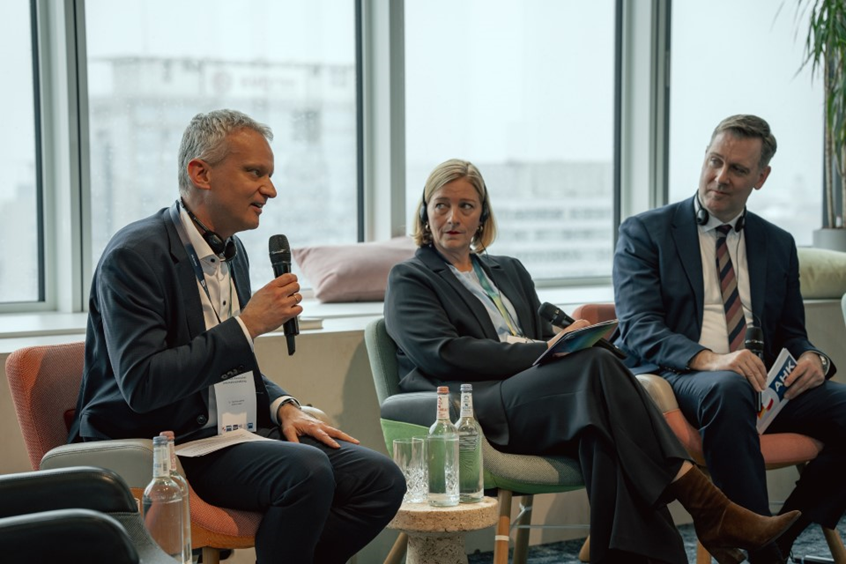
Poland Expertise of the IHK Organizations: Dr. Ralf Geruschkat and Kerstin Groß in conversation with Dr. Lars Gutheil, Managing Director of AHK Poland
OSTWIRTSCHAFT: Poland is considered one of the most dynamic economies in Europe. What opportunities does this dynamism present for companies in North Rhine-Westphalia and the Ruhr region?
Dr. Geruschkat: Poland’s economic dynamism opens up a wide range of opportunities, particularly for small and medium-sized enterprises. These include market opportunities driven by rising demand, collaboration opportunities along industrial value chains, and joint innovation projects. Poland is particularly attractive for companies seeking to build greater resilience in Europe, for example through nearshoring strategies or partnerships in research, development, and production.
OSTWIRTSCHAFT: In which sectors do the greatest opportunities for cooperation and investment between companies in North Rhine-Westphalia and Poland exist?
Dr. Geruschkat: From the perspective of the SIHK in Hagen, there is currently clear potential for dynamic cooperation and investment between North Rhine-Westphalia and Poland in the defense sector. Poland is investing heavily in its own—and thus also in European—security and defense capabilities, particularly in air defense, drones, cyber security, communications, and military infrastructure. For companies from North Rhine-Westphalia, and especially from our industrially oriented region, this presents opportunities primarily as technology partners: for example, in the fields of mechanical engineering, materials, sensor technology, electronics, automation, and dual-use technologies.
This is complemented by strong potential in energy, infrastructure, and digitalization, which are closely intertwined with the defense sector. Overall, we therefore view defense as a central theme of German-Polish economic cooperation, with concrete entry opportunities, particularly for industrial SMEs. Of course, there are other potential markets for NRW companies in Poland and vice versa. In line with the existing expertise of our two Chamber of Industry and Commerce (IHK) locations, we have divided these areas in our collaboration. With our strong expertise in both fields, we in Hagen focus on security and defense, while the Hesse office focuses on traditional industry
Groß: We in Essen are focusing on the potential Polish markets in the energy sector. This includes topics such as decarbonization and energy resilience, as well as the healthcare industry, IT, and digitalization. In all areas, we have set ourselves the goal of promoting cooperation among established companies as well as startups and innovation-driven enterprises—both toward Poland and vice versa to North Rhine-Westphalia.
OSTWIRTSCHAFT: Over the past centuries, many people have come from Poland to work in the Ruhr region. Does this special connection still play a role today?
Dr. Geruschkat: Poland and North Rhine-Westphalia, particularly the Ruhr region, are linked by an economic relationship spanning over 150 years. Their roots lie in the industrialization of the 19th century, when many workers came from Poland to the Ruhr region and, as so-called “Ruhr Poles,” played a decisive role in shaping the development of coal and steel. Since Poland’s political and economic opening in 1990, relations have continued to develop dynamically.
Today, Poland is one of North Rhine-Westphalia’s most important trading partners: in 2024, companies from North Rhine-Westphalia exported goods worth around 13.8 billion euros to Poland. Ties are particularly close in mechanical engineering, the automotive supply industry, the chemical sector, and logistics. Conversely, Germany is the most important market for Polish products. The Ruhr region plays a key role here as an industrial and logistics hub in the heart of Europe. At the same time, the partnership is no longer a one-way street: Over 31,000 foreign companies are active in the Ruhr region, including around 3,400 Polish firms, which constitute the second-largest group of foreign businesses in the region. This demonstrates how close, diverse, and forward-looking the economic ties between Poland, North Rhine-Westphalia, and the Ruhr region are today.
OSTWIRTSCHAFT: What support services and events do you offer companies to assist them in entering the market or expanding their activities in Poland?
Groß: The goal is to provide practical support to companies without creating duplicate structures. In doing so, we in Essen benefit from the SIHK’s many years of expertise in Poland. Together, we offer information sessions, consultation days, webinars, and networking events, working closely with the German-Polish Chamber of Industry and Commerce (AHK Poland). In parallel with our collaboration in North Rhine-Westphalia, a Germany-wide cooperation is also developing among the seven regional Chambers of Industry and Commerce (IHKs) with a focus on Poland. In addition to joint event formats, a shared information and advisory service is being developed on a wide range of Poland-specific topics. Here, we benefit greatly from the expertise of the Chambers of Industry and Commerce along the Polish border.
OSTWIRTSCHAFT: Both the Ruhr region and the Polish mining district in Upper Silesia are undergoing profound structural transformation. Where do you see parallels, and where can both sides learn from each other?
Dr. Geruschkat: Both regions face similar challenges: the transformation of industrial structures, decarbonization, and the creation of new value. At the same time, there are different approaches and experiences. Exchanging ideas on how to shape structural change is extremely valuable for both sides—especially in the areas of energy, industry, and skills development.
OSTWIRTSCHAFT: It’s not just German companies looking toward Poland; there’s movement in the opposite direction as well. What makes North Rhine-Westphalia an attractive location for Polish investors?
Groß: NRW is located in the heart of Europe and offers Polish companies direct access to the German and European markets. The region stands out for its industrial diversity, efficient infrastructure, and well-established value chains. At the same time, NRW is a pioneer in key transformation topics such as the energy transition, hydrogen, and new mobility. The strong research and higher education landscape ensures access to innovations and skilled workers. For many Polish investors, NRW is thus an ideal bridgehead for growth in Europe.
OSTWIRTSCHAFT: What can companies look forward to in 2027?
Dr. Geruschkat: Finally, we would also like to note that on February 11, 2027, the 5th German-Polish Business Dialogue NRW will take place here at the SIHK in Hagen.