What will Russia's economy look like in 2025? Economists are significantly raising their forecasts for Russia; Frederik Pleitgen reports on a boom in Moscow, while Janis Kluge sees capacity limits

Author: Klaus Dormann
The Russian Ministry of Economic Development can now feel vindicated by highly renowned German economic experts. In its “Spring Report,” the “German Council of Economic Experts” has surprisingly raised its forecast for Russia’s growth this year by one percentage point to +2.7 percent. This would mean that Russia’s economy would grow even more strongly than the Russian government expects (+2.5%). Many other forecasts for this year’s growth of the Russian economy, however, have remained largely unchanged over the past six months and continue to hover around 1.6 percent.
Last week, the former German ambassador to Moscow, Rüdiger von Fritsch, CNN journalist Frederik Pleitgen, and Janis Kluge, a Russia expert at the German Institute for International and Security Affairs (SWP), also commented on the Russian economy. While some assessments align, others offer very different views on the development of the Russian economy.
Council of Economic Experts Forecasts 2.7 Percent Economic Growth in Russia for 2025
Headlines in the German media regarding the Russian economy currently often read: “Russia faces a recession,” “Russia’s economy is suffering,” “Russia is in a bind,” … . In contrast, the “German Council of Economic Experts,” appointed by the federal government, forecasts in its “Spring Report” that the Russian economy will grow by 2.7 percent this year. And next year, the “economic experts” still expect economic growth of 1.4 percent in Russia. In contrast, the German economy is expected to remain virtually stagnant in 2025 (+0.1%) and to grow by only 0.7 percent in 2026—half as much as the Russian economy (Table 1, p. 25).
Forecasts by the German Council of Economic Experts
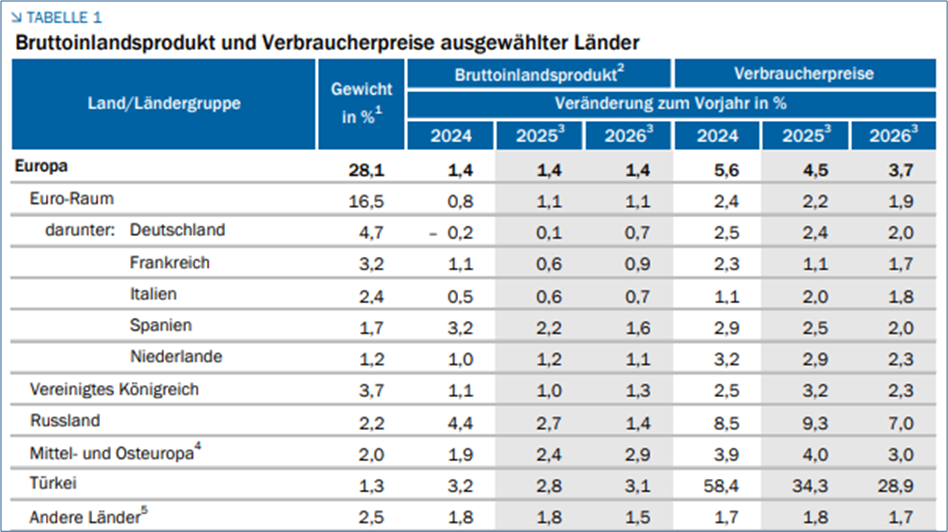
German Council of Economic Experts: Spring Report 2025, May 21, 2025
Russian analysts expect much less growth than the “wise men”
In their annual report published in mid-November 2024, the “economic sages”—in consensus with many other experts—had still expected Russia’s economy to grow by 1.7 percent in 2025. Unfortunately, in their new report, they do not explain in detail why they have now raised their forecast for Russia by a full percentage point—a surprisingly sharp increase. Their forecast, published on May 21, at +2.7% is even slightly higher than the Russian government’s forecast, which served as the basis for budget planning (+2.5%). The European Commission’s forecast, published on May 19, at +1.7%, is, by contrast, significantly lower than the government’s forecast. Analysts surveyed by Moscow’s Higher School of Economics in the first half of May expect an average increase in gross domestic product of just +1.4 percent this year.
Frederik Pleitgen: Many people in Russia now have “a lot more cash”
It is not only economic institutes that currently have very differing assessments of the Russian economy’s development. Some very contrasting views on the Russian economy were also expressed last week by Frederik Pleitgen, “Senior International Correspondent” for the U.S. television network CNN, and the former German ambassador to Moscow, Rüdiger von Fritsch.
Frederik Pleitgen conveyed his view of the current economic development in Russia very vividly on May 20 during the ZDF talk show “Markus Lanz” (minutes 13–19 and 28–32). Pleitgen also believes that the defense industry has naturally become much more important for Russia’s economy. But the claim that the Russian economy has been completely converted to a “war economy” is not accurate.
The purchasing power of the Russian population has risen sharply. Through military recruitment, many people have been able to increase their income from $300 a month to $2,000 a month. Many employees of private companies are being poached by the military. As a result, private companies are now paying much higher wages than before. Inflation is being offset by the fact that many people—with the exception of retirees and government employees—now have “a lot more cash.”
Huge construction projects are underway all over Moscow, including for private apartments, reported Frederik Pleitgen from his recent visit to the Russian capital. During his visit, he also attended a late-night press conference with President Putin regarding the talks with the U.S. Pleitgen reported on this in detail on the “Ronzheimer” podcast on May 11 (see also: WDR: Putin wants to negotiate with Ukraine—what’s behind this? 05/11/25).
On the Lanz show, Pleitgen noted that the sanctions have not affected “ordinary citizens” in Russia as much as we might think. The war, according to Pleitgen, is an “economic stimulus package” for the Russian economy—though, as he adds, “a bitter one” (fr.de; Robert Wallenhauer: Putin cannot afford peace in Ukraine: “Spending on weapons acts like an economic stimulus package,” May 24, 2025).
“Friendship with China” protects Russia from “isolation”
On ZDF, Pleitgen emphasized the importance of Russia’s good relations with China. Russia is now the largest import market for Chinese electric cars and other Chinese goods. Furthermore, there is a “technology transfer” from China to the Russian military, but also to many civilian economic sectors in Russia.
According to Pleitgen, the Russians had already stated at the beginning of the war in Ukraine that they could never be “isolated” by sanctions as long as China remained “their friend” (see Tagesschau report on President Xi’s visit to Moscow). On the other hand, the Chinese have also become somewhat more dependent on Russia due to their trade war with U.S. President Trump.
Because the Chinese economy is still growing very strongly, massive economic growth in Russia is also possible, Pleitgen argues. China is happy to take the Russian gas that we in Europe do not take. It is also happy to take Russian oil.
In the negotiations with the U.S., “it’s very much about the economy”
Frederik Pleitgen has the impression that discussions in Moscow are no longer about the fear of new sanctions, but rather about how to deal with foreign companies that want to return to the Russian market. The head of one of Russia’s largest banks told him that if American companies really wanted to return to Russia, they would have to “play by our rules.” It wouldn’t be enough to simply say “I’m sorry.”
According to Pleitgen, the players in Moscow see themselves as being on the verge of becoming active again, at least in the U.S. market. The negotiations with the U.S. are “very much about the economy.” Discussions are underway regarding what “deals” could be made in the Arctic, involving “rare earths” as well as oil and gas.
Regarding the effectiveness of the sanctions policy against Russia, Pleitgen draws the following conclusion:
“If the Russians have free rein in the Chinese market, free rein in the Indian market, and then eventually strike deals with the U.S. as well—then I don’t know what sanctions can still achieve.”
Since the first meeting between Presidents Putin and Trump, “the mood in Moscow has been very good,” says Pleitgen (see also reports from web.de, Tagesspiegel.de, and t-online.de regarding the “Markus Lanz” program).
Von Fritsch: U.S. President Trump is primarily pursuing economic interests
Rüdiger von Fritsch, German ambassador to Russia from 2014 to 2019 and a partner at “Berlin Global Advisors” since 2020, also commented on Russia’s negotiations with the U.S. in an interview on “Tagesthemen” on May 20. Von Fritsch apparently expects little willingness from U.S. President Trump to cooperate with the EU on Western sanctions policy. At the beginning of the interview, von Fritsch notes that President Putin knows Trump wants to end the “conflict in Europe, which is very costly and somewhat troublesome from the U.S. perspective,” at all costs. Trump is willing to sacrifice a great deal to end the Ukraine conflict, namely Ukraine’s interests and European security interests.
Like Frederik Pleitgen, Rüdiger von Fritsch believes that U.S. President Trump is primarily pursuing economic interests in his negotiations with Russia. It is very noteworthy that, in his phone call with President Putin, the U.S. president spoke primarily of American and Russian economic interests, for which he sees a “golden future.” Putin is exploiting this.
Von Fritsch calls for “unity and resolve regarding sanctions”
While Frederik Pleitgen apparently has serious doubts about the effectiveness of Western sanctions, von Fritsch is convinced that the sanctions have increasingly worsened Putin’s situation. The “civilian sector” of the Russian economy is currently sliding into recession. In an interview on Tagesthemen, he also cited the following symptoms of the deteriorating economic situation in Russia:
- Spending on the war in Ukraine now accounts for around 40 percent of the Russian national budget.
- In “good times,” Russia’s revenues from the oil and gas sector accounted for around 50 percent of the national budget. This share has fallen to around 27 percent. To maintain this share, the national budget assumes an oil price of $70 per barrel. Currently, however, the oil price is only $48 per barrel.
- Russia’s economy is completely overheated due to the war effort. Russia’s overall inflation rate stands at 10.2 percent, and in the food sector at more than 12 percent.
- The key interest rate at which the central bank lends money to other banks so that individuals and businesses can borrow money stands at 21 percent. Von Fritsch: “No one is investing anymore.”
- There are still “liquid reserves” in the national budget. However, they have shrunk by two-thirds since the start of the war.
At the end of the interview, von Fritsch calls for “unity and resolve in sanctions” to help ensure that Putin “reaches the limits of his capabilities.” Putin would only be willing to negotiate and compromise if he concluded that his power in Russia was at risk if he continued the war (see also: CNBC, Holly Ellyatt: Russia’s struggling war economy might be what finally drives Moscow to the negotiating table, May 22, 2025).
SWP expert Janis Kluge: Putin can still afford the war
According to Dr. Janis Kluge, however, President Putin has not yet had to factor Russia’s economic situation into his war plans. The Deputy Head of the Eastern Europe and Eurasia Research Group at the German Institute for International and Security Affairs (SWP) in Berlin stated in a detailed t-online interview on May 24 that Putin could continue to afford the war “for the foreseeable future.”
While inflation is increasingly becoming a problem in Russia and revenues are no longer as high due to the currently low oil price, Russia is nevertheless “not yet at the point where Putin would have to factor the economic situation into his strategic war plans.”
However, the deterioration of the economic situation in Russia is leading to conflicts over resource allocation and priorities. Putin needs to think more carefully about where he spends money. “There will likely be cuts this summer to balance the budget,” says Kluge.
High inflation, in particular, is a “political powder keg”
Kluge sees potential for conflict primarily due to the sharp price increases. However, the population is “seasoned” in this regard: as early as 2014, inflation had temporarily exceeded ten percent after European food imports were no longer possible.
The Russian Central Bank has also already achieved initial success in combating inflation. With its high key interest rate, it is slamming on the brakes. However, this comes “at the expense of economic strength.” The extent of the economic damage caused by the high key interest rate cannot yet be measured.
Russia’s economy is becoming further “militarized” amid stagnating production
Kluge sees the Russian economy as having reached the limits of its growth potential. He believes production is stagnating:
“The boom of recent years was a flash in the pan. Initially, the military and the growing defense industry created a good two million new jobs, and the war also boosted demand. But now unemployment is low, wages are high, and production is stagnating. The growth of recent years is catching up with Russia. The economy is reaching its limits.”
The SWP expert assumes that, in the face of stagnation, the economy will become further militarized. Civilian sectors would have to transfer labor to the military industry.
The resilience of the Russian economy is being weakened primarily by the labor shortage. Russia has a capacity problem rather than an economic cycle problem. For the population, however, this is good for the time being: they have jobs and high salaries.
Russia is constantly finding new ways to circumvent sanctions
While former ambassador von Fritsch calls for “unity and determination” to ensure the effectiveness of sanctions, Janis Kluge views the adoption of new sanction packages more as a “cat-and-mouse game.” Russia will find new ways to circumvent sanctions, to which the EU will then have to respond again. Kluge says:
“For a good two years now, new packages have primarily been about enforcing old measures, not about truly new sanctions. The last truly effective new punitive measure was the oil embargo from early 2023. The sanctions against the shadow fleet help enforce the oil price cap, but they do not limit Russia’s export volume.”
Still, Kluge notes, the sanctions would reduce Russian government revenue. Russia would have to grant its crude oil buyers—especially China and India—significant discounts. Transportation costs for the oil have also risen. As a result, Russia would lose between 20 and 30 billion dollars in revenue per year. Given total exports of just over 450 billion dollars, however, that is a relatively small share.
In conclusion regarding the sanctions policy, Kluge notes that there are not many options left for the EU to impose sanctions because bilateral trade with Russia has already been severely curtailed. Once the last imports of oil and gas are eliminated as well, there will be hardly anything left.
Kluge recommends:
“If we still want to achieve anything, we must ramp up aid to Ukraine.”
Sources and recommended reading:
- Janis Kluge (SWP) in an interview with Simon Cleven and Maritius Kloft on t-online.de: Putin’s economy is faltering. “The situation for Russia has changed,” May 24, 2025
- Rüdiger von Fritsch, German ambassador to Russia from 2014 to 2019, in an interview on Tagesthemen: Ukraine phone call. “Putin sees dollar signs in Trump’s eyes,” text with video, May 20, 2025
- Fred Pleitgen, CNN, on ZDF: “Markus Lanz, May 20, 2025”
- Focus online.de, Michael Becker: Alarming situation: Putin under pressure, Russia’s war economy suffers from embargo, May 24, 2025
- CNBC, Holly Ellyatt: Russia’s struggling war economy might be what finally drives Moscow to the negotiating table, May 22, 2025
- Merkur.de Larx-Eric Nievelstein: Despite Putin’s show of force: Russia in a bind – Kremlin “facing difficult decisions,” May 22, 2025
- Capital.de; Nils Kreimeier: Russia’s economy: “There is no sanctions bazooka,” May 22, 2025
- The Guardian: The Guardian view on Russia sanctions: a brittle economy is Putin’s weakness. Ukraine’s allies must ramp up sanctions to expose the fragility of the Kremlin’s strategy for perpetual war, May 21, 2025
- BR 24: EU Member States Enforce New Sanctions Against Russia; featuring an interview with Armin Laschet, designated Chair of the Foreign Affairs Committee in the Bundestag, May 20, 2025
- Alexander Libman, professor of political science specializing in Eastern Europe and Russia at the Institute for Eastern European Studies at Freie Universität Berlin, in a BR 24 interview with Jasper Ruppert: Sanctions against Moscow: Why the EU is imposing them gradually, May 20, 2025
- Tagesschau.de: EU adopts new sanctions against Russia, May 20, 2025; Tagesschau.de; Thomas Spickhofen: Meeting of foreign ministers. EU plans to sanction Russian shadow fleet, May 20, 2025
- ZDF.de; Felix Klauser: Analysis: Sanctions Package No. 17. What the new sanctions against Russia will achieve, May 20, 2025
- EU Commission; Directorate-General for Enlargement and Eastern Neighborhood: EU adopts 17th sanctions package against Russia, May 20, 2025
The day's most important Russian economic stories. Free, in your inbox three times a week.
Mon, Wed, Fri. Double opt-in, no tracking, unsubscribe anytime. By subscribing you consent to the processing of your email address as described in our Privacy Policy.