The Taliban Instead of Putin: Who Is Now Controlling Europe’s Vacation Flights to Asia

Thomas Baier
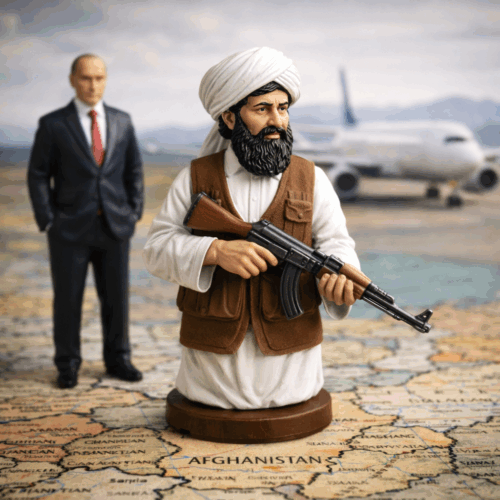
The Taliban are cashing in on European vacation flights. Kabul charges $700 per overflight—and the number of flights over Afghanistan has increased fivefold by 2025.
Anyone flying to Tokyo or Bangkok today with Lufthansa, British Airways, or KLM is highly likely to cross Afghan airspace. Without functioning air traffic control, without radar, without traditional traffic management. Pilots report their positions via radio themselves. There must be a 15-minute interval between aircraft. According to the Cockpit pilots’ union, this is manageable—but it places an additional burden on an already strained system.
The Pincer Movement in the Sky
European airlines are caught in a double bind. In the north, the Siberian route has been closed since 2022. Russia closed its airspace to aircraft from over 35 countries—in response to Western overflight bans following the invasion of Ukraine. A 17-million-square-kilometer restricted zone, twice the size of the U.S. Flights to Tokyo or Seoul have since taken up to four hours longer.
In the south, the next blow struck. Since 2025, the European Aviation Safety Agency (EASA) has warned against overflights of Iran, Israel, and the Persian Gulf. The war in Iran has rendered the airspace there largely unusable. Dubai is operating at 70% capacity.
What remains is a narrow corridor over Turkey, Azerbaijan, Turkmenistan—and then Afghanistan. The Kabul Flight Information Region is now the bottleneck between Europe and Asia.
280 overflights a day—and the Taliban are profiting from it
According to FlightRadar24 data, the number of daily overflights over Afghanistan rose from around 50 in the spring of 2024 to an average of 280 since June 2025. On October 2, 2024, one day after the Iranian attack on Israel, the Taliban reported 350 transit flights in 24 hours.
Each flight costs $700 in overflight fees. At 280 flights per day, that amounts to over $6 million per month. The World Bank noted as early as 2024 that these fees contributed to Afghanistan’s economic growth. Payments are routed through intermediaries: GAAC Holding, based in the UAE, operates Afghanistan’s airports and collects the fees. Direct transfers to Taliban authorities are virtually impossible due to frozen accounts and Western sanctions.
Lufthansa, Air France, British Airways, KLM, Singapore Airlines, and TUI are among the airlines that regularly use Afghan airspace. According to the industry portal airliners.de, several Western service providers have never received an invoice from Kabul—the payment channels remain opaque.
Chinese airlines fly comfortably via Russia
Chinese airlines do not face this problem. Air China flies Frankfurt–Beijing in nine hours. Lufthansa needs eleven for the same route. British Airways’ flight to Beijing takes nearly two hours longer than China Southern’s on the same route—because the British are not permitted to fly over Russia.
China Southern will launch a new Beijing–Helsinki route in the summer of 2026. In total, Chinese carriers are planning 2,900 additional flights to Europe for the 2026 summer schedule. Chinese airlines now control around 83% of capacity between China and Europe. The competitive advantage provided by Russian airspace is massive.
What the passenger pays
The surcharge hits passengers directly. According to an analysis by Travel and Tour World, average prices on seven major routes between Asia and Europe rose by nearly 70% in June 2026 compared to the previous year. The airspace closures over Russia and the Middle East are costing airlines 20 to 30% more fuel per flight.
Individual routes illustrate the extent of the impact: Bangkok–Frankfurt rose from 410 to 2,484 euros. Hong Kong–London from 435 to 2,872 euros. Sydney–London from 634 to 3,354 euros. Two hours longer, 560% more expensive.
Outlook: A corridor with no alternative
The situation will not ease in the short term. EASA has extended its warning for the Middle East until at least April 2026. Russia’s airspace remains closed for the foreseeable future. And the Caucasus corridor via Azerbaijan—only 160 kilometers wide at its narrowest point—is reaching its limits. Transit traffic through Azerbaijan rose by 36% compared to 2023. In March 2026, an Iranian drone struck Nakhchivan Airport for the first time. The security risk is growing.
For the Taliban, the skies over Kabul are a source of revenue that the West itself has created for them. For European airlines, it is an emergency exit with no real alternative. And for passengers, one quiet fact remains: Anyone flying to Asia in the summer pays the price of a world order that has become fragile.
The day's most important Russian economic stories. Free, in your inbox three times a week.
Mon, Wed, Fri. Double opt-in, no tracking, unsubscribe anytime. By subscribing you consent to the processing of your email address as described in our Privacy Policy.