The Russian government remains a lone "growth optimist"
Author: Klaus Dormann
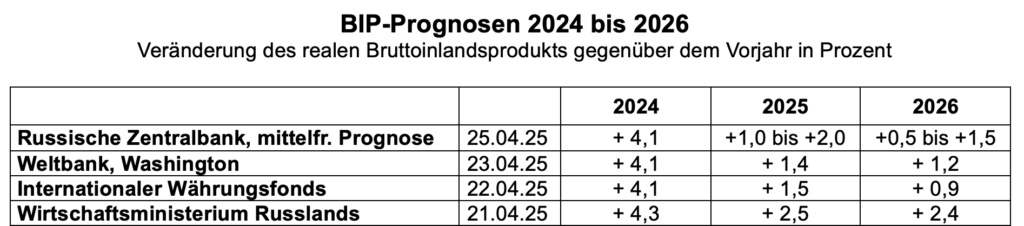
Shortly after Easter, the Russian government, the International Monetary Fund, and the World Bank updated their forecasts for Russia’s economic growth. They changed very little. As a result, the IMF and World Bank’s forecasts for Russia’s economic growth remain well below the Russian government’s growth expectations for 2025 and 2026. The Russian Central Bank also views Russia’s growth prospects with much greater skepticism than the government. The year-over-year increase in real gross domestic product in Russia has been noticeably slowing for nearly a year now.
IMF and World Bank expect much less growth than the government
Since early September, the Russian government has maintained its projection that the country’s real gross domestic product will rise by 2.5 percent in 2025 (Finmarket.ru). The IMF and the World Bank, however, both expect growth of only around 1.5 percent in Russia this year. In its “World Economic Outlook,” the IMF raised its forecast for Russia’s economic growth this year only slightly, from 1.4 to 1.5 percent. The World Bank lowered its forecast in the “Europe and Central Asia Economic Update” from 1.6 to 1.4 percent.
The forecasts for 2026 from the government and the two international economic organizations diverge even further. The IMF lowered its growth forecast for the Russian economy next year from 1.3 to 0.9 percent. The World Bank now forecasts a slightly stronger increase of 1.2 percent for 2026. Even so, the Russian economy would still grow only half as much as the government expects. The government believes that the Russian economy will nearly maintain this year’s growth rate of 2.5 percent, reaching 2.4 percent in 2026.
The Russian Central Bank is also much more skeptical than the government
The Russian Central Bank continues to disagree with its government’s growth forecasts. The Central Bank’s growth expectations in its “medium-term economic forecast,” updated on April 25, remain significantly lower. However, the ranges cited by the Central Bank for Russian economic growth in 2025 and 2026 cover the forecasts of the IMF and the World Bank.
According to the Central Bank, real gross domestic product growth in 2025 is still expected to range between 1.0 and 2.0 percent (IMF: +1.5 percent, World Bank: +1.4 percent, government: +2.5 percent).
In 2026, growth is expected to decline to 0.5 to 1.5 percent, according to the Central Bank (IMF: +0.9 percent, World Bank: +1.2 percent; Government: +2.4 percent).
World Bank: Russia’s growth is weak by international standards
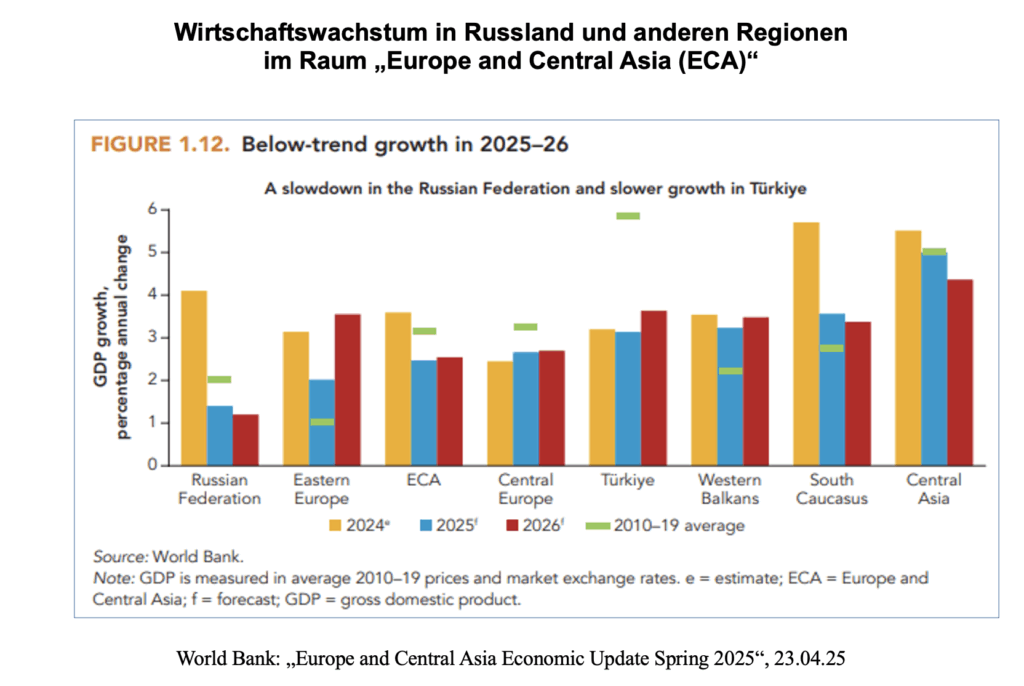
Looking ahead to 2025 and 2026, the World Bank notes in the “ECA Update”: In Russia, growth will average 1.3 percent over the next two years. This represents just under a third of last year’s growth (according to the World Bank: 4.1 percent) and is weaker than the average growth of around 2 percent achieved between 2010 and 2019. The World Bank cites capacity constraints, rising borrowing costs, tightened sanctions, and lower energy prices as the causes of Russia’s weak growth.
The following figure shows that the World Bank expects significantly lower economic growth in Russia in 2025 and 2026 than in all other regions shown in the “Europe and Central Asia (ECA)” region. The green lines in the figure indicate the average annual growth rate achieved in the ECA region between 2010 and 2019. The World Bank notes that economic growth in 2025 and 2026 in the ECA region as a whole and in many of its member countries, including Russia, is likely to remain below this “trend growth” rate from 2010 to 2019.
Eastern Europe: Belarus, Moldova, Ukraine; Central Europe: Bulgaria, Croatia, Poland, Romania; Western Balkans: Albania, Bosnia and Herzegovina, Kosovo, Montenegro, Republic of North Macedonia, Serbia; South Caucasus: Armenia, Azerbaijan, Georgia; Central Asia: Kazakhstan, Kyrgyz Republic, Tajikistan, Turkmenistan, Uzbekistan
Germany’s growth is even weaker than Russia’s
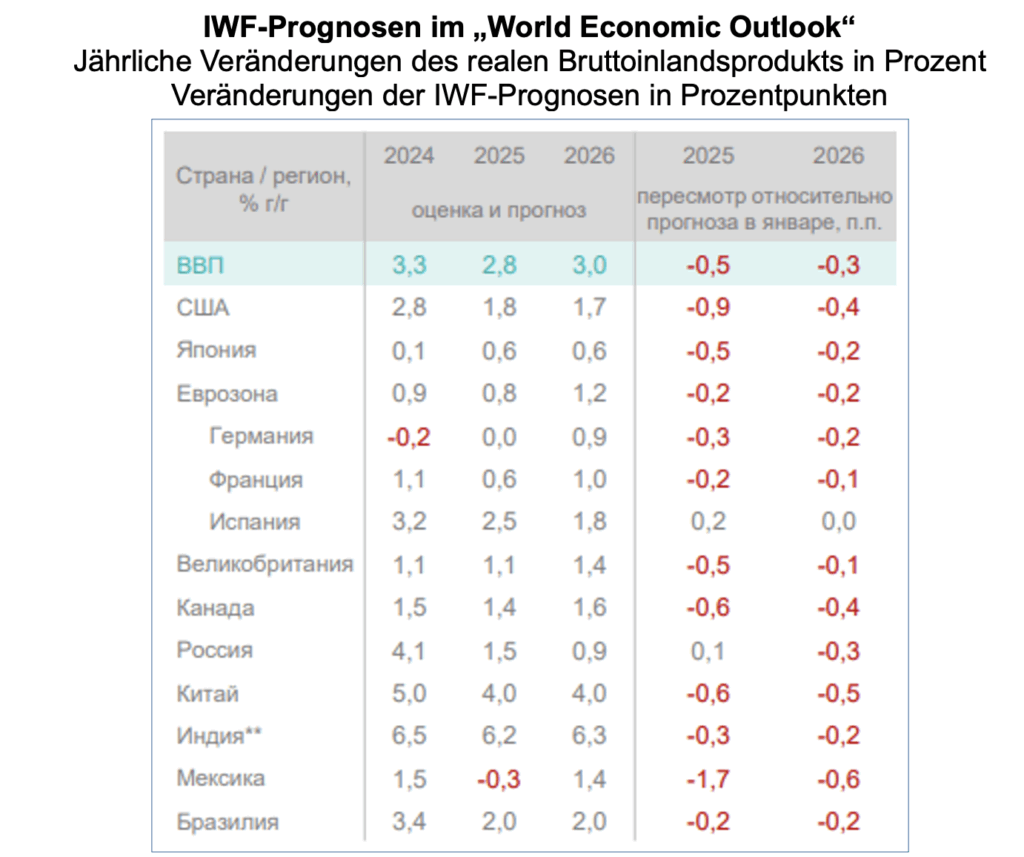
Even though, according to the IMF forecast, Russian economic growth will drop to 1.5 percent in 2025 and reach only 0.9 percent in 2026, the German economy is, according to the IMF, growing even more slowly than Russia’s. The IMF expects Germany’s gross domestic product to stagnate in 2025. It is not until 2026 that Germany will match Russia’s weak growth rate of 0.9 percent.
Vnesheconombank Institute: “World Economy and Markets Review”; April 25, 2025
Russia’s Ministry of Economic Development beat the IMF and the World Bank to the punch
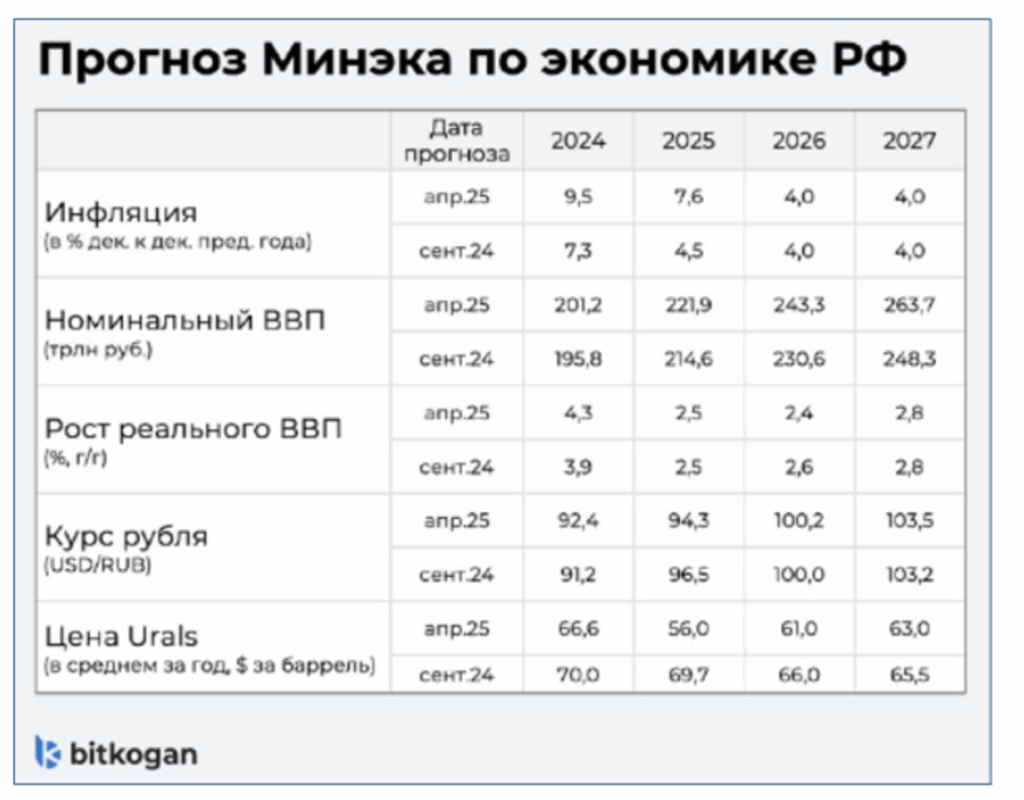
The Russian Ministry of Economic Development published an update to its macroeconomic forecasts on Easter Monday, immediately before the IMF released its forecasts on Tuesday and the World Bank on Wednesday. The Ministry maintained its forecast for this year’s real gross domestic product growth of 2.5 percent, which had already been published in September. It also lowered its growth forecast for 2026 only very slightly, from 2.6 percent to 2.4 percent. It continues to expect overall economic growth of 2.8 percent in 2027 (see the fifth row of the table below).
Comparison of the Ministry of Economic Development’s April and September
forecasts: Consumer price inflation (Dec./Dec. in %); GDP value in rubles; real GDP growth in %; exchange rate: ruble/$; Urals oil price ($/barrel)
Evgeny Kogan; bitkogan: The Ministry of Economic Development has updated its forecast for the Russian economy: what does this mean for us? 04/22/25
Economics professor: Oil prices are the most important risk factor
Vladimir Lyubetsky, associate professor at the Institute of Economics at the “Russian Presidential Academy of National Economy and Public Administration” (RANEPA), commented on the Ministry of Economic Development’s new growth forecast as follows, according to Finam.ru:
“The decline in GDP growth rates compared to growth in 2024 (+4.3 percent) is a completely normal—I would say necessary—process. The Russian economy continues to grow faster than most of the world’s developed economies.”
Lyubetsky emphasized the importance of oil prices for the Russian economy:
“The decline in oil prices is considered the most significant negative factor for the Russian economy. Prices on the oil market are the result of many processes: the slowdown in global economic growth, the decline of the dollar, the trade war, and above all, uncertainty stemming from political developments. If a negative scenario unfolds with oil prices continuing to fall, this could lead to an increase in the budget deficit and high inflation. This, in turn, would affect the growth rate of Russia’s gross domestic product, the government’s fiscal policy options, and the real income of the population.”
Government: The Urals oil price will fall by 16 percent in 2025 and recover only slowly
Russia’s economy faces the challenge of adjusting to the lowest oil prices since the COVID-19 crisis. According to the Ministry of Economic Development’s forecast, the average price for Urals crude will be $56 per barrel in 2025 (see the second-to-last row of the table above). This would be the lowest price since 2020, when the COVID-19 pandemic caused global demand to plummet and pushed the Urals price down to an average of $41.70. This is reported by Merkur.de. In 2024, the annual average price of Urals crude was just under $67. According to the government’s forecast, it will therefore fall by about $11 (approx. 16 percent) in 2025.
Investment banker Evgeny Kogan estimates that a one-dollar drop in the oil price would reduce annual revenue in the Russian state budget by approximately 160 billion rubles ($1.9 billion).
Sofia Donets, chief economist at T-Investments, believes that a $10 drop in the price of Russian crude oil—from $65 to $55 per barrel—could reduce GDP growth by at least 0.5 percentage points.
The Ministry of Economic Development also expects the oil price to recover only slowly. Even in 2028, it is likely to remain slightly lower than in 2024, at around $65.
The inflation target of 4 percent remains a distant prospect in 2025
In September 2024, the Ministry of Economy still assumed that the rise in consumer prices would ease to 4.5 percent by the end of 2025. Now, however, it expects the annual inflation rate to reach 7.6 percent in December 2025. This would still be nearly twice as high as the 4.0 percent rate targeted by the Russian Central Bank. According to the new government forecast, however, this target is expected to be reached by the end of 2026 (see the first row of the table above).
The Russian government and the Central Bank are much more in agreement regarding the assessment of inflation trends than they are regarding growth forecasts. Like the government, the Central Bank expects the “inflation target” to be reached in December 2026. By December of this year, however, the annual inflation rate is expected to fall only to 7.0 to 8.0 percent (see the first row of the table below). This forecast range covers the government’s inflation forecast of +7.6 percent.
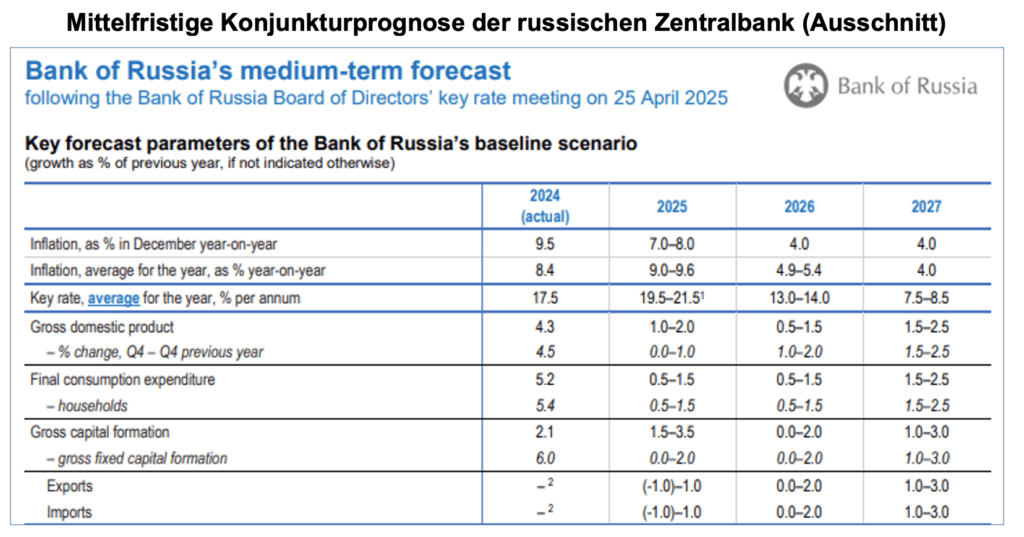
Russian Central Bank: Bank of Russia’s medium-term forecast, April 25, 2025
Russia’s growth had already begun to slow in the course of 2024
According to Rosstat’s second estimate, the annual average growth rate of aggregate economic output in Russia accelerated from 4.1 percent in 2023 to 4.3 percent in 2024. However, annual GDP growth had already begun to slow in the course of 2024.
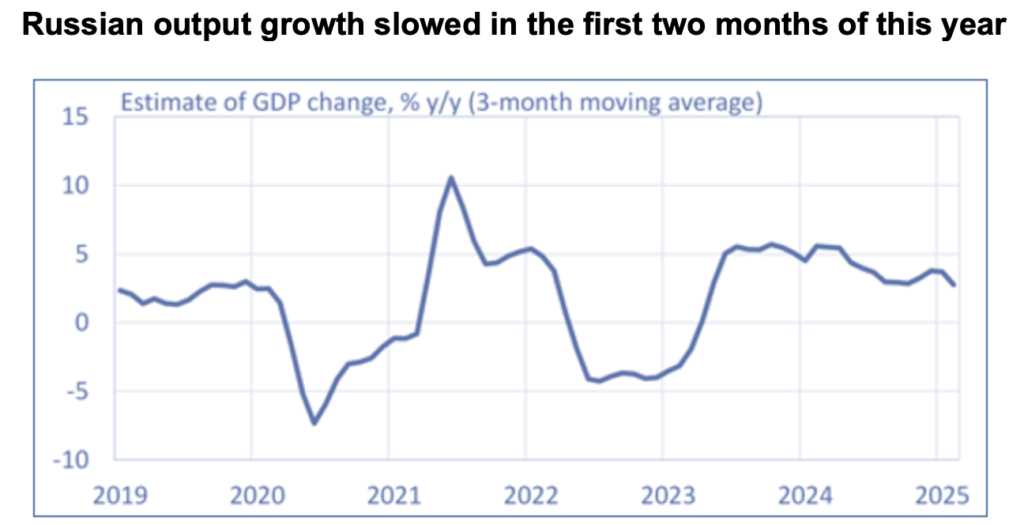
The following figure from the weekly report of the BOFIT research institute of the Bank of Finland shows how the annual growth of real gross domestic product in Russia developed when a 3-month moving average is calculated for real gross domestic product.
It can be seen that the annual growth rate, based on the 3-month average, rose to around 5 percent in mid-2023 following the recession in 2022. Since the spring of 2024, however, it has fallen significantly. After a temporary rise at the end of 2024, it remained at that higher level only in January 2025. In February 2025, the growth rate weakened again to roughly the level seen in the fall of 2024, at around 3 percent.
Sources: CEIC/Russian Ministry of Economic Development, BOFIT. BOFIT-Weekly: Russian growth slows, increased risks from declining oil prices, April 11, 2025
The figure for February 2025 shows the change in GDP from December 2024 to February 2025 compared to December 2023 to February 2024, according to a BOFIT estimate based on economic data available in mid-April.
President Putin on the “soft landing” of the Russian economy
During a video conference with government officials and Central Bank Governor Nabiullina on April 24, President Putin stated, according to a press release from the Presidential Administration:
“As you know, the government, the Central Bank, and experts agree that gross domestic product growth this year will be slightly lower than in 2024. In fact, we have already discussed this, and that is exactly what we wanted to achieve. We discussed the so-called soft landing to stabilize macroeconomic indicators and, above all, to overcome inflation.
In fact, GDP rose by 1.9 percent in the first two months of 2025 compared to the previous year. In the manufacturing sector, growth rates were higher, with an increase of 5 percent in January and February 2025.
However, inflation remains too high at over 10 percent.”
At a conference of the business association in mid-March, Putin had commented on the cooling of the Russian economy, noting that the process must be handled with great caution. It was clear, however, that a slowdown was inevitable. But it must not lead to an excessive slowdown. Everything must be done in small steps.
Regarding the differing growth forecasts from the government and the Central Bank, Putin said at the conference that it was well known the Central Bank had one figure, while the government and the Ministry of Economic Development had another. In 2025, economic growth would likely reach 2 to 2.5 percent (Monocle.ru). With this forecast range, Putin positioned himself exactly between the upper end of the Central Bank’s forecast range (1.0 to 2.0 percent) and the Ministry of Economic Development’s forecast.
Central Bank: GDP growth more moderate in the first quarter of 2025
In her statement accompanying the key interest rate decision on April 25, Central Bank President Nabiullina commented on current economic trends, noting that GDP is now growing “at a more moderate pace.” Regarding the development of consumption and investment, she said:
“After a certain acceleration in January, consumption growth has slowed. Due to the aforementioned time lags, a slower rise in demand is more clearly noticeable in the durable goods segment, while it is not yet as evident in sectors such as hospitality and tourism.
Investment activity remains close to the high level of the previous year. The vast majority of companies participating in our monitoring survey plan to maintain or increase their investment volume this year. … Nevertheless, investment growth rates are expected to decline, a trend confirmed by certain leading indicators such as sales of trucks and agricultural machinery, as well as the utilization of transportation infrastructure.”
There are initial signs of easing in the labor market
Nabiullina pointed out that labor shortages are slowing investment growth. However, the Central Bank’s monitoring shows signs of easing in the labor market:
“First sign: Many companies are reducing their demand for labor, which is accompanied by a shift of workers to other companies or sectors. Unemployment, however, remains at a record low.
Second sign: Companies are planning more moderate wage indexation than in the previous two years.”
The day's most important Russian economic stories. Free, in your inbox three times a week.
Mon, Wed, Fri. Double opt-in, no tracking, unsubscribe anytime. By subscribing you consent to the processing of your email address as described in our Privacy Policy.