The Logistics Sector in a Bind: How Internet Blockades, the Telegram Ban, and Whitelisting Are Affecting the Industry

Internet blackouts, Telegram throttling, and government “white lists” are increasingly disrupting the day-to-day operations of the logistics industry in Russia. Although mobile internet has been largely restored in Moscow since late March, the latest restrictions have exposed the structural vulnerability of digitally controlled supply chains. Since further regional outages remain possible at any time, companies are already responding by adapting their communication and IT structures. As a result, the stability of digital infrastructure itself is becoming a key risk factor for transport planning, communication, and supply chain management.
Internet Outages and Logistics Processes
Recurring mobile internet outages and tests of a more tightly controlled network architecture are increasingly having a direct impact on operational logistics processes. Applications that rely on mobile data connections and real-time transmission are particularly affected, including GPS tracking, fleet management, digital freight exchanges, and cloud-based transport and warehouse management systems. Since, according to Telekom analyses published in the business newspaper Kommersant, 50% to 70% of internet traffic in Russia runs over mobile networks, outages directly lead to restrictions on vehicle tracking, scheduling, and the coordination of time slots in warehouses and terminals. Shipping service companies such as SDEK report that during regional outages, location data is temporarily unavailable and making last-minute route adjustments is only possible to a limited extent.
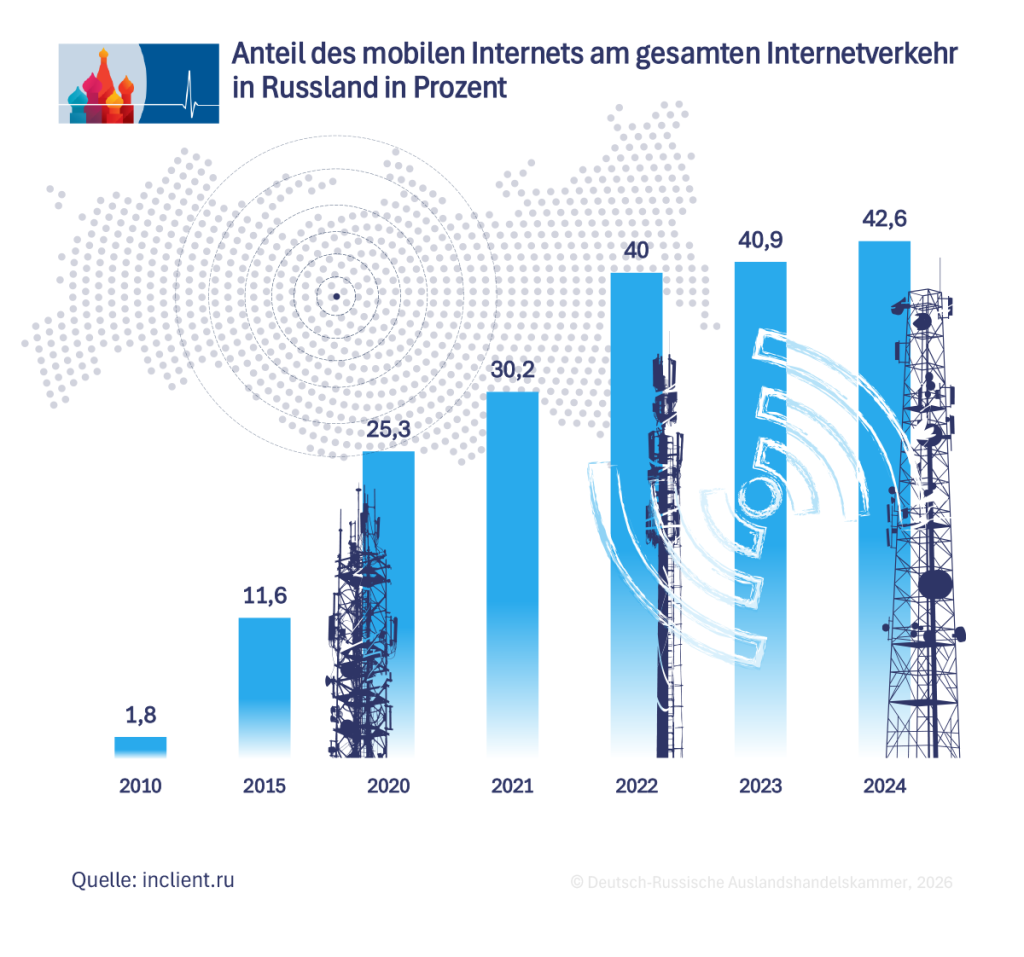
A survey of affected companies conducted by the Russian Union of Industrialists and Entrepreneurs (RSPP) underscores the high dependence of logistics processes on mobile internet. About 40% of respondents rate mobile networks as essential, and another 45% as important for operations. Only 10% view mobile connectivity as non-critical, while 5% rate it as unimportant.
Courier and logistics companies are particularly hard hit, as their operations rely on real-time communication between dispatchers, drivers, customers, and pickup stations. Outages result in the loss of tracking capabilities, communication breakdowns between couriers, customers, and pickup stations, and an increase in support requests. This leads to additional strain on dispatch centers and operational bottlenecks, such as overloaded packing stations or delayed delivery processes.
Cybersecurity analyses by the Financial Times estimate that internet restrictions can cause daily economic losses of up to approximately 2 billion rubles (equivalent to 22.4 million euros), including due to outages in cloud infrastructure, payment systems, and logistics-related platforms. At the same time, mobile data traffic in affected regions dropped by about 20% during the outages, highlighting the high dependence of transport-related processes on mobile networks. Specific regional restrictions also have measurable economic impacts: According to the business magazine Forbes, multi-day mobile internet outages in Moscow caused damages ranging from 3 to 5 billion rubles (33.7–56 million euros). Courier services, transportation services, and the retail sector were particularly affected. The measures were not limited to the capital but gradually expanded; after restrictions were imposed in Moscow in early March, similar measures followed shortly thereafter in St. Petersburg.
Export and import processes are also highly sensitive to disruptions in mobile internet connectivity. Digital freight documents, slot bookings, customs communications, and coordination with freight forwarders and warehouse operators are increasingly handled via online platforms. If access to these systems is lost, companies must resort to telephone coordination or manual processes, which lengthens processing times and increases the likelihood of errors. Recurring outages thus increase operational uncertainty, extend lead times, and complicate the precise planning of transport capacity along the entire supply chain.
Overview of the Russian logistics sector
The Russian logistics sector has expanded significantly in recent years, while operational complexity has increased. Analyses by the Russian HR outsourcing provider Sequoia and the logistics company STS Logistics show that the total revenue of companies in the logistics sector is projected to reach approximately 24.3 trillion rubles in 2025 rubles (272.6 billion euros) in 2025, representing growth of approximately 17% compared to 2023. At the same time, transport volume remained at a high level at around 9.4 billion tons, while freight turnover reached approximately 5.57 trillion ton-kilometers. Despite rising revenues, industry profitability declined: According to industry analyses, logistics companies’ profits fell by 9.8% to approximately 1.9 trillion rubles (21.3 billion euros), primarily due to higher personnel, fuel, and financing costs. At the same time, total logistics costs rose by 20% to 25% according to the marketing agency MegaResearch, significantly increasing cost pressure along the supply chains.
Structurally, the industry is increasingly shifting toward road transport and e-commerce logistics. Industry figures show that road transport increased by 21.2% in the first quarter of 2025, while rail transport declined by 12% and air freight by 59.3%. At the same time, according to market analyses, online retail grew by 19% to 28%, reaching approximately 13.4 trillion rubles (150.3 billion euros) with around 8.3 billion orders, which further increases the demand for fulfillment and last-mile logistics. Road transport is increasingly playing a dominant role in this context and already accounts for more than 70% of goods transported in certain segments. This development is leading to longer transport distances, higher utilization of hubs, and greater demands on coordination and scheduling.
At the same time, structural bottlenecks are exacerbating the industry’s situation. Analyses by MegaResearch and industry reports by Sequoia Service estimate a labor shortage of up to one million workers, with a particular shortage of Category E truck drivers. Companies are responding with rising wages and increased automation; according to industry studies, the use of transport management systems can reduce costs by up to 21%. At the same time, supply chains are lengthening due to the shift toward eastern transport corridors and additional transshipment points. An analysis by Russia’s largest financial institution, Sber, on logistics development through 2025 shows that companies are increasingly relying on digital platforms, real-time tracking, and cloud-based control to manage this complexity. As a result, the industry’s dependence on stable digital infrastructure is growing, making it a critical factor for the functionality of logistics processes.
Telegram Ban and Communication Bottlenecks
The restriction on Telegram is hitting companies particularly hard, as the messenger has effectively become the standard for operational communication in many industries. According to analyses by ppc.world, based on data from telecommunications provider MTS, approximately 105 million people in Russia were using Telegram in November 2025. Unlike email or traditional business software, Telegram enables rapid communication with external partners, drivers, subcontractors, customs agents, and warehouse operators via shared groups, often across national borders. In addition, Telegram serves as an important tool for customer acquisition, particularly for small and medium-sized enterprises, through channels, groups, and targeted advertising, making the platform relevant not only for operational communication but also for closing business deals.
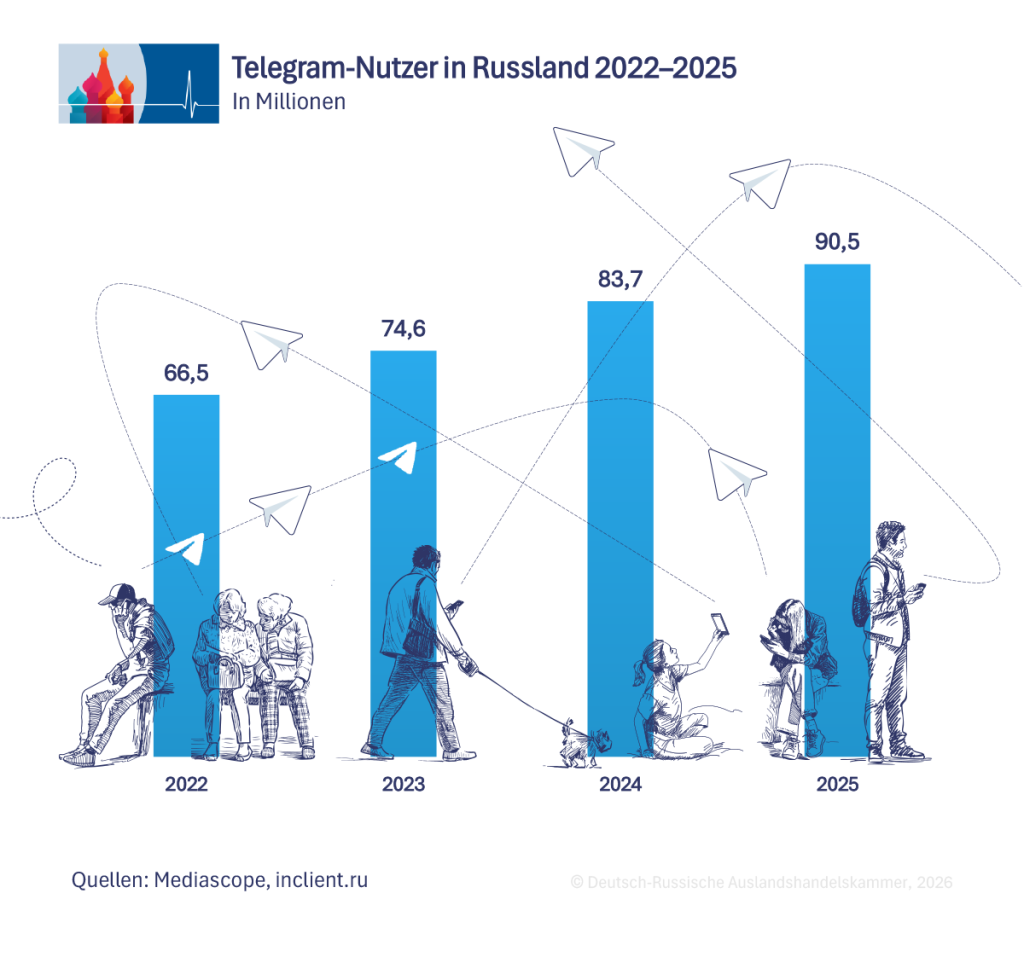
In logistics in particular, Telegram fulfills several functions simultaneously: dispatchers communicate last-minute route changes, drivers send location photos and documents, freight forwarders coordinate loading windows, and customs agents share approvals in real time. These processes often run in parallel in groups with multiple participants and partially replace traditional transport management systems, particularly at smaller freight forwarders and in cross-border trade. Technical limitations are already causing a significant portion of requests to Telegram domains to fail. According to Kommersant, 80% to 90% of connection attempts to the platform are occasionally unreliable. Telegram is throttled, or file transfers and messages are delayed, creating immediate operational problems: drivers receive instructions late, transshipments are not coordinated in time, and last-minute changes to border clearance or terminal slots cannot be communicated quickly.
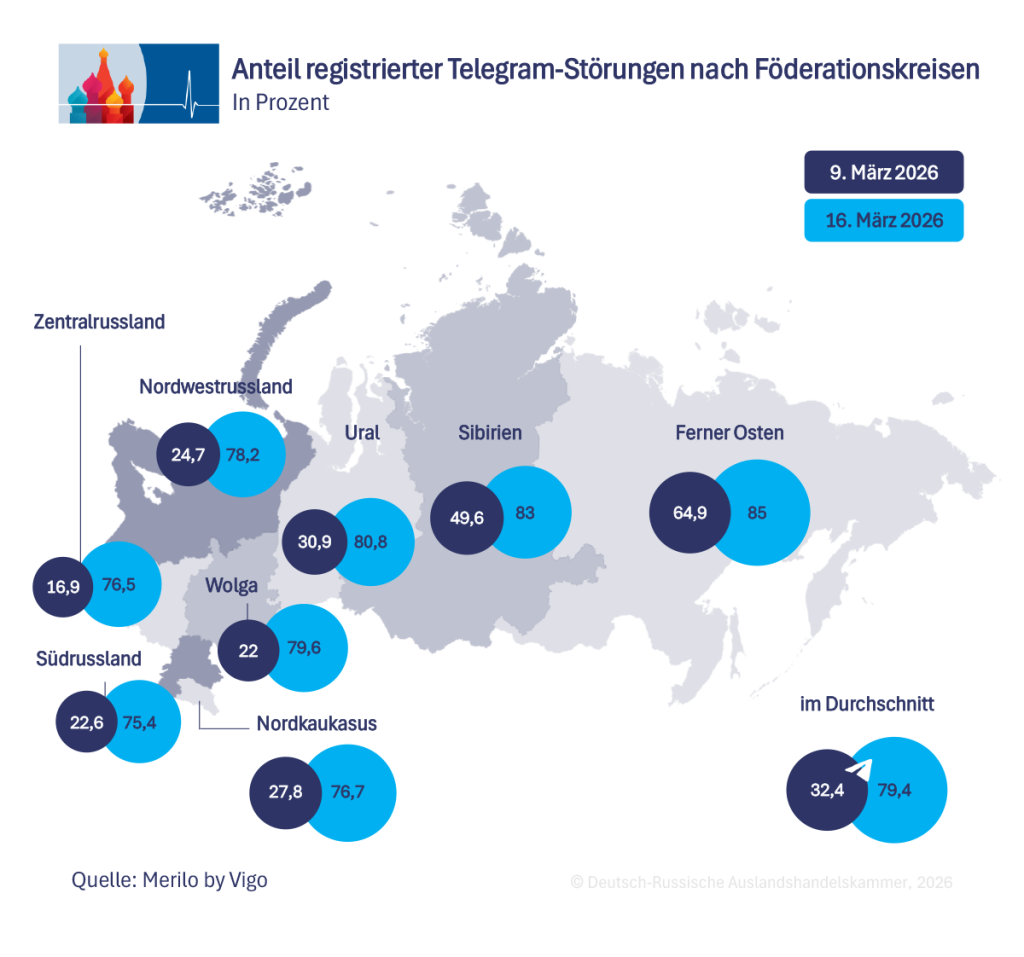
The result is additional downtime, unreliable scheduling, and delayed supply chains. Companies must resort to phone calls, text messages, or alternative messaging apps, which fragments coordination and slows the flow of information. At the same time, government agencies are promoting MAX, an alternative platform developed by the VK Group, which is intended to serve as a replacement for Telegram and other messengers. However, according to Kommersant, expert Anastasia Bidelova believes that a complete technical block is difficult to implement; instead, ongoing restrictions could lead users to gradually switch to alternative services like MAX. For companies, this means a phase of parallel communication channels, additional coordination, and increasing organizational complexity in the day-to-day management of logistics operations.
White Lists and IT Risks
The introduction of so-called white lists—which list email, IP, and domain addresses deemed secure and reputable—creates an additional IT risk for logistics and retail companies. The concept stipulates that during network restrictions or within the framework of a more tightly controlled internet architecture, only pre-approved platforms, cloud services, and communication solutions will remain reliably accessible. Services not on these lists may be slowed down, blocked, or function only with limitations. For companies whose operational systems rely on international cloud infrastructures or software solutions, this creates the risk of sudden outages of critical applications.
Inclusion on such white lists is subject to certain conditions. According to current guidelines, services with high social or economic priority are given priority, while at the same time requirements are imposed on the technical infrastructure, including the use of servers and cloud solutions located within Russia. For logistics companies, this means that applications hosted abroad or connected to international cloud services may not be reliably accessible. Particularly affected are tracking platforms, transport management systems, ERP software, and collaborative tools whose servers are located outside Russia. If access to such systems is lost, shipment tracking, order management, and document exchange can only be carried out to a limited extent, particularly for cross-border shipments involving multiple partners.
The introduction of white lists thus increases the pressure on companies to adapt their IT infrastructure. This includes migrating to locally hosted solutions, using Russian cloud services, or establishing redundant parallel structures in “friendly” countries that have not sanctioned Russia. At the same time, industry associations are warning against overly broad restrictions. The Russian e-commerce association AKIT writes: “Due to the regular outages, the issue of the white list is critical for companies. In our view, every service provider operating legally in Russia that offers services to the public must maintain its availability. Otherwise, this situation could lead to serious distortions of competition, in which only a few of the largest services continue to function while all others cease to do so.” From a business perspective, this creates additional uncertainty regarding which platforms will remain available in the long term. Investment decisions become more difficult, while dependence on approved local IT solutions increases and planning reliability in logistics and trade processes decreases.
How Logistics Chains Are Adapting
The increasing restrictions on digital infrastructure are forcing logistics companies to gradually adapt their processes and build redundant structures. Many companies are responding by introducing additional communication channels, including parallel messaging apps, telephone-based scheduling, and email-based coordination. At the same time, critical information is being transmitted in advance more frequently to cushion the impact of last-minute changes, even in the event of temporary outages. In transport planning, this leads to longer time buffers, additional confirmation steps, and greater manual oversight of operational processes. At the same time, numerous companies are shifting their internal communication channels to Russian providers such as Yandex 360 or VK Teams to reduce dependence on potentially restricted international services and ensure more stable accessibility.
Companies are also adapting their structures at the IT level. This includes local server solutions, mirroring of critical data, and the migration of individual applications to neutral or locally hosted cloud infrastructures. Some logistics companies are increasingly turning to offline tools, locally stored documents, and paper-based backup processes to maintain operations in the event of limited connectivity. This applies in particular to freight documents, loading instructions, and contact information, which are additionally maintained in non-digital formats. While such measures increase resilience, they lead to higher administrative overhead and slower decision-making processes.
At the same time, transport networks are being streamlined more extensively. Companies are reducing the number of partners involved, consolidating shipments, and favoring more stable routes with less reliance on short-term digital coordination. Transshipment points and warehouse locations are selected so that operational interventions are possible even without a permanent online connection. These adjustments increase the stability of supply chains but are accompanied by longer planning cycles, reduced flexibility, and additional costs.
Survival Risks for Companies with Servers in “Unfriendly” Countries
Companies whose IT infrastructure is based entirely or partially on servers in so-called “unfriendly” countries that have imposed sanctions on Russia face increasingly existential risks. In the context of tightening regulations and the introduction of white-list mechanisms, there is a possibility that access to central systems could be restricted at short notice or completely shut down. This particularly affects cloud-based ERP systems, transport management software, inventory management systems, and collaboration platforms, which are indispensable for managing logistics processes. If access to these systems is lost, orders cannot be processed, shipments cannot be coordinated, and invoicing processes cannot be completed.
The resulting risks go beyond operational disruptions and affect fundamental business operations. Companies face the decision of either switching to local or “friendly” IT solutions in a short time or accepting significant system outages. However, such a migration involves high costs, technical challenges, and organizational effort, especially when existing systems are deeply integrated into international supply chains. At the same time, there is a risk of regulatory action if companies continue to use unauthorized software or infrastructure.
In practice, this leads to strategic considerations regarding future market presence. Some companies are investing in redundant IT structures and localized systems, while others are scaling back their operations or gradually withdrawing from the market. Dependence on stable and approved IT infrastructure thus becomes a decisive competitive factor. Companies that cannot establish robust solutions run the risk of losing their operational capacity and, in the long term, forfeiting their position in the Russian market.
The day's most important Russian economic stories. Free, in your inbox three times a week.
Mon, Wed, Fri. Double opt-in, no tracking, unsubscribe anytime. By subscribing you consent to the processing of your email address as described in our Privacy Policy.