Russia: To achieve 1.5 percent growth, production must pick up now

Author: Klaus Dormann
The Russian economy is set to grow by “no less than 1.5 percent” this year. At least, that is what the Russian government apparently expects. Its deliberations on updating its economic forecasts for budget planning are not yet complete. However, according to a transcript published by the Presidential Administration (kremlin.ru), Finance Minister Anton Siluanov revealed at a meeting between President Vladimir Putin and government officials on August 27:
“...the economic growth rate this year will be no less than 1.5 percent, at least according to the Ministry of Economic Development’s assessment.”
However, the Ministry of Economic Development’s press service subsequently stated, according to Finmarket.ru, that it was still too early to report on the ministry’s updated estimates. Work on the macroeconomic forecast is still ongoing. In April, the Ministry of Economic Development had forecast significantly stronger growth in Russia’s gross domestic product in its baseline scenario: +2.5% for 2025 and +2.4% for 2026.
GDP growth in the second quarter of 2025 remains unclear
In the first quarter of 2025, Russia’s real gross domestic product fell by 0.6 percent year-on-year compared to the fourth quarter of 2024, according to the statistics agency Rosstat (Bruegel). Rosstat has not yet reported whether aggregate economic output in the second quarter was also lower than in the previous quarter. It therefore remains unclear whether Russia’s GDP has fallen in two consecutive quarters compared to the respective previous quarter. If so, the Russian economy would have entered a so-called “technical recession” in the first half of the year.
Ostwirtschaft.de reported on August 18 that analysts from the Telegram channel MMI had reached this assessment based on initial calculations. Raiffeisenbank and “Capital Economics,” on the other hand, estimated that gross domestic product grew by 0.3 percent in the second quarter compared to the previous quarter, thereby avoiding a “technical recession.” Many commentators in Russia adopted this assessment.
VEB Chief Economist Klepatch: There was a “technical recession” in the first half of the year
However, RBC.ru reported on August 29 that Andrey Klepach also believes there was a “technical recession” in Russia. Andrey Klepach has been chief economist at Vnesheconombank (VEB), a state-owned development bank, since 2014. He previously served as Deputy Minister of Economic Development, among other roles. According to RBC.ru, Klepatch said at a closed-door meeting at the Stolypin Club on August 26, as reported by a participant in the meeting:
“According to our preliminary assessment, GDP contracted by 0.6 percent in the second quarter, taking into account seasonal and calendar factors.”
According to RBC.ru, this was also confirmed by the “Stolypin Institute for Growth Economics.”
It is puzzling that on August 29, the research institute of Vnesheconombank did not publish a “World Economy and Market Report” on Friday, as it had done every week up to that point. Until early June, the VEB Institute had provided monthly updates on the development of Russia’s gross domestic product in these reports, complete with charts (see the June 6, 2025, issue). The most recent issue of the VEB Institute’s monthly “GDP Index” report, featuring the May results, was published on July 17. Apparently, the institute is scaling back its reporting on the Russian economy. The institute’s latest economic forecast for Russia was published just under a year ago.
After a sharp rise in the second half of 2024, GDP fell into stagnation
Over the course of last year, Russia’s real gross domestic product had still grown by 4.3 percent. However, following a sharp rise in the second half of 2024, seasonally adjusted aggregate economic output declined during the first half of 2025 and then remained virtually stagnant. This is shown in the following figure from the Institute of Economics of the Russian Academy of Sciences (IEF-RAS), based on data from early August. In June 2025, the institute estimates that the GDP index fell back to the level reached in October 2024 (see also Ostwirtschaft.de from August 25).
Index of seasonally adjusted real gross domestic product (January 2019=100)
Blue bars: Year-over-year changes in percent
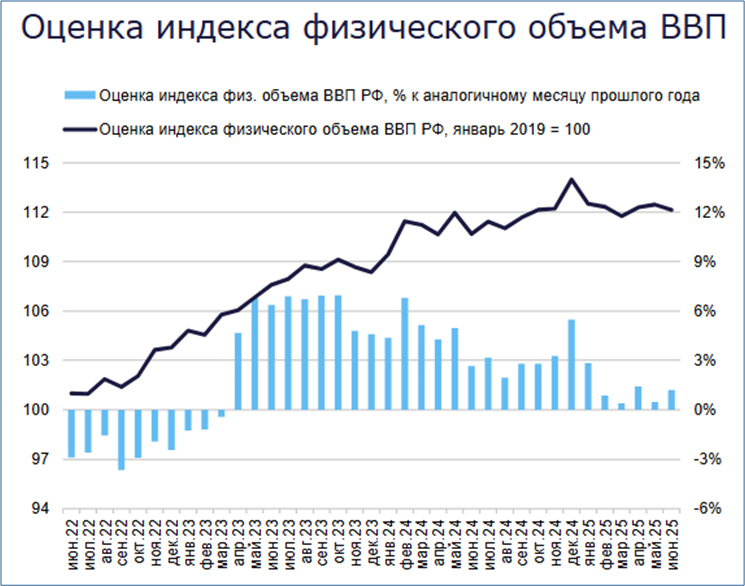
Institute for Economic Forecasting of the Russian Academy of Sciences:
Short-Term Analysis of GDP Development – August 2025, August 14, 2025
From January to July 2025, Russia’s GDP was only 1.1 percent higher than in the previous year
On August 28, one day after the Finance Minister’s forecast that real GDP would rise by at least 1.5 percent in 2025, the Federal State Statistics Service (Rosstat) and the Ministry of Economic Development released economic data for July. According to the Ministry of Economic Development’s estimates, real GDP rose by only +1.1 percent year-over-year from January to July 2025. In July, annual GDP growth reached only +0.4% (June 2025/June 2024: +1.0%; Finmarket.ru).
To achieve a 1.5 percent increase in overall economic output for the full year 2025, the Russian economy will need to grow significantly by the end of 2025. The Russian Central Bank expects real gross domestic product to rise by 1.0 to 2.0 percent year-over-year in 2025. In its explanation of its medium-term forecast published on August 6, it assumes that aggregate economic output in the third quarter of 2025 will be 1.6 percent higher than in the same quarter of the previous year (However, according to the Ministry of Economy, it was only 0.4 percent higher in July 2025 than a year ago). For the fourth quarter, the central bank still expects a growth rate of 0 to 1 percent in real gross domestic product, which rose sharply in the fourth quarter of 2024.
Is 1.5 percent growth still achievable in 2025?
Olga Belenkaya, chief economist at the brokerage firm FINAM, points out that growth so far in the first seven months, at +1.1%, is close to the lower end of the Central Bank’s forecast for the entire year 2025 (+1.0 to +2.0%). She says:
“Given this development, Finance Minister A. Siluanov’s statement that the Ministry of Economic Development now expects economic growth of ‘at least 1.5%’ by the end of the year seems quite optimistic.”
Denis Popov of PSB Analytics sees the weak July result as a “certain deviation from the scenario of a soft landing” for the economy. There are increasing risks to the realization of the growth forecast of at least 1.5 percent, which is shared by PSB Analytics. The weakness of the economy remains the main argument for further easing of monetary policy.
However, on August 28, the Moscow-based “Center for Macroeconomic Analysis and Short-term Forecasts, CMASF,” maintained its forecast on August 28 that Russia’s economic growth will reach 1.0 to 1.4 percent in 2025 and is expected to accelerate to 1.5 to 1.8 percent next year.
Industrial growth in 2025 will also be weaker than previously expected
First Deputy Prime Minister Denis Manturov announced a downward revision of forecasts for industrial production growth this year during a meeting between government members and President Putin on August 27 (Reuters). Industrial production is expected to grow by around 2% overall in 2025 (previous forecast: +2.6%). Production in the “manufacturing sector” is projected to rise by around 3% (previous forecast: +4.3%).
In the first seven months of 2025, production in the “manufacturing sector” did rise by 3.3 percent year-over-year. Overall, however, industrial production was only 0.8 percent higher than in the previous year, primarily because production in the “mining and raw materials extraction” sector fell by 2.3 percent (Finmarket.ru).
The following excerpt from a report by the Telegram channel MMI shows the production trends for total industry (left figure), the “manufacturing sector” (middle figure), and the “mining and raw materials extraction” sector (right figure).
Trends in total industrial production and production in the “manufacturing” and “mining” sectors
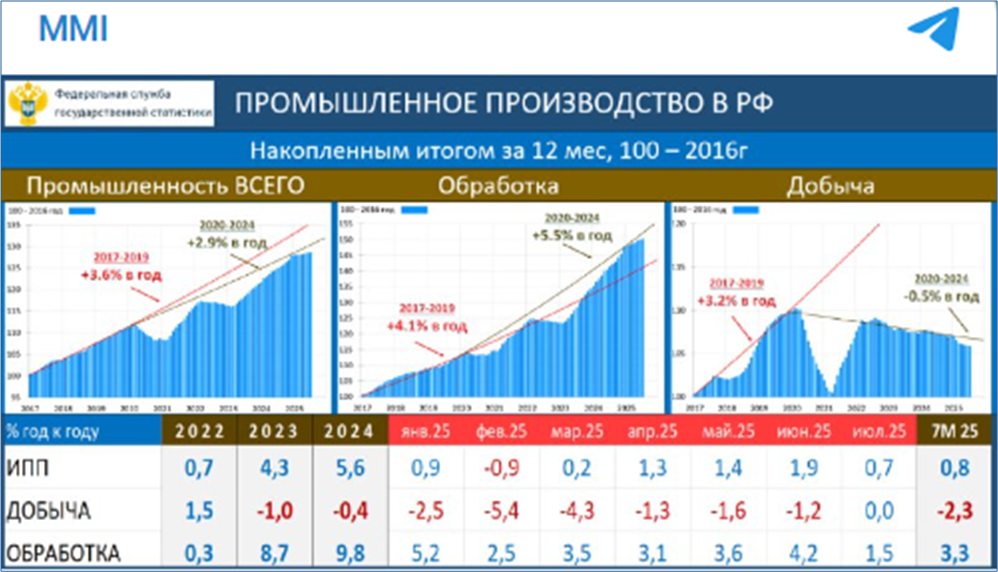
MMI: Industry: 2024 Forecast Revised Sharply Upward, Aug. 29, 2025
The table above shows:
Total industrial production (first row) rose by +0.7% year-over-year in July 2025. In the first seven months of 2025, annual industrial growth totaled +0.8% (right column). From January to July, the main driver of growth was the “manufacturing” sector. In the mining sector, however, production declined.
The mining sector, including oil and natural gas production (second row), stagnated in July at the previous year’s level (+0.0%). In the first seven months, production in the mining sector was 2.3% lower than in the previous year. According to Belenkaya, the fact that production in the raw materials sector did not decline further in July was likely due to a gradual easing of restrictions on oil production under the OPEC+ agreements.
Production in the “manufacturing sector” (third row) rose by +1.5% year-over-year in July. In the first seven months, its growth was +3.3% compared to the previous year.
The following chart from the Telegram channel “Harte Zahlen” illustrates the current overall trend in industrial production over the past few months. According to estimates by “Harte Zahlen,” the index of total industrial production fell by 0.5 percent in July on a seasonally and calendar-adjusted basis, following a decline in June.
Index of seasonally and calendar-adjusted industrial production (2015=100)
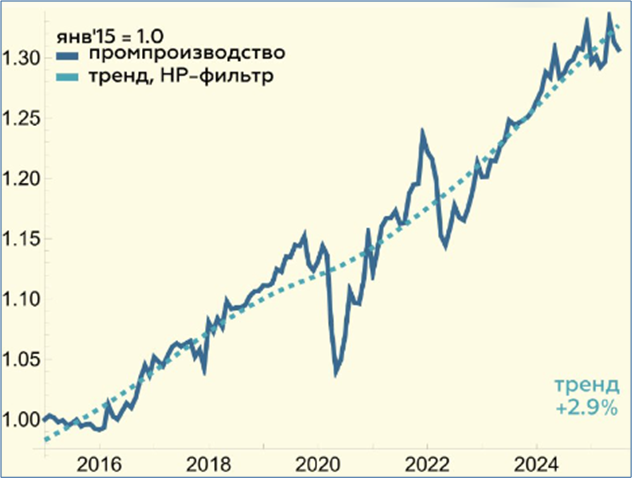
Harte Zahlen: Industrial Production in July, 08/27/25
Growth in the “manufacturing sector” slowed sharply in July
The slowdown in annual growth of total industrial production from 1.9 percent in June 2025 to just 0.7 percent in July was primarily caused by the sharp decline in growth in the manufacturing sector. Here, only a 1.5 percent year-over-year increase in production was recorded in July—down from +4.2 percent in June (Finmarket.ru).
Within the manufacturing sector, production in the defense-oriented sector “Other transport vehicles and equipment, including aircraft and shipbuilding” grew by far the most year-over-year in July (+49.1%).
The sharpest declines compared to July 2024 were recorded in the production of motor vehicles (-26.5%), furniture (-12.0%), and machinery and equipment not included in other groups (-11.9%).
Industrial production in 2024 was revised sharply upward
Rosstat’s calculation of industrial production growth rates for July 2025 took into account the fact that Rosstat significantly revised upward the rates of change in industrial production for 2024. Accordingly, total industrial production last year rose not by +4.6%, but by +5.6%. The main reason for this was that production in the “manufacturing” sector rose not by +8.5%, but by +9.8%. Production in the “Mining and Extraction of Raw Materials” sector did not fall by -0.9%, but only by -0.4% (Finmarket.ru).
In the following chart by Dmitry Polevoy (Investment Director at JSC “Astra Asset Management”), the blue line shows the trend in industrial production before the revision, and the red line shows the trend in industrial production after the revision.
Industrial Production Index, December 2023=1.0
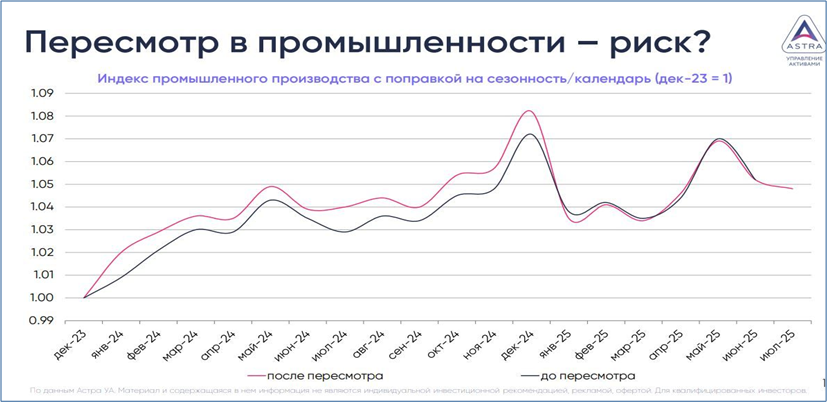
Dmitry Polevoy; JSC “Astra Asset Management,” in: Finam.ru: The revision of industrial data has no impact on the decision of the Central Bank of the Russian Federation in September, Aug. 29, 2025
The Telegram channel MMI estimates that the upward revision of industrial production will lead to an upward revision of the increase in aggregate economic output in 2024 from +4.3% to +4.6%.
Construction output rose sharply in July
As mining output declined, goods transportation also fell.
According to the Telegram channel “Hard Numbers,” freight turnover in the transport sector fell by -1.8% year-over-year in July, following growth of +1.4% in June. In the first seven months, freight turnover decreased by -0.6% compared to the previous year.
Agricultural production fell by -0.4% year-on-year in July, following growth of +1.5% in June. In the first seven months, agricultural production rose by +1.0% year-on-year.
Construction output rose by +3.3% year-over-year in July, after having remained virtually flat in the previous two months. In the first seven months
construction volume rose by +4.2% year-over-year.
Strong real wage increases are driving further consumption growth
The annual increase in real wages accelerated in June to 15% in nominal terms and 5.1% in real terms, compared with 14.5% and 4.2%, respectively, in May.
Growth in private consumption accelerated. Real total sales in retail, public food service, and fee-based services rose by +2.2% in July, up from +1.8% in June.
Real retail sales grew by +2.0% year-over-year in July, following +1.2% in June. In the first seven months of 2025, real retail sales rose by +2.1% year-over-year (see Raiffeisenbank analysis).
The unemployment rate remained at a historic low (2.2%).
Monthly economic trends since November 2024 at a glance Year-over-year changes in percent (unemployment rate in percent)
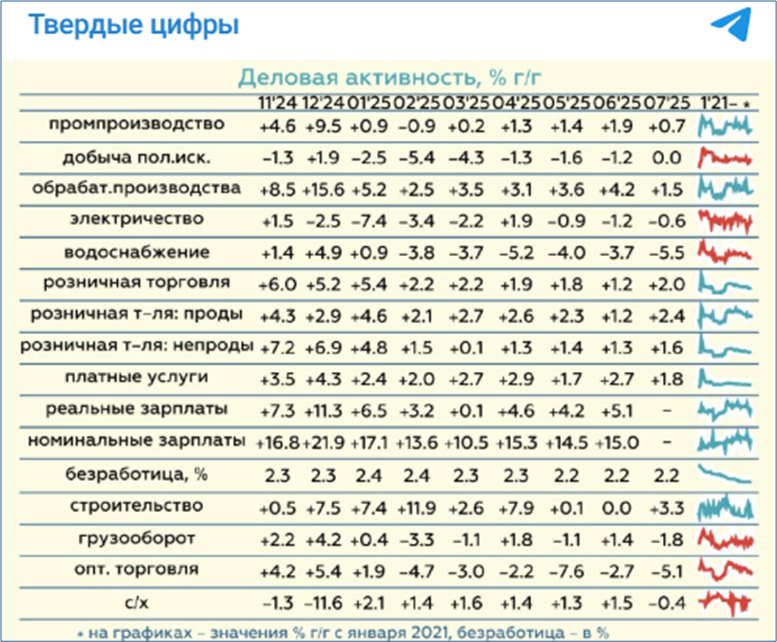
Hard data: https://t.me/xtxixty/5602
Recommended reading:
- fr.de; Lars-Eric Nievelstein: War economy in Putin’s Russia stalls – Kremlin lowers growth expectations, 08/30/25
- The Moscow Times: Kremlin’s main state bank has announced a recession in the Russian economy, 08/29/25
- RBC.ru: VEB Chief Economist Reports Second Consecutive Quarterly Decline in GDP, 08/29/25
- The Bell: Economists propose reintroducing the “free market economy” to avoid a recession, 08/29/25
- Finmarket.ru: Experts identify risks to the Russian economy. “Short-term analysis of GDP dynamics” by the Institute for Economic Forecasting (IEF) of the Russian Academy of Sciences, 08/29/25
- scanx.trade: Russia’s Economic Growth Slows, Falling Short of Central Bank Projections, 08/28/25
- en.Izvestia.ru: Add — not subtract: the devaluation of the ruble was cited as a key risk for the Russian economy. What else could weaken or bolster Russia’s GDP this year, 08/29/25
- National Security Journal, Stephen Silver: Russia’s Economy Looks Like a Giant Mess, August 29, 2025
- Finam.ru: Olga Belenkaya: The Russian Economy in July – What the Central Bank Will Focus On, 08/28/25
- serrarigroup.com; Montel Kamau: Russia Lowers Its 2025 Growth Forecast to 1.5% as the War Economy Faces a Reality Check, 08/28/25
- onvista.de, Reuters: Russia’s Finance Minister Expects Lower Economic Growth – Reuters; August 27, 2025, Global Banking and Finance Review; Reuters: Russia Lowers Growth Forecast for 2025 from 2.5 to 1.5 Percent, August 27, 2025
The day's most important Russian economic stories. Free, in your inbox three times a week.
Mon, Wed, Fri. Double opt-in, no tracking, unsubscribe anytime. By subscribing you consent to the processing of your email address as described in our Privacy Policy.