Russia: "Technical stagnation" or "technical recession"?
Author: Klaus Dormann
The extent to which the Russian economy slowed in the first half of 2025 remains highly controversial.
Some experts believe that economic output declined on a seasonally adjusted basis not only in the first quarter but also in the second quarter compared to the previous quarter. Russia has thus entered a so-called “technical recession.” Others estimate that gross domestic product stagnated or rose very slightly in the first two quarters. Sberbank CEO German Gref spoke last week at the Economic Forum in Vladivostok of a “technical stagnation.”
To revive growth in the Russian economy, Gref—like the Russian Union of Industrialists and Entrepreneurs (RSPP)—is calling for significantly lower key interest rates. The Central Bank will decide next Friday whether to further lower the key interest rate to support growth.
The government continues to anticipate a “soft landing”
Analyst surveys continue to project economic growth for 2025 compared to the previous year. In a survey conducted by the Central Bank from August 29 to September 2, none of the 33 participants expected a recession in Russia in 2025. Their growth forecasts for 2025, compared to 2024, ranged from +0.6 to +2.0 percent. On average, analysts’ forecast for this year’s Russian economic growth has fallen only from +1.4 to +1.2 percent since the last survey in mid-July.
However, Sberbank CEO German Gref stated at the “Eastern Economic Forum” in Vladivostok on September 4 that the Russian economy had fallen into “technical stagnation” in the second quarter. Economic activity also remained very weak in July and August. Gref believes that a further cut in the key interest rate from the current 18 percent to 12 percent is necessary for a recovery in Russia’s economic growth (The Moscow Times).
President Putin, however, does not share Gref’s opinion. When the moderator addressed him on September 5 at the Economic Forum regarding Gref’s observation of signs of “technical stagnation” in the Russian economy and asked Putin whether he agreed with this assessment, the president replied succinctly: “No” (transcript en.kremlin.ru, Moscow Times). Gref knows that too. At the same time, Putin pointed out that some members of the government share Gref’s opinion.
Putin described the Central Bank’s policy as “deliberate.” “We must address the macroeconomic challenges and ensure a soft, smooth landing for the economy in order to stabilize the key macroeconomic indicators and slow the pace of inflation,” the president said.
“I am certain that we will ultimately succeed in resolving the issues of maintaining the necessary pace of economic growth while keeping inflation at a minimum,” he is quoted as saying by *Der Spiegel*.
What the Federal State Statistics Service (Rosstat) has published so far on GDP growth
At the end of August, the Russian Federal State Statistics Service (Rosstat) reported that in the first half of 2025, Russia’s real gross domestic product had grown by 1.2 percent compared to the same period the previous year. Previously, the statistics agency had already determined that annual growth in the Russian economy had slowed from 1.4 percent in the first quarter of 2025 to 1.1 percent in the second quarter of 2025 (Interfax.com). This decline is shown by the black line in the following figure from the “Russia Chartbook” published by the Kyiv School of Economics.
Quarterly change in real gross domestic product in percent
Blue bars: Changes from the previous quarter, seasonally adjusted; black line: Changes from the same quarter of the previous year
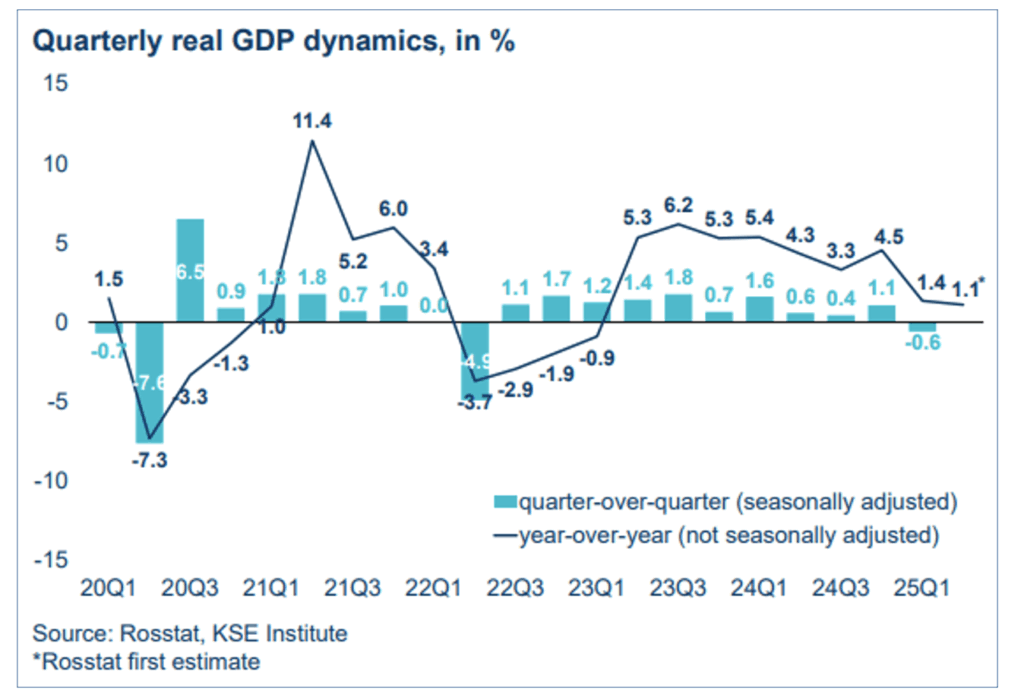
Kyiv School of Economics: Russia Chartbook August 2025, August 29, 2025
The blue bars show how real gross domestic product, seasonally adjusted, has changed compared to the previous quarter. According to Rosstat, it fell by 0.6 percent in the first quarter of 2025 compared to the fourth quarter of 2024. Rosstat is expected to publish a preliminary estimate of how GDP developed in the second quarter compared to the previous quarter on September 12.
“Whether Russia is in a technical recession remains to be seen”
Benjamin Hilgenstock, Senior Economist at the Kyiv School of Economics, described the current state of the Russian economy in an interview with Deutsche Welle’s Russian service published on September 5:
“We can definitely see that the war and the sanctions have had a noticeable impact on the Russian economy. Whether it is in a technical recession—that is, recording negative growth for two consecutive quarters—remains to be seen.
According to available data from Rosstat, the Russian economy did indeed contract in the first quarter. There are no final figures yet for the second quarter, but initial estimates show virtually zero growth. This is also in line with expectations for the rest of the year.
We can therefore conclude that the growth model of recent years, which relied heavily on massive military spending and fiscal stimulus, has reached its limits, and that the sanctions are significantly restricting the room for maneuver of the Russian Ministry of Finance and the Central Bank.”
According to CMASF, GDP did not decline in the first half of 2025, but rather stagnated
A leading Russian economic research institute, the Moscow-based “Center for Macro-economic Analysis and Short-term Forecasts (CMASF),” has now published its own new estimates on GDP development in the first and second quarters of 2025.
Unlike Rosstat, the CMASF does not assume that Russia’s aggregate economic output in the first quarter of 2025 was lower than in the fourth quarter of 2024. On September 3, the institute published a new estimate indicating that seasonally and calendar-adjusted real gross domestic product in the first quarter remained flat compared to the fourth quarter of 2024. In the second quarter of 2025, adjusted real gross domestic product rose by 0.1 percent compared to the first quarter, according to the CMASF estimate (see table in the CMASF report, p. 2).
In the following CMASF figure on the quarterly development of the real gross domestic product index (2018=100), the dark blue line shows the adjusted trend of the GDP index, which stagnated in the first quarter of 2025 at the level of the fourth quarter of 2024 (113.7).
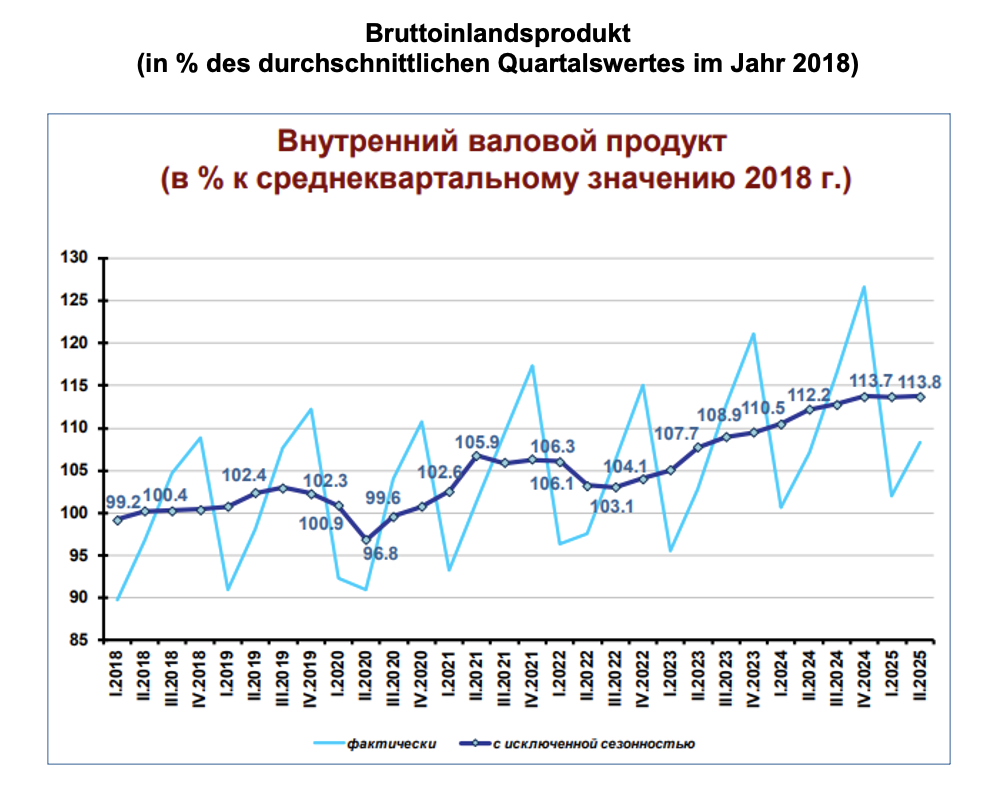
Center for Macroeconomic Analysis and Short-Term Forecasts (CMASF):
Trends in the Russian Economy, July 2025; 09/03/25
Russian Central Bank’s “Talking Trends” chart signals a decline in GDP
In contrast to the CMASF estimates, however, estimates from the Russian Central Bank signal a decline in real gross domestic product since the beginning of 2025. On September 2—ahead of its next key interest rate decision on September 12—the Central Bank again published a report titled “What the Trends Say” on macroeconomic developments in Russia.
The report also includes the following chart. The Central Bank compares the trend in production of the so-called “core sectors” of the Russian economy (red line), as published by Rosstat, with its own estimate of the trend in overall economic output (blue lines).
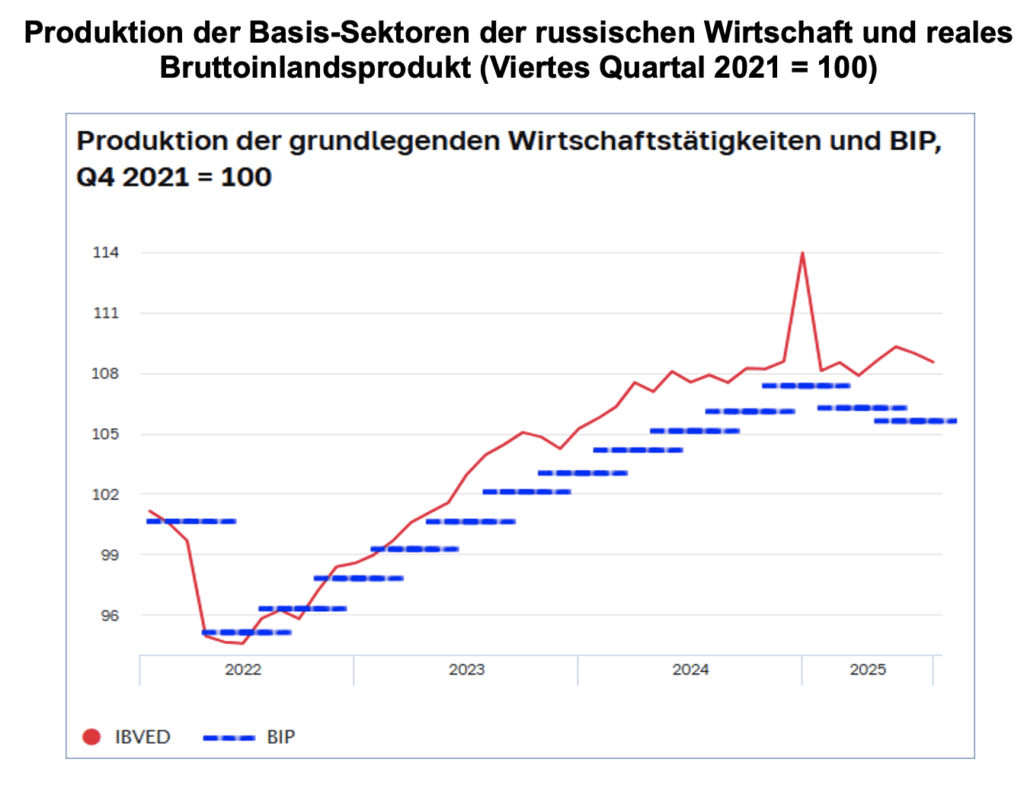
Russian Central Bank; Press Release: What the Trends Say, September 2, 2025
Unfortunately, the Central Bank does not provide further explanation for the above figure. The last three blue lines apparently show the Central Bank’s estimates for real gross domestic product over five-month periods: October 2024 to February 2025, January 2025 to May 2025, and March 2025 to July 2025. The lines show a decline in real gross domestic product over the last two five-month periods.
Dmitry Polevoy, Investment Director at JSC Astra Asset Management, wrote on September 3 in an analysis published by Finam.ru—presumably referring to the central bank’s chart above:
“Yesterday’s Central Bank estimates for GDP in the second quarter of 2025 of -0.6% q/q following -1% in the first quarter of 2025, seasonally adjusted, imply that the economy has already entered a technical recession. Given this trajectory, GDP growth of 1% in 2025 would be a major success, but we have left our forecast of +0.6% unchanged since the end of 2024.”
Minister of Economic Development: The economy is cooling faster than expected
According to data from the Ministry of Economic Development on August 28, total economic output in July 2025 was only 0.4 percent higher than in July 2024. In the first seven months of 2025, Russian GDP rose by 1.1 percent year-over-year, according to the ministry (Finmarket.ru).
The head of the Ministry of Economic Development, Maxim Reshetnikov, told journalists on the sidelines of the Economic Forum in Vladivostok that the latest data indicated the economy was cooling down faster than expected. The government’s growth forecast will be revised downward shortly (Wirtschaftswoche). In April, the Ministry of Economic Development had still forecast that Russian GDP would grow by 2.5 percent in 2025.
Regarding the announced downward revision of the government’s growth forecast, Finance Minister Anton Siluanov stated on August 27, citing a new forecast from the Ministry of Economic Development, that Russian GDP would grow by at least 1.5 percent this year.
According to press reports, however, “a source familiar with the progress of the budget forecasts” is now reported to have stated that the government now expects GDP growth of only 1.2 percent for the current year (1Prime.ru).
German Gref on economic growth: “We are approaching the zero line”
Sberbank CEO German Gref, who previously served as Minister of Economic Development from 2000 to 2007, expressed strong skepticism about the growth prospects of the Russian economy during a press conference at the “Eastern Economic Forum (EEF)” in Vladivostok. According to a report in the Russian edition of the “Moscow Times,” he said that overall economic output had slowed significantly in the second quarter of this year. The economy is in a phase of “technical stagnation”:
“The slowdown is continuing; we can see that from the GDP growth rate. The second quarter can practically be considered technical stagnation. July and August show clear signs that we are approaching the zero line.”
The Sberbank CEO expressed hope that the Central Bank would not allow a “slide into recession” (Meduza.io/en and Market Screener/Reuters).
Gref: For growth to recover, the key interest rate must fall to 12 percent
German Gref emphasized how important it is to end the phase of controlled economic cooling in a timely manner. The longer one waits, the more difficult it will be to revive the economy. He pointed to cuts in the Central Bank’s key interest rate as a tool for strengthening growth.
The central bank had raised the key interest rate to 21 percent in October 2024 to combat rising inflation. So far in 2025, it was lowered to 20 percent in June and to 18 percent in July. The annual inflation rate, which had risen to 10.3 percent in March, fell to 8.8 percent in July (TradingEconomics chart).
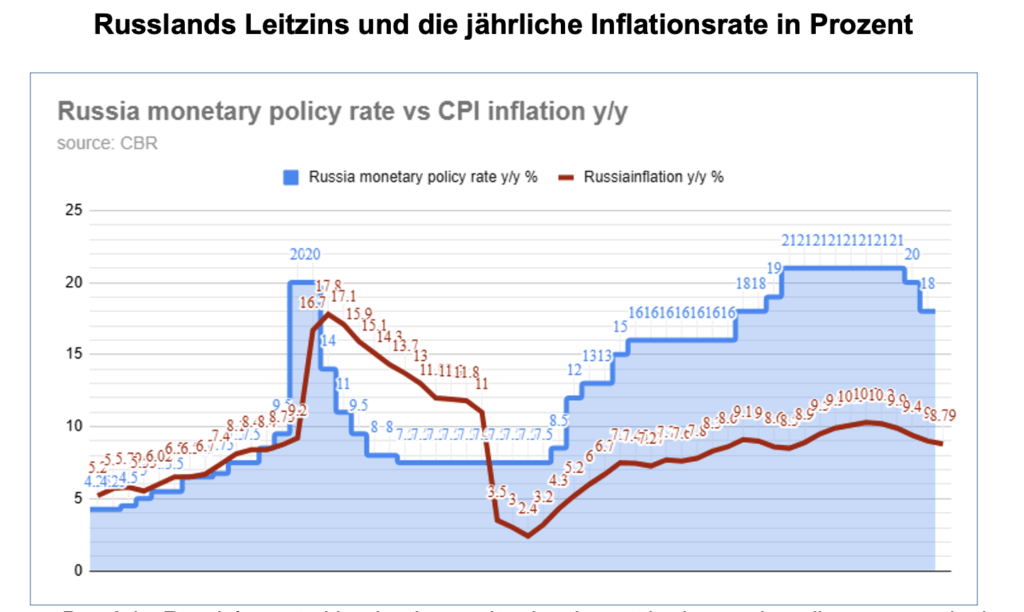
bne Intellinews, Ben Aris: Russia’s central bank releases its closely-watched annual medium-term outlook report, 09/04/25
Gref announced in Vladivostok that, according to Sberbank’s expectations, the key interest rate is likely to be lowered from the current 18 percent to 14 percent by the end of 2025. However, the Sberbank CEO does not consider a cut to 14 percent sufficient. Regarding a cut to 14 percent (Interfax.com), he said:
“Is that enough for the economy to recover? In our opinion, it is not enough. Given current inflation, the key interest rate at which we can hope for an economic recovery is 12 percent or less.”
Alexander Shokhin, president of the “Russian Union of Industrialists and Entrepreneurs” (RSPP), advocates for key interest rates as low as those suggested by Gref. Shokhin described a reduction of the key interest rate to 16 percent as “a necessary step.” According to Shokhin, a key interest rate of 10 to 12 percent would be an acceptable, if not optimal, rate for the economy next year (Euro News).
However, according to dpa, President Putin explicitly contradicted Gref’s arguments and his call for a rapid interest rate cut during his visit to Vladivostok. The president acknowledged that the situation in some sectors of the economy was “not easy.” But if inflation spiraled out of control, he warned, it would not end well. Not only would long-term economic planning become impossible.
Monetary policy, however, is, according to Putin, a “very delicate matter.” He referred to statements by the CEO of VTB Bank, Andrei Kostin. If one were to ask Kostin for his opinion on monetary policy, the VTB CEO would say that perhaps the central bank’s monetary policy had been somewhat excessive and the economy might have cooled off a bit too much.
Kostin had already warned last December that, given high military spending and sanctions, interest rate hikes might not be fully effective in bringing inflation under control (Reuters video; Business Insider). According to the “Moscow Times” on September 5, Kostin is also calling for an accelerated cut in the key interest rate. He says:
“I am also in favor of a faster reduction in the interest rate. I have my own self-interested motives in this. For us, a high interest rate means major losses.”
Alfa Bank: The key interest rate is likely to fall to only 15 percent by the end of 2025
According to Natalia Orlova, chief economist at Alfa Bank, against the backdrop of the discussion at the Vladivostok Economic Forum, the Central Bank is likely to lower the key interest rate to only 15 percent by the end of 2025 (not to 12 percent, as Gref has demanded). Orlova argues (alfabank.ru):
“Weak economic momentum could be an argument for easing monetary policy. The Bank of Russia could consider lowering the key interest rate to 16% as early as September.
However, the scope for further easing is limited. Given high fuel prices and the ongoing labor shortage, inflationary pressure remains significant. Under these conditions, the key interest rate could stabilize at 15% by year-end.”
Results of the Central Bank’s survey on economic development through 2028
Ahead of its key interest rate decision scheduled for September 12, the Russian Central Bank again surveyed banks, research institutes, and financial media from August 29 to September 2 regarding their assessment of economic developments.
Compared to the July survey, analysts lowered their forecast for the annual increase in consumer prices in December for the current year from 6.8% to 6.4%. They continue to expect an inflation rate of 4.7% in December 2026.
Forecasts for the average key interest rate in 2025 and 2026 have fallen from 19.3% to 19.0% and from 13.8% to 13.2%, respectively.
Results of the Central Bank Survey from September 2025 (excerpt)
in parentheses: Results of the July survey for 2025 to 2028
| 2021 | 2022 | 2023 | 2024 | 2025 | 2026 | 2027 | 2028 | |
| Consumer Price Index (%, Dec./Dec. of the previous year) | 8.4 | 11.9 | 7.4 | 9.5 | 6.4 (6.8) | 4.7 (4.7) | 4.2 (4.3) | 4.0 (4.0) |
| Consumer Price Index (% year-over-year, annual average) | 6.7 | 13.8 | 5.9 | 8.4 | 8.9 (9.1) | 5.1 (5.5) | 4.4 (4.3) | 4.1 (4.1) |
| Key interest rate (% p.a., annual average, including weekends) | 5.7 | 10.6 | 9.9 | 17.5 | 19.0 (19.3) | 13.2 (13.8) | 10.3 (10.2) | 8.5 (8.5) |
| GDP (%, year-over-year) | 5.9 | -1.4 | 4.1 | 4.3 | 1.2 (1.4) | 1.6 (1.6) | 1.9 (1.8) | 2.0 (1.9) |
| Unemployment rate (%, annual average) | 4.8 | 4.0 | 3.2 | 2.5 | 2.3 (2.4) | 2.5 (2.6) | 2.8 (2.8) | 3.0 (3.0) |
Bank of Russia: Bank of Russia Macroeconomic Survey, 09/03/25
No survey participant expects a recession in Russia
Forecasts for this year’s economic growth range from +0.6 to +2.0 percent. On average, analysts’ forecast for Russian economic growth in 2025 fell from +1.4 to +1.2 percent.
As previously projected in July, growth is expected to pick up to +1.6 percent in 2026.
Change in real gross domestic product compared to the previous year, in percent
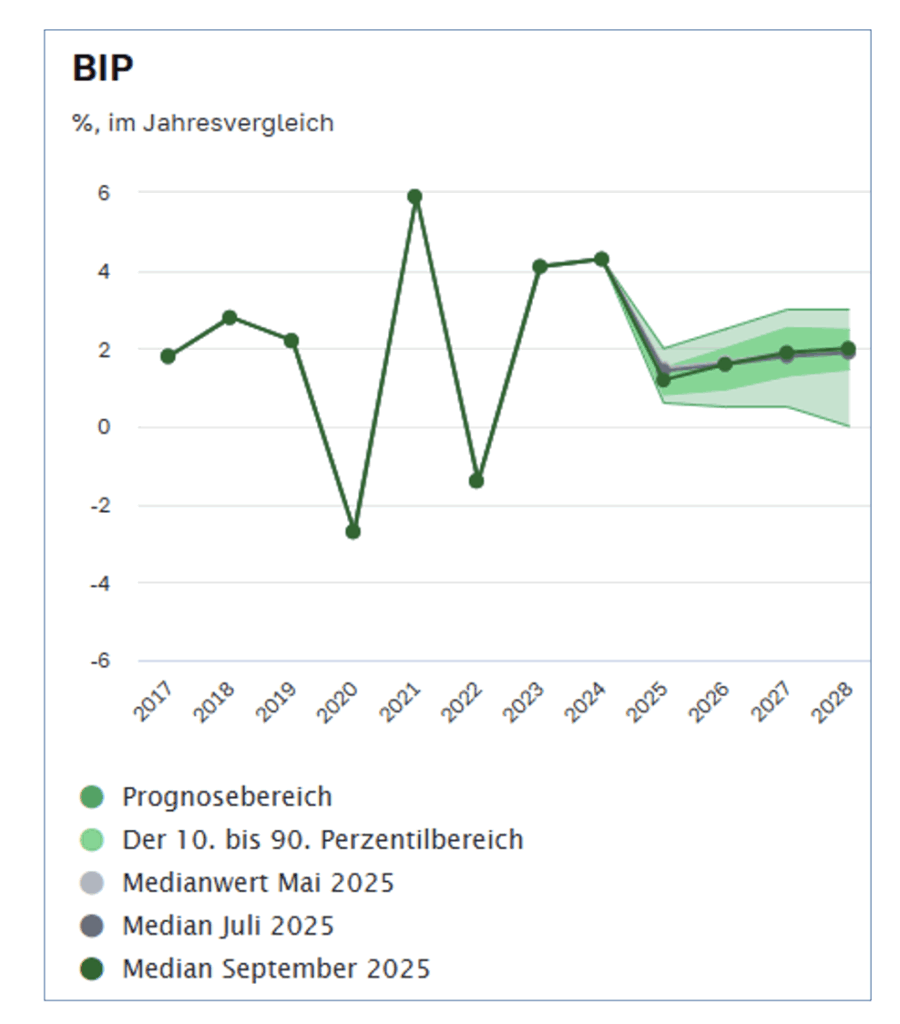
Bank of Russia: Macroeconomic Survey by the Bank of Russia, September 3, 2025
Recommended reading:
- Economic interview “Food Retailers”; Vladislav Zhukovsky in a video interview (Russian): Gref complains to Putin about Nabiullina. What is “technical stagnation”? 52 min., 09/06/25
- Timothy Ash, Associate Fellow, Russia and Eurasia Programme, Chatham House: The ‘Fortress Russia’ economy has adapted well to pressure. But stagflation presents an opportunity for the West, 09/05/25
- Finam.ru, Alla Kolesnikova: On the Brink of a Recession. How Much Has the Russian Economy Cooled Off? Debriefing on the Economic Forum in Vladivostok, 09/05/25
- RND; Paul Katzenberger: Economic Forum in Vladivostok. Russia’s Economy in Crisis: Putin Bets on Pragmatic Optimism, 09/05/25
- Reuters, translated by MarketScreener: Putin Rejects Claims of Economic Stagnation – Central Bank Sees Signs of a Recession, 09/05/25; uk.finance.yahoo.com; Reuters, Vladimir Soldatkin and Gleb Bryanski: Russia’s Putin denies economy is stagnating, as evidence suggests otherwise, 09/05/25
- cash.ch; Reuters: Putin contradicts Sberbank CEO: Russian economy not stagnating, 09/05/25
- The Moscow Times.ru; Reuters: VTB CEO sees no qualitative deterioration in the Russian economy and calls for accelerated key interest rate cuts, 09/05/25
- Deutsche Welle. Russian Service; Olga Lebedeva: Sberbank CEO sees “technical stagnation” in the Russian economy, 09/04/25
- Interfax.com: Gref sees technical stagnation in Russian economy, hopes Central Bank will prevent recession by lowering rate, 09/04/25
- ntv.de: Finance Minister revises forecast. Defense spending and sanctions are slowing down Russia’s economy, 09/04/25
- EuroNews: Russia’s economy has entered a phase of “technical stagnation,” 09/04/25
- bne Intellinews, Ben Aris: Russia’s central bank releases its closely-watched annual medium-term outlook report, 09/04/25
- Andrey Gurkov in an interview with Eckart Aretz on Tagesschau.de: “Russia’s economy is deteriorating rapidly,” 09/03/25; Pro Sieben; Benedict Hottner on Andrey Gurkov in conversation with “tagesschau.de”: Expert warns: Inflation, recession, war: Russia’s economy in crisis, 09/03/25
- fr.de; Lars-Eric Nievelstein: War economy in Putin’s Russia stalls – Kremlin lowers growth expectations, 08/30/25
- en.Izvestia.ru: Add — not subtract: the devaluation of the ruble was called a key risk for the Russian economy. What else can weaken and support Russia’s GDP this year, 08/29/25
- FRANCE 24 English, Video: “This party is almost over,” expert says as Russia slashes 2025 forecast; Alexander Kolyandr, Senior Fellow at the Center for European Policy Analysis, says that the stimulus provided by spending on the war in Ukraine “cannot last forever,” 08/27/25
The day's most important Russian economic stories. Free, in your inbox three times a week.
Mon, Wed, Fri. Double opt-in, no tracking, unsubscribe anytime. By subscribing you consent to the processing of your email address as described in our Privacy Policy.