Russia's savings boom is slowing down

The annual growth rate of Russian bank deposits slowed from 23% to 10.4% over the course of two years. Experts attribute the declining savings rate to the end of two one-time factors: The key interest rate fell from 21% to 14%. The era of large salary increases is over.
Media reports indicate a run on banks, while central bank data show growth
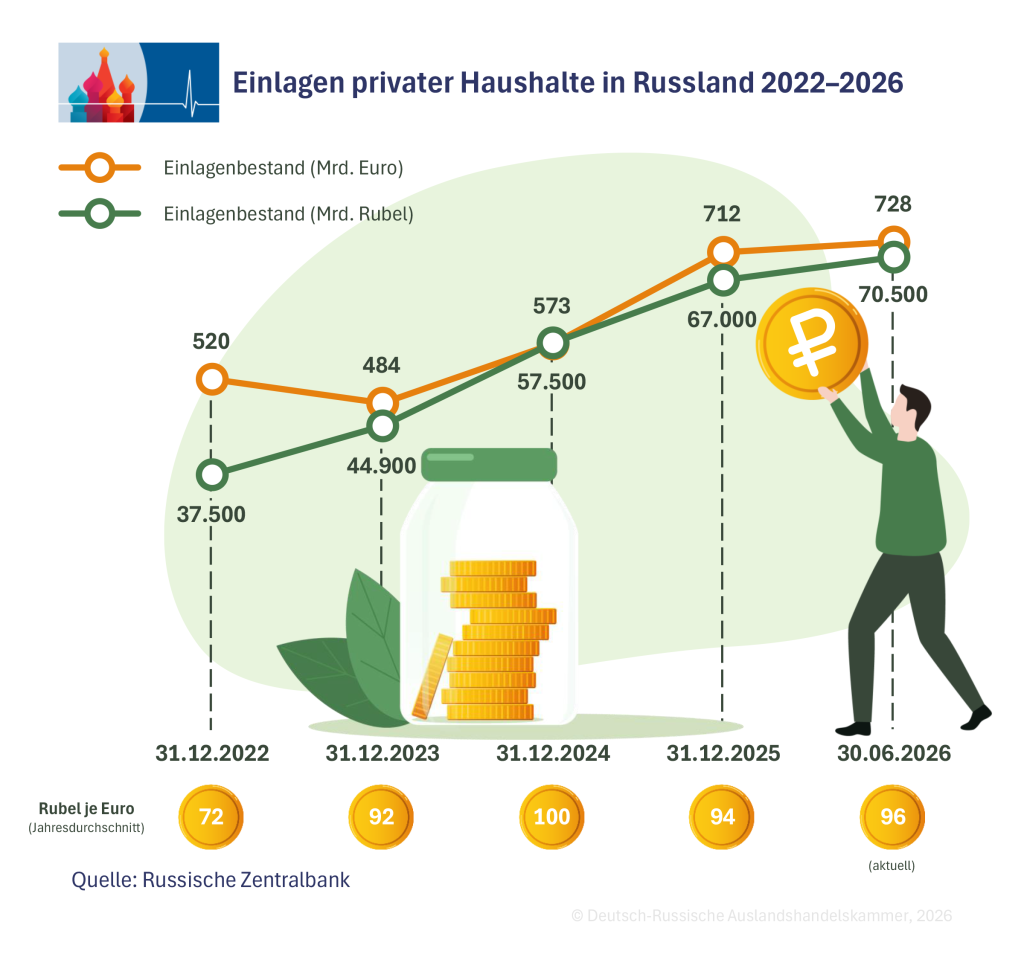
In mid-August, the Washington Post reported that Russians were withdrawing billions of rubles from their accounts. The British Telegraph reported on fears of expropriation by the state, and numerous media outlets echoed this narrative. Citing central bank data, the Washington Post puts the cash outflows at $4.5 billion in June, $7.3 billion in July, and $3.4 billion in the first two weeks of August. Together, that amounts to a good $15 billion, or just under 2% of the total deposit base of more than $800 billion. Janis Kluge, a Russia expert at the Berlin-based German Institute for International and Security Affairs (SWP), wrote, however: “The Russians are not withdrawing their money. The proportion of cash has remained largely constant.”
Graphic: German-Russian Chamber of Foreign Trade
Savings Rate Falls by Two-Thirds
The central bank’s annual data show just how sharply the savings rate has declined: In 2024, household assets grew by 27.7% or 12.5 trillion rubles (approx. 124.7 billion euros)—a record. Last year, this was followed by a 16.2% increase, or 9.5 trillion rubles (101 billion euros). At the end of the year, deposits exceeded the 67 trillion ruble (700 billion euro) mark for the first time. In the first half of 2026, deposits grew by only 1.6%.
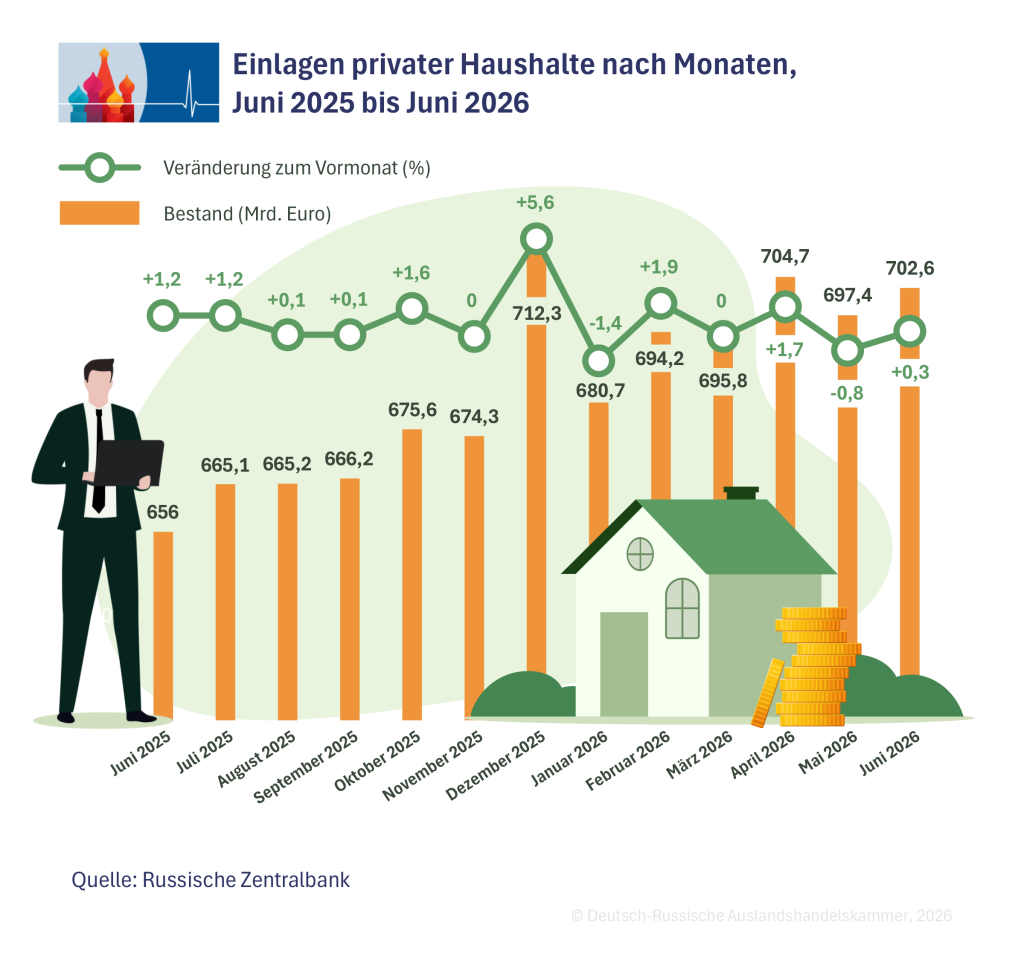
The monthly data reveal a seasonally influenced deposit market. In December 2025, deposits rose by 5.6% due to the payment of annual bonuses; this was followed in January by the usual decline of 1.4%. February saw a 1.9% increase, April a 1.7% increase, May a 0.8% decrease, and June a 0.3% increase. In the 24 months through June 2026, deposits fell four times. Three of these months were Januaries and followed peak levels in December. The structure of bank deposits contradicts the theory of a bank run in Russia: 46.8 trillion rubles (483.4 billion euros), or about 69% of the total, were held in time deposits as of July 1. Current accounts accounted for 20.2 trillion rubles (209.0 billion euros). During a bank run, money is typically transferred from time deposits to demand accounts, which account holders can access at any time without notice or restrictions. There was a bank run in the spring of 2022, when the share of time deposits fell from 59% to 52% within a year. Today, households are tying up their money to earn higher interest rates.
In fact, foreign exchange reserves in Russia are shrinking: down 12.4% in the first half of the year to 3 trillion rubles (31.2 billion euros), now accounting for just 4.5% of total reserves. This continues the trend of de-dollarization that began in 2022, writes British analyst Ben Aris. The central bank does not report yuan holdings for private households separately. The shift toward the Chinese currency remains invisible in official statistics.
The new savings rate is plummeting
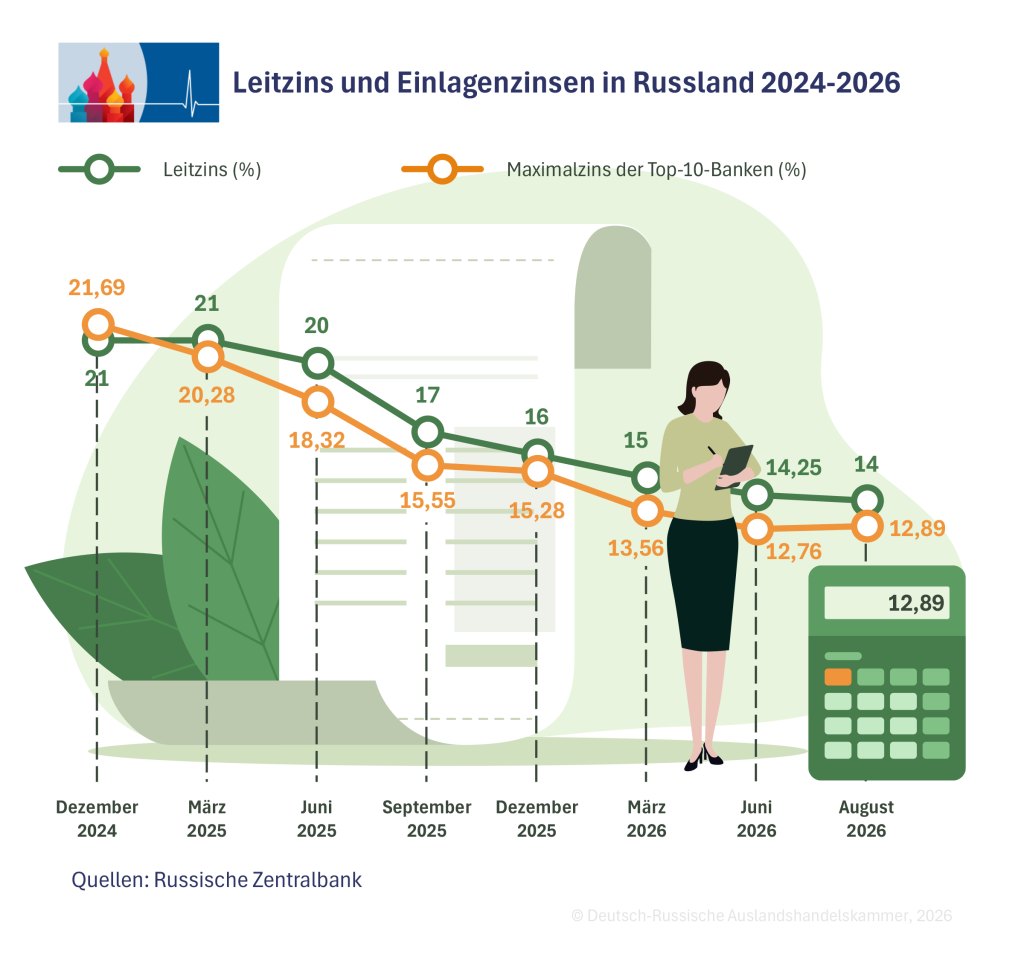
Deposit balances grow from two sources: new savings and accrued interest. For two years, interest rates in Russia were exceptionally high. The key interest rate rose from 7.5% in mid-2023 to 21% in October 2024 and remained at that level until June 2025. Since then, the central bank has cut the rate in ten steps to 14%, most recently on July 24.
The maximum deposit interest rate at the ten largest banks fell from 22.28% in December 2024 to 12.89% in early August 2026; new time deposits with terms of more than one year now yield an average of 10.88%, down from 17.55% a year earlier.
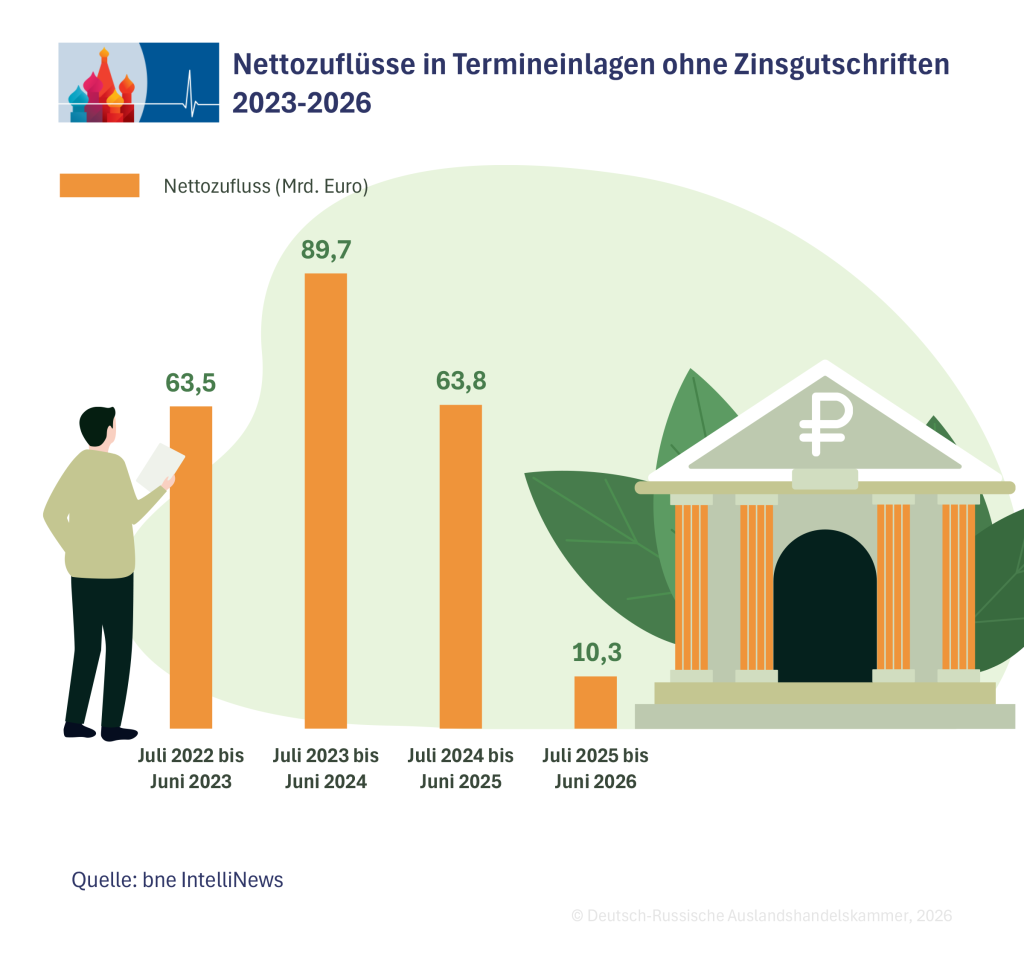
Ben Aris has factored out the interest effect: Excluding interest credits, households set aside approximately 5.9 trillion rubles (63.5 billion euros) in new savings by June 2023. By June 2024, the figure stood at 9 trillion rubles (93 billion euros). By June 2025, the figure was 6 trillion rubles (63.8 billion euros)—and by June 2026, about 1 trillion rubles (10.3 billion euros). New savings are thus currently about 90% below the 2024 peak. This year’s deposit growth consists almost entirely of interest that the banking system credits to existing balances. With every further interest rate cut, both the interest credited and the incentive to save decline.
Graphic: German-Russian Chamber of Foreign Trade
The income surge is losing steam
The second source of the savings boom is also drying up: rising incomes. Labor shortages caused by mobilization, recruitment, and emigration, as well as large defense contracts, drove wages upward starting in 2022, particularly in poorer regions. This momentum is now fading. According to the statistics agency Rosstat, nominal wage growth stood at 13.3% in the first five months of 2026, while real wage growth was 7.2%. In May, the figures were still 10.1% in nominal terms and 4.5% in real terms. The unemployment rate rose slightly from 2.1% to 2.2%.
After 4.9% growth in 2023 and 4.3% in 2024, growth slowed to just 1% in 2025 and 0.3% in the first half of 2026. Incomes are still rising, but the exceptionally high growth rates are a thing of the past.
Demand for cash follows tax payments and power outages
Cash in circulation rose by 2.16 trillion rubles (22.3 billion euros) from January to July. During the same period the previous year, it had fallen by 603.9 billion rubles (6 billion euros).
In total, Russians hold about 21.9 trillion rubles in cash, equivalent to 226.1 billion euros. Experts cite the following reasons: The value-added tax rose from 20% to 22% at the turn of the year, and mobile network outages following drone attacks disrupted card payments, which Russians had recently been using for four out of every five purchases.
According to the business newspaper Vedomosti, the share of cash wages at small businesses increased to 20% to 25% of the total payroll, while for sole proprietors it rose from 10% to 15% to around 40%. For the full year, Sberbank expects a cash increase of 3.8 trillion rubles (41 billion euros), according to the Interfax news agency.
Graphic: German-Russian Chamber of Foreign Trade
Denials All the Way Up to the Ministerial Level
Rumors that the Russian government is tapping into its citizens’ savings are older than the current headlines. They surfaced on Russian Telegram channels at the end of 2024, when the key interest rate stood at 21%. At the time, the Central Bank called the idea of frozen deposits absurd. In August 2025, the Central Bank categorically ruled out withdrawal restrictions: Such a move would have “destructive consequences for the financial system and the economy,” the business portal RBC quoted the Central Bank as saying. In May 2026, Finance Minister Anton Siluanov dismissed the speculations circulating this year as fabrications, stating that such proposals were not being considered. Sowkombank Deputy CEO Sergei Khotimsky explained to the business newspaper Vedomosti where the rumor originated: It was “a brilliant creative feat” by the PR departments of real estate developers who wanted to steer savers away from deposits and toward home purchases.
Central Bank Governor Elvira Nabiullina described the trend on July 24: Savings activity is declining slightly, the share of bank deposits is falling, and financial market instruments and real estate are gaining importance.
The bond market and the budget deficit are the real sources of tension
“We are seeing serious upheavals in the financial and capital markets,” says Janis Kluge of the Berlin-based German Institute for International and Security Affairs (SWP). He cites a plunge in stock prices on the Moscow Stock Exchange and a sharp rise in interest rates on Russian government bonds as the main problems. In July, the Ministry of Finance canceled an auction of federal bonds. Because government bonds are primarily purchased by Russian commercial banks, speculation ensued: the banks lacked the funds following the outflow of cash.
It is more likely, the analyst says, that the ministry was unhappy with the terms: Banks are now demanding a yield of more than 16%.
Russia’s debt-to-GDP ratio remains low at less than 20%—Germany’s is over 60%, and the U.S.’s is over 120%. However, debt service already costs more than 1.5% of GDP, and the trend is upward. At the same time, military spending is spiraling out of control and is significantly above budget. Instead of the projected 1.6%, the budget deficit reached 2.6% at the end of July.
Economist Heli Simola of the BOFIT Institute at the Finnish Central Bank considers a confiscation of deposits to be politically risky and therefore unlikely. The Russian government has other options, ranging from tax increases to forced contributions from the business sector. “Furthermore, the government could simply ask the central bank to transfer more money to it—in other words, to print more money,” says the economist. However, that would further fuel inflation.
Graphic: German-Russian Chamber of Foreign Trade
The propensity to save has fallen to its lowest level since 2015
Only 47.9% of Russians now prefer to save their disposable income rather than spend it. This represents a 6.5% drop within a month and is the lowest figure since March 2015. These findings came from the Central Bank’s July survey.
Consumer confidence fell to 89.5 points, 15.5 points below the previous year’s level; inflation expectations rose to 14.7%, and perceived inflation to 15.1%.
Retail sales rose 7.3% year-over-year in June and 5.4% in the first half of the year. Private consumption is currently the main driver of growth. The next interest rate decision will be made on September 11. The Central Bank forecasts an average key interest rate of 13.7% to 14% for 2026.
Non-performing corporate loans reached 11.3 trillion rubles (116.7 billion euros) in May, or 11.7% of the portfolio. At the same time, the sector earned a net profit of 3.5 trillion rubles in 2025—more than 40 billion euros. Russian banks remain profitable, emphasizes analyst Janis Kluge.
Savings Comparison with Germany
According to the Bundesbank, German households held approximately 3.5 trillion euros in cash and deposits at the end of the third quarter of 2025—nearly five times the Russian total of 727.9 billion euros. This amounts to an average of 41,600 euros per resident, compared to about 5,000 euros in Russia.
The structure of the deposits differs significantly: Germans keep two-thirds of their holdings readily available, totaling 2,314 billion euros in cash and demand deposits. Time deposits account for 638.8 billion euros, or 18 percent, while savings deposits and savings bonds account for 520.3 billion euros.
Russian households, by contrast, tie up about 69% in time deposits. The German interest rate turnaround in 2023/24 had made time deposits attractive only briefly: According to the Bundesbank, the volume of time deposits has stagnated at around 640 billion euros since the beginning of 2025, while demand deposits are growing again: from 2,229.1 billion euros in the first quarter to 2,314.4 billion euros in the third quarter of 2025.
According to the Federal Statistical Office, the German savings rate stood at 10.3% in the first half of 2025, down from 11.1% in the same period the previous year, and close to the long-term average. Only during the COVID-19 years of 2020 and 2021 did Germans save an exceptionally high amount, at just over 15%. Russia’s savings behavior, by contrast, fluctuates with the key interest rate: Two years of new savings ranging between 63.5 billion and 89.7 billion euros were followed in the first half of 2026 by a sharp drop to 10.3 billion euros, with the propensity to save falling to its lowest level since 2015. Germans save steadily and are largely insensitive to interest rates. Russian households react sharply to interest rate signals.
Source: German-Russian Chamber of Foreign Trade, “Russia’s Savings Boom Is Slowing,” August 27, 2026.
This article was prepared for the German-Russian Chamber of Foreign Trade.