Russia's Reading Culture: Books Are More Expensive, Online Retailers Are More Dominant
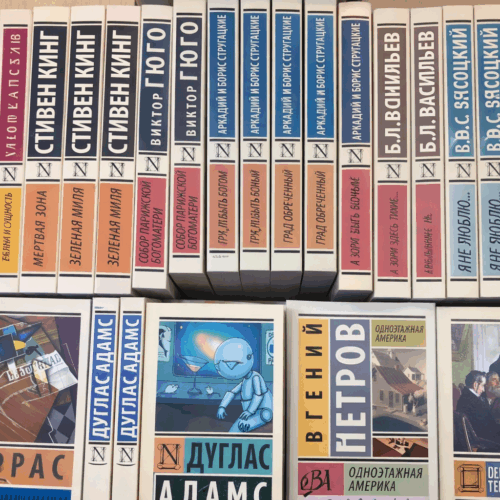
The Soviet Union was once considered the ultimate paradise for readers. Today, Russia is also among the world’s most avid reading nations. Books are inexpensive in the country, although rising prices in recent years have caused some titles to become slow-moving inventory. Meanwhile, traditional bookstores are locked in a bitter battle with online marketplaces for customers—and usually come up short in price wars.
Book prices in Russia have risen steadily in recent years. According to the Russian Booksellers Association (ASKR), the average book price has risen from 374 rubles (4.11 euros) in 2021 to 560 rubles, equivalent to 6.15 euros. From January to November 2025, shoppers spent an average of 837 rubles (9.30 euros) on books and bookstore items, according to calculations by the analytics provider Check Index, part of the Russian tax data operator OFD Platform. Spending thus rose by 9% compared to the previous year, while sales figures fell by 4%.
As early as 2024, the industry saw significantly fewer buyers, as figures from the market research firm Businesstat show. Since 2020, book sales in Russia have declined from an average of 385 million to 373 million in 2024. The only exception was the pandemic year of 2021, which saw strong readership, with 414 million books sold.
Largest Publishers
According to the Russian Association of the Book Printing Industry (GIPP), the total volume of the Russian book market in 2024 amounted to 135.2 billion rubles, equivalent to 1.48 billion euros, representing a 10.6% increase over the previous year. For 2025, Oleg Novikov, president of the Eksmo-AST publishing group, expects further growth of 10%. This growth is attributable to the annual rise in book prices.
Eksmo is one of the largest publishers in the Russian book market. In 2024, the company generated revenue of 21.8 billion rubles, or 239.7 million euros, an increase of 16% over the previous year. In second place is the AST publishing house with 9.5 billion rubles, 104.4 million euros (+10%). Both publishers are part of the Eksmo-AST publishing group. Rounding out the top three is Rosman Publishing with 9 billion rubles, approximately 99 million euros (+9%). Behind them are Azbooka-Attikus with 5.7 billion rubles, approximately 62.7 million euros (+15%), and Alpina Publisher with 1.7 billion rubles, 18.7 million euros (+23%).
Chapter: Price Dumping
Traditional bookstores view marketplaces that attract customers through price dumping as their biggest competitors. Many bookstores cannot compete with the low-price policies of the Russian online giants Ozon and Wildberries. This is because the price difference is sometimes significant. For example, a current bestseller is available in stores or the respective publisher’s online shop for around 1,000 rubles, equivalent to 11 euros—on online marketplaces, however, the sought-after novel costs only 600 rubles, 6.60 euros. This sometimes leads to absurd situations where a potential customer flips through a book in a store and, the very next moment, orders that exact same book from an online giant, industry representatives complain.
Market participants do not share the widespread view that audiobooks, traditional books, and e-books compete with one another. On the contrary: a successful audiobook can actually boost sales of a traditional book. According to the Russian audiobook publisher Bimbo, 70% of audiobook consumers switch to books and e-books they haven’t read since their school days.
Cheaper than the rest
Despite rising prices, the Russian book market holds its own internationally. In both Europe and the U.S., people spend significantly more money on their reading material. On average, a European hardcover costs 27 to 44 euros and a paperback 16 to 27 euros. In Russia, on the other hand, bookworms pay an average of 800 to 1,500 rubles—about 9 to 16.50 euros—for a hardcover and 500 to 800 rubles—5.50 to 8.80 euros—for a paperback. Experts point to a distinctive feature of European book markets. In countries such as Germany, France, Spain, and the Netherlands, fixed book prices are mandated by law, which even online giants like Amazon are not allowed to undercut. This protects smaller and independent bookstores from the aggressive price dumping of competitors.
Print Run and Paper Are Decisive
One of the biggest factors driving up prices in the Russian book market is production costs. According to industry representatives, these depend on two factors: print run size and paper prices. Printing accounts for 60% of production costs, while paper accounts for the remaining 40%. According to Sergei Rubis, head of fiction at AST Publishing, printing costs have risen by 70–80% over the past three to four years. Boris Kuznetsov, director of Rosman Publishing, estimates that printing costs will rise by 25–30% in 2024, with an additional 10–12% increase last year.
The smaller the print run, the higher the cost per unit produced. A book’s print run is profitable for the publisher if it at least covers production costs. Today, 2,500 to 3,000 copies are considered optimal. The crux of the matter: the book may not sell well. Konstantin Lun, production manager at Alpina Publisher, explains: “The first print run should demonstrate a minimum level of profitability. Publishing houses generate their main revenue from reprinting bestsellers.” It is precisely in these cases that readers can hope for reduced book prices, as the publishing costs have already been covered by that point, Lun adds.
Bookworm Ranking
According to the analysis platform World Population Review, most of the world’s bookworms live in the U.S. Americans read an average of seven hours per week and get through 17 books a year. Second and third place go to India (6.55 hours per week, 16 books a year) and the United Kingdom (6.30 hours per week, 15 books a year). France and Italy rank fourth and fifth. The French read for 5.50 hours per week and finish 14 books a year, while Italians spend 5.20 hours per week reading and get through 13 books a year. Russia holds a solid sixth place in this ranking with about 4.30 hours of reading per week and 11 books per year. Germany trails far behind in 25th place—2.40 hours per week and about six books per year.
This article first appeared in the exclusive newsletter of the German-Russian Chamber of Foreign Trade
The day's most important Russian economic stories. Free, in your inbox three times a week.
Mon, Wed, Fri. Double opt-in, no tracking, unsubscribe anytime. By subscribing you consent to the processing of your email address as described in our Privacy Policy.