Russia's Economy: Warnings Against Overly Optimistic Growth Forecasts

Author: Klaus Dormann
According to preliminary calculations by the Russian Ministry of Economic Development, the annual growth rate of the Russian economy accelerated to +1.6% in October. The research institute of the state development bank VEB.RF even estimates that real gross domestic product rose by a total of just over 2 percent in September and October, adjusted for seasonal and calendar effects. This would already put it higher than at the end of 2024. However, analysts and Economy Minister Maxim Reshetnikov warn that one-time factors likely contributed to the strong growth surge.
President Putin estimates this year’s growth at +0.5 to +1.0 percent
In 2023 and 2024, the Russian economy—“overheated” by high defense spending—still grew by a solid 4 percent annually. Production reserves were exhausted, and the annual rise in consumer prices accelerated to 9.5 percent by the end of 2024. The Central Bank raised the key interest rate to 21 percent at the end of October 2024 and only began to lower it in small steps at the end of May—to 16.5 percent so far.
The Russian government has long sought to “cool down” the economy. Initially, starting in early September 2024, it projected a decline in the annual growth rate to +2.5 percent in 2025. For a good year, until the end of September 2025, it stuck to this forecast—at least officially. It was only in the course of its new budget planning that the government began assuming, as of late September, that economic growth of just +1.0 percent would likely be achieved this year.
On December 2, at VTB Bank’s “Russia Calling!” economic forum, President Putin scaled back this growth forecast even further. He no longer ruled out the possibility that real gross domestic product would grow by only +0.5 percent this year. In any case, in his speech, the president adopted the Russian Central Bank’s current forecast range of +0.5 to +1.0 percent as an estimate for this year’s economic growth (en.kremlin.ru: Speech text with video).
The government anticipates a “soft landing” with much lower inflation
The “soft landing” of the Russian economy expected by the government will thus be achieved this year, the President emphasized. However, “some imbalances” have emerged. “In several sectors, production output this year has not only failed to rise but has actually fallen.” While this year’s slow economic growth in Russia is certainly disappointing, it is generally in line with the economic trajectory expected by the government, according to Putin.
President Putin sees the decline in inflation as “one of the biggest successes this year.” He expects the rise in consumer prices to be only around six percent by the end of December 2025, which is below the previous forecasts of the government (+6.8%) and the Central Bank (+6.5% to +7.0%). Putin noted that the inflation rate was still in the double digits in March 2025 (+10.3%).
In October, the annual inflation rate fell to 7.7 percent. Based on data for November and early December, it declined further to 6.6% as of December 1 (Interfax.ru).
Consumer price trends since October 2024
Year-over-year increase in percent
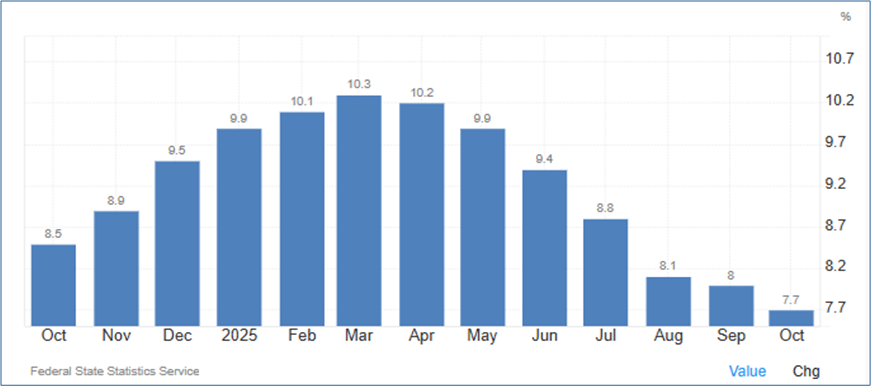
Trading Economics: Russia Inflation Rate, Dec. 6, 2025
For the end of 2025 and early 2026, the Russian Central Bank forecasts a temporary acceleration in price increases due to the VAT hike from 20% to 22% effective January 1. According to the Central Bank, the annual inflation rate will then reach 4.0% to 5.0% in December 2026, roughly one year from now (Interfax.ru). The Central Bank’s inflation target is 4.0 percent.
Central Bank Governor Elvira Nabiullina emphasized at the VTB Forum “Russia Calling” that a low inflation rate is also in the interest of businesses. She noted that businesses’ interests are not limited solely to the level of the key interest rate and the burden of interest payments on loans.
VTB CEO Andrey Kostin speculated at the forum that the Central Bank would decide on December 19 to cut the key interest rate by at least 50 basis points, as the inflation rate is below 7%. Kostin explained that the high key interest rate has a negative impact on business activity—just as tax hikes do. By the end of next year, the key interest rate should be lowered to 12 to 13%. The Central Bank expects the key interest rate to average 13 to 15% in 2026. This was reported by RBC.ru.
Ministry: GDP growth accelerated to +1.6% in October
The day after Putin’s speech at the VTB Forum, the Russian Federal State Statistics Service (Rosstat) released economic data for October. According to preliminary calculations by the Ministry of Economic Development, economic growth in October picked up to +1.6% year-over-year. In the preceding third quarter of 2025, it had slowed to just +0.6% (Vedomosti.ru). In the first ten months of 2025, GDP was +1.0% higher than in the previous year (Finmarket.ru).
Seasonally adjusted, real gross domestic product rose by +1.1% in October compared to the previous month of September, according to the Ministry’s estimates, following a rise of just under half that rate—+0.5%—in September compared to August (Finam.ru).
According to the VEB Institute, GDP is now already higher than it was at the end of 2024
The research institute of the state development bank VEB.RF estimates GDP growth in September and October to be significantly higher than the Ministry’s figures (VEB’s chief economist is former Deputy Minister of Economic Development Andrei Klepach). The VEB Institute estimates that, thanks to strong increases in September and October, the seasonally and calendar-adjusted real gross domestic product index is already higher than at the end of 2024.
Real Gross Domestic Product Index (Jan. 2014=100)
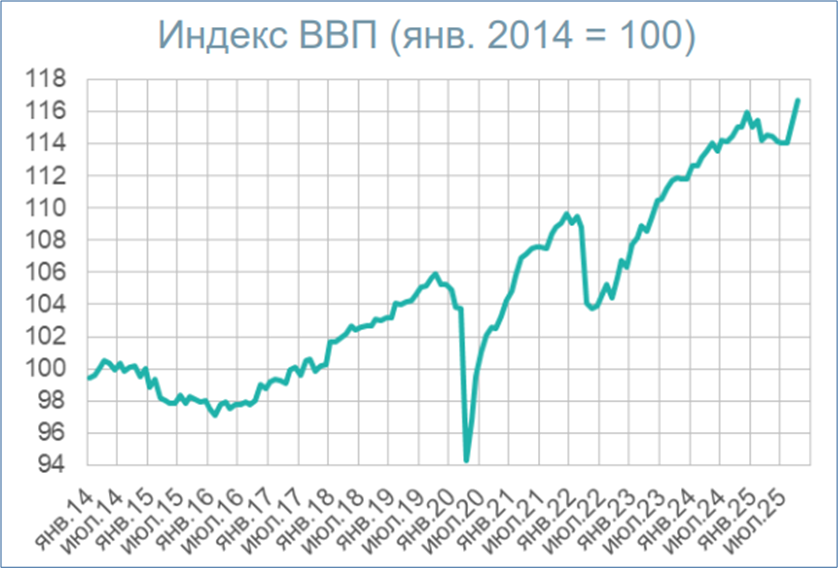
Global Economy and Markets; Dec. 5, 2025
The VEB Institute estimates: In October, real GDP rose by +1.1 percent on a seasonally and calendar-adjusted basis compared to the previous month of September. In September, according to revised calculations, it grew even slightly more strongly by +1.2 percent compared to August.
Real Gross Domestic Product in August, September, and October
: Month-over-month changes in % and
year-over-year changes in %
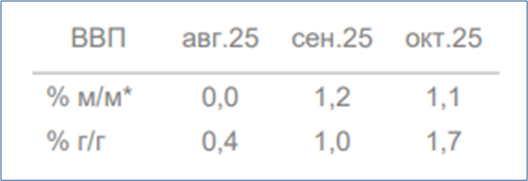
VEB Institute: Global Economy and Markets; 12/05/25
The VEB Institute estimates GDP growth in October 2025 compared to October 2024 at +1.7 percent (Ministry of Economy: +1.6 percent).
Minister Reshetnikov warns against jumping to conclusions
Analysts’ concerns that aggregate economic output in the current fourth quarter of 2025 might not reach the level seen a year ago in the fourth quarter of 2024—which had risen sharply—appear to be unfounded following the continued strong increase in output in October. However, Russian Economy Minister Maxim Reshetnikov told journalists in Delhi on December 4 regarding the acceleration of GDP growth to +1.6% in October: “We assume that the GDP acceleration in October is most likely due to one-off factors.” It is still too early to speak of a trend reversal, the minister said (Finmarket.ru; Moscow Times.ru).
His deputy, Polina Kryuchkova, also pointed out in a conversation with journalists that caution is warranted when assessing the outlook. “According to Rosstat data for October, we see an improvement in the dynamics of many indicators. However, this is largely due to local and temporary factors. It is still too early to draw conclusions about a trend reversal,” she emphasized (investfuture.ru)
Olga Belenkaya, chief economist at the brokerage firm FG Finam, warns against premature hopes for a sustained economic recovery right in the headline of her detailed analysis of current economic developments in October. She writes:
“The Russian economy experienced a strong but likely only temporary recovery in October.”
Belenkaya believes that the upcoming increase in the recycling fee for automobiles played the main role in the rise in consumer demand. Demand is also likely to have been supported by strong growth in corporate loans, increased growth rates for mortgages and auto loans, and a decline in savings. The planned increase in the value-added tax from 20 to 22 percent in early January is also expected to boost demand.
According to Belenkaya, the Central Bank faces a difficult decision on the key interest rate on December 19. On the one hand, inflation is falling faster than forecast. On the other hand, however, the effects of one-off inflationary factors are expected at the end of 2025 and in the first half of 2026. Consumption and lending would increase. Furthermore, the already high inflation expectations among the public and businesses would rise (arb.ru)
How the “core sectors” of the Russian economy are developing
The growth in the production of goods and services in the so-called “core sectors” of the Russian economy accelerated to +2.9% year-over-year in October 2025 (following +0.8% in September and +0.4% in August). The production index for the “core sectors” includes not only industrial production but also production in retail, wholesale, freight transport, agriculture, and the construction industry (Finmarket.ru).
The strong increase in production in the core sectors, totaling +2.9% in October, was driven by industrial production (+3.1%), real retail sales (+4.8%; Finmarket.ru), freight turnover in the transport sector (+2.7%), construction output (+2.3%), and agricultural output (+7.0%; Finmarket.ru).
However, following a brief recovery in September, wholesale sales slipped back into negative territory in October (-2.5% year-over-year). Overall, real wholesale turnover fell by 3.0 percent in the first ten months of 2025. Olga Belenkaya believes the sharp decline is likely due to falling gas exports and weak import growth.
Production trends by sector
: Year-over-year change in %
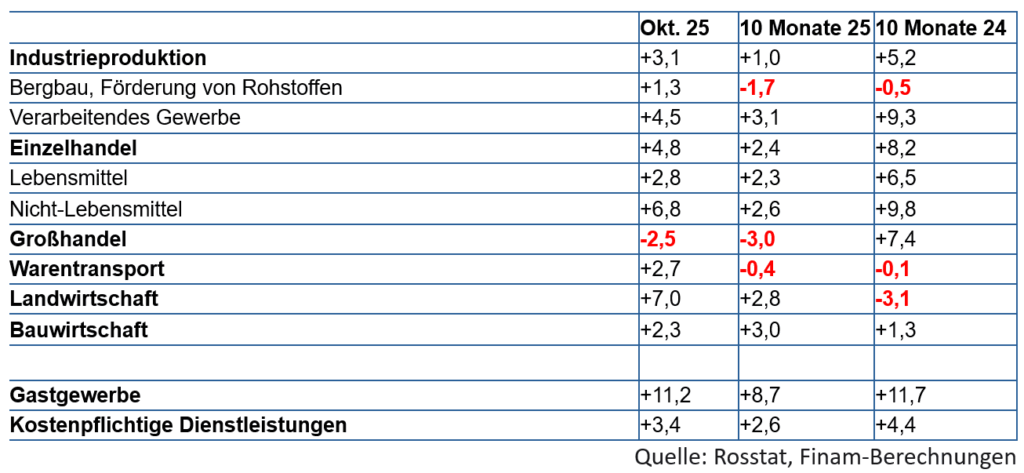
Turnover in the hospitality sector continued to grow particularly strongly in October (+11.2%). Paid services recorded overall growth of +3.4%.
In industry, production is growing primarily in the “manufacturing sector”
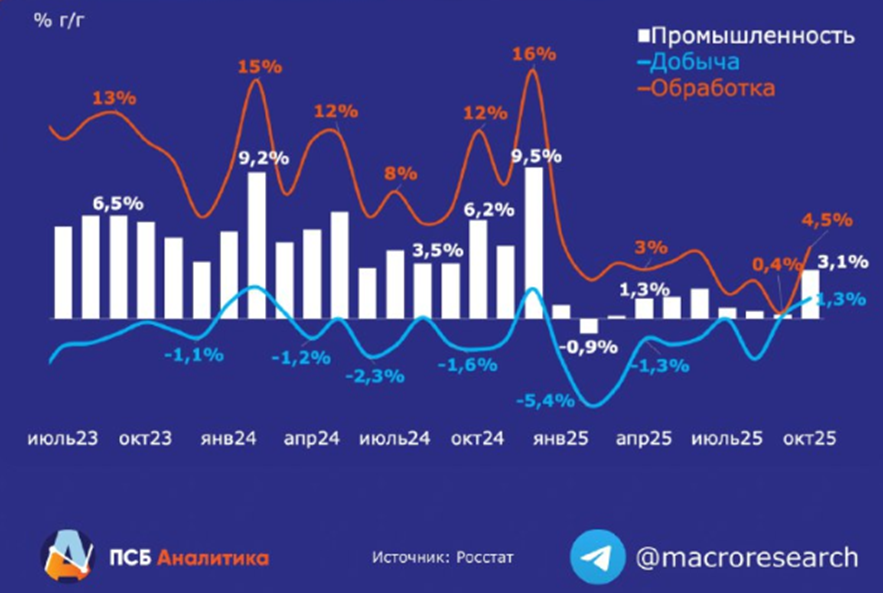
The faster rise in industrial production (+3.1% overall; white bar in the following figure from PSB Analytics) contributed to the accelerated GDP growth in October (+1.6%).
Within the industrial sector, there was above-average growth in the “manufacturing sector” (+4.5%; red line). Here, production rose particularly in the “defense industry” and the pharmaceutical industry (+20.3%).
The mining sector recorded growth of +1.3% in October (blue line), following a weak increase of +0.2% in September. However, in the January–October period, production in the mining sector fell by 1.7% compared to the previous year.
Trends in Industrial Production
: Year-over-Year Changes in Percent
White bars: Total industrial production;
Red line: Manufacturing; Blue line: Mining, extraction of raw materials
PSB Analytics, Denis Popov: Industry has seen accelerated growth, but fragmentation persists, 11/27/25
“Industrial growth in October was driven primarily by sectors dominated by the defense industry, as well as (to a lesser extent) by oil production and refining,” explained Vladimir Salnikov, head of the Center for Macroeconomic Analysis and Forecasting (CMASF), to Interfax (Finmarket.ru, ng.ru).
Passenger car production fell by nearly 10 percent in the first 10 months
According to Rosstat, passenger car production in Russia in October 2025 fell by nearly half compared to the previous year and by nearly a quarter compared to the previous month (-46.7% year-on-year and -24.8% month-on-month). The main reason for the sharp decline in production in October 2025 was the switch to a shortened four-day workweek at AvtoVAZ, the market leader in passenger car sales. From January to October 2025, nearly 10 percent fewer passenger cars were produced in Russia (537,000; -9.6%; Finmarket.ru).
While production is falling sharply, the passenger car retail sector is recording strong sales growth. Strong demand drivers include the planned increase in the recycling fee and the resumption of government subsidy programs.
According to Olga Belenkaya, the rise in demand for automobiles prior to the increase in the recycling fee plays the most significant role in the growth of Russian consumer demand.
Strong growth in fixed capital investment came to a halt
According to Rosstat, investment in fixed assets fell by 3.1% in the third quarter of 2025 compared to the same quarter of the previous year, for the first time since the third quarter of 2020. Overall, fixed asset investment rose by only +0.5% in the first nine months of 2025, compared to an increase of +9.0% in the first nine months of 2024 (see FINAM analysis and Moscow Times.ru).

At the VTB Forum, President Putin highlighted faster investment growth as a government goal. Over the past three years, investments have risen at an above-average rate: by +6.7% in 2022, by +9.8% in 2023, and by +7.4% in 2024. He cited declining corporate profits across a number of industries as reasons for the slower growth this year. At the same time, borrowing costs have risen (en/kremlin.ru).
The unemployment rate remained very low, while wage growth was strong
The unemployment rate remained at 2.2% in October, the same as in September, close to the August low (2.1%; Finmarket.ru),
Annual growth in real wages reached +4.7% in September. This was slightly higher than the average for the first nine months (+4.5%). However, it remained significantly lower than the average for the first nine months of 2024, Belenkaya reports.
Nominal and real
wage changes year-over-year in percent

Belenkaya expects GDP growth of +0.8 percent in 2025, in line with the consensus
FINAM’s chief economist believes that October’s economic data could improve the outlook for the previously expected weak economic performance in the fourth quarter of 2025. However, in her view, leading indicators for further developments in November suggest that the acceleration in growth observed in October is unlikely to be sustained.
Belenkaya continues to expect GDP growth of 0.8% for 2025 as a whole. This forecast aligns with the results of a Reuters survey of 12 participants and, among other things, with the European Commission’s forecast published in mid-November.
For 2026, analysts in the Reuters survey, similar to the European Commission and the Russian government, expect a slight acceleration in the sharply declined growth to +1.2%. The Paris-based OECD, on the other hand, expects growth to slow further next year to just +0.5%.
GDP Forecasts 2024 to 2026
Year-over-year change in real gross domestic product, in percent
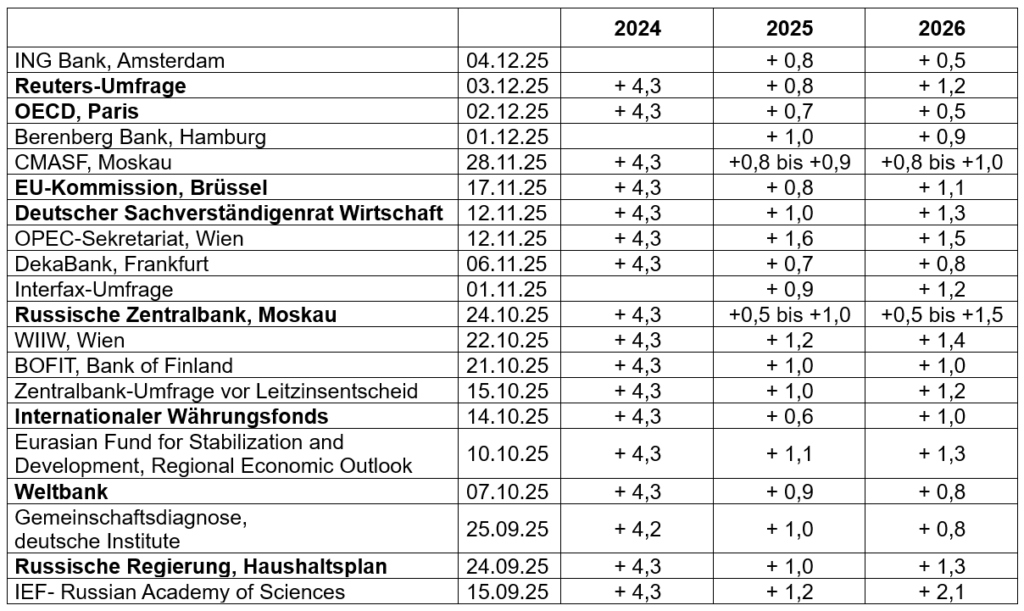
Denis Popov, Chief Analyst at PSB Analytics, expects slightly stronger growth for 2025 (+1.1 percent) than the “consensus” in the Reuters survey (+0.8 percent). In an analysis of the development of S&P Global’s Purchasing Managers’ Indices, he states:
“The first leading indicators for November do not, at least, point to a deterioration in the economic situation.
We can speak of an increased likelihood of accelerated real GDP growth in the fourth quarter (in the third quarter, it stood at +0.6% year-over-year). This is supported not only by the leading indicators but also by the strong industrial momentum in October.
Real GDP growth in 2025 is likely to be at the upper end of the central bank’s forecast (+0.5% to +1%) and close to our forecast (+1.1%).
However, given the tax hikes, the consolidation of budget spending, and the still-high key interest rate, the risks of an excessive economic slowdown have not yet been averted and remain significant for the first half of 2026.”
Recommended reading:
- VEB Institute: Global Economy and Markets; Dec. 5, 2025
- The Moscow Times: Russia Could Face Systemic Banking Crisis by Late 2026, Kremlin-Linked Think Tank CMASF Warns, Dec. 5, 2025
- Oreanda News.com: The government expects inflation in Russia to reach 6% or slightly higher in 2025; Dec. 5, 2025
- BOFIT (Bank of Finland); BOFIT Weekly: New sanctions reduce export price of Russian oil, 12/05/25
- Finam.ru; Olga Belenkaya: The Russian economy experienced a strong but likely only temporary recovery in October, 12/04/25
- Finmarket.ru: Economy Minister Reshetnikov: The acceleration of Russian economic growth in October was due to one-off factors, 12/04/25
- FR.de, Nils Thomas Hinsberger: Putin frustrated – Russia’s economy deep in the war crisis, 12/04/25
- Mikhail Sergeev, Nezavisimaya Gazeta: Investment in fixed assets in Russia fell by 3.1%. The Central Bank sees no risk of recession for the domestic economy, Dec. 4, 2025
- Marina Voitenco, Politcom.ru: Financial stability: Risks of an economic slowdown, 12/04/25
- Promsvyazbank: In November, the PMI index in the services sector rose to a nearly one-year high (52.2 points after 51.7 points in October), Dec. 4, 2025
- t-online, Reuters: Growth is slowing. Putin dissatisfied with the Russian economy, 12/03/25
- Russia.capital: VTB Forum: Nabiullina, Kostin, and Siluanov discussed the state of the Russian economy, with a video of President Putin’s speech, Dec. 3, 2025
- Interfax.ru: The Ministry of Economic Development reported that Russian GDP growth for January through October was 1.0%, 12/03/25
- russian.rt.com. Vladimir Zegoyev: “Overall, we’re managing”: VTB CEO Kostin on the economy, the key interest rate, and the ruble exchange rate, 12/03/25
- Finmarket.ru: According to Rosstat, real wage growth accelerated to 4.7% in September, up from 3.8% in August, 12/03/25
- The Moscow Times: Russia’s Oil and Gas Revenues Fall 34% Year-on-Year in November, 12/03/25
- Vedomosti: Russia’s GDP grew by 1.6% in October, 12/03/25
- Vedomosti, Anastasia Bryanceva: Putin’s Key Statements at the “Russia Calls!” Forum, Dec. 2, 2025
- RBC.ru: “Russia Calls!” Forum: Nabiullina Suggested Not Limiting Business Interests Solely to the Key Interest Rate, 12/02/25
- Kommersant; Oleg Sapozhkov, Artem Chugunov: Life has become more affluent, but not more enjoyable. Income growth does not solve the structural problems of the labor market; 12/02/25
- Kyiv School of Economics: KSE Russia Chartbook: KSE Institute’s Russia Chartbook – Serious Vulnerabilities Ahead of New U.S. Sanctions Against Rosneft/Lukoil, 12/02/25
- FR.de; Nils Thomas Hinsberger: Russia’s industrial sector collapses: new low during the war in Ukraine, 12/01/25
- IEF RAS: Conference on macroeconomic and macrostructural analyses and forecasts held at the Russian Academy of Sciences: The Russian Economy: A Challenge Was Issued, in: Monokel No. 49 (1414). December 1–8, 2025
- Nezavisimaya Gazeta, Mikhail Sergeev: Russia experienced an economic miracle in October. The extraordinary growth did not reduce the risk of recession in 2026, November 30, 2025
- CMASF: Industrial Production Trends in October 2025, Nov. 28, 2025
- Politcom.ru; Marina Voitenco: Business Activity and Prices: Mixed Trends, Nov. 28, 2025
- PSB Analytics, Denis Popov: Industry has seen accelerated growth, but fragmentation persists, 11/27/25
The day's most important Russian economic stories. Free, in your inbox three times a week.
Mon, Wed, Fri. Double opt-in, no tracking, unsubscribe anytime. By subscribing you consent to the processing of your email address as described in our Privacy Policy.