Russia: Recession Unlikely Following Recovery in Industrial Production
Author: Klaus Dormann
Russia’s economy is “on the brink of a recession.” Economy Minister Reshetnikov made headlines with this assertion at the International Economic Forum in St. Petersburg. Following a strong growth spurt in the fourth quarter of 2024, Russia’s gross domestic product declined in the first quarter of 2025 compared to the previous quarter. Some analysts speculated that the economy could also contract in the current second quarter compared to the previous quarter. Russia would thus be entering a “technical recession.” According to Rosstat, however, industrial production in May returned to its previous peak from December 2024. The strong recovery in industrial production suggests that seasonally and calendar-adjusted output for the Russian economy as a whole will also be higher in the second quarter than in the first.
Well-known analysts had not ruled out a technical recession
Before the recovery in industrial production was announced, some experts considered it possible that Russia’s overall economic output could decline in two consecutive quarters this year.
Dmitry Belousov, Deputy Director General of the Moscow-based “Center for Macroeconomic Analysis and Short-term Forecasting” (CMASF), said in an URA.ru interview at SPIEF that “under more or less normal conditions,” gross domestic product would grow by 1.5 to 1.8 percent in 2025. Belousov apparently did not rule out a “technical recession.” He argued that, due to external economic risks, a decline in GDP of around 1 percent over the course of one to two quarters is possible in 2025. However, barring any unexpected events, the overall economy would be in the black by the end of 2025. Belousov cited an “excessive strengthening” of the ruble—which would create problems for exporters—and high interest rates that deter investment as risks to his forecast.
Like Belousov, Olga Belenkaya, chief economist at the brokerage firm FINAM, also considered a technical recession in 2025 a possibility. According to a Finam.ru report, she noted last week that real GDP in the first quarter of 2025 had fallen by 0.6 percent on a seasonally adjusted basis compared to the previous quarter. A “technical recession” within 2025 could not be completely ruled out. However, Belenkaya noted that the data so far suggests that economic growth will continue on a year-over-year basis from 2024 to 2025. She expects economic growth of around 1.5 percent, significantly less than the Ministry of Economic Development forecast in April (+2.5 percent).
FocusEconomics: How Russia’s Economy Slowed in the First Quarter
In the following chart from the Barcelona-based research firm FocusEconomics, the black line shows the 0.6 percent decline in Russia’s seasonally adjusted real gross domestic product in the first quarter of 2025 compared to the fourth quarter of 2024.
Compared to the first quarter of 2024, GDP growth slowed to just 1.4 percent (blue bar). In the fourth quarter of 2024, however, real GDP had still grown strongly by 4.5 percent year-over-year.
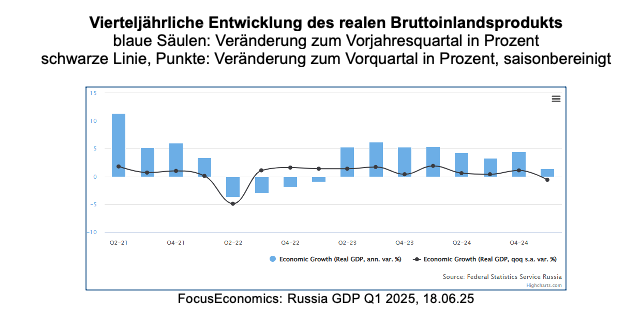
FocusEconomics cites the increasing strain from the ongoing war, sanctions, and “sky-high” interest rates and inflation rates as reasons for the slowdown in overall economic output at the beginning of 2025.
Further economic growth is expected in the 2025/2024 year-over-year comparison
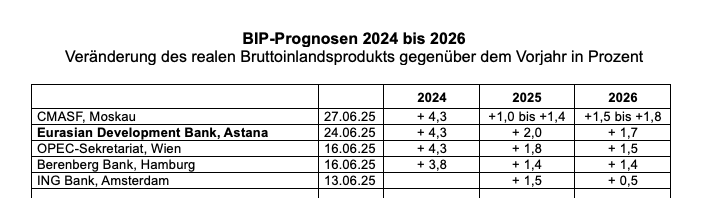
The forecasts from banks and institutions compiled by FocusEconomics suggest, on average, that Russia’s economic growth will more than halve in 2025. According to FocusEconomics, the consensus forecast falls below the average growth rate of 1.9 percent at which the Russian economy grew in the 10 years prior to the pandemic.
In surveys published by Interfax and Reuters in early June, analysts predicted an average increase in real gross domestic product of 1.5 percent for the full year 2025.
The Eurasian Development Bank, based in Almaty, Kazakhstan—a development bank supported by Russia and six other former Soviet states—expects half a percentage point more growth. In its semi-annual economic outlook published in June, it forecast economic growth of 2.0 percent for Russia in 2025.
In late May, the Moscow-based CMASF raised its forecast for this year’s growth of the Russian economy to 1.2 to 1.5 percent in its monthly updated “Base Version of the Macroeconomic Forecast for 2025 to 2028.” However, at the end of June, the center lowered this forecast again slightly to 1.0 to 1.4 percent.
VEB Institute: Overall economic output picked up again in April
The research institute of the state-owned Bank for Foreign Economic Affairs (Vnesheconombank) published an analysis last week of the development of the Russian economy in April and May 2025. The following chart illustrates the development of the real gross domestic product index through April. It shows that aggregate economic output fell by a total of about 2 percent from its peak reached in December 2024 through the end of March 2025.
In April, according to estimates by the VEB Institute, GDP rose by 0.5 percent on a seasonally and calendar-adjusted basis compared to March. In April, GDP exceeded its level from the previous year by 1.9 percent (see table).
Real Gross Domestic Product Index, January 2014=100
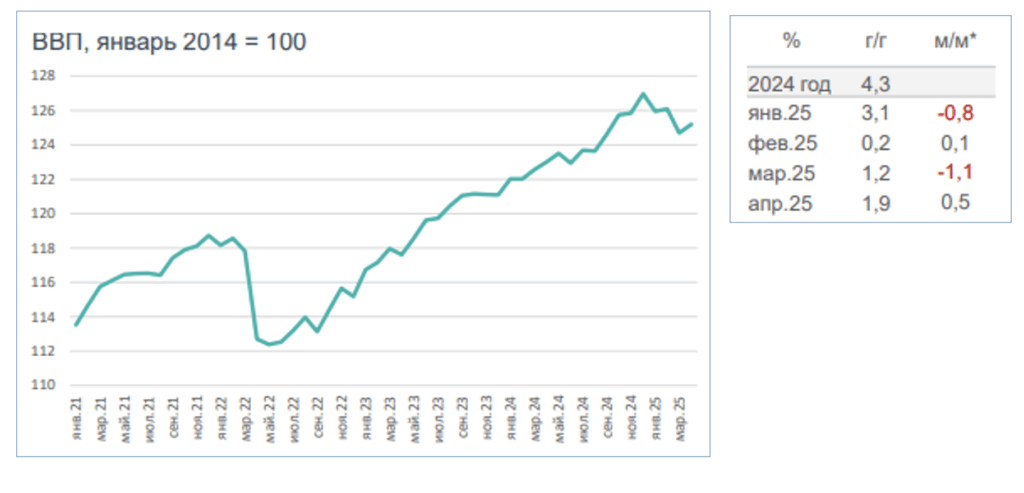
VEB Institute: Russian Economy in April and May 2025, June 25, 2025
Industrial production rose in May to its highest level since the beginning of the year
Initial economic data for May is now available. On June 25, the Federal State Statistics Service (Rosstat) reported that Russia’s industrial production grew by 1.8 percent in May compared to May 2024. Seasonally and calendar-adjusted, it rose to its highest level since the start of the year. According to initial calculations by the Research Institute of the State Bank for Foreign Economic Affairs (Vnesheconombank), seasonally and calendar-adjusted industrial production in May was 2.1 percent higher overall than in April (see the black line in the figure below).
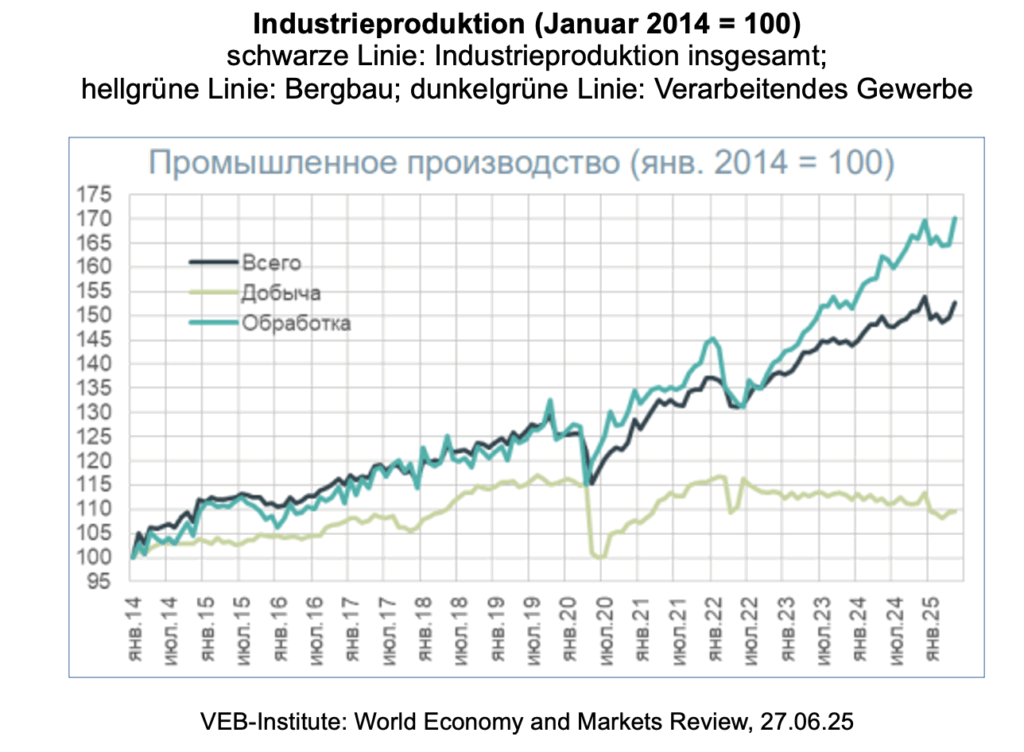
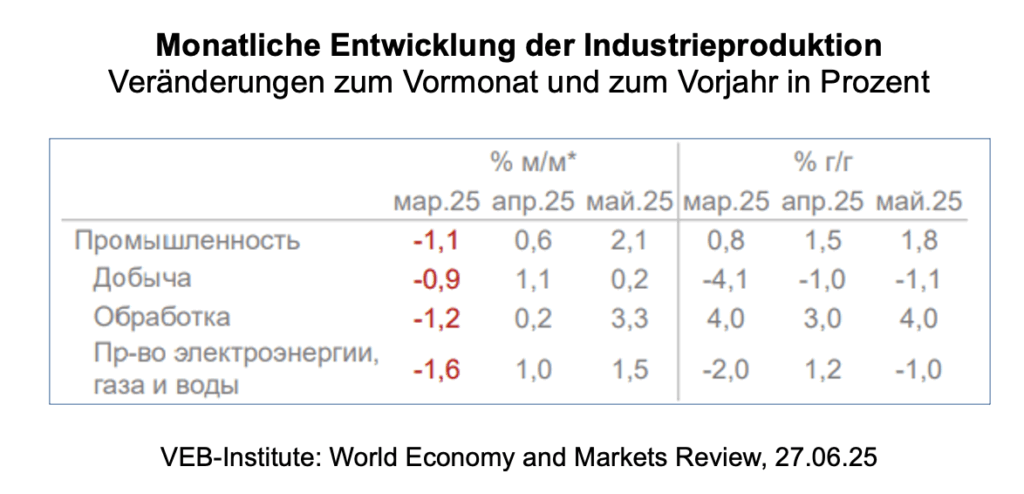
The “manufacturing sector” (upper dark green line) contributed most significantly to the seasonally and calendar-adjusted 2.1 percent growth in industry in May compared to April. Its production in May was 3.3 percent higher than in the previous month (see table below).
In the “Mining and Raw Materials Extraction” industrial sector, production rose by only 0.2 percent overall in May compared to the previous month. Not only did oil production and the production of liquefied natural gas (LNG) increase, but mining output also grew.
According to the VEB Institute, seasonally and calendar-adjusted production at companies supplying electricity, gas, and water rose by 1.5 percent in May compared to April due to the unusually cold weather.
FocusEconomics: Annual industrial growth rose to 1.8 percent in May
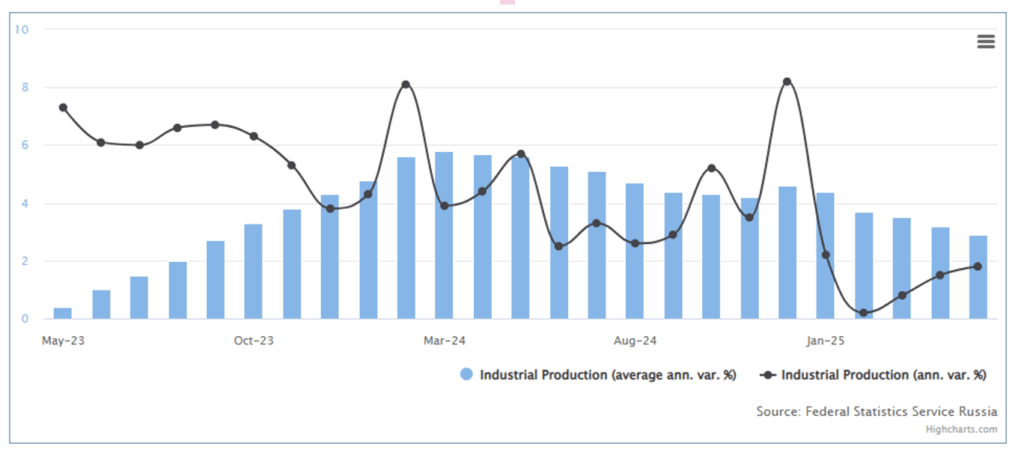
In the following chart, FocusEconomics shows with the black line that the annual growth rate of industrial production has fluctuated significantly over the past twelve months. After a rise in industrial production of just over 8 percent in December 2024, it was barely higher in February than a year earlier. However, the annual growth rate has been picking up since March. In April 2025, growth accelerated to 1.5 percent compared to the same month a year earlier, and to 1.8 percent in May.
Industrial production
(black line): Change from the same month of the previous year in percent; blue bar: Average annual growth rate over the last 12 months
FocusEconomics: Russia Industrial Production May 2025, June 25, 2025
FocusEconomics has calculated an average annual growth rate (blue bars) based on the annual growth rates of industry over the past 12 months. It has been falling almost steadily for about a year. In the period from May 2024 to May 2025, the average year-over-year increase in industrial production was only 2.9 percent. In the year-over-year comparison between 2024 and 2023, industrial production had still risen by 4.6 percent.
Rosstat: Industrial production in May back to December’s peak
The Moscow-based CMASF published a detailed analysis of current trends in industrial production on June 26. The center notes that industry recorded a “sharp increase” in production in May. Seasonally and calendar-adjusted, it rose by 2.6% compared to the previous month. The statistics agency Rosstat had only recorded an even stronger increase in July 2020 during the recovery in production following the COVID-19 pandemic.
As the red line in the following figure shows, according to Rosstat, the index of total industrial production rose back to the record high reached in December 2024 (112.3).
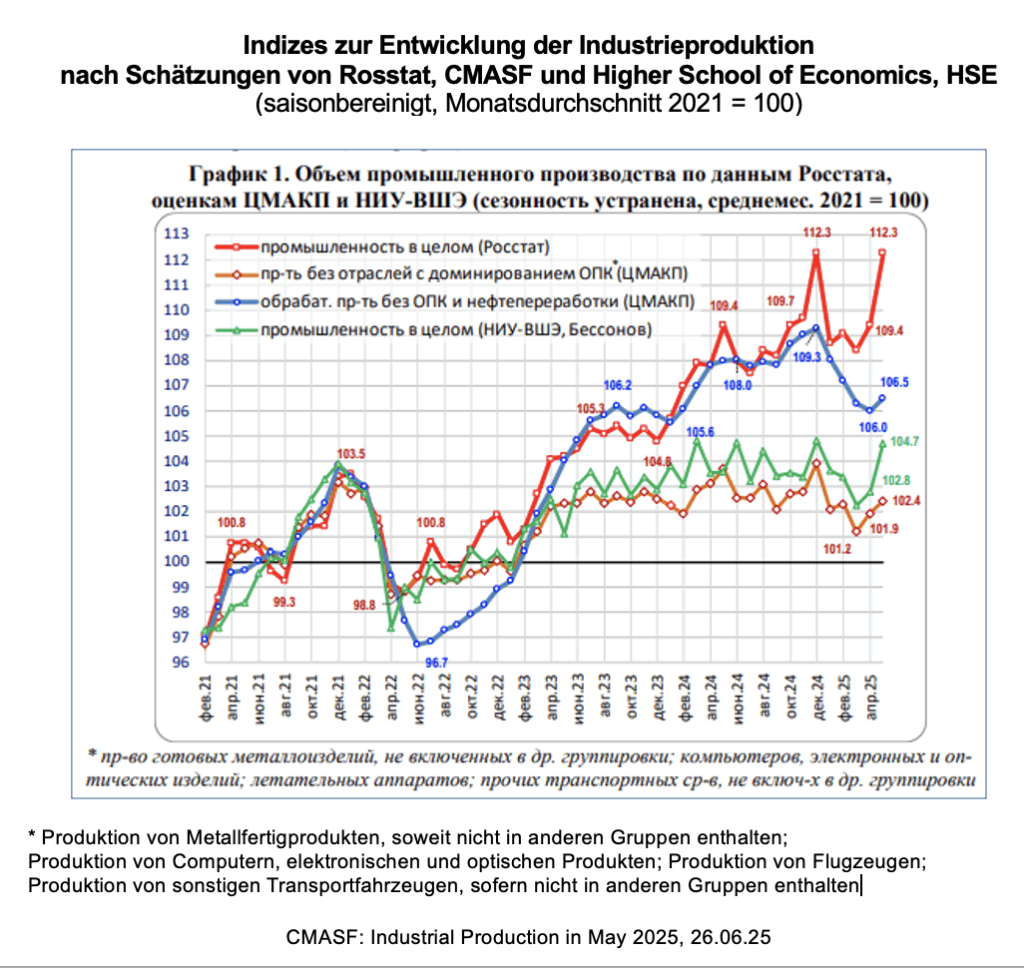
The CMASF itself also calculated two additional indices tracking the development of industrial production:
an index of total industrial production excluding “military-oriented industries” (lower brown line in the figure)
and
an index of “manufacturing” production excluding the defense industries and the petroleum industry (blue line in the figure).
In the footnote to the figure, the CMASF includes the following sectors in the “defense industries”: The production of finished metal products (unless included in other industrial sectors); the production of computers, electronic, and optical products; the production of aircraft; the production of other transport vehicles (unless included in other industrial sectors).
The figure also includes an index from the Higher School of Economics on the development of total industrial production (green line in the figure). Like the Rosstat index, this HSE index also returned to a level close to that of December 2024 in May.
CMASF: Defense production accounted for two-thirds of the increase in production
The CMASF emphasizes that, despite the sharp rise in industrial production, it is still too early to speak of a “full-fledged growth trend” in Russian industry. It points to the significant role played by the increase in arms production:
“According to our estimates, about two-thirds of the increase in May is attributable to a sharp jump in production in sectors dominated by defense products. The remaining portion of the increase is attributable to a rise in production in the non-ferrous metallurgy sector. In other industries, average daily production generally did not change significantly in May.”
The day's most important Russian economic stories. Free, in your inbox three times a week.
Mon, Wed, Fri. Double opt-in, no tracking, unsubscribe anytime. By subscribing you consent to the processing of your email address as described in our Privacy Policy.