Russia: From an Economic Slowdown to a Recession? SPIEF 2025
Author: Klaus Dormann
“Recession”—in Germany, politicians from the ruling parties often shy away from using this dreaded “R-word” at all, partly to avoid negative reactions in the financial markets.
Russia’s Minister of Economic Development, Maxim Reshetnikov, showed no such hesitation last week at the St. Petersburg International Economic Forum (SPIEF). Last Thursday, he painted a bleak picture of the Russian economy’s trajectory. The minister criticized the central bank’s high-interest-rate policy and warned of a slump in investment. Reshetnikov fears that Russia is “on the brink of a recession.” This resulted in numerous headlines in the media.
Finance Minister Anton Siluanov and Central Bank President Elvira Nabiullina, however, took a much more relaxed view of the current decline in annual growth rates of the Russian economy during a panel discussion with Reshetnikov. For Siluanov, the significantly lower growth in aggregate economic output is a “planned slowdown”; for Nabiullina, it is a “way out of overheating.”
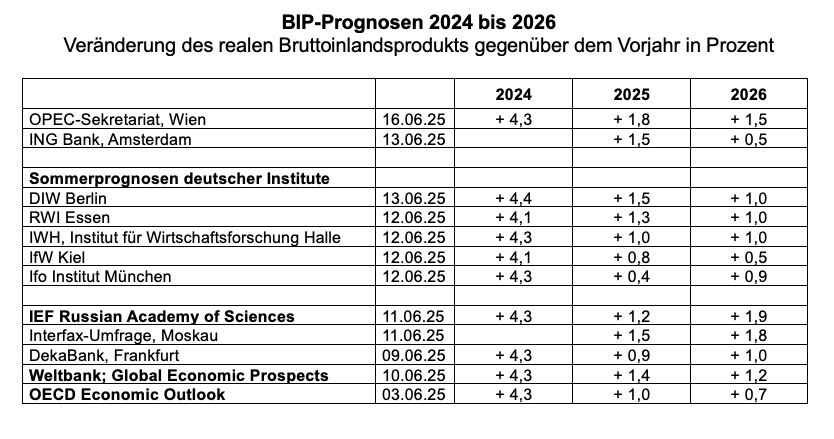
Current growth forecasts for 2025 generally range between 1 and 2 percent
Finally, in its “medium-term forecast” from April, the Russian Central Bank expects Russia’s real gross domestic product to grow by another one to two percent this year compared to the previous year. Based on the Ministry of Economic Development’s forecasts, the government itself even anticipates a 2.5 percent increase in GDP for 2025 in its budget planning (rbc.ru).
International economic organizations also do not expect a recession—meaning that Russia’s real gross domestic product this year will be lower than in 2024. The World Bank expects Russia to grow by 1.4 percent in 2025, the OECD by 1.0 percent, and the International Monetary Fund by 1.5 percent. The latest analyst surveys by Interfax and Reuters also suggest a GDP increase of +1.5 percent in 2025. In mid-June, the OPEC Secretariat in Vienna lowered its forecast for this year’s growth of the Russian economy by just 0.1 percentage points to +1.8 percent.
Reshetnikov: “I did not predict a recession”
However, there has already been a slight decline in Russia’s overall economic output. In the first quarter of 2025, Russia’s gross domestic product was 0.4 percent lower on a seasonally adjusted basis than in the fourth quarter of 2024, according to initial calculations by the Institute for Economic Research of the Russian Academy of Sciences. If gross domestic product were to decline in the second quarter of 2025 compared to the previous quarter, many experts believe this would constitute a so-called “technical recession.” Year-over-year, however, Russia’s economy could still achieve growth in 2025 compared to 2024. The Minister of Economic Development may have been referring to such a “technical recession” when he stated at the SPIEF that Russia was on the brink of a recession.
According to Tagesschau.de, the Minister of Economic Development made it clear that a recession is avoidable. “I did not predict a recession. I said we are on the brink. From now on, everything will depend on our decisions,” he emphasized. Further developments depend in particular on interest rates.
Reshetnikov urged Central Bank Governor Elvira Nabiullina not to go too far in her decisions to combat inflation. He expressed the view that the Central Bank was “simplifying” the discussion and overemphasizing the need to reach the 4 percent inflation target by 2026. He asked the Central Bank chief, sitting next to him, for “a little love” for the economy. This was reported by russland.capital.
Putin: GDP was 1.5 percent higher in the first four months than in the previous year
In his speech on Friday (kremlin.ru transcript with video), President Putin noted that Russia’s gross domestic product grew by 1.5 percent year-over-year in the first four months of 2025. Annual growth accelerated to 1.9 percent in April (estimate by the Ministry of Economic Development, according to Vedomosti).
Commenting on this—one day after the Economy Minister’s remarks—the President noted that “some specialists and experts” were simultaneously pointing to the risk of stagnation or even a recession.
According to Putin, stagnation or a recession must, of course, be prevented at all costs. It is necessary to pursue competent, well-considered fiscal and tax policies, as well as monetary and credit policies. Their measures must first and foremost be coordinated to support and stimulate economic growth, and of course, macroeconomic stability, stable prices, and sound finances must also be ensured at the same time (Finam.ru).
How differently Siluanov, Nabiullina, and Reshetnikov view the current economic situation
The Russian government’s “economic bloc” discussed the topic
“Supply-Side Economic Policy: How to Achieve Growth in the Face of Modern Challenges” (roscongres.org program with video).
Finance Minister Anton Siluanov described the current economic trend in the discussion as a “planned cooling” of the economy (Kommersant). Central Bank President Elvira Nabiullina sees the slowdown in economic growth as “a way out of overheating” (Reuters).
Economy Minister Reshetnikov, however, commented on the economic situation according to dpa:
“According to the figures, we are experiencing a slowdown; according to the current sentiments of entrepreneurs, we are already on the verge of entering a recession.”
Reuters quoted the minister as saying:
“Judging by the current mood among companies and the economic indicators, it seems to me that we are already on the brink of a recession.”
RBK.ru published a transcript of the remarks made by Nabiullina, Siluanov, and Reshetnikov at SPIEF. On YouTube, the channel “Michael Nacke” offers an excerpt from the video of the discussion on the question “Slowdown or Recession." A video of the entire discussion in Russian is available on YouTube via FilmFusionMagic.
How the “slowdown” developed through April
The following figure shows how Russia’s real gross domestic product developed through April, according to estimates by the Institute for Economic Forecasting of the Russian Academy of Sciences (IEF-RAS). After a sharp rise in December, the index of aggregate economic output (black line) fell by March to just below the level reached in October and November 2024. By April 2025, however, it was again slightly higher than in the fall of 2024. Compared to April 2024, real GDP rose by 1.5 percent (blue bar) according to the institute’s estimate. Compared to the previous month of March, it grew by 0.5 percent on a seasonally adjusted basis, according to IEF-RAS.
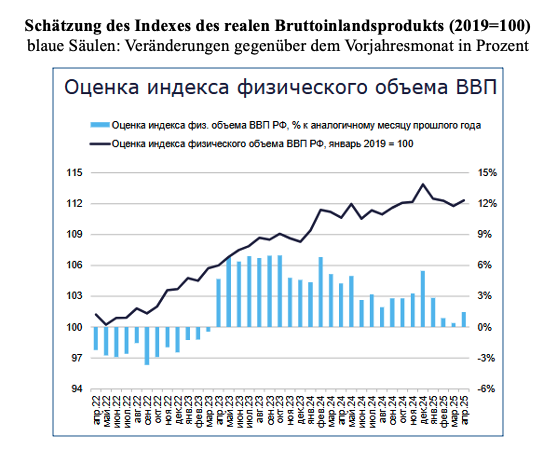
IEF-RAS: Short-term analysis of GDP dynamics, June 16, 2025 (Data as of June 9, 2025)
Dmitry Polevoy, Investment Director of Astra Asset Management JSC, states in an analysis published by Finam.ru that if aggregate economic output remains at the first-quarter level, it will be 0.5 percent higher in 2025 than in 2024. He considers it likely that economic growth of +0.5 to +1.5 percent will be achieved in 2025.
Forecasts by the Russian Academy of Sciences for 2025 to 2028
In its quarterly economic forecast published on June 11, the IEF-RAS expects Russia’s real GDP for the full year 2025 to grow by 1.2 percent compared to the previous year.
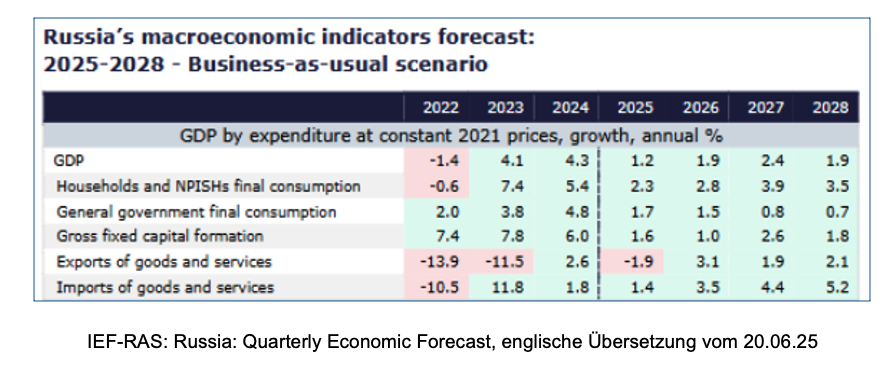
According to the IEF-RAS, GDP growth in 2025 will be driven primarily by private consumption (+2.3 percent). Government consumption is expected to increase by 1.7 percent, and gross fixed capital formation by 1.6 percent.
Reshetnikov: High interest rates are deterring companies from investing
Regarding current investment trends, Economy Minister Reshetnikov reported that while investment in the first quarter of 2025 was 8.7 percent higher than a year ago, he views this strong growth as a significant deviation from the trend. For the full year 2025, the Ministry of Economy expects investment to rise by 1.7 percent. This, too, is a rather ambitious goal, as most investments are financed with companies’ own funds and a significant inflow of deposits is being observed at banks.
“We are aware that current interest rates not only hinder the implementation of new projects with borrowed capital, but also strongly discourage companies from investing their own money,” emphasized the Minister of Economic Development (Interfax.com).
Nabiullina: The Central Bank is sticking to its inflation target of 4 percent
Central Bank President Elvira Nabiullina emphasized during the SPIEF discussion that the Central Bank would continue to pursue a reduction in the inflation rate to its target of 4 percent. A modest rise in prices is the foundation for growth in real household incomes. High inflation, on the other hand, erodes incomes and savings. Low inflation is also important for companies because the goal is sustainable growth in production, not a short-lived boom accompanied by high inflation (Interfax.com).
Dmitry Belousov, Deputy Director General of the Moscow-based “Center for Macroeconomic Analysis and Short-Term Forecasting” (CMASF), had recently suggested, however, that the Russian Central Bank should raise its “inflation target” from 4 percent (Finam.ru).
Nabiullina pointed to the Central Bank’s determination to achieve its inflation target. Some might call this “stubbornness” on the part of the Central Bank, but “perseverance” would be a more accurate term, she said in response to a question from Andrei Makarov, Chairman of the State Duma’s Budget and Tax Committee, who was moderating the discussion.
Finance Minister Anton Siluanov agreed, noting that the Central Bank’s persistence—reinforced by fiscal measures—is crucial. It is important to believe in achieving the 4% inflation target: “The most important thing is belief. If we believe in 4%, it will definitely happen,” Siluanov said. Nabiullina agreed that inflation expectations play a significant role.
Inflation is falling faster than the Central Bank expected
The Central Bank president assured that the Central Bank would continue to cut interest rates as inflation declines. Price increases are currently slowing even faster than expected. Inflation expectations would decline accordingly. In the week ending June 9, the annual inflation rate fell to 9.6 percent, according to Rosstat (Interfax.com).
In May, the annual rise in consumer prices had fallen to 9.9 percent (Joe Blogs video). BOFIT, the research institute of the Finnish central bank, shows in its weekly report in the following figure—with the dark blue line in the middle—the decline in the annual rise in consumer prices to just below the 10 percent line (left scale). The rise in food prices (top line) has also slowed somewhat recently, but still stood at 12.5 percent in May (left scale). The month-over-month increase in consumer prices has fallen sharply since December 2024 (red dots, right scale).
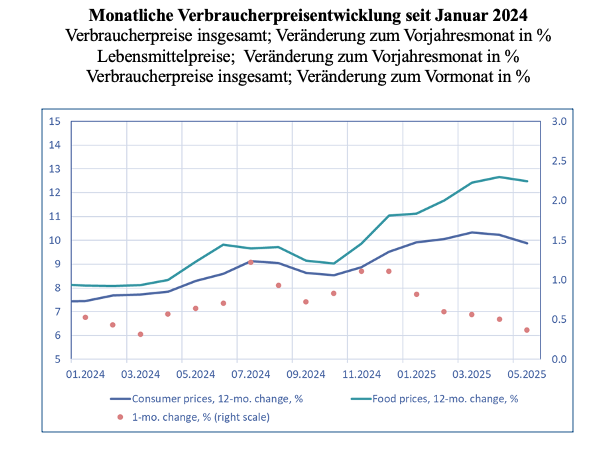
BOFIT, Bank of Finland: BOFIT Weekly, June 19, 2025
Nabiullina also commented on the financing of the state budget. She noted that Russia’s economy had grown for two years despite the sanctions, thanks to funds from the Welfare Fund and existing capital reserves in the banking system. “We must understand that many of these resources have in fact been exhausted, and we must think about a new growth model,” she said (Der Spiegel, dpa).
Sberbank CEO Gref: Russia’s economy is in a “perfect storm”
Sberbank’s traditional “Economic Breakfast” at SPIEF took place under the theme “Interest Rates vs. Growth: What Will the Coming Year Look Like?”
According to a Vedomosti report, Sberbank CEO German Gref emphasized that the Russian economy is simultaneously affected by a high real policy rate and a strong ruble exchange rate. There are many problems in the labor market, and productivity is very low compared to industrialized countries. Russia’s economy is in a “perfect storm,” said the former Minister of Economic Development (2000–2007), meaning a situation in which several negative factors are at play simultaneously and reinforce one another.
However, in a conversation with journalists, Gref expressed confidence that Russia would succeed in avoiding a recession (Finam.ru). He noted that a recession is defined as the economy contracting for two consecutive quarters. Currently, the Russian economy shows no signs of a recession, but it is important not to miss the right moment to transition to a looser monetary policy. Right now is a crucial moment, Gref said (Interfax.com).
According to Gref, the high real policy rate will pose a threat to Russia’s economic growth not only this year but also over the next two to three years.
Gref sees exchange rate developments as another problem. The appreciation of the ruble is having a negative impact on Russia’s exports and the state budget. Gref sees the “equilibrium rate” at 100 rubles per U.S. dollar and above. Currently, however, the exchange rate stands at 78 to 79 rubles per U.S. dollar (Finam.ru).
Regarding the state budget, Gref noted that by the end of the year, the Ministry of Finance will have to cover the deficit through new sources. Finance Minister Anton Siluanov acknowledged at the economic breakfast that the state budget is also “in serious turmoil.” He assured, however, that taxes for businesses would not be raised (Finam.ru).
Gref also pointed out Russia’s technological and organizational shortcomings. Productivity in various sectors in Russia is far lower than in other industrialized countries. In some cases, productivity there is four times higher than in Russia (Vedomosti.ru). On YouTube, the “Michael Nacke” channel features video clips from Sberbank’s business breakfast as part of an interview with Vladimir Milov.
Maxim Oreshkin: Russia Needs a “New Growth Model”
In the run-up to SPIEF, former Minister of Economic Development and current Deputy Head of the Presidential Administration Maxim Oreshkin also called for a “new growth model” for the Russian economy.
“The current growth model of the Russian economy has run its course. For further development, we need to make the leap to the next technological level,” Oreshkin said in an interview with the magazine Expert.ru.
Russia’s previous growth model, he explained, was based on mobilizing unused production resources, particularly human labor. However, he noted that no other major country in the world currently has an unemployment rate as low as Russia’s. The former Minister of Economic Development also noted that the utilization of existing production capacity is quite high. For the Russian economy to continue developing now, it must take a step “upward” to a higher technological and organizational level.
In Oreshkin’s view, such a step is the development of “digital platforms.” These would have a positive impact on economic growth. It is important not to hinder the development of these platforms with overly strict government regulations.
See also: Ostwirtschaft.de; Ben Aris, bneIntellinews: Putin Advisor: Russia’s Growth Model Is Exhausted, 06/16/25
Sources and recommended reading:
- Michael Nacke: YouTube Interview with Vladimir Milov: Reshetnikov: Economy on the Brink; Officials Break at the SPIEF, Video, June 22, 2025
- Finam.ru; Elena Aleshina: Recession, 100 rubles per dollar, and labubu officials. What will SPIEF-2025 be remembered for, June 21, 2025
- Joe Blogs video: Russia on the brink of recession; June 21, 2025
- Finam.ru: Putin orders measures to prevent economic recession, June 20, 2025
- Reuters; Vladimir Soldatkin, Guy Faulconbridge: Putin says war in Ukraine is not killing Russia’s economy, June 20, 2025
- The Moscow Times: At Flagship Forum, Putin Promotes BRICS Growth and Economic Restructuring, June 20, 2025
- The Moscow Times: Sberbank CEO Warns High Rates and Strong Ruble Creating ‘Perfect Storm’ for Russian Economy, June 20, 2025
- Vedomosti, Ksenia Kotchenko: Ways for the economy to emerge from the “perfect storm”: what was discussed at Sber’s breakfast, June 20, 2025 Vedomosti; Ekaterina Litova, Ksenia Kotchenko: Gref urged to seek new drivers of economic growth. This is necessary to realize the ambitious potential, June 20, 2025
- russland.capital.de: Where does the Russian economy stand: “On the brink of a recession,” in a “cooling-off phase,” or in an “overheated upswing”? June 20, 2025
- Meduza.io: An economic reality check. Officials clash at St. Petersburg forum over the perfect weather metaphors for Russia’s recession risks and the ruble’s strength, June 20, 2025
- Der Spiegel, dpa: Looming recession. Russia’s economy is deep in crisis, June 20, 2025
- Tagesschau.de: Putin’s speech at SPIEF; with an interview with Ina Ruck, May 20, 2025
- Tagesschau.de: Criticism of the Central Bank. Russia’s Minister of Economic Development warns of a recession, June 19, 2025
- Finam.ru; Dmitry Polevoy, Investment Director of JSC Astra Asset Management: Overheating, cooling, or almost a recession? 06/19/25
- Deutsche Welle.ru; S. Romashenko: Economy Minister: Russia is “on the brink of recession,” June 19, 2025
- Merkur.de, dpa: Russian Economy Minister warns of recession, June 19, 2025
- RBK.ru: “We are on the brink of recession.” What Nabiullina, Reshetnikov, and Siluanov discussed, June 19, 2025
- Interfax.com: Current interest rates demotivate businesses; investment in Russia may turn negative in Q3 or Q4 – economic development minister, June 19, 2025
- Interfax.com: Central Bank of Russia will cut rates as inflation slows, current deceleration exceeds expectations – Nabiullina, June 19, 2025; Interfax.com: Central Bank of Russia reaffirms commitment to achieve 4% inflation target, June 19, 2025
- The Moscow Times, AFP: Russia’s Economy Minister Warns of Looming Recession, June 19, 2025
- Börsenzeitung, Reuters: High interest rates, weak growth. Russian Economy Minister sees country on the brink of a recession, June 19, 2025
- DW.com,ru; Mikhail Bushuev: What awaits the Russian economy after the growth slowdown? June 18, 2025
The day's most important Russian economic stories. Free, in your inbox three times a week.
Mon, Wed, Fri. Double opt-in, no tracking, unsubscribe anytime. By subscribing you consent to the processing of your email address as described in our Privacy Policy.