Poland moves up to fourth place: France under pressure as a trading partner
 Thomas Baier
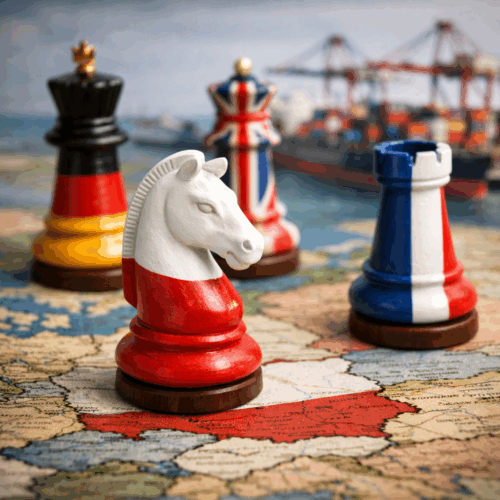
Only 4.8 billion euros separate Poland and France in the ranking of Germany’s most important trading partners. If the current pace continues, Poland will overtake its western neighbor by 2026.
According to Destatis, the Federal Statistical Office, German-Polish trade reached a volume of 180.2 billion euros in 2025. This represents a 5.5% increase over the previous year. German-French trade stood at around 185 billion euros—an increase of just 1.6%. The gap is shrinking rapidly.
In the first half of 2025 alone, bilateral trade exceeded the 90 billion euro mark. German exports to Poland rose to 49.4 billion euros (+5.7%), while Polish exports to Germany rose to 40.6 billion euros (+5.2%). By comparison, German exports to China amounted to 41.4 billion euros during the same period. Poland is already a more important export market for German companies than China.
Rising in the Rankings
As recently as 2004, the year of EU accession, Poland lagged far behind Germany’s traditional trading partners. Since then, the country has steadily climbed the ranks. Italy and China have already overtaken Poland. France is the next target.
The current ranking of Germany’s largest trading partners by total volume in 2025: China (€252.2 billion), the U.S. (€241.3 billion), the Netherlands (€209.0 billion), France (~185 billion), Poland (180.2 billion). Poland’s growth rate is three to four times higher than France’s.
According to the Polish Economic Institute (PIE), Poland’s economy is now 42% larger than it would be without EU membership. In 2025, GDP per capita reached 81% of the EU average for the first time—the highest level since accession. Convergence with Western Europe is accelerating.
This rise has structural causes. Poland’s GDP grew by 3.6% in 2025—the fourth-highest growth rate in the EU, behind Ireland (12.3%), Malta (4.0%), and Cyprus (3.8%). The European Commission forecasts 3.5% for 2026. According to the Polish Ministry of Finance, investment is expected to increase by 10 to 11%. Added to this is a record volume of EU funds: 180 billion zloty will flow to Poland in 2026, 120 billion of which will come from the national recovery plan (KPO).
At the same time, Warsaw is consolidating its budget. The deficit is expected to fall to 6.3% of GDP in 2026. New sources of revenue include a temporary special tax on banks, higher excise taxes, and the introduction of mandatory electronic invoicing.
What this means for German companies
For German SMEs, Poland has long ceased to be merely a extended workbench. The country is developing into a full-fledged sales market with rising purchasing power. Private consumption is driving growth, supported by rising real wages and inflation, which is expected to fall to 2.6% in 2026 according to a survey by the Polish central bank.
Demand for German machinery, vehicle parts, and industrial equipment is growing alongside the Polish economy. EU investment funds are flowing into infrastructure, energy, and digitalization—sectors in which German suppliers have traditionally had a strong presence. The major CPK airport and a new high-speed rail network are driving additional orders.
At the same time, Poland is diversifying its energy sector. In 2026, the first offshore wind farms will feed electricity into the grid. The state-owned gas network operator Gaz System plans to issue a request for proposals for a second floating LNG terminal. This, too, presents supply opportunities for German companies.
Outlook: 2026 as a Turning Point
Whether Poland will actually overtake France in 2026 depends on several factors. Polish growth must remain at its current level. EU funds must be disbursed as planned. And the German economy itself must increase exports again after two weak years.
Fiscal policy remains a risk. Poland’s budget deficit of 6.3% is among the highest in the EU. Rising social spending, public sector pay raises, and growing healthcare costs are straining the budget. The European Commission is closely monitoring the debt.
Nevertheless, the direction is clear. Poland’s share of German foreign trade has been rising for 20 years. The country is Germany’s most important trading partner in Central and Eastern Europe. In a few months, it could become the most important one on the European continent after the Netherlands.
For German exporters, the question is no longer whether Poland is relevant. The question is whether they have a strong enough presence there.