No recession in Russia—but growth of just 1% in 2025
Author: Klaus Dormann
The Russian government plans to present its budget proposal as early as September. This will also reveal how its economic forecasts have changed. In April, it had still assumed that the Russian economy would grow by 2.5 percent this year. However, Finance Minister Siluanov said at the end of August that growth could slow to as low as 1.5 percent in 2025.
In its economic forecast published on September 15, however, the Institute of Economic Forecasting of the Russian Academy of Sciences (IEF RAS) assumes that Russia’s annual growth rate will drop to just 1.2 percent this year. This forecast aligns with the results of the Russian Central Bank’s analyst survey published in early September.
Russian Academy of Sciences: Back to solid 2 percent growth starting in 2026
However, the IEF Institute expects annual growth in Russia to return to a solid 2 percent starting in 2026. The Russian government’s forecasts are likely to be similarly positive. Despite its above-average growth forecast of 2.1 percent for 2026, however, the IEF states in the very first sentence of its new forecast that the Russian economy currently remains “between stagnation and recession.”
According to a Vedomosti report from September 8, IEF Director Alexander Shirov also stated that the seasonally adjusted indicators for the first two quarters showed “signs of economic stagnation, perhaps even a recession.” Against the backdrop of discussions at the Vladivostok Economic Forum regarding stagnation in the Russian economy, Shirov remarked:
“But the president believes that so far everything is going according to plan; the economy is cooling down. The only question is how it will heat up again after this cooling.”
Central Bank President Nabiullina: “There is no recession in Russia”
The President of the Russian Central Bank, Elvira Nabiullina, reiterated at the Moscow Financial Forum last week that, in her view, while there is an economic slowdown in Russia, there is no recession. Nabiullina explained to forum participants, according to ntv.ru:
“Do not confuse a recession, which in my opinion is accompanied by very negative phenomena, with an economic downturn. Yes, there is an economic downturn, but it is not a recession. And even when people speak of a technical recession, they mean that the economy has contracted for two consecutive quarters. We haven’t even experienced that.
After all, a so-called recession cannot be assessed based on a single indicator, not even one as important as real GDP. A recession is usually accompanied by falling real incomes and high unemployment—not just rising unemployment, but high unemployment.
And if a recession is caused by a slowdown in demand, it is accompanied by low inflation. Yes, our inflation has fallen, but it is still above the target.”
Nabiullina had already made a very similar argument on September 12 at the Central Bank’s press conference following the key rate cut from 18 to 17 percent (Ostwirtschaft.de reported; russland-ru video in German). Economist Vladimir Milov, who emigrated from Russia in April 2021 and is classified as a “foreign agent,” comments on Nabiullina’s statement in a video published on September 19 (“Is the Russian economy already in a recession or not yet?”, in Russian).
Raiffeisenbank: No recession, but growth has slowed across all sectors
According to a September 12 statement from the Federal State Statistics Service (Rosstat), there was no “technical recession” in Russia during the first half of the year. Real gross domestic product rose by 0.4 percent in the second quarter of 2025 on a seasonally adjusted basis compared to the first quarter, after falling by 0.6 percent in the first quarter compared to the previous quarter. Compared to the same quarter of the previous year, gross domestic product grew by 1.1 percent in the second quarter of 2025, according to Rosstat. In the fourth quarter of 2024, the Russian economy had still grown by 4.5 percent compared to the same quarter of the previous year.
Stanislav Murashov, chief economist at Russia’s Raiffeisenbank, illustrates in an analysis with the following chart how the annual growth rates of the Russian economy have developed since the fourth quarter of 2023 (blue line). He has also calculated the contributions of the economic sectors to overall economic growth.
Regarding the change in growth contributions in the first half of 2025, he notes:
All economic sectors made smaller contributions to growth in the first two quarters of 2025 than a year earlier. The slowdown in GDP growth in the first two quarters of 2025 is mainly attributable to developments in industrial production (yellow bar section) and trade (light blue bar section). The services sector (light gray bar section) continued to make a significant positive contribution to growth.
The growth contribution from industry remained weak in the second quarter
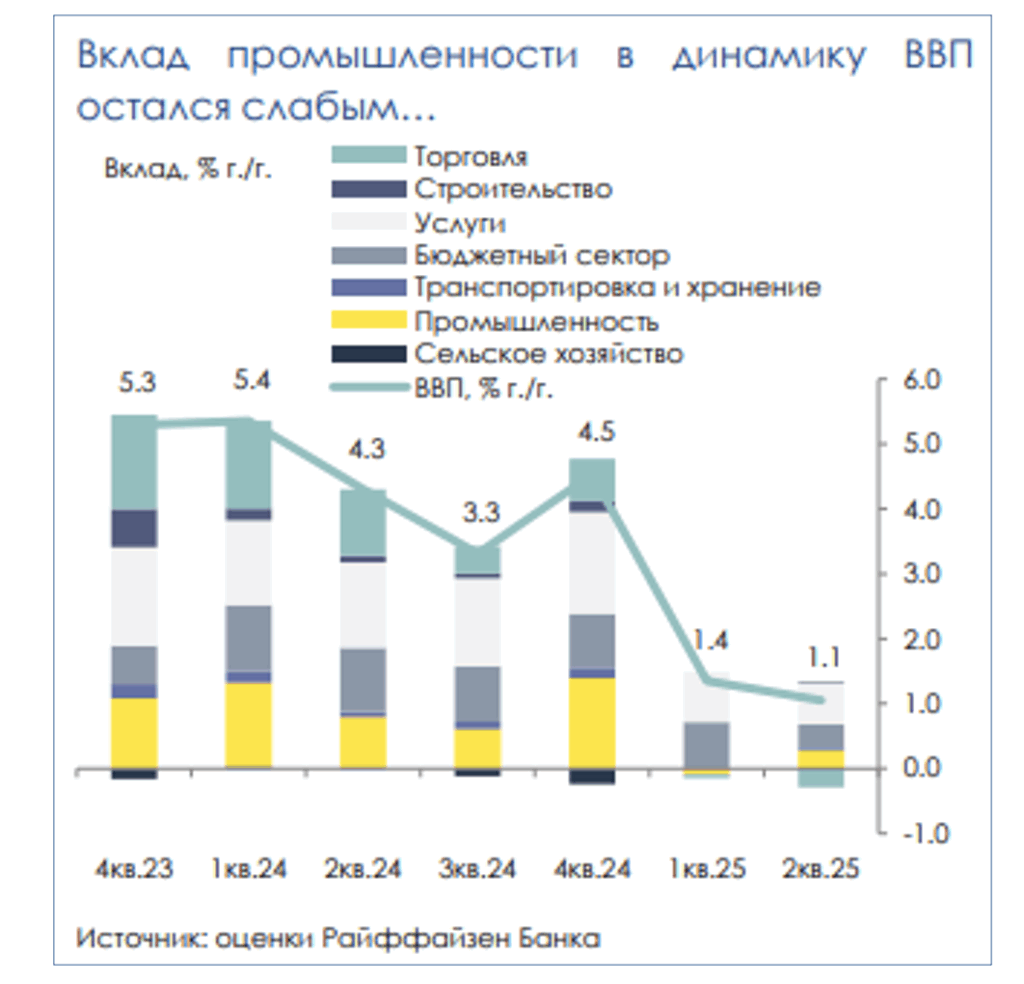
Growth contributions from the sectors of trade, construction, services, the public sector, transport and warehousing, industry, and agriculture; in percentage points, Raiffeisenbank.ru: RAIF: Daily Focus, 09/17/25
Industry (yellow) still contributed an average of about one percentage point to GDP growth in 2023 and 2024. Since early 2025, however, its contribution to growth has been close to zero.
Trade (light blue) still made an average growth contribution of 0.8 percentage points in both 2023 and 2024. In the first half of 2025, however, production in the trade sector declined. The growth contribution turned negative (-0.2 percentage points).
The public sector’s contribution to growth (dark blue bar segment) has declined compared to 2024 (+0.7 percentage points) but still stands at 0.4 percentage points.
Raiffeisenbank expects the “economic slowdown” to continue in the second half of 2025. GDP growth is projected to decline to 0.9% year-over-year in the third quarter and to 0.3% year-over-year in the fourth quarter.
For 2025 as a whole, Raiffeisenbank now expects economic growth of only 0.9% compared to 2024.
IEF-RAS: How production cooled off in the first seven months
The Institute for Economic Research of the Russian Academy of Sciences (IEF) expects slightly stronger economic growth for 2025 than Raiffeisenbank. In the fall edition of its quarterly economic forecasts, it projects year-over-year growth of +1.2% for 2025 compared to 2024,
In this forecast (based on data from early September), the IEF assumed that GDP stagnated in the second quarter of 2025 compared to the previous quarter. Overall economic output also remained virtually stagnant throughout the first half of 2025. The institute cites interest rate and exchange rate developments as the causes:
High interest rates weakened the growth of production and demand.
The ruble appreciated. Exports fell, while imports rose.
The institute notes that the previous growth drivers have been exhausted.
There are increasing signs of a trend toward a decline in production and a deterioration in the financial situation of companies.
The IEF describes the development of production in key sectors during the first seven months of 2025 as follows:
The overall growth in industrial production has been slowing since the beginning of the year. At the same time, production in the “civil sector” of industrial production is declining. Excluding defense production, industrial production fell by 2.4% year-over-year from January to July. In July, the decline in production accelerated in many sectors of the manufacturing industry (in the civilian sector, production fell by around 5%).
Given the decline in production in the civilian industrial sector and in exports, real sales in freight transport and wholesale continue to fall. Wholesale sales were 4.5% lower in the period from January to July than in the previous year.
Production growth in the construction industry has come to a standstill. Against the backdrop of declining production of construction materials, no sustainable growth is expected in this sector. New orders in residential construction have declined significantly in recent months.
BOFIT: GDP growth slowed to 0.4 percent by July
In its weekly report, the BOFIT research institute of the Bank of Finland shows in the following figure that the annual growth rate of aggregate economic output in Russia has been trending downward since early 2024. In the figure, the institute compares the Ministry of Economic Development’s monthly estimates of annual gross domestic product growth (dark blue line) with the output in five “core sectors” of the Russian economy as calculated by Rosstat (light blue line).
Annual GDP growth fell to 0.4 percent in July
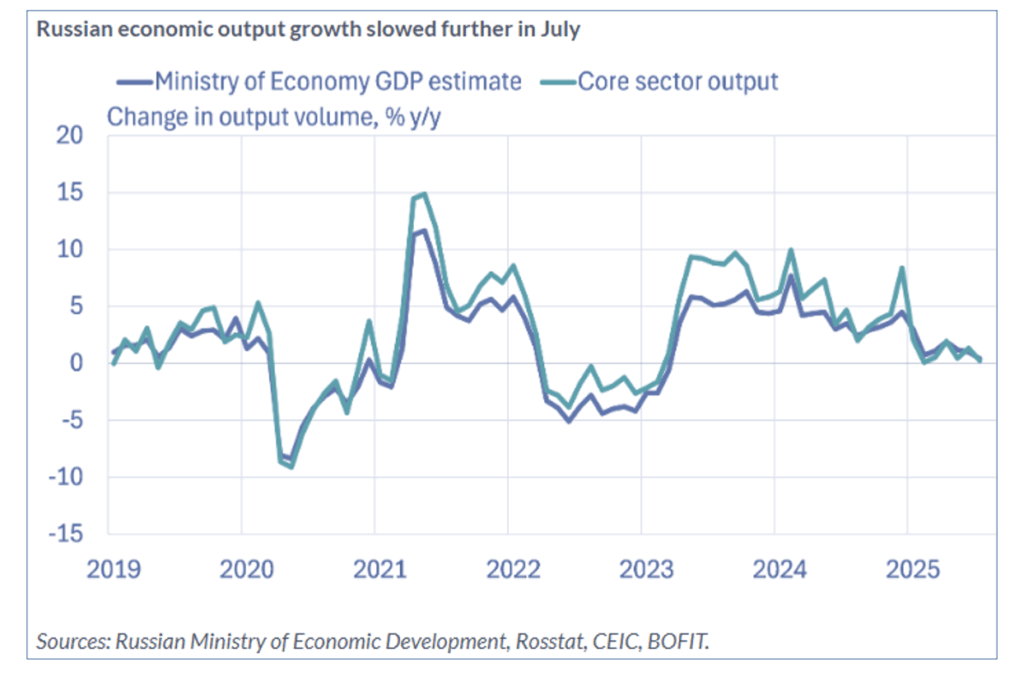
BOFIT Weekly: Russian economic growth slowed further in July, 09/12/25
In July 2025, the annual growth rate of gross domestic product fell to just 0.4 percent, according to the Ministry of Economic Development. The production index in the five core sectors of the economy rose by only 0.2 percent.
BOFIT notes that the weak overall economic growth was likely driven primarily by consumer-oriented sectors. According to BOFIT, real sales in the retail and service sectors rose by about 2% in July compared to the previous year. Unemployment remained at a historic low, and wages continued to rise quite strongly.
Regarding the slowdown in economic growth and the outlook for the Russian economy in the coming months, BOFIT states:
“The effects of restrictive monetary policy on demand are becoming more apparent, particularly in the slowing growth of fixed investment and investment-oriented sectors.
Inflation has also gradually eased in recent months.
The Russian economy is expected to continue growing moderately in the coming months, but economic development is subject to numerous risks. Government spending continues to rise while government support measures appear to be scaling back. Companies are expected to bear an even greater burden of war costs.”
IEF: Investment growth fell significantly, while consumption continues to grow
The Institute for Economic Research of the Russian Academy of Sciences (IEF-RAS) reports on the development of investment and consumption:
Investment growth slowed significantly over the course of the first half of the year. Following an annual increase of 8.7% in the first quarter of 2025, investment grew by only 1.5% year-over-year in the second quarter of 2025. This is due to a decline in profits outside the financial sector, a decline in production in the civilian sector, and expectations of a further economic slowdown. Leading indicators suggest that investment is highly likely to decline in the second half of the year.
Private consumption grew by 2.4 percent year-over-year in the first half of the year.
Demand in the non-food retail sector stagnated. However, significant growth in the areas of paid services and the food service industry (cafés, bars, restaurants) continued. Consumer demand continues to grow due to persistently rising wages. This is driven by labor shortages. Additionally, private income from real estate is rising.
IEF Forecasts for Consumption and Investment for the Full Year 2025
The IEF expects the growth rate of real private consumption for the full year 2025 to roughly halve, falling from 5.4 percent to just 2.7 percent (second row of the table below). According to the IEF forecast, growth in fixed investment is slowing at a similarly sharp rate. It is falling from 6.0 to 3.0 percent (fourth row).
Forecast of Gross Domestic Product Allocation
Year-over-year changes in percent
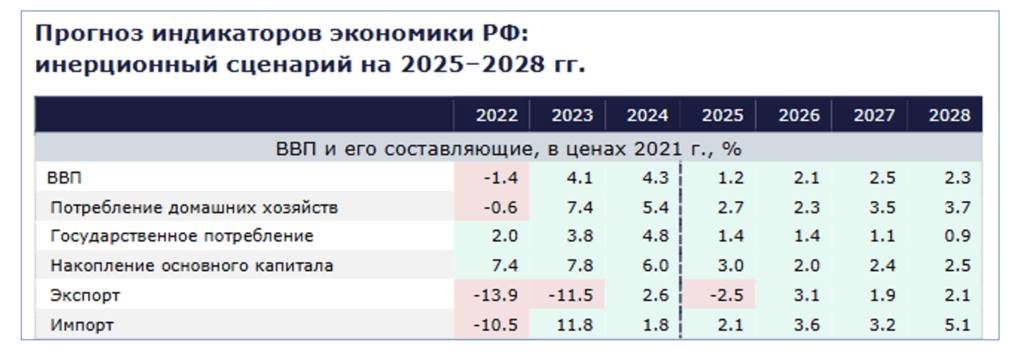
Institute of Economic Forecasting of the Russian Academy of Sciences; IEF-RAS: Quarterly forecast of macroeconomic indicators of the Russian Federation, September 15, 2025
GDP growth will fall to 1.2 percent in 2025 but will then roughly double
According to the IEF, real GDP growth will fall to just 1.2 percent year-on-year in 2025 compared to 2024 (first row of the table above). Regarding the risks to macroeconomic development in the second half of 2025, the IEF states:
“In the second half of the year, the economy will remain on the brink of a recession. A significant risk remains a decline in oil and petroleum product exports as a result of a possible increase in U.S. sanctions pressure on importers of Russian hydrocarbons.”
However, according to the IEF’s assessment, the Russian economy will grow significantly stronger again from 2026 to 2028, at a rate of 2.1 to 2.5% per year.
This IEF forecast is based on the assumptions of the Ministry of Economic Development’s baseline forecast. According to this forecast, oil and gas exports are expected to rise by 3 to 5% per year over the forecast period.
According to the IEF, an additional boost to economic growth in the coming years will come from the easing of monetary policy. This is expected to accelerate growth in private consumer demand.
The IEF’s forecast for 2026 is comparatively very optimistic
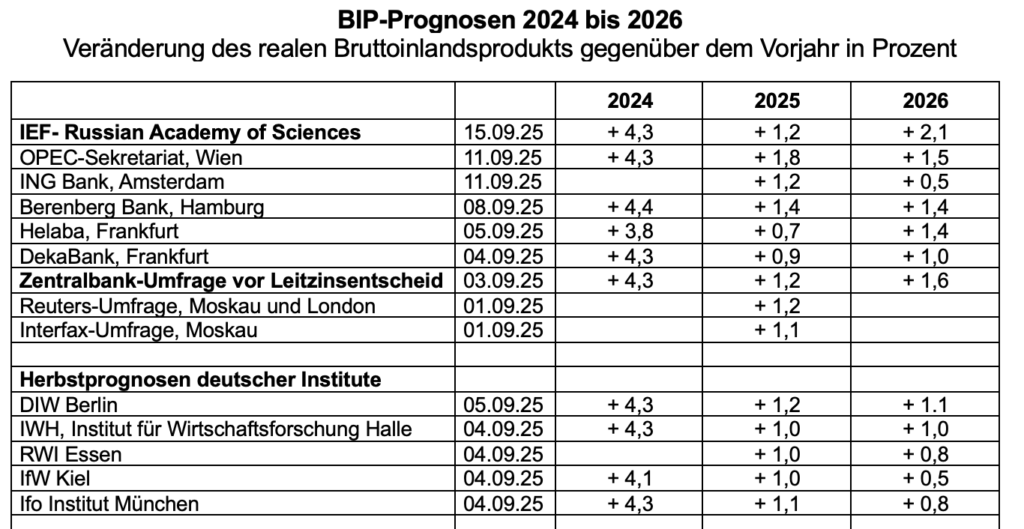
The IEF’s growth forecast for 2025, at +1.2 percent, largely corresponds to the “consensus” of forecasts published in Russia as well as abroad. The “autumn forecasts” from the five leading German economic research institutes also project an increase in Russian economic output of between 1.0 and 1.2 percent for 2025.
Next year, however, the German institutes do not expect a rapid recovery in economic growth to just over 2 percent, as the IEF does. On the contrary, they anticipate a further slight slowdown in the growth of the Russian economy for 2026 (see: German-Russian Chamber of Foreign Trade; Focus Analysis: Falling Key Interest Rate, Falling Growth Forecasts for Russia, September 15, 2025).
In the Russian Central Bank’s most recent analyst survey, the average forecast for 2026 did indeed predict a recovery in Russian economic growth, as the IEF had. However, the “consensus” among the almost exclusively Russian survey participants—at a growth rate of 1.6 percent—is noticeably lower than the IEF’s forecast for 2026 (+2.1 percent).
GDP Forecasts 2024 to 2026
Change in real gross domestic product compared to the previous year, in percent
Recommended reading:
- Vladimir Milov video: Is the Russian economy in recession or not yet?, in Russian, 09/19/25
- Alexandra Prokopenko; Carnegie Russia Eurasia Center. Berlin: Can Russia’s Militarized Economy Ever Return to a Civilian Model? A painless return to the civilian model is impossible…, 09/19/25; FR.de; Lars-Eric Nievelstein: Russia’s economy is experiencing a “vacuum cleaner effect”: Expert highlights Putin’s major problem, 09/19/25
- Kyiv Post: Putin Says He Is ‘Deliberately’ Curbing Economic Growth, 09/18/25
- ntv.ru: Nabiullina: There Is No Recession in the Russian Economy, 09/18/25
- Vedomosti.ru, Elena Vostrikova: What Nabiullina and Siluanov said about the Russian economic situation, 09/18/25; Vedomosti: Nabiullina urged not to confuse an economic slowdown with a recession, 09/18/25
- Vedomosti.ru; Ksenia Kotchenko: Siluanov announced a price cut in the updated budget. By 2030, the budget rule’s oil price cap will drop to $55 per barrel, 09/18/25
- Reuters; Gleb Bryanski and Darya Korsunskaya: Russia unveils ‘muscular’ budget changes to counter sanctions, oil price falls, 09/18/25; Reuters; Darya Korsunskaya: Russian government explores ways to make ends meet as budget deadline looms, 09/18/25
- Siberian Information Agency: What will help the Russian economy overcome a possible recession? Natalia Milchakova, Freedom Finance Global, September 17, 2025
- Professor Igor Lipsits: On the new interview with Professor Vyugin, 09/18/25; Movchans: Ruble, inflation, and banks: What is the Russian economy? // “Экономика будущего,” YouTube video, 09/17/25
- Dmitry Prokofiev, Nikita Demidov: “Money and the Arctic Fox”: Economy in Decline – Analysis of the “Forecast of Russian Economic Indicators: Business-as-Usual Scenario for 2025–2028,” September 17, 2025
- Kommersant, Artem Chugunov: Without Supply, Inflation Will Not Disappear, 09/17/25
- Finance Rambler, Lera Bukina: There’s no denying it: The Russian economy faces serious problems, 09/17/25
- Siberian Information Agency: GDP growth rates could drop to 0.8–1% in the third quarter, Vladimir Chernov, analyst at Freedom Finance Global, 09/16/25
- The Moscow Times, Yuri Kotshetkov: The Russian Academy of Sciences reported a standstill in the country’s economic growth, 09/16/25
- Steppe News, Lyudmila Yudina: Economic growth in the country has slowed, 09/16/25
- Nezavisimaya Gazeta, Mikhail Sergeev: Economic growth in Russia has stalled. Decline in investment expected in the second half of the year, 09/16/25
- Lenta.ru; Platon Shchukin: Russia’s consolidated budget revenues are at risk of falling. IEF RAS: Consolidated budget revenues could fall for the first time since 2020, 09/16/25
- Institute of Economic Forecasting of the Russian Academy of Sciences; IEF-RAS: Quarterly forecast of macroeconomic indicators of the Russian Federation, 09/15/25
- German-Russian Chamber of Foreign Trade; Focus Analysis: Falling key interest rate, declining growth forecasts for Russia, September 15, 2025
- Finam.ru; Evgeny Suvorov, CentroCredit Bank: The Central Bank is doing everything right. A technical recession did not occur, September 15, 2025
- Russland.ru Video, in German: Part 2/3 Press conference by Central Bank Governor Nabiullina on Russian monetary policy, September 12, 2025
- Radio Moskva Podcast: Ben Aris, editor of bne IntelliNews, and Chris Weafer, CEO of Macro Advisory: Window on the East: Russia under pressure but won’t collapse yet, Audio + Transcript, 60 min., July 5, 2025
The day's most important Russian economic stories. Free, in your inbox three times a week.
Mon, Wed, Fri. Double opt-in, no tracking, unsubscribe anytime. By subscribing you consent to the processing of your email address as described in our Privacy Policy.