New forecasts from Germany and Finland for Russia's economy

Author: Klaus Dormann
How will the “energy price shock” triggered by the war in Iran affect global economic growth? In which countries is production likely to be particularly hard hit by high energy prices? Which countries could benefit from this? The answers to these questions are particularly relevant for Russia as a major energy exporter.
“Joint Assessment” by German Economic Research Institutes:
Less Growth in Germany; More Growth in Russia
In their semi-annual “Joint Assessment” updated on April 1, April, the five leading German economic research institutes have more than halved their forecast for this year’s growth in the German economy in light of the sharp rise in energy prices, lowering it from 1.3 percent to just 0.6 percent. “The energy price shock” will dampen the recovery of the German economy, but it is unlikely to bring it to a complete standstill, the institutes write. This is ensured by the “significantly expansionary course” of German fiscal policy.
Forecasts from the “Joint Economic Forecast”:
Growth of the German economy
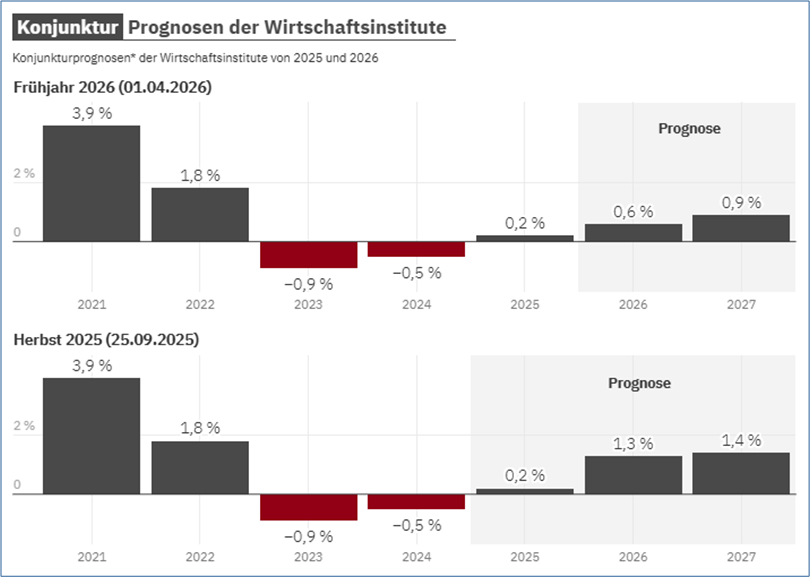
* Change in gross domestic product (GDP) from the previous year in percent, price-adjusted.
Graphic: n-tv.de / lstSource: Joint Economic Forecast by the economic institutes, Destatis
n-tv.de: Institutes: War with Iran Slows German Economic Growth, April 1, 2026
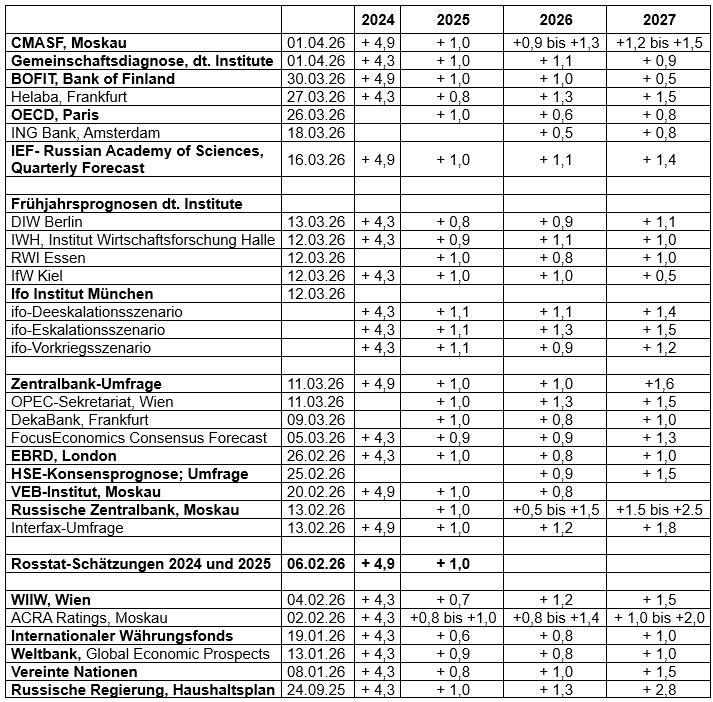
In Russia, however, German institutes now expect slightly stronger economic growth this year and next than in their last joint forecast at the end of September. They raised their forecast for Russia’s economic growth in 2026 from 0.8 to 1.1 percent, and their growth forecast for 2027 from 0.8 to 0.9 percent. The institutes do not provide a rationale for this upward revision of their growth forecasts. However, they likely expect that Russia, as a major energy exporter, will receive a boost to its economic growth from rising energy prices.
On March 26, the Paris-based OECD had raised its growth forecasts for Russia by a similarly modest margin as the “Joint Economic Forecast” has now done. The OECD now expects real gross domestic product in Russia to rise by 0.6 percent in 2026, accelerating to 0.8 percent in 2027. Thus, the forecasts by German economic research institutes for the rise in Russian gross domestic product in 2026 and 2027 remain slightly higher than the OECD’s forecasts.
The growth forecasts in the “Joint Economic Assessment” for Russia also remain slightly higher than the forecasts published on March 30 by the BOFIT research institute of the Bank of Finland. BOFIT now expects Russia’s economic growth to reach only about 1 percent again in 2026. Next year, it is projected to halve to just around 0.5 percent.
In 2026, Russia’s growth will stabilize at around 1 percent
According to the forecasts of the “Joint Economic Outlook,” the OECD, and the Finnish Central Bank’s research institute, Russia can at best expect the current rise in energy prices to lead to a stabilization of its growth in 2026—growth that is projected to have fallen to just around 1 percent by 2025. According to forecasts, similarly weak growth in the Russian economy is expected in 2027.
On April 1, the Moscow-based “Center for Macroeconomic Analysis and Short-term Forecasting” (CMASF) raised its growth range for 2026 from 0.5 to 0.8 percent to 0.9 to 1.3 percent. It expects growth of up to 1.5 percent in 2027.
GDP Forecasts for Russia 2024–2027
Year-over-year change in real gross domestic product, in percent
Joint Economic Assessment: Energy prices will start to fall again in the summer,
but will still be noticeably higher at the end of 2027 than before the Iran war
The Joint Economic Forecast describes the “severe energy price shock” following the start of the Iran war as follows:
“The military conflict in the Persian Gulf has largely blocked the Strait of Hormuz, one of the central transport corridors for global energy supply. Since this region accounts for about one-fifth of global crude oil production and LNG production, the restricted transport capacities have led to a significant rise in energy prices and increased volatility in commodity and financial markets.
The price of Brent crude oil surpassed the $100 mark; in January, it had still stood at $65. At the same time, the gas price in Europe (Dutch TTF) temporarily doubled to 60 euros per MWh.”
In the following two figures from the Joint Economic Forecast, which present scenarios for the development of the Brent crude oil price and the natural gas price (Dutch TTF), the blue line for the baseline scenario shows the price development to date through March 20 and the further price development expected through the end of 2027 based on market expectations as of March 20.
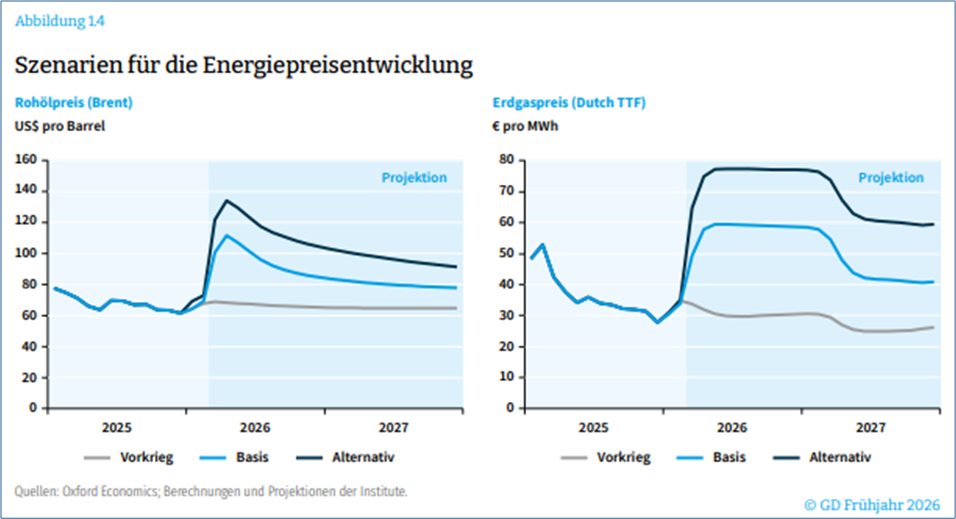
German Institutes: Joint Economic Forecast, April 1, 2026
The development of energy prices assumed in the baseline scenario of the Joint Economic Forecast based on market expectations as of March 20 is compared, on the one hand, with a “pre-war scenario” based on market expectations for price trends from late February, i.e., before the outbreak of the war (lower gray line).
On the other hand, the energy price trend in the baseline scenario is compared with the price trend in an “alternative scenario,” in which significantly larger and longer-lasting increases in energy prices are assumed (upper black line).
The Joint Economic Forecast describes its assumptions regarding the further development of energy prices through the end of 2027 as follows:
“In their forecast, the institutes assume that the Strait of Hormuz will become fully passable again in the course of the second quarter and that, in the second half of the year, exports of oil and liquefied natural gas from the region will gradually return to pre-war levels. In line with futures market prices, it is assumed that while energy prices will begin to fall again starting in the summer, they will still be noticeably higher at the end of the forecast period than they were before the outbreak of the war.”
BOFIT: Russia’s GDP growth to stagnate at around one percent in 2026
At the end of March, BOFIT, the research institute of the Finnish central bank, published the “spring edition” of its semi-annual forecasts for the Russian economy. The institute does not expect the current sharp rise in energy prices to trigger a strong growth spurt for the Russian economy. It stands by its October forecast that Russia’s economic growth will again reach only around 1 percent in 2026. BOFIT even halved its growth forecast for 2027 from 1.0 to just 0.5 percent. The Russian economy is expected to grow just as weakly in 2028.
According to BOFIT’s assessment, high commodity prices will merely “support” Russia’s economic growth in 2026, not accelerate it. However, the stabilizing effect of high commodity prices will wane in 2027/2028.
Review: How BOFIT Assesses Russia’s Economic Performance in 2025
Economic growth last year was primarily hampered by declines in production in the commodity sector and in wholesale trade.
In the manufacturing sector, the “polarization” of production intensified: value added in the “war-critical sectors” of manufacturing rose by 20%, while total value added increased by only 0.4%.
Key economic indicators, year-over-year changes in %
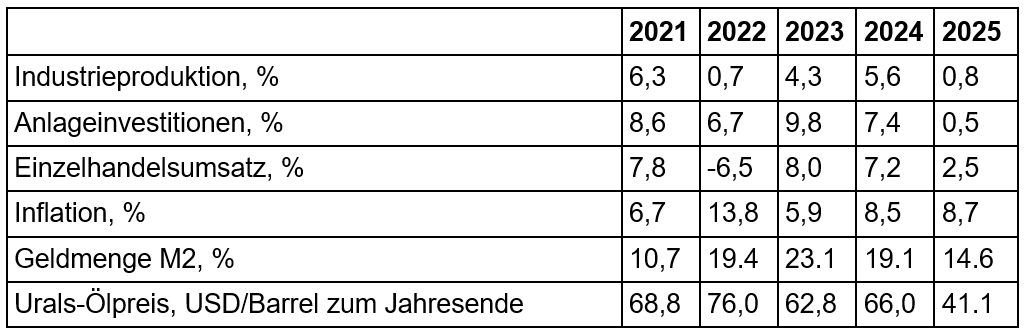
Source: BOFIT Russia Statistics
Private demand was indeed the most important driver of growth. In 2025, real wages and real disposable income continued to rise despite the slowing economy. At the same time, unemployment remained at a historic low. However, the annual increase in real retail sales in 2025 also saw a significant decline compared to the previous year.
Growth in fixed investment was subdued compared to previous years, primarily due to weak demand and restrictive monetary policy.
Net exports had a negative impact on GDP growth in 2025. Exports were hampered by new sanctions against the oil sector.
Labor shortages remain a significant problem for Russia, even though economic growth slowed in 2025. By the end of 2025, Russia was effectively at full employment. Growing immigration contributed little to increasing the supply of skilled workers. The labor shortage is primarily attributable to the war in Ukraine exacerbating long-term demographic trends over the past three decades.
BOFIT Forecasts for 2026 to 2028
BOFIT assumes that the pressure from sanctions weighing on the Russian economy will remain at the level seen in early 2026 and that the Russian economy will experience “no further significant external or internal shocks” during the forecast period.
BOFIT does not base its forecast on explicit assumptions regarding the future development of oil prices. The institute notes that oil prices surged globally with the outbreak of the war in Iran at the end of February. It is unclear how long this situation will persist.
Under these assumptions, BOFIT expects the following economic development:
Economic growth is expected to stabilize at around 1 percent this year. High commodity prices will support economic growth this year, but this effect will subside in 2027/28.
Annual change in real gross domestic product (in %)

Rosstat figures 2021–2025 (as of February 16, 2026); BOFIT forecasts 2026–2028 (as of March 30, 2026)
Weakening private demand and the lack of growth in fixed investment are the main obstacles to growth. Real wage growth is slowing. Companies’ ability to invest remains constrained by low profitability and restrictive monetary policy.
Despite the continued restrictive monetary policy, the Russian Central Bank expects the key interest rate to gradually decline over the entire forecast period. It is expected to average 13.5 to 14.5% this year, 8 to 9% in 2027, and 7.5 to 8.5% in 2028.
The combination of restrictive monetary policy and stricter government restrictions on the granting of subsidized loans this year is likely to reduce incentives to borrow.
Economic growth will no longer be able to be driven by a strong expansion of public stimulus programs because the government’s ability to finance deficits is limited. The productive capacity of Russia’s working-age population is nearly fully utilized. Therefore, a further increase in government spending would heighten the risk of “economic overheating.”
Growth in household consumption is slowing
Private consumption will continue to rise, but at a slower pace than in previous years. Household consumption will continue to be supported by real wage increases and savings. However, the rapid wage growth seen from 2023 to 2025 is over, as companies are struggling with weaker financial positions. The increase in VAT rates since early 2026 and fee hikes for municipal services will also dampen consumption growth.
Growth in fixed investment could come to a standstill
“Priority” investments in the military sector will continue. However, they are unlikely to boost the future growth potential of the Russian economy, as large portions of these investments will be destroyed in combat operations.
Other fixed investments are likely to decline. The financial situation of many companies has deteriorated due to weak demand, high interest rates, increased labor costs, and heavy tax burdens. This makes significant investments by private companies that are not integrated into military-industrial production chains or receive other government subsidies more difficult. The sanctions have also raised prices for capital goods and reduced their availability.
BOFIT highlights an increasing division of the Russian economy into a “military-industrial complex” and a “civilian sector”:
“This is solidifying a two-track economic structure: companies that benefit from military spending are thriving, while those struggling for market-oriented growth are falling behind. The situation for private companies not involved in military operations will become increasingly dire. The gap between companies serving the military-industrial complex and firms struggling in the civilian sector is widening.”
Growth in government spending is slowing,
defense spending is expected to decline in 2026
The rise in government spending was the main driver of growth in the Russian economy in 2023/24, but now real growth in public consumption is likely to slow. According to the 2026 budget, spending in the Russian consolidated budget (federal budget, regional budgets, and social security funds) is set to rise by 4% in 2026, which in real terms amounts to a spending cut.
Defense spending is projected to decline in nominal terms in 2026. However, this is unlikely if Russia continues the war this year. The country will be forced to
tap into new sources of revenue through additional taxes and the sale of state assets.
The planned reduction of the budget deficit to 1.6% of GDP is uncertain
To reduce the budget deficit, taxes and fees will be increased this year. According to the budget plan, this could generate additional revenue of up to one trillion rubles (about 11 billion euros or 0.5% of GDP). However, actual tax revenues could fall short of targets due to slower economic growth and weak private consumption.
Despite high oil prices, the public sector will continue to run a deficit in 2026. However, it is currently projected to fall to 1.6% of GDP. Financing is to be provided through increased government debt. The liquid assets of the National Welfare Fund have been reduced by the war from the equivalent of 6.5% of GDP before the invasion of Ukraine in 2022 to just 1.8% of GDP by the end of 2025. The Russian Ministry of Finance has stated that no further assets will be withdrawn from the fund to cover financing shortfalls.
Russia’s national debt remains relatively low by international standards (below 20% of GDP). However, debt service costs have risen due to increased borrowing and higher interest rates. The current budget assumes that these costs will range between 1.5% and 1.7% of GDP over the next three years. The implementation of the budget is uncertain, which is why a further increase in borrowing costs is expected.
BOFIT also notes the following regarding the likelihood of the budget plan being realized:
“Significant increases in the budget, particularly in military spending, have become a common feature of fiscal planning in recent years. Should the war continue, we expect this trend to persist in 2026, with further adjustments to the budget taking place throughout the year. The consolidated budget deficit for 2025 was originally planned at 0.8% of GDP but reached nearly 4% of GDP.”
BOFIT views Russia as “an increasingly isolated economy”
BOFIT expects net exports to have no impact on Russian economic growth throughout the forecast period. The institute assesses external economic developments as follows:
The combined value of exports and imports relative to GDP fell to around 33% last year—the lowest level in 15 years. Assuming that sanctions pressure remains at current levels throughout the forecast period, Russia’s isolation from global markets is likely to persist.
It is unlikely that Russia’s export volume will increase significantly in the coming years. Oil and natural gas, Russia’s most important export commodities, remain subject to sanctions.
Import volumes are being held back by weaker overall demand, and sanctions are keeping prices for imported goods high.
However, Russia will continue to run substantial current account surpluses, although these are expected to be smaller than in the 2022–2024 period.
Recommended reading:
Forecasts:
- German Institutes: Joint Economic Forecast: 04/01/26
- CMASF: Base version of the macroeconomic forecast, 04/01/26
- BOFIT: BOFIT Forecast for Russia, 03/30/26
- vz-nn.ru: The Ministry of Economic Development will lower its forecast for Russian GDP growth in 2026; 03/28/26
- OECD: OECD Economic Outlook, Interim Report March 2026 – Testing Resilience, March 26, 2026
- de.euronews.com; Doloresz Katanich with AFP: OECD lowers eurozone growth forecast due to rising energy prices, March 26, 2026
- IEF RAS: Quarterly GDP Forecast. Issue No. 69, 03/16/26; Nezavisimaya Gazeta; Mikhail Sergeev: Russians do not believe in a peace agreement for Ukraine. According to survey participants, the economy’s toughest times are yet to come, March 17, 2026
Monthly and weekly economic reports:
- Sergey Blinov: Macro Overview No. 13 (2026), April 1, 2026
- Politkom.ru; Marina Voitenko: Weekly Economic Report: Compromise Under Pressure from Uncertainty, March 28; Extremely High Volatility in Oil Prices and Extreme Uncertainty Regarding the Consequences, March 19, 2026
- VEB Institute: Global Economy and Markets, Weekly Report, March 27, 2026
- Economic Expert Group: Economic Analysis March 2026, March 25, 2026
- CMASF Monthly Report: “Analysis of Macroeconomic Trends,” March 24, 2026
GDP and Industrial Production in February 2026:
- Finmarket.ru: Russia’s GDP fell by 1.8% in January and February, April 1, 2026
- Finmarket.ru: Industrial production in Russia fell by 0.9% in February, March 25, 2026
- Kommersant; Artem Chugunov: Industrialists are not expecting the best. Industrial production in February and results of recent business surveys, March 26, 2026
- Hard Numbers: Industrial production in February: below trend, 03/25/26
The day's most important Russian economic stories. Free, in your inbox three times a week.
Mon, Wed, Fri. Double opt-in, no tracking, unsubscribe anytime. By subscribing you consent to the processing of your email address as described in our Privacy Policy.