Is Russia's economy sliding into a "recession"? Here's how the economy slowed down in the first quarter of 2025
Author: Klaus Dormann
In 2024, Russia’s economy grew by 4.3 percent. The rise in production accelerated once again in the fourth quarter of 2024. Compared to the same quarter of the previous year, real gross domestic product growth reached 4.5 percent. In the first quarter of 2025, however, it slowed to just 1.4 percent. The Russian Federal State Statistics Service (Rosstat) announced this in a preliminary estimate on May 16 (Interfax).
Given the significant slowdown in the annual growth rate, there are now some voices predicting a “recession” in Russia. However, it is important to distinguish whether this refers to a decline in real gross domestic product in 2025 compared to 2024 or “merely” a decline in aggregate economic output from quarter to quarter over the course of 2025.
“Analysts Expect a Technical Recession”
This was the headline of an article on the Russian economy published by the Russian business newspaper “Kommersant” on May 12. What is a “technical recession”? Anyone searching the internet will find a confusing array of different definitions. According to the Federal Statistical Office, a “technical recession” exists “when the price- and seasonally-adjusted gross domestic product declines in (at least) two quarters compared to the previous quarter.”
In the first quarter of 2025, GDP fell compared to the previous quarter
According to initial estimates, Russia’s economy could be heading toward such a “technical recession.” The Russian Ministry of Economic Development no longer publishes estimates on the quarterly seasonally adjusted trend in aggregate economic output. However, according to Kommersant, analysts at Raiffeisenbank and “Bloomberg Economics” have concluded in their initial calculations that Russia’s real gross domestic product in the first quarter of 2025 fell on a seasonally adjusted basis compared to the fourth quarter of 2024. However, their estimates differ considerably.
How the Russian Academy of Sciences views the economy
Kommersant also points to estimates from the “Institute for Economic Forecasting” (IEF) of the Russian Academy of Sciences regarding the development of the seasonally adjusted gross domestic product index. The index had reached a new high in December. In January, February, and March 2025, it then fell steadily month-over-month (see the black line in the figure below). In March 2025, the GDP index fell by 0.3% compared to February 2025, according to the institute, and was no higher than in the fall of 2024.
The blue bars in the figure show the percentage change in the real gross domestic product index compared to the same month of the previous year. The IEF estimates the annual increase in GDP in March 2025 compared to March 2024 at 0.8 percent. In the first quarter of 2025, real GDP was 2.3 percent higher than in the same quarter of the previous year, according to the IEF’s estimate of May 7.
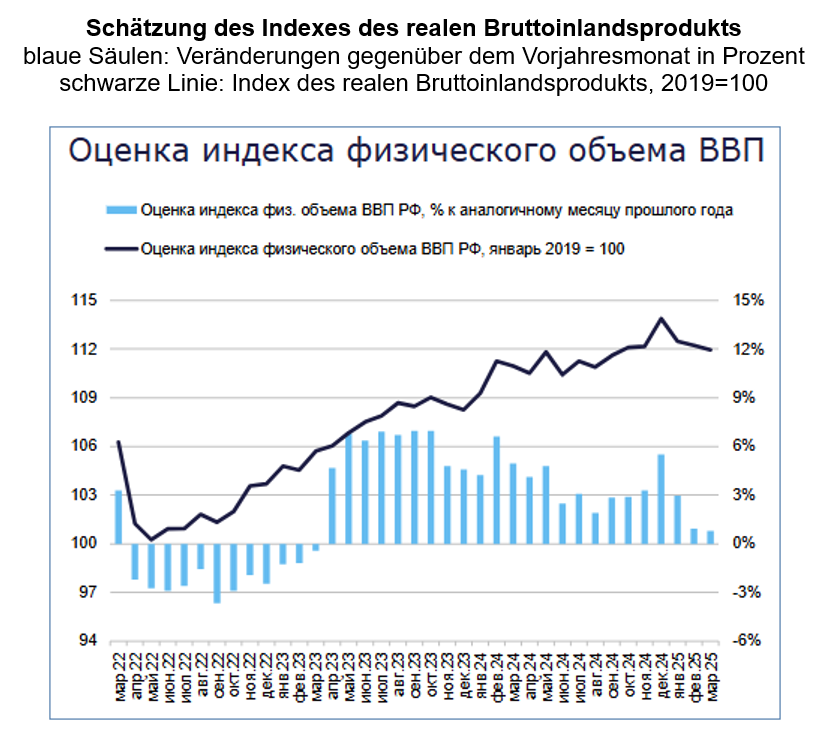
Institute of Economic Forecasting of the Russian Academy of Sciences; IEF-RAS:
Short-term forecast of Russia’s GDP dynamics, May 2025, May 7, 2025
According to a Finmarket report, the Russian government also estimated annual growth of the Russian economy in the first quarter of 2025 at 2.3 percent in a press release on May 7. This was the level of growth compared to the same quarter of the previous year on a “calendar-adjusted” basis, taking into account that the first quarter of the leap year 2024 had one more working day than the first quarter of 2025.
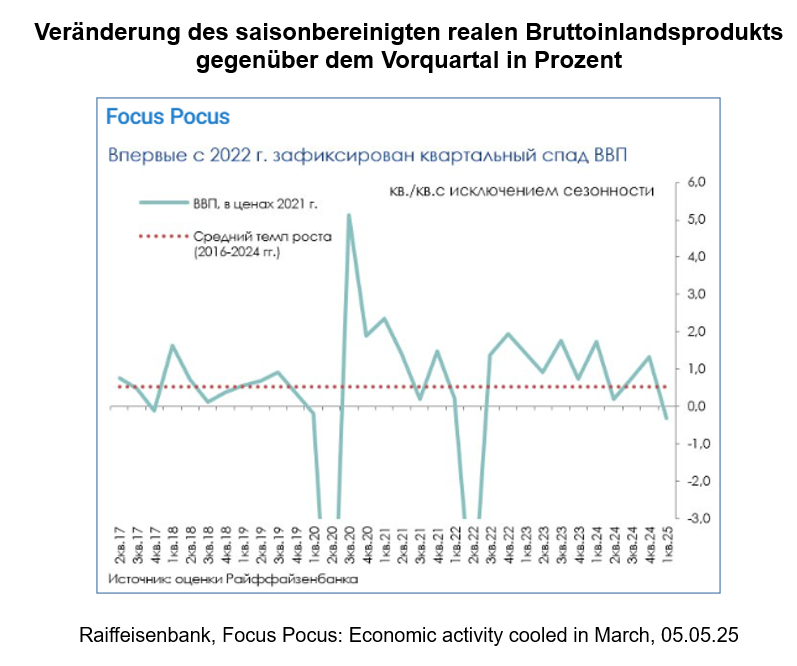
Raiffeisenbank: GDP fell by 0.3 percent compared to the previous quarter
The downturn in the Russian economy is evident when comparing aggregate economic output in the first quarter of 2025 with output in the fourth quarter of 2024. According to Raiffeisenbank’s calculations, seasonally adjusted gross domestic product fell by 0.3 percent in the first quarter compared to the previous quarter. In the fourth quarter of 2024, it had still grown strongly by 1.3 percent compared to the third quarter.
Bloomberg Economics: A “technical recession” is highly likely, but GDP will grow by about 1 percent year-over-year
According to Kommersant, Bloomberg Economics estimates that, taking seasonality into account, the Russian economy actually contracted by 0.6 to 0.8 percent in the first quarter compared to the previous quarter.
According to Bloomberg analyst Alexander Isakov, the initial economic data for April also suggests that the “slowdown” in production is continuing. He points out that the Purchasing Managers’ Index in the industrial sector remains below 50 points, indicating a decline in production. In addition, freight transport by Russian railways has fallen rapidly—by 9.7 percent compared to the previous year (“The Moscow Times”).
Isakov believes that Russia is highly likely to enter a “technical recession”—that is, two consecutive quarters of GDP decline compared to the previous quarter. At the same time, however, he expects the Russian economy to still grow by about 1 percent year-over-year in 2025 compared to 2024. This is reported by ProFinance.ru.
The Russian Ministry of Economic Development does not anticipate a “technical recession”
According to Finmarket.ru, a representative of the Ministry of Economic Development also commented on the possibility of a “technical recession” in Russia about a month ago, on April 21. Upon the release of the Russian Ministry of Economic Development’s draft for updating the Russian government’s forecast on Russia’s socio-economic development from 2025 to 2028, he noted that economic growth would indeed slow in the first quarter. However, the ministry does not expect a “sharp decline” in production.
The Ministry of Economic Development has so far maintained its forecast that the Russian economy will grow by 2.5 percent year-over-year in 2025, while the Bank of Russia expects GDP growth of only 1.0 to 2.0 percent. In response, the representative of the Ministry of Economic Development noted that there would have to be a “technical recession” during 2025 for Russia’s economy to grow by only 1.5 percent in 2025. However, the ministry does not anticipate this in its “base scenario.” In its “stress scenario,” however, it considers a “technical recession” in 2025 to be possible.
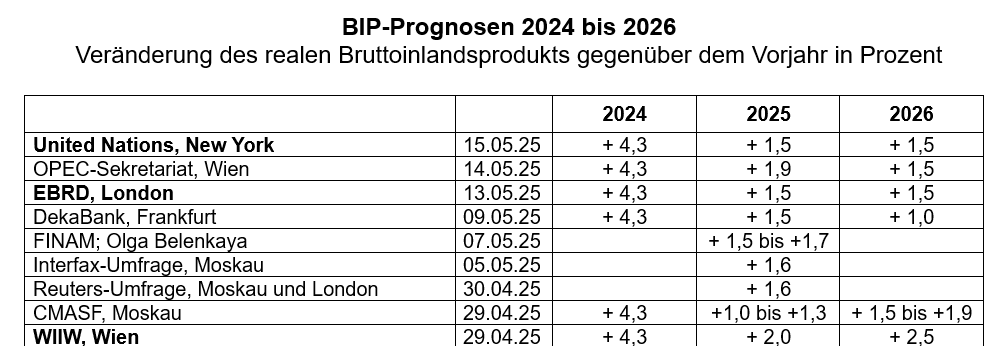
United Nations and EBRD expect 1.5 percent growth in Russia in 2025
According to forecasts published in mid-May by the United Nations Department of Economic and Social Affairs and the London-based European Bank for Reconstruction and Development (EBRD), Russia’s economic growth will slow to 1.5 percent in 2025. This is roughly in line with the results of analyst surveys by the news agencies Interfax and Reuters, both of which project growth of 1.6 percent.
Russian Central Bank: Growth of no more than 1 percent in the fourth quarter
According to Interfax, the Russian Central Bank had estimated the annual GDP growth rate in the first quarter at 2.0 percent—significantly higher than Rosstat’s current estimate (+1.4 percent).
In the summary of its Board of Directors’ discussion released recently by the Central Bank following the last key interest rate decision at the end of April, the Central Bank states the following regarding current economic developments in Russia, according to Interfax:
“We can say with greater certainty that the peak of economic overheating was passed in the fourth quarter of 2024 and that the positive output gap began to shrink in the first quarter of 2025. This is evidenced by a decline in current inflationary pressures, a gradual cooling of domestic demand, and signs of some easing in the labor market. … At the same time, the economy remains significantly overheated.”
According to Interfax, the Central Bank expects annual economic growth of 1.9 percent in the second quarter of 2025. By the fourth quarter, it is expected to slow further to 0 to 1 percent (see the Central Bank’s commentary on its medium-term forecast).
How key sectors performed in the first quarter of 2025
According to “The Moscow Times,” Raiffeisenbank points to the following signs of an economic “cooling” in the first quarter of 2025:
Annual industrial production growth fell to 1.1% overall.
Annual real growth in retail sales fell to 3.2%.
Real wholesale sales fell by 2.1% year-over-year.
As shown in the following table from the brokerage firm FINAM, the slowdown in industrial production growth to 1.1 percent was primarily due to a decline in production in the “Mining and Extraction of Raw Materials” sector (Mining: –3.7 percent). Production in the “manufacturing” sector still rose by 4.7 percent year-over-year in the first quarter. High growth rates were also recorded in the construction sector (+6.9%) and in real sales in the catering sector (+7.1%).
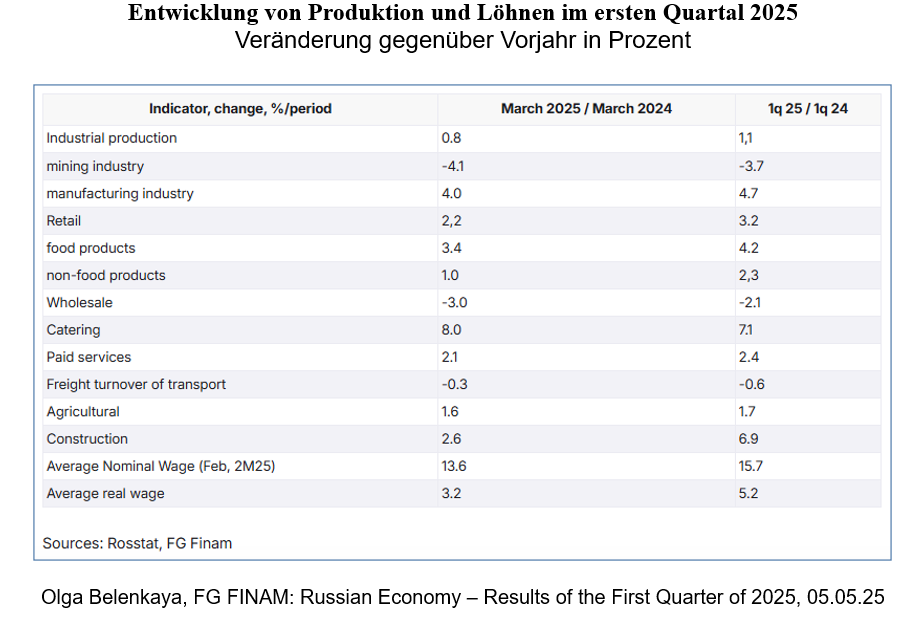
The basis for the growth in private consumer spending on retail, services, and catering was the strong increase in real wages in January and February (Jan.–Feb. 2025/Jan.–Feb. 2024: +5.2 percent).
BOFIT: Russia’s economic growth slowed significantly further in March
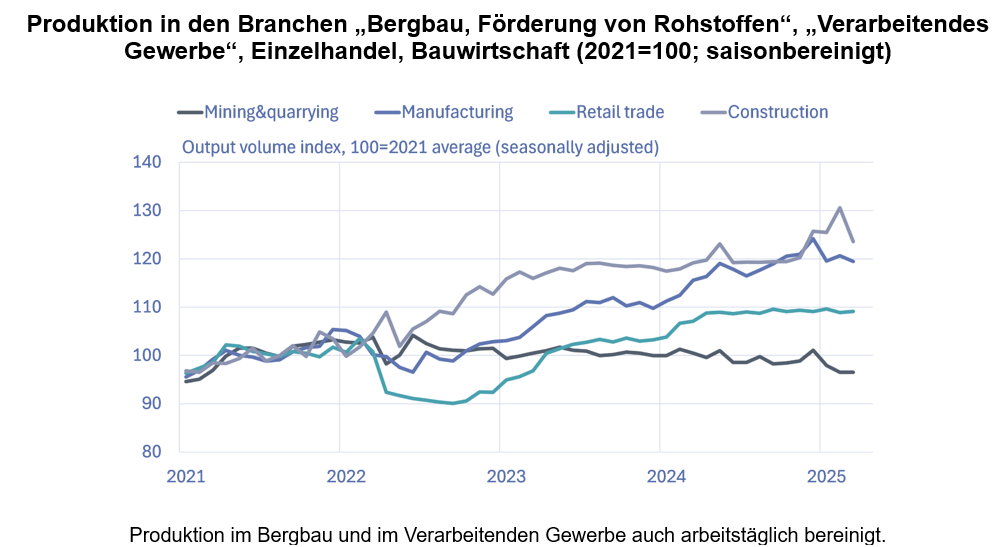
The BOFIT research institute of the Bank of Finland published the following chart in its weekly report dated May 9 on the seasonally adjusted performance of key sectors of the Russian economy in the first quarter of 2025.
Sources: Rosstat, CEIC, BOFIT
BOFIT Weekly: Russia’s economic growth continued to slow significantly in March, May 9, 2025
BOFIT highlighted the following trends:
In the “Mining and Quarrying” sector, production declined by about 4% in both March and the entire first quarter compared to the same period last year (see the lower black line in the figure below).
In the “Manufacturing” sector, production fell in the first quarter of 2025 compared to the peak reached at the end of last year. However, it was still about 4% higher in March compared to the previous year (see dark blue line).
Production in the construction sector also declined in March, following another surge in growth in February (top dark gray line). Compared to the previous year, growth in the construction sector still amounted to around 3%.
Real retail sales have remained virtually unchanged for several months. Year-over-year, growth remained at around 2% (middle dark green line).
Although average real wages continued to rise in the first months of the year, growth has slowed significantly. High inflation has weakened consumer purchasing power. In March, consumer prices rose by around 10% compared to the previous year.
Sources and recommended reading:
- t-online: Recession looms. Russia’s economy is growing significantly slower, May 17, 2025; Source: The Moscow Times: Rosstat reports threefold slowdown in Russian economy, May 16, 2025
- bfm.ru: Rosstat reported a sharp slowdown in GDP growth in the first quarter; Chief Economist of T-Investments, Sofya Donetsk, comments, May 17, 2025
- ntv.de; Hannes Vogel: Economy geared toward war. Putin cannot afford peace, May 17, 2025
- Meduza: Once red hot, Russia’s war-driven economy is slowing down. What does that mean for consumers, the Kremlin, and Ukraine? May 16, 2025
- Janis Kluge, SWP, in an ntv.de interview: Kluge: “Russia will likely slide into recession” – War economy at a turning point, video, 4 min., May 15, 2025
The day's most important Russian economic stories. Free, in your inbox three times a week.
Mon, Wed, Fri. Double opt-in, no tracking, unsubscribe anytime. By subscribing you consent to the processing of your email address as described in our Privacy Policy.