Highly qualified, highly complex: HQS reform is causing concern among companies

Since 2010, companies in Russia have been using the procedure for hiring foreign highly qualified specialists (HQS). The model has proven to be a useful tool for the Russian economy: skilled workers with the necessary expertise come to Russia and increase the value added in businesses. In return, they receive a legal status that comes with benefits. The amendments to the law on HQS legal status proposed by the Russian Ministry of Finance in mid-February essentially provide for a nearly threefold increase in the statutory minimum salary.
HQS threshold to be readjusted
Specifically, the ministry proposes raising the monthly gross minimum salary for HQS from the current 250,000 rubles (about 2,700 euros) to 717,000 rubles (about 7,800 euros). Exceptions are made for doctors, teachers, and researchers—their minimum salary is to be set at 358,000 rubles, equivalent to 4,000 euros.
The current minimum salary of 250,000 rubles has so far applied to all occupational groups with the exception of foreign highly qualified medical personnel (at least 83,000 rubles, equivalent to 910 euros) and foreign specialists in Russian special economic zones (58,000 rubles, 640 euros). The new regulation could take effect as early as this year.
When the HQS model was introduced in 2010, the minimum salary was 167,000 rubles, equivalent to 4,142 euros at the exchange rate of 40.33 rubles per euro at the time. “The authors of the employment concept viewed the minimum salary for highly qualified professionals in relation to the Russian average wage and wanted to ensure that the bar was set significantly higher, thereby making the HQS status meaningful,” says Ruslan Kokarev, who was actively involved in drafting the plan at the time as a member of the leadership of the Association of European Businesses (AEB) and is now the managing director of the German-Russian Chamber of Foreign Trade.
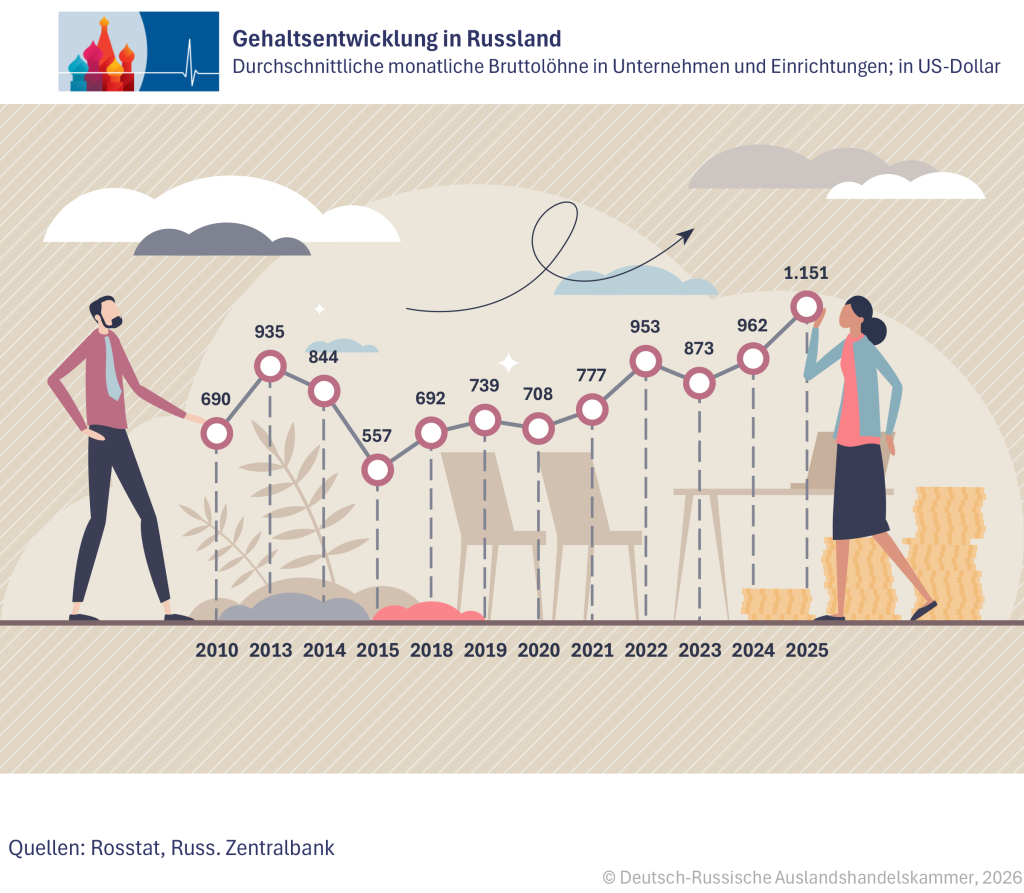
In light of inflation and the ongoing wage rally in Russia, the government raised the HQS minimum salary for the first time in 2024 from 167,000 rubles—equivalent to 1,815 euros— to 250,000 rubles, approximately 2,717 euros. Last year, the nominal average salary in Russia was 100,000 rubles (1,100 euros), which is five times higher than in 2010, when it stood at 21,000 rubles, at the exchange rate of 40.33 rubles per euro at the time. Last year, the monthly wage of a delivery courier in Moscow was 140,000 rubles (1,500 euros), while car couriers earned as much as 200,000 rubles (2,200 euros).
Supporters of the new regulation argue that this trend is blurring the lines between unskilled and highly skilled work and necessitates a market-driven adjustment of the minimum salary for foreign specialists.
Combating employer loopholes
By raising the HQS minimum wage, the Ministry of Finance also aims to close loopholes that employers exploit to hire unskilled foreigners. According to Major General Kirill Adzinov, head of the Work Permits and Visas Department at the Ministry of the Interior, the authorities take issue with the current “non-transparent” employment model for foreigners. He criticizes it as a free, uncontrollable movement of labor that goes hand in hand with tax evasion.
“We also hear from employers, especially large companies, that they are dissatisfied with employee turnover. Companies invest in recruiting and the hiring process, and then the workers leave and find work through online platforms,” explains Adzinov. Vladimir Grusdev, chairman of the Russian Bar Association, sees a consistent logic in the authorities’ approach: The state wants higher tax revenues—and is now demanding more from foreigners as well. Budget funds should only benefit those who have contributed to the budget, the lawyer explains.
Business associations take a stand
If the initiative is implemented, it would have significant consequences for numerous companies in Russia that rely on foreign top executives—including many member companies of the German-Russian Chamber of Foreign Trade. According to experts, the planned measure primarily affects skilled workers recruited from small and medium-sized enterprises. Foreign top managers working as CEOs or in corporate leadership are not affected. Their compensation generally exceeds the targeted minimum gross salary of 717,000 rubles.
Alexander Kalinin, president of the business association for small and medium-sized enterprises “Opora Rossii,” warns: “Raising the minimum salary to 700,000 will effectively spell the end of the HQS model.” Such salaries are conceivable at best for downtown Moscow, but are out of the question in the regions, such as the Ivanovo Oblast, the association head adds.
The initiative is causing unease in business circles. In a resolution drafted in mid-February as part of the forum “Personnel of the Future: Interaction Between Business and the State” in mid-February, Alexander Shokhin, president of the Russian Union of Industrialists and Entrepreneurs (RSPP), warns: “A minimum wage of 717,000 rubles is a clear barrier. Such wages are not widespread even among the Russian workforce.”
The demographic situation and a significant exodus of workers for various reasons have impacted the labor market and necessitate the search for additional workers, including abroad, according to the resolution drafted by the RSPP and addressed to the government.
The Russian economy is increasingly reaching its limits in terms of labor. According to estimates, the available labor force has decreased by approximately 1.5 million people since 2022, due to reduced immigration and fewer migrant workers from Central Asia, as well as mobilization, casualties, and injuries. The unemployment rate was already low before 2022 and currently stands at 2.2%.
Competition for labor between the military, the defense industry, and civilian sectors is hampering economic growth. Companies report rising wages and increasing difficulties in filling skilled positions. The result is higher costs and limited expansion of production.
Chamber Proposal: Link the Increase to Inflation
The German-Russian Chamber of Foreign Trade, together with other business associations operating in Russia, is advocating for an adjustment to the proposed HQS regulation. The Chamber considers a multiple increase in the minimum salary for highly qualified specialists as early as this year to be counterproductive—not only for the affected companies but also for the competitiveness of the Russian economy. Because companies’ financial plans for 2026 are already set and a revision would entail additional financial and administrative costs, the measure will directly drive up inflation and be reflected in the final prices of the products and services offered by the affected companies.
To avoid such a burden, the German-Russian Chamber of Foreign Trade proposes raising the HQS minimum salary not in relation to the Russian average salary, but to the cumulative inflation of recent years. Taking into account the inflation rate since 2010, the increase would then rise, for example, to 482,000 rubles, equivalent to 5,300 euros. Taking into account the inflation rate since 2024, the minimum threshold would be 285,000 rubles, or 3,600 euros. The German-Russian Chamber of Foreign Trade also proposes introducing the new regulation no earlier than January 1, 2027.
According to the Chamber’s assessment, this approach ensures a well-paced transition to the new minimum salary requirements, reduces the risk of a decline in the number of highly qualified specialists in the Russian economy, and secures stable tax revenues for the state. Ultimately, the increase strengthens the legal status of highly qualified specialists, who are better protected against being displaced by unqualified workers.
HQS Privileges
In Russia, HQS refers to foreign specialists with high qualifications in a specific field. The assessment of HQS competence is the responsibility of the employer and does not require separate verification by the authorities. However, since 2023, authorities in some Russian regions have been requiring proof of the immigrant’s qualifications.
The HQS procedure comes with several benefits for foreign specialists. For instance, the employer does not need approval from the authorities to hire a highly qualified immigrant. Such specialists are also not subject to the annual employment quota for foreigners.
An HQS work permit is valid for three years. The foreign specialist receives a residence permit for this period. After two years, they are then entitled to a permanent residence permit. In addition, the highly qualified foreigner may bring their immediate family members to Russia. In the event of termination, the highly qualified immigrant must find a new job within 30 days. The new employer then arranges for a new work permit. Employers also enjoy a number of benefits under the HQS procedure. For instance, they need only take out workers’ compensation insurance for their foreign specialists and are not required to contribute to the statutory health insurance fund.
With regard to income tax, foreign specialists are treated the same as Russian citizens. Until the 2025 tax reform, income tax rates were 13% and 15% (for annual salaries of 5 million rubles or more, approximately 55,400 euros). Following the tax reform, a progressive five-tier tax scale applies throughout Russia. Russian citizens and HQS workers with a gross annual salary of up to 2.4 million rubles (26,600 euros)—i.e., a monthly salary of up to 200,000 rubles (2,200 euros)—pay a 13% income tax. Since highly qualified professionals often belong to the higher-income bracket, their income tax is at least 15% depending on their salary level (200,000–417,000 rubles per month, 2,200–4,600 euros), 18% (417,000–1.67 million rubles, 4,600–18,300 euros), 20% (1.67–4.17 million, 18,300–45,800 euros), or 22% (over 4.17 million per month, 45,800 euros).
How the HQS system came about
After a decade of upheaval during the Yeltsin era, Russia, the world’s largest country, entered a phase of active growth in the early 2000s. Numerous foreign companies discovered the potential of the Russian market, which was still largely untapped in some areas. European companies, in particular, increased their direct investments in Russia, leading to the emergence of industrial enterprises with international investor participation across Russian regions. It quickly became clear that this market opening must also be accompanied by the necessary expertise.
The idea of creating a simplified procedure for recruiting foreign skilled workers was proposed by the Russian business community in 2008. The Foreign Investment Advisory Council (FIAC), which advises the Russian government on foreign investment, and the Association of European Businesses (AEB) were at the forefront of this initiative.
Ruslan Kokarev, then Chief Operating Officer at the AEB, was involved in the process and explains: “We didn’t want to reinvent the wheel and relied on the experience of our European colleagues. The European ‘Blue Card’ for highly qualified foreign professionals, which was actively being discussed within the EU at the time, served as the basis for the HQS law in Russia.”
Established in an EU directive in June 2009, the Blue Card did not come into effect in Germany until 2012. The Blue Card is the most important residence permit for skilled migration to Europe and is aimed at highly qualified third-country nationals with academic degrees, graduates of tertiary education programs, or IT specialists and executives without formal qualifications who are seeking a professional career in the EU. With the exception of Ireland and Denmark, the Blue Card is valid in all EU member states.
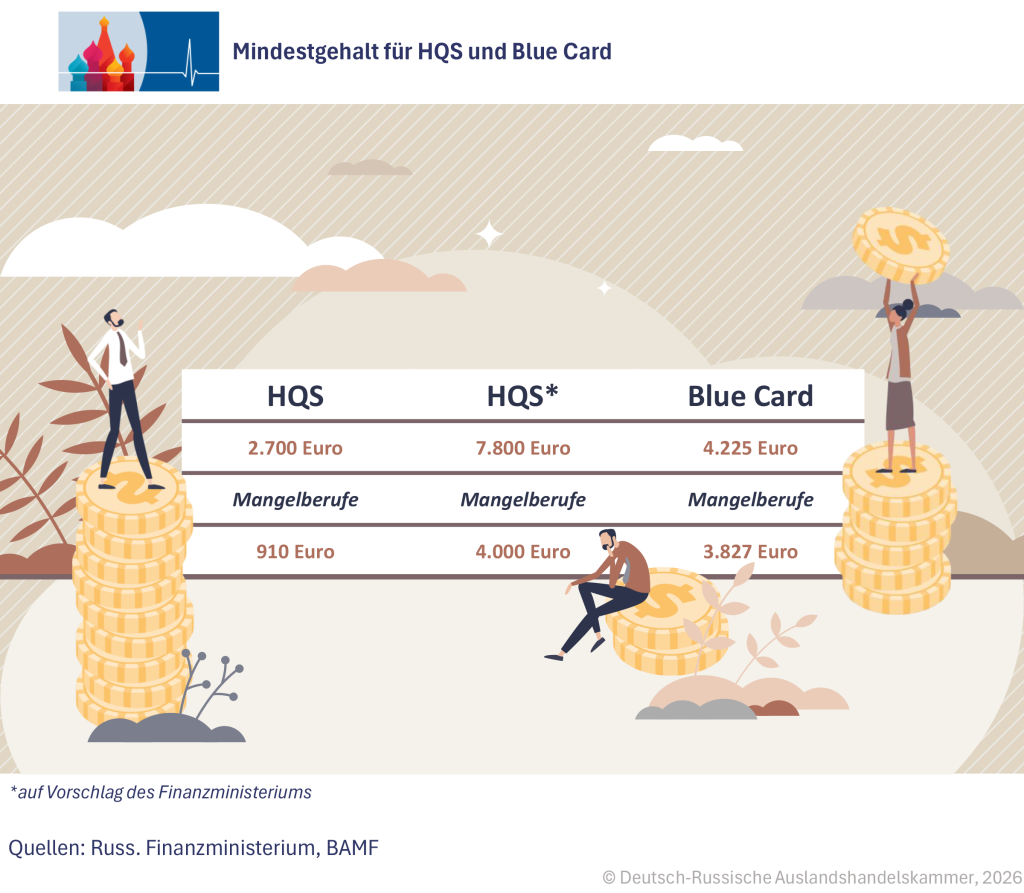
The EU Blue Card also simplifies the conditions for obtaining a permanent residence permit and family reunification. Its issuance requires a certain salary level. The minimum gross salary is currently 4,225 euros per month. An exception is made for so-called shortage occupations, which include IT specialists, engineers, doctors, scientists, mathematicians, and academic nurses. Their minimum gross salary is €3,827 per month.
HQS and Blue Card in Comparison
The HQS model is used in particular by Russian subsidiaries of foreign companies to hire specialists and executives. There is high demand for highly qualified specialists in the fields of IT, education, research, and healthcare. In particular, companies need experienced engineers and technicians who bring the necessary expertise for technology and production processes.
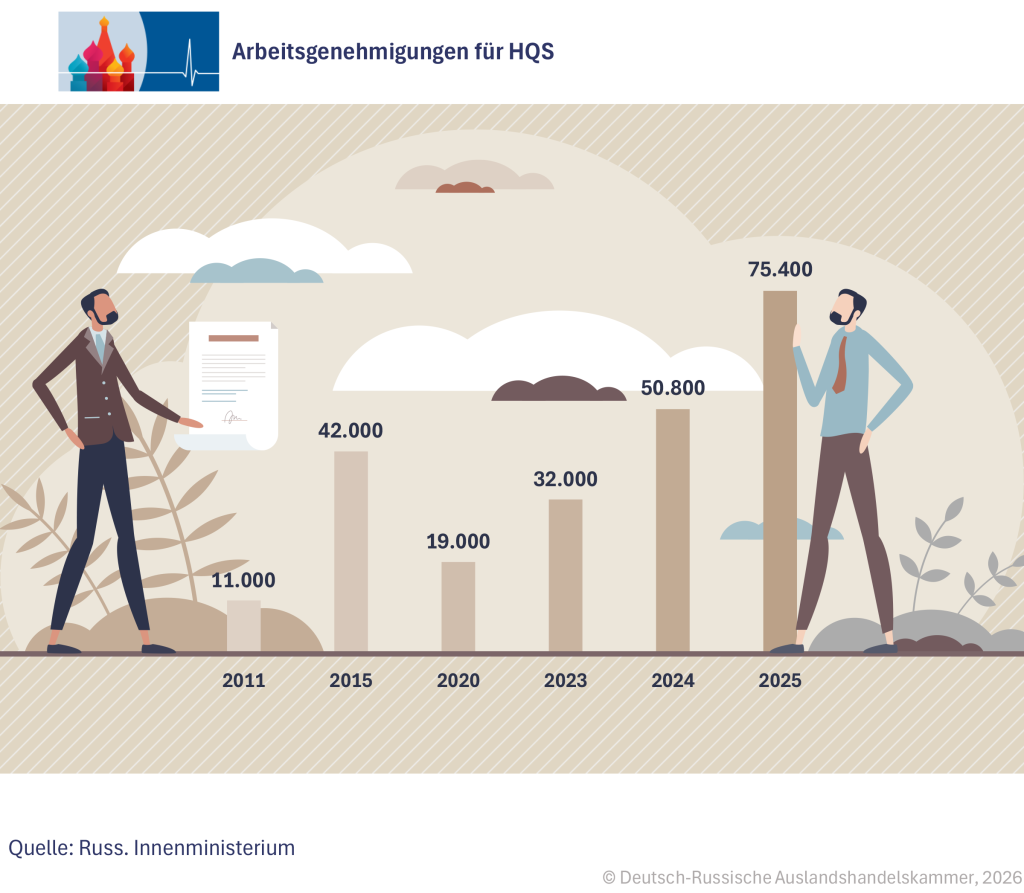
Since the introduction of the HQS regulation in 2010, the number of work permits for highly qualified foreign professionals has grown steadily. In 2011, it stood at 11,000; in 2015, it exceeded the 40,000 mark for the first time. In 2020, the year of the COVID-19 pandemic, the number of work permits temporarily fell below 20,000 and reached 44,000 the following year. In 2024, the figure stood at 50,800, compared to 32,000 the previous year. Last year, 75,400 work permits were issued to foreign specialists, the highest number to date.
In 2024, 42,600 Blue Cards were issued in Germany, 14,850 of which went to new arrivals. In 2023, the figure was 41,000 Blue Cards. The main countries of origin among immigrants to Germany in 2024 were India (20%), Turkey (13%), Russia (10%), Iran (7%), and China (5%). In 2023, the share of highly qualified immigrants from Russia was as high as 19%.
Rising Foreign Resident Rates
Work permits not issued through the HQS system are granted in Russia to nationals of countries requiring visas, such as European Union member states, China, or India. Last year, a total of 240,000 such work permits were issued. In 2024, the total was 138,000.
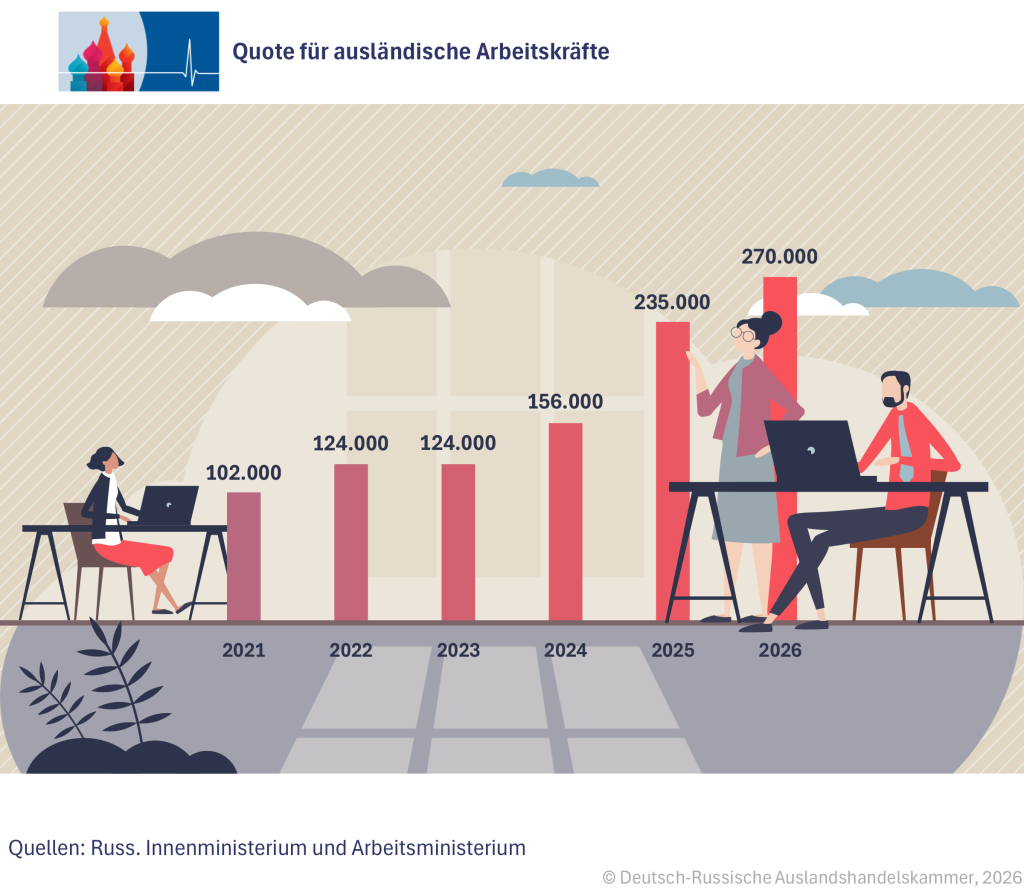
The maximum number of work permits is set annually by quotas; these do not apply to foreign HQS. The size of the quota depends on the number of employer applications submitted by companies that cannot find domestic employees and rely on foreign workers. For 2026, the foreign worker quota will be 270,000—a 12.5% increase compared to 2025.
Since 2022, the number of Chinese nationals entering Russia for work purposes has multiplied. In 2022, there were 11,800 Chinese citizens; by 2024, this number had risen to 98,300; and in the first three quarters of 2025 alone, it had already reached 106,700. India now ranks second; in 2022, 2,800 people entered Russia for work purposes, and from January to September 2025, the number had already reached 27,200. Turkey ranks third, with 14,700 entries most recently. Vietnam, Bangladesh, and Cuba are examples of other visa-required countries from which more people have been entering Russia for work purposes since 2022.
In addition to work permits, Russian migration authorities issue so-called work permits intended for migrants from visa-exempt countries (Uzbekistan, Tajikistan, Azerbaijan). Such a permit is issued for a period ranging from one month to one year. Excluded from this are foreigners with a residence permit or settlement permit, as well as citizens of the Eurasian Economic Union (Armenia, Kazakhstan, Kyrgyzstan, Belarus).
In 2024, Russian authorities issued 2.08 million work permits—a decline from the previous year, when 2.13 million permits were issued. When the number of work permits is combined with work authorizations for workers from visa-required countries and HQS, the share of highly qualified professionals in 2024 stood at around 2.2%.
This article first appeared in the exclusive newsletter of the German-Russian Chamber of Foreign Trade
The day's most important Russian economic stories. Free, in your inbox three times a week.
Mon, Wed, Fri. Double opt-in, no tracking, unsubscribe anytime. By subscribing you consent to the processing of your email address as described in our Privacy Policy.