German institutions expect growth in Russia to remain weak
Author: Klaus Dormann
The year isn’t over yet, and economic news is still in full swing—especially in Russia, where the roughly two-week “Christmas break” doesn’t begin until the turn of the year. Before then, on December 19, the Russian Central Bank will decide on another key interest rate cut. In preparation, it once again surveyed 33 banks, research institutes, and financial media outlets regarding their assessment of the Russian economy’s development. German institutes were not among the few foreign participants.
However, new forecasts from Germany regarding the Russian economy can be found in the “Winter Forecasts” of the five leading German economic research institutes, which were published on Thursday and Friday. At the very least, the institutes’ tables on the global economy also indicate how production, prices, and the unemployment rate in Russia are likely to develop through 2027. Unfortunately, only the Kiel Institute for the World Economy found room for a few sentences on the development of the Russian economy.
In 2025, the German institutes expect only about 1 percent growth in Russia
Six months ago, in their “summer forecasts” published in early June, the expectations of the five German economic research institutes for Russia’s economic growth this year still differed considerably in some cases. While the Berlin-based DIW forecast a 1.5 percent rise in Russia’s GDP, the Munich-based ifo Institute predicted that the Russian economy would grow by only 0.4 percent in 2025.
In their “fall forecasts” published in the first week of September, however, the institutes were already in broad agreement. All five institutes expected economic growth of around 1 percent in Russia this year. They also forecast this in their “Joint Diagnosis” for 2025, published at the end of September.
Little has changed in the institutes’ “Winter Forecasts” published on Thursday and Friday. The forecasts of the Munich-based ifo Institute (+1.1%) and the Kiel Institute for the World Economy (+1.0%) for this year’s growth in Russia remained completely unchanged. The IWH Halle and the RWI Essen both lowered their forecasts slightly, from +1.0% to +0.9%. The Berlin-based DIW now expects growth of only +0.8% this year, down from the previous forecast of +1.2%.
These forecasts from the German institutes largely align with the growth forecast of +1.0 percent in the Russian government’s budget plan for 2025.
The institutes expect similarly weak growth in 2026 and 2027
Next year, the Russian government expects a slight acceleration in economic growth to +1.3%. The German institutes, on the other hand, all anticipate even less growth in 2026 than in 2025. Their forecasts for 2026 now range from +0.5% to +0.9%. The Kiel-based IfW expects the growth rate to halve to just +0.5% next year. The forecasts of the four other institutes for 2026 were revised downward much less significantly.
GDP Forecasts 2024 to 2027
Change in real gross domestic product compared to the previous year in percent
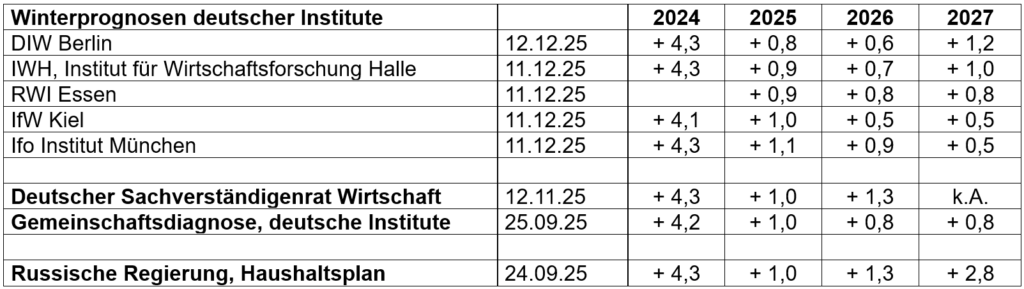
In 2027, German institutes in Russia expect, on average, growth to be similarly weak as in 2025 and 2026. Their forecasts range from +0.5% (ifo and IfW) to +1.2% (DIW). The institutes are by no means in agreement on whether growth in the Russian economy will pick up in 2027. The ifo Institute believes that growth is likely to slow from +0.9% in 2026 to +0.5% in 2027. The DIW, on the other hand, expects the growth rate to double from +0.6% to +1.2%.
Even so, the Berlin-based institute remains well below the Russian government’s forecast. In its budget planning for 2027, the government anticipates a sharp acceleration in growth from +1.3% to +2.8% (Kommersant).
IfW Kiel: In 2026 and 2027, the Russian economy will grow by only +0.5%
The Kiel Institute for the World Economy takes a particularly skeptical view of the Russian economy’s growth prospects. In its report “World Economy in Winter 2025,” it notes that Russia’s export revenues have plummeted due to lower oil prices and war-related production constraints.
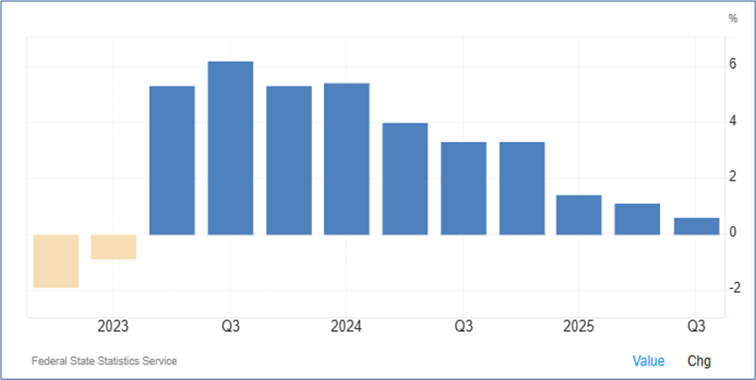
According to the IfW, annual growth in aggregate economic output continued to weaken slightly in the third quarter of 2025 compared to growth in the first two quarters. Compared to the high growth rates in 2023 and 2024, a significant decline in growth is evident.
According to Interfax on December 12, the Russian statistics agency Rosstat confirmed its initial estimate from November that total economic output in the third quarter of 2025 was only 0.6% higher than in the same quarter of the previous year. In the first quarter, the annual growth rate had still reached +1.4%, and in the second quarter, +1.1%.
Quarterly trend of Russia’s real gross domestic product
Year-over-year change in percent
Trading Economics: Russia GDP Annual Growth Rate, Dec. 12, 2025
The IfW Kiel notes: “In Russia, the economy is now apparently operating at full capacity.” Given the strained macroeconomic capacity and significantly lower oil revenues, the institute expects only modest production growth in Russia. For 2025, the IfW, like the Russian government, still expects economic growth of +1.0%. In the next two years, however, the Russian economy is projected to grow by only +0.5% each year.
Sber Analysis: Weak Growth and a Strong Ruble Drive the Budget Deficit
In a study, analysts at “SberCIB Investment Research” expect Russian economic growth to reach only +0.7% as early as 2025. Although real gross domestic product was still 1.0 percent higher in the first nine months than in the previous year, they assume that GDP growth will slow further in the fourth quarter due to restrictive monetary policy and declining government spending.
According to Sber analysts, weaker economic growth and the strong ruble exchange rate will cause the government budget deficit to rise in 2025. Regarding the development of the government budget, they note: Revenues from the oil and gas sector are declining in ruble terms because the ruble has strengthened more than planned in the spring (the ruble exchange rate rose to an average of 86.1 rubles per dollar compared to the expected 94.3 rubles per dollar). This led to an increase in the budget deficit in the updated 2025 budget compared to the spring forecast, which projected a deficit of 1.7% of GDP. The Ministry of Finance refrained from using the National Welfare Fund to finance the deficit and significantly increased net borrowing. According to preliminary government estimates, the budget deficit will reach 2.6% of GDP in 2025.
Sber CEO expects approx. 1% growth in 2026 with loosened monetary policy
Sber CEO Herman Gref said at the bank’s Investor Day, looking back on 2025, according to Interfax:
“Together, we have overcome a number of challenges: restrictive monetary policy and strict regulations have slowed economic growth. External factors, including export prices, also contributed to instability.
The challenge ahead is to break the cycle of economic contraction and provide timely impetus for investment projects that will shape the country’s development in the coming years.”
Gref expects inflationary pressure to ease and approach the Central Bank’s target of 4 percent. “Under these conditions, we expect monetary policy to be eased; by the end of 2026, the key interest rate could reach 12%,” he said.
Sberbank expects a moderate pickup in economic growth to around +1% in 2026. This remains slightly below the government’s forecast of +1.3%.
For comparison with the central bank’s forecasts: According to the “medium-term forecast” published by the Russian Central Bank on the occasion of its latest key interest rate decision on October 24, the Russian economy will grow by +0.5 to +1.5% in 2026. The Central Bank expects annual inflation to slow to 4–5% in December 2026 and the key interest rate to average 13–15% in 2026.
Results of the Central Bank Survey on Inflation, Key Interest Rates, and Growth
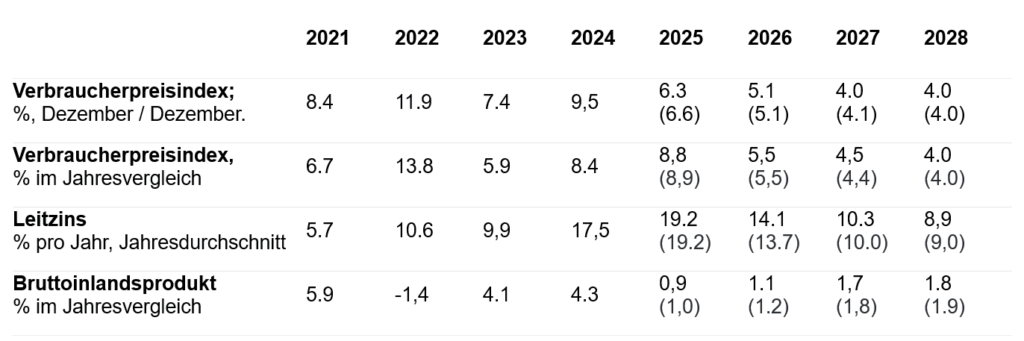
The Russian Central Bank conducted another analyst survey ahead of its next key interest rate decision on December 19. The following table shows a selection of the results from this Central Bank survey. For 2025, participants expect the following trends in consumer price inflation, the key interest rate, and real GDP growth:
The annual increase in the consumer price index will slow to 6.3 percent in December 2025. At the end of 2024, the annual inflation rate had reached 9.5 percent.
However, the annual average inflation rate for 2025 will be 8.8 percent, slightly higher than in 2024 (+8.4 percent).
The key interest rate will also be higher this year, averaging 19.2 percent, compared to 17.5 percent last year.
Economic growth will slow from 4.3 percent to 0.9 percent in 2025.
Central Bank Survey Results: December 2025
(results from the October survey in parentheses)
Bank of Russia: Macroeconomic survey of the Bank of Russia, Dec. 10, 2025 (excerpt)
Survey: Inflation will still exceed the 4 percent target at the end of 2026
The following figure shows the development of the inflation rate according to the analyst survey. The central bank’s target inflation rate of 4.0 percent will not yet be reached by the end of 2026 based on the average of the survey participants’ estimates (black line). According to the survey, consumer prices will still rise by 5.1 percent in December 2026 (thus slightly exceeding the central bank’s forecast range of 4.0 to 5.0 percent). According to the survey, the inflation target will not be reached until the end of 2027, with a price increase of 4.0 percent.
Consumer
Price Index: Year-over-year increase in December compared to December of the previous year (in %)
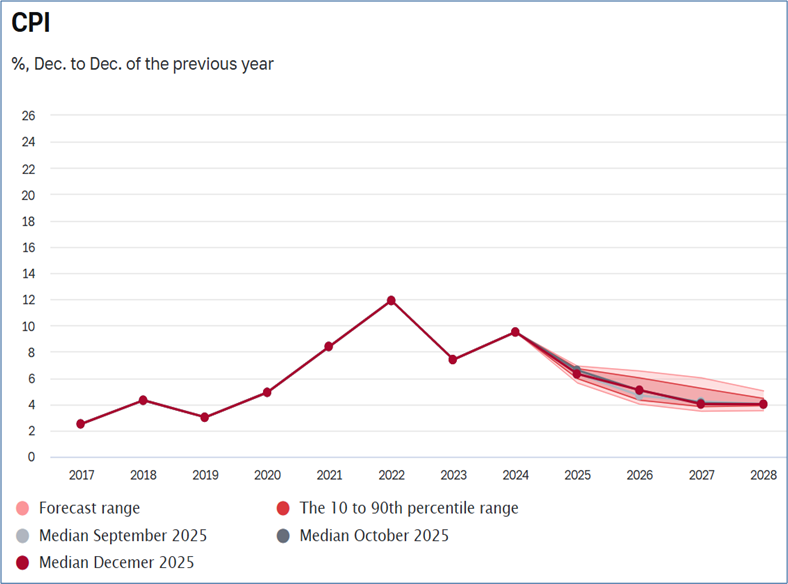
Bank of Russia: Macroeconomic Survey of the Bank of Russia, December 10, 2025
Analysts expect significantly less growth in 2027 and 2028 than the government
Participants in the Central Bank survey lowered their new forecasts for Russia’s economic growth by 0.1 percentage points for each year of the forecast period through 2028 compared to the survey conducted in October.
For 2025 and 2026, analysts expect, on average, only slightly less growth than the government. For 2025, they now expect growth of just +0.9% (government forecast: +1.0%). For 2026, analysts expect slightly stronger growth of +1.1% (government forecast: +1.3%).
However, analysts’ growth forecasts for 2027 (+1.7%) and 2028 (+1.8%) remain well below the government’s growth expectations (2027: +2.8%, 2028: +2.5%; RBC.ru).
Real Gross Domestic Product
Year-over-year changes in percent
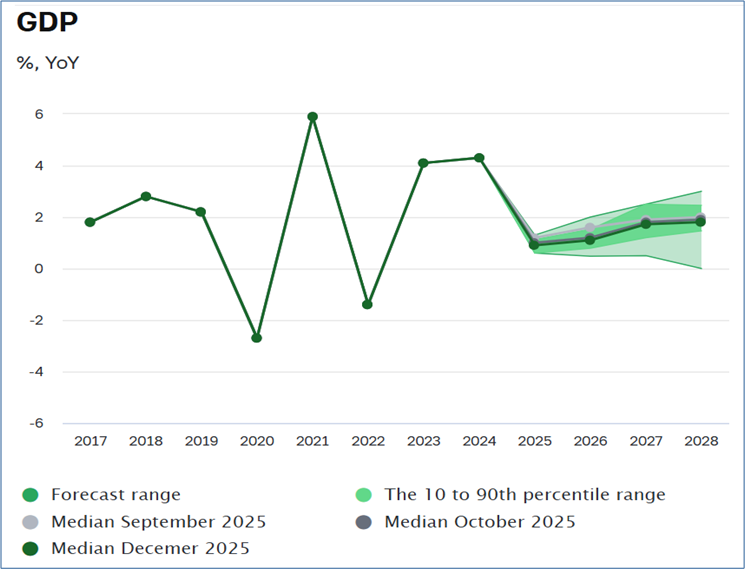
Bank of Russia: Macroeconomic Survey of the Bank of Russia, Dec. 10, 2025
Growth forecasts from a rather skeptical expert at Moscow’s HSE.
Elena Butyrina interviewed several experts for FederalPress.ru last week regarding their economic outlook. Grigory Zhirnov expressed a somewhat more skeptical view of the Russian economy’s growth prospects than the “consensus” among participants in the Central Bank survey. Zhirnov is a researcher at the “Laboratory for Macrostructural Modeling” at Moscow’s “Higher School of Economics.” He forecasts similarly weak growth for the Russian economy in 2025 and 2026 as the German economic research institutes. In summary, he states:
According to my estimates, the economy will grow “moderately” by 0.6–0.8% in 2025.
Next year, too, annual growth will remain below 1% due to persistently high interest rates, a labor shortage, and subdued corporate investment activity. However, a recession—a decline in real gross domestic product compared to 2025—is likely to be avoided thanks to government contracts and production growth in the defense industry, even though the probability of a recession next year is increasing.
Overall, we are already seeing this weak production trend:
In the manufacturing sector, production is declining in most industries—with the exception of the raw materials and defense industries. For example, significant declines in production are being recorded in the apparel industry, the automotive industry, furniture manufacturing, and wood processing. The situation in the construction and transportation sectors is also negative.
In retail and the service sector, however, the current situation is still relatively good. Although growth rates are falling here, they remain positive thanks to stable wage trends driven by labor shortages.
Zhirnov: The key interest rate will only be cut “symbolically” by March
According to Zhirnov, how long economic growth will remain “close to zero” depends on the development of monetary policy conditions and government spending. In terms of monetary policy, he expects the following trend in 2026:
Given the VAT increase and the expected rise in inflation expectations, the Russian Central Bank will most likely act cautiously until March 2026. Any potential key interest rate cut during this period will be “purely symbolic”—as was the case at the last meeting, when the Central Bank lowered the key rate by only 0.5 percentage points.
However, given the significant economic slowdown, the acceleration in inflation caused by the VAT increase is likely to be only temporary. Therefore, the Central Bank will be able to continue its monetary easing in the second quarter of 2026. By the end of 2026, the key interest rate will be lowered to the range of 10 to 12%.
Zhirnov emphasizes that monetary policy decisions will have a delayed effect. Growth in production due to the key interest rate cut is therefore not expected until toward the end of next year.
Forecasts by Alexey Vedev on inflation, exchange rates, and the key interest rate
Alexey Vedev, head of the Gaidar Institute’s Financial Research Laboratory and former Deputy Minister of Economic Development, predicted to the newspaper “Izvestia” that the inflation rate in Russia will fall to about 5% by the end of 2026. He says:
“By the end of 2025, inflation will be around 7%, possibly slightly lower. I expect inflation to be around 5% by the end of 2026. The decline in inflation is primarily due to the fact that food inflation dominated this year. Growth in consumer demand is now slowing down. This will continue next year. This is due to more moderate wage increases. … There is reason to believe that inflation will continue to fall—partly thanks to price controls on essential goods. Therefore, I consider the trend toward falling inflation to be quite sustainable.”
Alexey Vedev also commented on the causes of the ruble’s appreciation in 2025 and its projected trajectory in 2026:
“I have forecast a stable ruble exchange rate or even a slight appreciation for 2025. This is due to several factors.
First, a positive current account balance, which favors the stabilization or appreciation of the ruble.
Second, interest rate arbitrage: Extremely high bond yields attract capital, including from ‘unfriendly countries,’ and increase demand for the ruble.
Third, the population is showing lower demand for foreign currencies due to the risks associated with frozen accounts and potential foreign exchange restrictions for Russian citizens.
Fourth, the Ministry of Finance is buying less foreign currency this year, which reduces pressure on the ruble.
All these factors have led to a stabilization of the exchange rate in the range of 75 to 82 rubles per dollar, and I expect the rate to remain within this range next year as well.”
In the interview, Alexey Vedev expects the Russian Central Bank’s key interest rate to remain unchanged or be cut by 0.5 percentage points on December 19. Regarding a 0.5 percentage point cut, he says:
“This is a symbolic change that will have no significant impact on the situation. In my opinion, the key rate cut next year will also be minor. This will slow down the growth of the Russian economy.”
Will key interest rates be cut further on December 19?
According to a survey by the newspaper “Vedomosti,” the vast majority of experts expect the key interest rate to be cut by 50 basis points to 16% on December 19. Seventeen out of 23 respondents gave this forecast.
Three other analysts expect a cut of one percentage point to 15.5%.
Three experts anticipate either a maintenance of the current level of 16.5% or a cut to 16%.
Recommended reading:
- bne IntelliNews: Russia’s inflation eases to 6.6% in November but central bank maintains tight policy stance, 12/13/25
- Olga Belenkaya, FG Finam: A 50-basis-point cut in the central bank’s key interest rate could be a reasonable compromise, preliminary report on the interest rate decision with economic analysis; Dec. 12, 2025
- news.tek.fm: Russia’s military spending reached a record high of 11.8 trillion rubles in the first nine months of 2025, study by Janis Kluge, German Institute for International and Security Affairs (SWP), Dec. 12, 2025
- Expert.ru: Herman Gref predicted a cut in the key interest rate to 12% next year; Kommersant.ru: Gref predicted a cut in the key interest rate to 12% by the end of 2026, Dec. 10, 2025
- news.tek.fm: Sberbank forecasts a key interest rate of 12% by the end of 2026, Dec. 10, 2025.
- Interfax.ru: Rosstat confirmed its estimate for Russian GDP growth in the third quarter at 0.6%, 12/12/25
- Trading Economics: Russia GDP Annual Growth Rate, Dec. 12, 2025
- Merkur.de, Bona Hyun: Putin’s economy weakened – NATO member Turkey withdraws as a trading partner, Dec. 12, 2025
- n-tv.de: “It’s like Yalta.” Trump’s Ukraine plan is said to provide for Russian energy for Europe, Wall Street Journal report; Dec. 11, 2025
- FederalPress.ru, Elena Butyrina: Not Stagnation, but a Fresh Start: What Will Happen to Russia’s Economy in 2026? 12/11/25
- Censor.net: The state of the Russian economy: The Russian army is advancing slowly, and the economy is showing signs of strain, – The Economist, Dec. 11, 2025
- Paluba.media—shipbuilding portal—on the Central Bank’s report on Russian corporate profit trends: Slow motion. The worst performance was seen in the coal industry, construction, the oil and gas sector, and transportation, 12/11/25
- FR.de; Stefan Scholl: Russia’s economy is emitting alarming noises from the engine room, 12/11/25
- bne Intellinews, Ben Aris: Putin updates the National Projects program to “clean up the economy” and boost productivity, 12/11/25
- “Winter Forecasts” from German economic research institutes, December 2025
- German Institute for Economic Research Berlin: Press Release: German Economy in the Starting Blocks – Fiscal Policy Fuels an Upturn on Credit, Dec. 12, 2025; Forecast in: DIW Weekly Report 50/2025, German Economy in the Starting Blocks – Global Economy Holds Its Ground, Dec. 12, 2025
- Ifo Institute Munich: Economic Forecasts; Press Release: ifo Economic Forecast Winter 2025: ifo Economic Forecast Winter 2025: Structural Change Has Germany Firmly in Its Grip; in: ifo Schnelldienst, 2025, 6, No. 24: ifo Economic Forecast Winter 2025, Dec. 11, 2025
- IWH Leibniz Institute for Economic Research Halle: Press Release: Current Economic Outlook: Slight Recovery on the Horizon, Structural Problems Persist, Forecast in: Current Economic Outlook, Vol. 13 (4), Dec. 11, 2025
- RWI Leibniz Institute for Economic Research Essen: Press Release: Economy: RWI lowers growth forecast – fiscal policy stimulus still lacking; Forecast in: RWI Economic Report: Fall 2025: Fiscal Stimulus Is Slow in Coming, Dec. 11, 2025
- Kiel Institute for the World Economy: Kiel Economic Reports including: World Economy in Winter 2025: Headwinds Persist, Expansion Remains Moderate, Dec. 11, 2025; Dossier: Economy; with key data table on the world
- Deutsche Bundesbank: Monthly Report – November 2025; with side note: Russia’s Economy Sends Crisis Signals, pp. 28–31; Nov. 20, 2025
- Politkom.ru; Economic Report by Marina Voitenko: Macro Trends: October Results and Expectations for November, Dec. 11, 2025
- Bank of Russia: Macroeconomic Survey of the Bank of Russia, Dec. 10, 2025
- Moscow Times, AFP: Russia Reports Steep Inflation Drop as High Interest Rates Weigh on Economy, Dec. 10, 2025
- Finmarket.ru: Inflation in Russia stood at 0.42%in November. The annual inflation rate fell from 7.71% in October to 6.64% in November, Dec. 10, 2025
- Interfax.com: Analysts lower Russian 2025 inflation and GDP growth forecasts; key rate expectations unchanged – Central Bank survey, Dec. 10, 2025; Finmarket.ru: Analysts have lowered their inflation forecast for 2025 to 6.3%. 12/10/25
- bne IntelliNews, Ben Aris: Russia’s central bank warns of economic stagnation due to wartime pressures. The CBR warned in its latest issue of Talking Trends, 12/10/25
- Finmarket.ru: At the start of the fourth quarter, economic activity in Russia recovered, though unevenly across different sectors. Central Bank report “What the Trends Say,” Dec. 10, 2025
- Banking Association, abr.ru: “What the Trends Say” by the Russian Central Bank: Price growth slowed in November, inflation expectations rose, Dec. 9, 2025
- Prime.ru: Ministry of Finance: Russia’s budget deficit amounted to two percent of GDP in the period from January to November, Dec. 9, 2025
- VEB Institute: GDP Index – October 2025, Dec. 9, 2025
- Sergey Blinov: Macro Review No. 49 (2025), 12/09/25
- Interfax.com: Germany boosts exports to Russia by 4.8%, cuts imports by 10.6% in October, 12/09/25
- BOFIT Policy Brief; Heli Simola: Examining the effects of potential shocks on the Russian economy, 12/08/25
- RBC.ru: Siluanov explained when the Russian economy will start moving again “like a bicycle,” Dec. 8, 2025.
- Expert.ru: Vladimir Putin ordered the immediate start of a restructuring of the Russian economy, meeting of the Council for Strategic Development and National Projects; 12/08/25
The day's most important Russian economic stories. Free, in your inbox three times a week.
Mon, Wed, Fri. Double opt-in, no tracking, unsubscribe anytime. By subscribing you consent to the processing of your email address as described in our Privacy Policy.