Forecasts for Russia's growth continue to decline

Author: Klaus Dormann
On Friday, the Russian Federal State Statistics Service (Rosstat) announced in a “preliminary estimate” that total economic output in the third quarter of 2025 was only 0.6 percent higher than a year earlier. The Rosstat estimate thus confirmed figures from the Ministry of Economic Development. Russia’s annual growth rate slowed significantly further in the third quarter. In the first quarter of 2025, it had reached +1.4 percent, and in the second quarter, +1.1 percent.
In the current fourth quarter of 2025, many analysts estimate that output in the Russian economy could even be lower than a year ago. In the fourth quarter of 2024, real gross domestic product had risen unusually sharply (+4.5% compared to the fourth quarter of 2023).
However, it is not expected that Russia’s GDP for the full year 2025 will be lower than in 2024, meaning there will be a “recession” this year. Since the beginning of 2025, however, forecasts for the annual growth of the Russian economy have been significantly lowered.
The European Commission now expects growth of only 0.8 percent in 2025
In May, for example, the European Commission still assumed in its “Spring Forecast” that the growth rate of the Russian economy would decline from +4.3 percent in 2024 to +1.7 percent in 2025. In its “Autumn Forecast” published on November 17, it revised its expectation for Russia’s economic growth this year down even further to just +0.8 percent.
The German “German Council of Economic Experts” revised its forecast for Russia even more sharply. In May, the “economic experts” had still predicted that the Russian economy would grow by +2.7 percent in 2025. Now, in its annual report, the Council of Economic Experts expects real gross domestic product to rise by only +1.0%. This forecast aligns with the forecast for Russian economic growth issued by German economic research institutes in their “Joint Diagnosis” from September.
Since late September, the Russian government has also been factoring in just 1 percent economic growth for 2025 in its budget planning. Analysts surveyed by Interfax in early November expect even slightly weaker growth this year, averaging +0.9 percent.
GDP Forecasts 2024 to 2026
Change in real gross domestic product compared to the previous year in percent
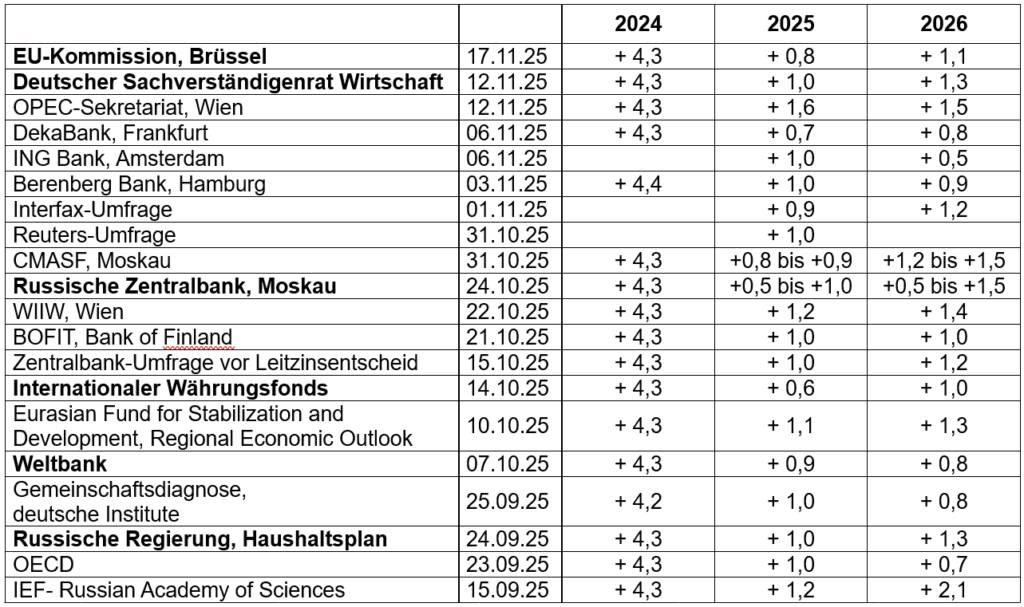
No “recession” is expected in the 2025/2024 year-over-year comparison
According to the forecasts in the table above, year-over-year growth of at least +0.6 percent is currently expected for the Russian economy in 2025 compared to 2024 (IMF forecast from mid-October).
Nor has there been a so-called “technical recession” so far in 2025, at least according to estimates by the Russian Federal State Statistics Service (Rosstat). For a “technical recession” to occur, the price- and seasonally-adjusted gross domestic product would have had to decline in at least two consecutive quarters compared to the previous quarter (definition by the German Federal Statistical Office, Destatis). In the first quarter of 2025, real gross domestic product was 0.6 percent lower than in the fourth quarter of 2024, according to Rosstat. However, according to Rosstat, it rose again by 0.4 percent in the second quarter compared to the first quarter (see blue bars in the following figure from the Kyiv School of Economics).
Quarterly trend in real gross domestic product
blue bars: changes compared to the previous quarter in %, seasonally adjusted
black line: changes compared to the same quarter of the previous year in %
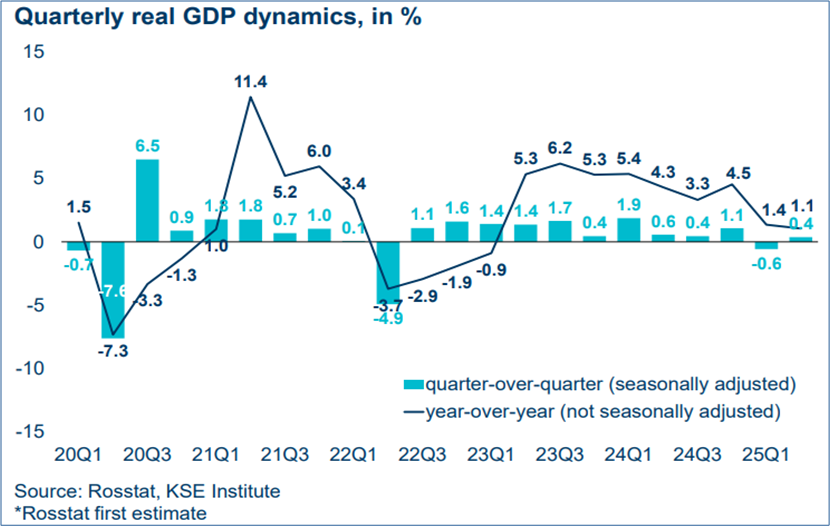
Kyiv School of Economics: Russia Chartbook September 2025, 10/09/25
As the black line in the figure shows, the annual GDP growth rate fell from +1.4% in the first quarter of 2025 to +1.1% in the second quarter, according to Rosstat. In the third quarter of 2025, the annual GDP growth rate, according to Rosstat, was only +0.6%.
In September 2025, GDP was 0.9% higher than in September 2024, according to the Ministry of Economic Development. In the first nine months of the current year, it rose by 1.0% year-over-year (Prime.ru).
EU: From 2025 to 2027, Russia’s GDP will grow by only about 1 percent per year
In its “Autumn Forecast,” the European Commission also notes in an analysis of economic developments in Russia that a “technical recession” was avoided in Russia thanks to economic growth of 0.4 percent in the second quarter of 2025 compared to the first quarter.
For growth and inflation trends from 2025 to 2027, the Commission highlights the following:
After two years of overheated economic activity, with annual output growth exceeding 4% since early 2025, Russia’s economic growth has slowed significantly. It is expected to decline to +0.8% in 2025. After that, it is projected to pick up slightly again. GDP growth is expected to reach +1.1% in 2026 and +1.2% in 2027.
The inflation rate, which peaked at 10.3% in March 2025, is gradually declining due to high interest rates. The annual average increase in consumer prices in 2025 is expected to be 8.9%. It is projected to fall to 5.4% in 2026 and to 4.6% in 2027.
The Commission cites capacity constraints and the central bank’s “restrictive monetary policy” as the causes of the “dramatic slowdown” in economic growth from +4.3% in 2024 to an expected +0.8% in 2025. The sanctions imposed by the EU and its allies have exacerbated “macroeconomic imbalances” such as high inflation, rising private debt, and the deterioration of the fiscal situation. The Commission emphasizes that the economic downturn is primarily attributable to the negative effects of Russia’s war of aggression against Ukraine.
In 2025, private consumption remains a key driver of growth
Regarding the trend in consumption and investment so far in 2025, the Commission notes:
Despite record-high interest rates, private consumption remained a key driver of growth, primarily thanks to robust growth in real wages, which was supported by a persistently tight labor market.
Government consumption continued its comparatively slow growth pace
from the second half of 2024, as military spending stabilized.
Investment began to decline in the second quarter of 2025. The dampening effect of high interest rates on the performance of “civilian” sectors without demand from the military sector could no longer be offset by government investment and support measures.
As the excerpt from the Commission’s forecasts in the following table shows, the Commission expects private consumption to grow by 2.3 percent for the full year 2025 (2024: +5.4%). Government consumption is expected to rise by only +1.0% (2024: +4.8%). Growth in gross fixed capital formation is projected to slow from +6.0% to just +0.2%.
EU Commission Forecasts on Growth and Employment in Russia
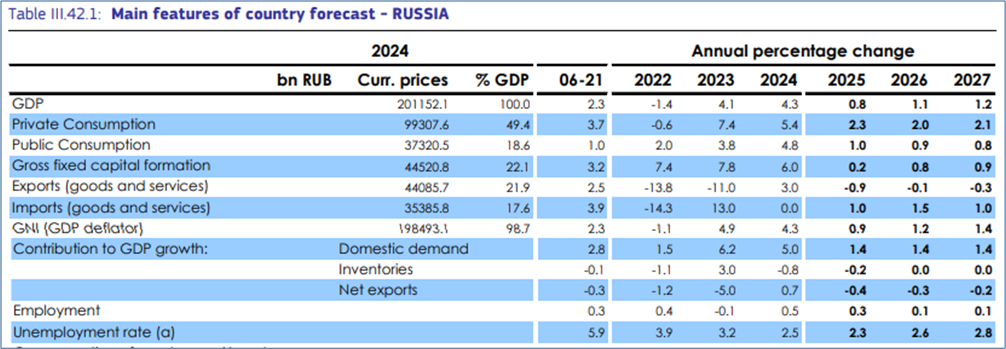
European Commission: Autumn 2025 Economic Forecast, Russian Federation 11/17/25
The trend in net exports is slowing Russia’s growth somewhat
According to the European Commission’s assessment, the development of Russia’s foreign trade will slightly slow overall economic growth during the forecast period from 2025 to 2027. It anticipates that the “global environment” for the Russian economy will deteriorate. Combined with sanctions, this is expected to have a negative impact on the development of Russian exports. At the same time, the development of Russian imports is likely to receive growth impulses from trade diversion and favorable “terms of trade.” The European Commission therefore expects Russia’s net exports to make slightly negative contributions to growth in the years 2025 to 2027.
Here is how the Commission assesses the outlook for consumption and investment
According to the Commission’s assessment, private consumption will remain Russia’s key growth driver, although its growth in 2026 and 2027 is likely to be somewhat lower than in 2025 (yellow portion of the bar in the following figure).
Government consumption (blue portion of the bar) will continue to grow over the forecast period through 2027. However, its growth will slow as defense spending remains high but reaches a plateau.
Gross fixed capital formation (black portion of the bar) is expected to nearly stagnate in 2025. In the following two years, however, it will pick up slightly as inflation declines and the central bank cuts interest rates. Continuous public investment and subsidized private investment in war-related sectors are expected to prevent a decline in total investment in 2025. They will also support investment in the next two years.
Real Gross Domestic Product
Black line: Year-over-year GDP changes in percent;
bar segments: Contributions of expenditure categories to the GDP growth rate
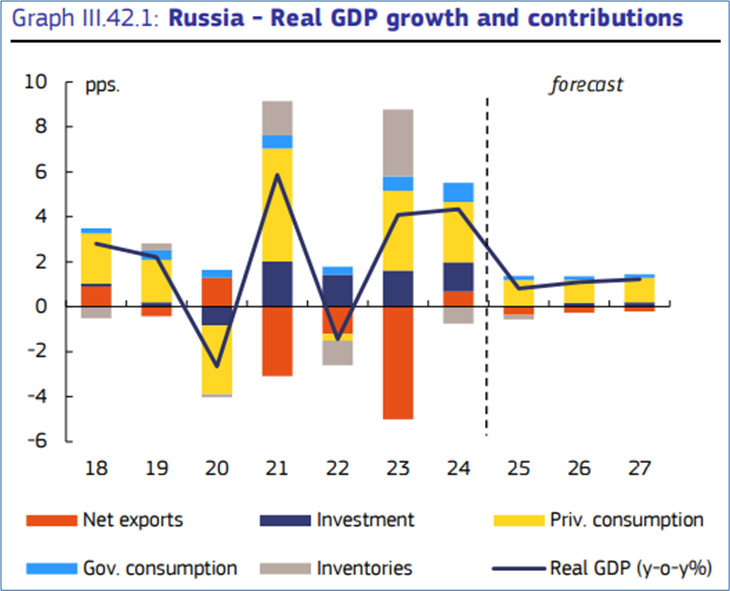
European Commission: Autumn 2025 Economic Forecast, Russian Federation 11/17/25
Overall, the European Commission forecasts a sharp decline in GDP growth to +0.8% in 2025 (black line). In 2026, growth in aggregate economic output is expected to pick up slightly to +1.1% and to +1.2% in 2027.
Russia’s federal budget deficit will rise to 3.1 percent of GDP in 2025
According to the European Commission, Russia’s federal budget recorded a substantial deficit of 3.8 trillion rubles (1.7% of GDP) in the first three quarters of 2025. Weak global oil prices, Western sanctions against the Russian oil sector, and a rising ruble reduced oil and gas revenues in the Russian federal budget by 20.6% in the first three quarters compared to the previous year.
According to the European Commission’s assessment, these developments are expected to cause the Russian budget deficit to rise to 3.1% of GDP in 2025. In 2024, the deficit had fallen to 1.6% of GDP.
The Russian government responded to the deterioration in fiscal performance by raising the value-added tax by 2 percentage points to 22% starting in 2026. Despite the government’s efforts to limit defense spending in the federal budget for 2026 and 2027, the European Commission continues to expect spending increases. However, it anticipates that the federal budget deficit will fall to 2.7% of GDP in 2026 and to 2.4% of GDP in 2027.
At the same time, it expects the public debt-to-GDP ratio to rise from 22.1% of GDP in 2025 to 24.2% in 2026 and 25.6% in 2027.
Recommended reading:
- Janis Kluge: Russia’s unrealistic budget plan. Officially, Russia expects a budget deficit of 2.6% of GDP this year. It will be closer to 3.5% of GDP unless a miracle happens, 11/11/25
- CMASF: Analysis of Macroeconomic Trends; 11/17/25
- Kommersant, Artem Chugunov: Russia’s economy is slowing down. Analysts continue to debate its current state, 11/16/25
- Finmarket.ru: According to the Ministry of Economic Development, slowing inflation in Russia is expanding the scope for further monetary policy easing. 11/15/25
- D.R. Belousov (CMASF): “On the State of the Russian Economy and Some Forecast Parameters” (with video, starting at 8:04); Presentation at the Annual Conference of the Presidential Management Training Program 2025, Nov. 14, 2025
- Finmarket.ru: The Central Bank of the Russian Federation estimates the structural deficit of the 2025 budget, following the amendments, to be significant. 11/14/25
- Finmarket.ru: Inflation in Russia stood at 0.5% in October, Nov. 14, 2025; Finam.ru: Inflation in Russia accelerated to 0.5% in October, Nov. 14, 2025
- Interfax.com: VAT hike in Russia expected to have main impact in Jan, 11/14/25
- Vedomosti.ru: Nabiullina identified the Central Bank’s main mistakes. These include a delayed increase in the key interest rate in 2023 and a communication error in 2024, 11/14/25
- Interfax.ru: Rosstat reported a decline in Russian GDP growth to 0.6%, 11/14/25
- RBC.ru: Russian economic growth slowed to 0.6%, 11/14/25
- Vedomosti, Maxim Stulov: According to VTB, economic growth in the third quarter was zero. Russia’s GDP growth in the third quarter of 2025 was seasonally adjusted to zero compared to the second quarter, stated Vitaly Sergeychuk, a member of VTB’s board of directors, Nov. 14, 2025
- Lenta.ru: Nabiullina’s advisor described the budget changes as a factor driving inflation, Nov. 14, 2025
- Business Online: VTB: Russian economic growth was zero in the third quarter, with unemployment at a record low, Nov. 13, 2025:
- Expert.ru; VTB: A conservative budget will allow the Central Bank to cut the key interest rate more aggressively, Nov. 13, 2025
- t-online., Nilofar Breuer: Russia’s economy in crisis. One country is now cutting off Putin’s funding. The sanctions imposed by U.S. President Trump against Russian oil companies are having an effect, Nov. 13, 2025
- New Eurasian Strategies Centre: Sergey Aleksashenko; Vladislav Inozemtsev; Dmitry Nekrasov: The dictator’s legacy: A new zastoy, 11/25/13
- Novaya Gazeta Europe: Record drop in price of Russian oil due to US sanctions leads to return of budget deficit, 11/12/25
- FR.de; Lars-Eric Nievelstein: Bleak outlook for Putin: Russia’s economy will suffer from oil, 11/12/25
- MK.ru: The Central Bank sees the wage race coming to an end: How much will Russians earn? Russians’ nominal incomes will barely cover the official inflation rate in 2026, 11/12/25
- Lenta.ru, Platon Shchukin: The Russian Central Bank denied that a recession has begun in the country. Advisor Tremasov stated that there will be no technical recession in 2025, 11/12/25
- Russian Central Bank Video Blog: What Is a Recession? “What Does It Cost?” with Kirill Tremasov. In the video blog “What Does It Cost?”, Kirill Tremasov, advisor to the Central Bank president, analyzes the key indicators for assessing the economic situation in Russia, 11/12/25
- Die Presse podcast: Trump takes aim at Russia’s oil companies: Should Putin be afraid? Or rather Europe? Eduard Steiner (“Die Presse”) discusses with Vasily Astrov (WIIW) and Johannes Benigni, an advisor on international oil trade, Nov. 12, 2025
- Janis Kluge, German Institute for International and Security Affairs (SWP), in an interview with Schold Wilhelm on the “Der Standard” podcast “Thema des Tages”: Is Russia’s economy on the verge of collapse? 34 min., Nov. 11, 2025
The day's most important Russian economic stories. Free, in your inbox three times a week.
Mon, Wed, Fri. Double opt-in, no tracking, unsubscribe anytime. By subscribing you consent to the processing of your email address as described in our Privacy Policy.